Almond or hazelnut butter: raw, activated, what changes and how to use almond butter
You open a jar of almond butter and a layer of oil shines on the surface, when on the shelf you were already torn between "white", "wholegrain", "raw" and "activated". Those labels mostly change the taste, the colour and the texture, and the oil that rises simply stirs back in with a spoon. If you are wondering how to use almond butter, this Biovie page draws on the USDA composition database and on the only human trial that has tested the "activation" of almonds.
I have been vegan since 1992, I have followed a living-food diet since the early 2000s, and I founded Biovie in 2007, after my engineering studies at ISTOM. In other words, almond butter is a fixture at home. And yet a simple jar raises very practical questions, which product sheets rarely answer with sources. Here is what I know, with the figures in hand, and what I think.
Almond or hazelnut butter: what are we talking about?
A nut butter is disarmingly simple: one ingredient. You grind almonds or hazelnuts for a long time, and as the machine keeps turning, their own fat is released and turns the powder into a creamy paste, without a single drop of added oil (if you have ever tried it in a food processor, you know the moment when everything suddenly tips over). On the jar, the ingredient list should therefore read in one second: 100% almonds, or 100% hazelnuts. No sugar, no oil. Nothing else. That is what a natural almond butter looks like.
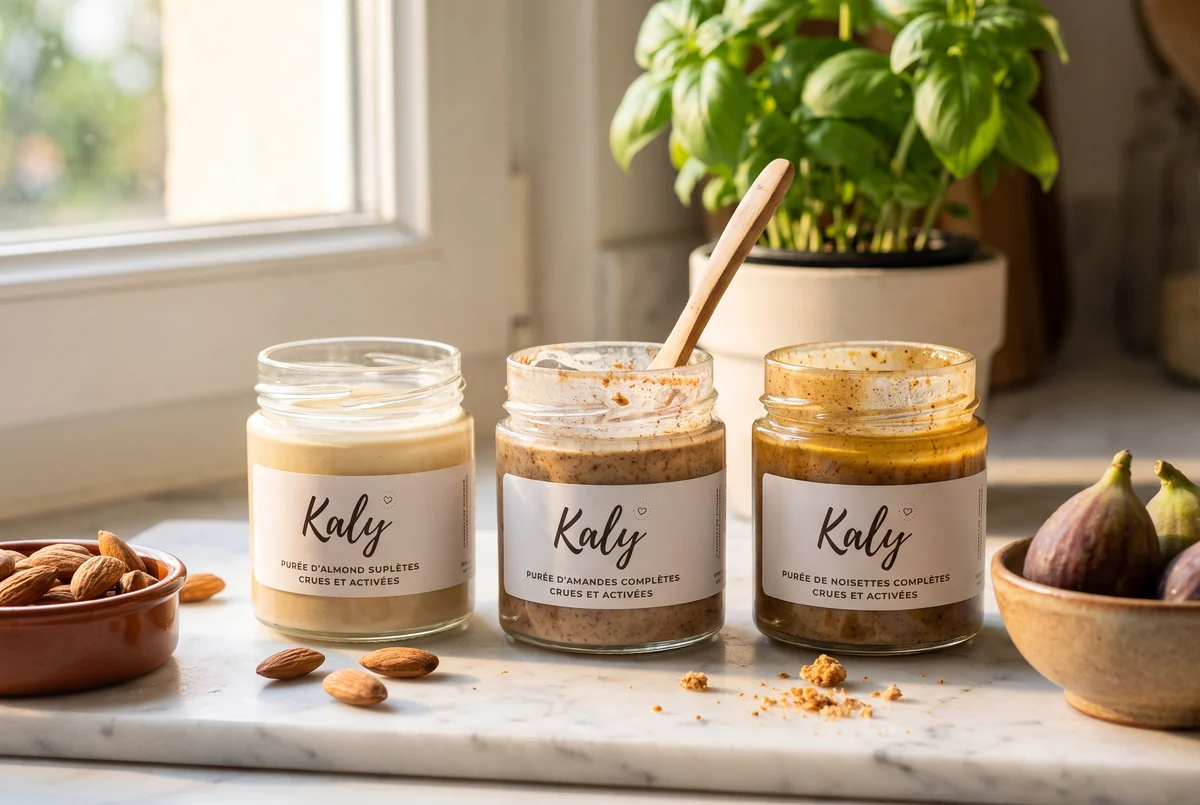
White or wholegrain almond butter
White almond butter is made from blanched almonds, that is, almonds stripped of their thin brown skin: mild taste, cream colour. The wholegrain one keeps the skin, so it is browner and more pronounced. Neither is better than the other: it all depends on how you use it and on your palate.
What is in almond butter
For the figures, I rely on the public database of the United States Department of Agriculture (USDA, 2019), for a plain almond butter with no added salt. Per 100 g, count first 614 kcal, then 20.96 g of protein and 55.5 g of fat, mostly monounsaturated (32.4 g, against 13.6 g of polyunsaturated and 4.2 g of saturated). Then come 10.3 g of fibre, only 4.43 g of sugars, 24.21 mg of vitamin E (alpha-tocopherol), 279 mg of magnesium and 347 mg of calcium. Yes, calcium, in an almond: people often forget it. Those 614 kcal mostly say one thing: the butter is a very dense food, counted by the spoonful.
As for hazelnuts, the database gives no butter, and I would rather tell you so than improvise: the values are for 100 g of raw whole hazelnuts (USDA, 2019), that is 628 kcal, 15.0 g of protein, 60.8 g of fat of which 45.7 g monounsaturated, 9.7 g of fibre, 15.0 mg of vitamin E, 163 mg of magnesium and 114 mg of calcium. Allowing for the difference in scope (a butter on one side, a whole nut on the other), hazelnut is fattier and has more monounsaturated fat, while almond shows more protein, magnesium and calcium. Variety, skin and process move these values, which is why labels differ from one brand to another.
Per 100 g
Plain almond butter (USDA)
Raw whole hazelnuts (USDA)
Energy
614 kcal
628 kcal
Protein
20.96 g
15.0 g
Fat (of which monounsaturated)
55.5 g (32.4 g)
60.8 g (45.7 g)
Fibre
10.3 g
9.7 g
Vitamin E
24.21 mg
15.0 mg
Magnesium / calcium
279 mg / 347 mg
163 mg / 114 mg
To anyone asking "is almond butter healthy?", I prefer to hand over its composition: it promises nothing, and it does not lie. These figures only make sense as part of a varied and balanced diet and a healthy lifestyle.
Roasted, raw or activated: what the process changes
Everything happens before the grinding, and that is where labels get interesting. A roasted almond butter comes from toasted almonds, hence its toasty taste and brown tint; the raw one, from untoasted almonds, milder and paler; the activated one, from almonds soaked in water then dried, with a rounder taste and a softer texture.
Almond butter
Process
Taste
Colour and texture
Roasted
Toasted almonds, then ground
Toasty, Maillard notes
Darker, golden brown
Raw
Untoasted almonds, ground
Mild, more milky
Paler
Activated
Almonds soaked in water, dried at low temperature, then ground
Rounder, less skin bitterness
Pale, softer texture
Roasted almond butter, the most common
The roasted one owes its toasty taste to Maillard reactions, the ones that brown the onion in the pan and the crust of bread (the baker's son in me has known them since childhood). A laboratory study on Californian almonds roasted at 115 °C or 152 °C (Franklin et al., 2018) shows that consumer liking follows these Maillard compounds (pyrazines, methylbutanals) and that it peaks on freshly roasted almonds. Home-oven temperatures, nothing extreme. The toasty note is at its best when the roasting is recent.
Raw almond butter
Here, nothing goes in the oven. The almonds are ground as they are, and the butter keeps a milder, more milky taste and a paler colour: a discreet base, one that knows how to disappear in savoury dishes as well as in a drink. Raw vs roasted almond butter, then, is a choice made first with the tongue, not on principle.
Activated almond butter: soaking, then drying
Why soak and then dry an almond that you are going to grind anyway? The question deserves asking. The principle: the almonds soak in water, then dry slowly at low temperature, and only after that do they go into the grinder. When tasting, the flavour seems rounder and the texture softer, with less skin bitterness.
That leaves the digestive question, and here I owe you honesty. Soaking is often presented, including in the little world of living food that I belong to, as the gesture that would make almonds easier to digest. A randomised crossover trial run in New Zealand on 76 adults (Taylor et al., 2018) put that to the test: each person ate 30 g of almonds a day, a small handful, for 12 days in each of four forms, whole or flaked, soaked or not. "Crossover" means that each participant tries every form in turn and becomes their own control, which smooths out the differences from one person to another. Result: digestive symptoms stayed minimal for all forms, and the authors conclude that soaking improved neither digestive tolerance nor liking.
Activation is therefore chosen for taste and texture, not for a digestive promise. Of course, the trial was on whole almonds and not on butters, and everyone remains the judge at the spoon. But I would rather give you the real reason for a choice than a promise that nobody has demonstrated. The same logic goes for activated hazelnut butter, which you choose for its softness. I have written elsewhere about what soaking changes in the taste of almonds.
At Biovie, this is precisely the process, soaking then drying at low temperature, that we chose for our activated hazelnut butter, as for our almond butter. For the taste, then. And we own it.
On a shelf, the label says more than the front of the jar. Turn it over. Five landmarks are enough.
A short ingredient list, ideally a single item: 100% almonds or 100% hazelnuts.
No added sugar or oil. Some pastes presented as "pure" still contain palm oil, often to stabilise the texture: read the list to the end.
White or wholegrain, depending on the use.
Roasted for the toasty note, raw or activated for softness.
Organic, if you care how the almonds were grown: the label tells you about the farming method, nothing more.
The right jar depends mostly on what you will do with it. Before choosing, think about how to use almond butter in your own kitchen. For savoury dishes and sauces, a white or raw almond butter stays discreet. For a toast with a bold taste, the wholegrain one or hazelnut have more character. And for a drink, the white one fades away, colour included.
If you like the skin and a mild taste without toasty notes, look for a wholegrain, raw and activated butter. That is the case of our raw and activated almond butter, in organic.
How to use almond butter every day, no recipe needed
No need for a cookbook or a scale: a nut butter is handled like a condiment. One spoon, one gesture, and the dish changes texture. Here is how to use almond butter without a recipe.
At breakfast and on toast
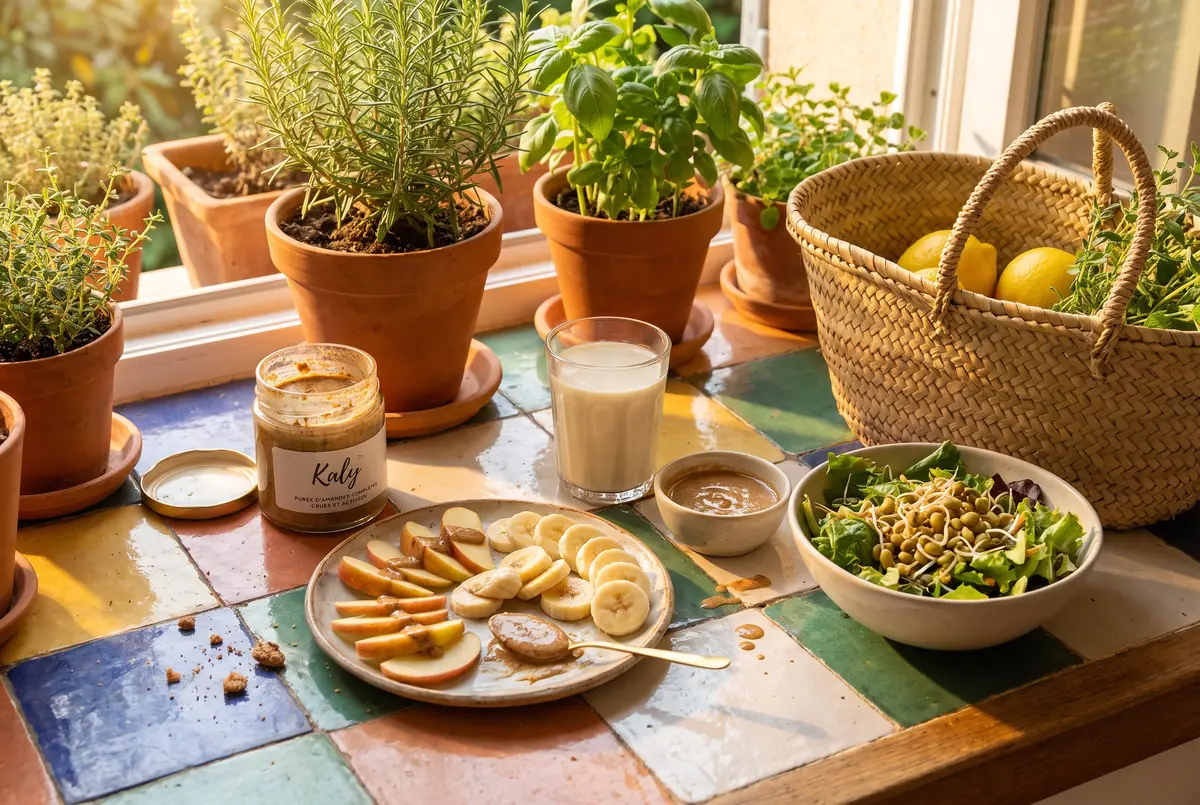
In the morning, almond butter spreads on bread, on banana slices or on apple wedges, or goes in a ribbon over a bowl of fruit; hazelnut, for its part, gets along very well with a little cocoa. As part of a varied and balanced diet and a healthy lifestyle, it is a simple way to add nuts to your mornings, without taking anything away. We add, we do not remove. And to vary things, there is also another spread, unpasteurised tiger nut butter.
In a drink
One spoon stirred into lukewarm water, a turn of the blender, and there you go: an express drink. The white one disappears into it. For more roundness, start from a homemade tiger nut milk or a plant milk from the shop.
In savoury sauces
Loosened with a little water, a squeeze of lemon juice or a few drops of soy sauce, the butter becomes a creamy dressing in two turns of the fork. It also replaces cream in a sauce or a soup, provided you add it off the heat. At our place, it is the joker of rushed evenings. Home at 6:50 pm, we blend dried and fresh mushrooms, almond butter, avocado, a clove of garlic and lukewarm water. At 7:05 pm, we are eating a living soup.
How to store almond butter
Should you throw away a jar whose oil has risen?
Not at all. Think of a forgotten vinaigrette on the table: the oil floats, the rest settles at the bottom. In a jar of nut butter, the fat separates from the particles in the same way, and this physical phenomenon is not spoilage. A spoon that scrapes right to the bottom, and everything becomes smooth again.
The real enemy is rancidity. In a laboratory study on Californian almonds (Franklin et al., 2018), roasted almonds stored at 39 °C, in accelerated storage for up to 12 months, lose their toasty notes and take on "cardboard", "paint" or "soap" flavours, which follow the rise of lipid oxidation products (hexanal, pentanal). Thirty-nine degrees is heatwave heat. The heat of a cupboard stuck against the oven in midsummer, for example.
To know how to store almond butter, remember this: jar tightly closed, away from heat and light, clean and dry spoon. After opening, the fridge slows down rancidity and firms up the texture; take the jar out a few minutes before serving yourself. You only have to look at nature: the almond ripens enclosed in its shell, away from air and light. We invented nothing. For how long it keeps, go by the best-before date printed on the jar.
I speak from experience, and not the most glorious. At one time, we kept up to 25 kilos of walnuts and almonds under the sofas, around 120 kilos in all, in duvet bags vacuum-sealed with the vacuum cleaner. Not a good idea, believe me, between the rancidity and the rodents. Today, we store by 5 kilos.
For whole nuts, like our whole activated Tuono almonds to crunch on, and for dried fruit, vacuum-sealing in a glass jar makes complete sense. The BocUp vacuum kit combines a dome and a small hand pump, with no electricity and no plastic bag, and works with the glass jars you already have, if they have "shoulders" and a 65 or 84 mm lid. Nothing else to buy, and that is just what I like in this kind of low tech object. According to the manufacturer, fresh products keep up to 5 times longer; for dried fruit, the benefit is mostly keeping moisture and moths away.
Behind the search "almond butter danger", there are three legitimate questions. None justifies alarm, and none deserves to be brushed aside either.
First precaution, allergy: almonds and hazelnuts are tree nuts, allergens that must be declared in the European Union (Regulation (EU) No 1169/2011, Annex II, point 8). For an allergic person, no almond butter, full stop.
Second point, energy density: 614 kcal per 100 g (USDA, 2019), so about 92 kcal for a 15 g spoonful. A small snack held in a single spoon. One spoon is enough, as part of a varied and balanced diet and a healthy lifestyle.
Last, the rancid taste, and here your nose knows more than any label: cardboard, paint (Franklin et al., 2018). The butter has aged or taken on heat. Better to go without then, with no regrets.
In short, open your next jar, stir it back together, taste: it is still the best way to find the butter that suits you. And if you have found a way of your own to use it, write to me!
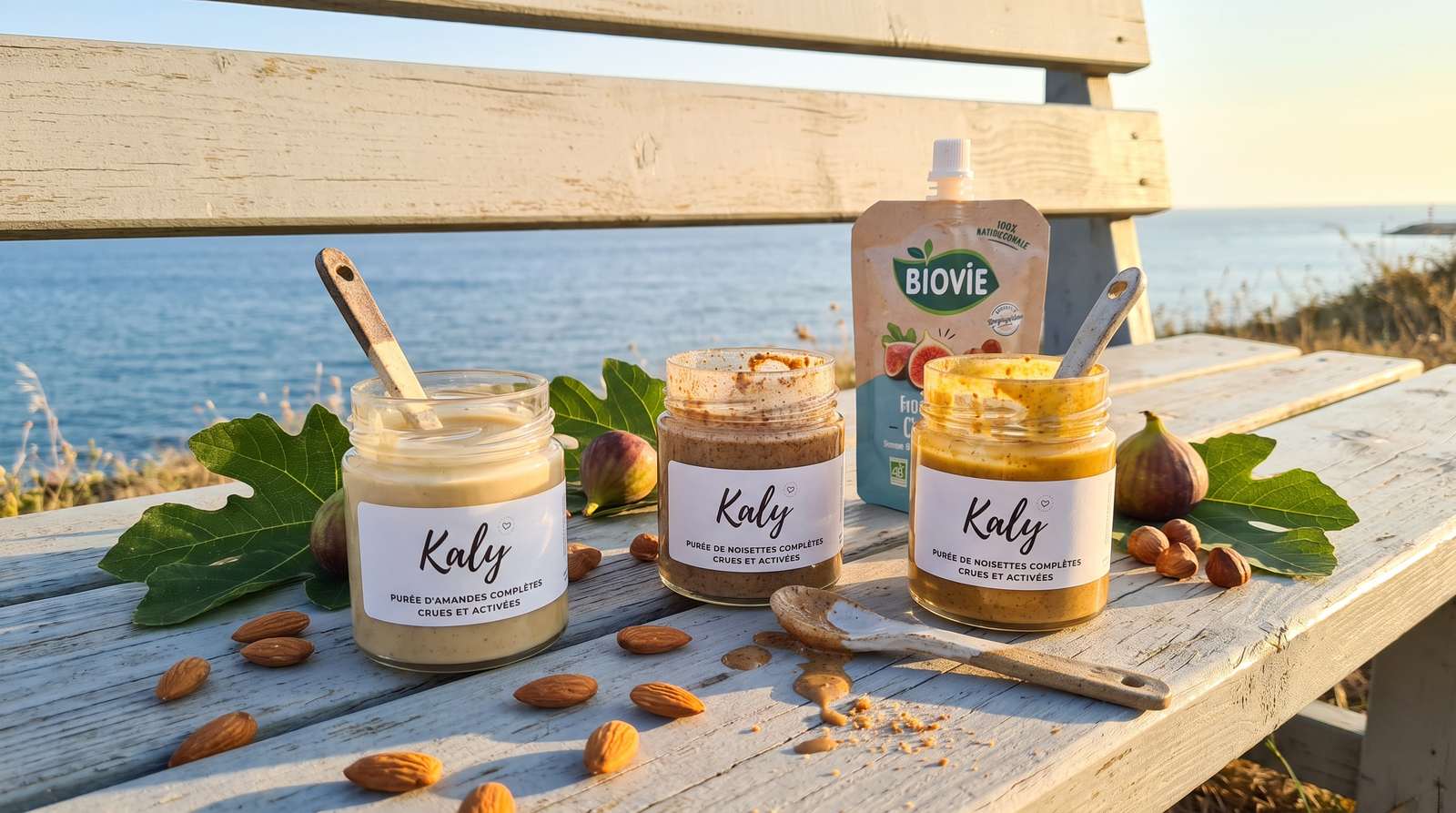
Fair trade tiger nut from Niger, Amazon nuts from Bolivia, activated buckwheat from Brittany, and activated oilseed purées made in Alsace by Kaly: this range brings together oilseeds and seeds of raw quality, most of them soaked then dehydrated at low temperature (activation). To get started with activation, an activated almond or hazelnut purée is easier to use than a whole oilseed you have to soak yourself. For everyday raw cooking, tiger nut (whole, sliced or as a purée) comes in several formats suited to different uses, from homemade plant milk to crunchy snacks., 20
products
What is the difference between white and wholegrain almond butter?
White almond butter is made from blanched almonds, without their skin, which gives it a mild taste and a pale colour. The wholegrain one keeps the skin: it is browner and more pronounced. There is no ranking between the two, the white suits drinks and savoury dishes, the wholegrain suits toasts with character.
Which nut butter should you choose: almond or hazelnut?
The choice depends mostly on taste and use. Per 100 g, almond butter contains 20.96 g of protein and 279 mg of magnesium according to the USDA, while raw hazelnuts count 60.8 g of fat of which 45.7 g monounsaturated. Almond stays more neutral in cooking, hazelnut more indulgent, especially with a little cocoa.
Where can you find raw or activated almond butter?
You will find it in organic shops and online, checking that the ingredient list is limited to 100% almonds, with no added sugar or oil. At Biovie, the organic wholegrain, raw and activated almond butter keeps the skin of the almonds and offers a mild taste, without toasty notes.
Raw or roasted almond butter: which should you choose?
Choose the roasted one if you like toasty notes: a sensory study on Californian almonds shows that liking is at its maximum when they are freshly roasted. The raw or activated one suits better for a mild taste, a pale colour and a discreet base in sauces and drinks.
Is almond butter dangerous?
For most people, the risk comes down to three simple precautions. Almonds and hazelnuts are allergens that must be declared in the European Union. The butter is dense, with 614 kcal per 100 g, and one spoon is enough. Finally, a taste of cardboard or paint signals a rancid butter, not to be eaten.
How do you store almond butter after opening?
Keep the jar tightly closed, in the fridge after opening, away from heat and light, and help yourself with a clean and dry spoon. If the oil rises, stir back down to the bottom: it is normal. For how long it keeps, go by the best-before date printed on the jar.
The information presented in this article is provided for information purposes only and does not constitute medical advice. Consult a healthcare professional before making any change to your diet or supplementation.