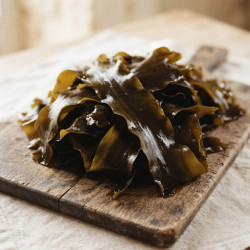
How to rehydrate dried seaweed, and when fresh is the better pick for your use, budget and routine
Standing in front of a bucket of salted kombu and a bag of flakes, choosing between fresh and dried seaweed comes down to looking at your own kitchen: salted fresh seaweed if you cook with it several times a week, dried seaweed for a light reserve that keeps for a long time in the pantry. Either way, soaking lowers the iodine. This page covers how to rehydrate dried seaweed, and when fresh is the better pick. At Biovie we offer both forms, and we lean on the Anses opinion on iodine and on three studies carried out on kombu.
Same seaweed, two products, and they are not cooked at all the same way. Between fresh and dried seaweed, my advice: choose according to your kitchen, not according to the label. As the founder of Biovie and an ISTOM engineer, I'm sharing a few studies with you, and here is what they say about these two forms (and what they don't say).
Fresh vs dried seaweed: the short answer
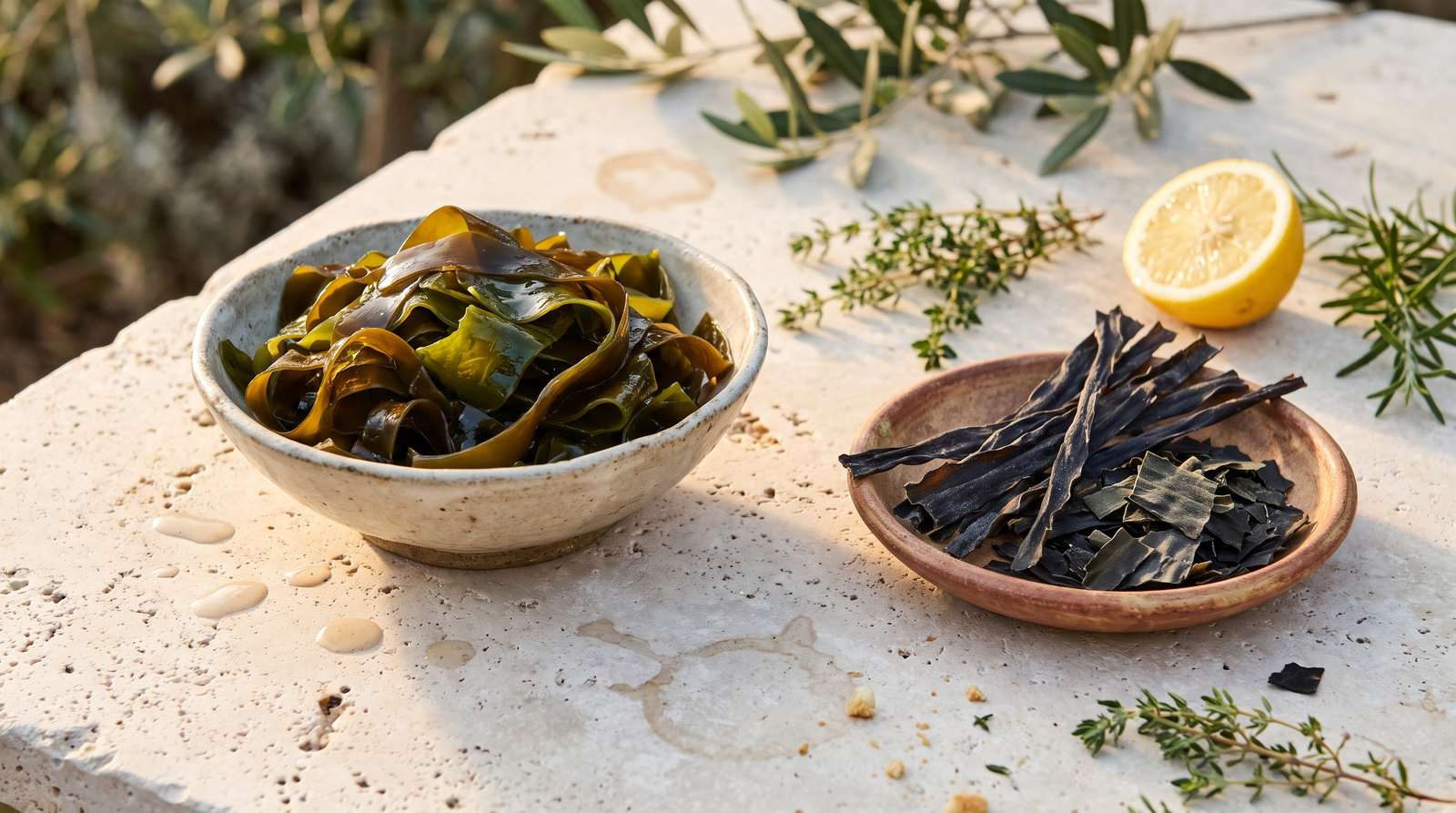
Salted fresh seaweed has bite: a rinse, a short desalting soak, and it goes straight into the salad bowl; once the bucket is open, it lives in the fridge. Ideal if you cook with seaweed often. Dried seaweed is light, waits patiently in a dry spot and is rehydrated before use: perfect for occasional use. In both cases, the iodine drops during soaking.
Criterion
Salted fresh seaweed
Dried seaweed
Preservation
In salt, in a bucket or a bag
Dried, as sheets, flakes or a mix
Texture
Fleshy, close to a crunchy vegetable
Finer and softer once rehydrated
Preparation
Rinse, then a short soak to remove the salt
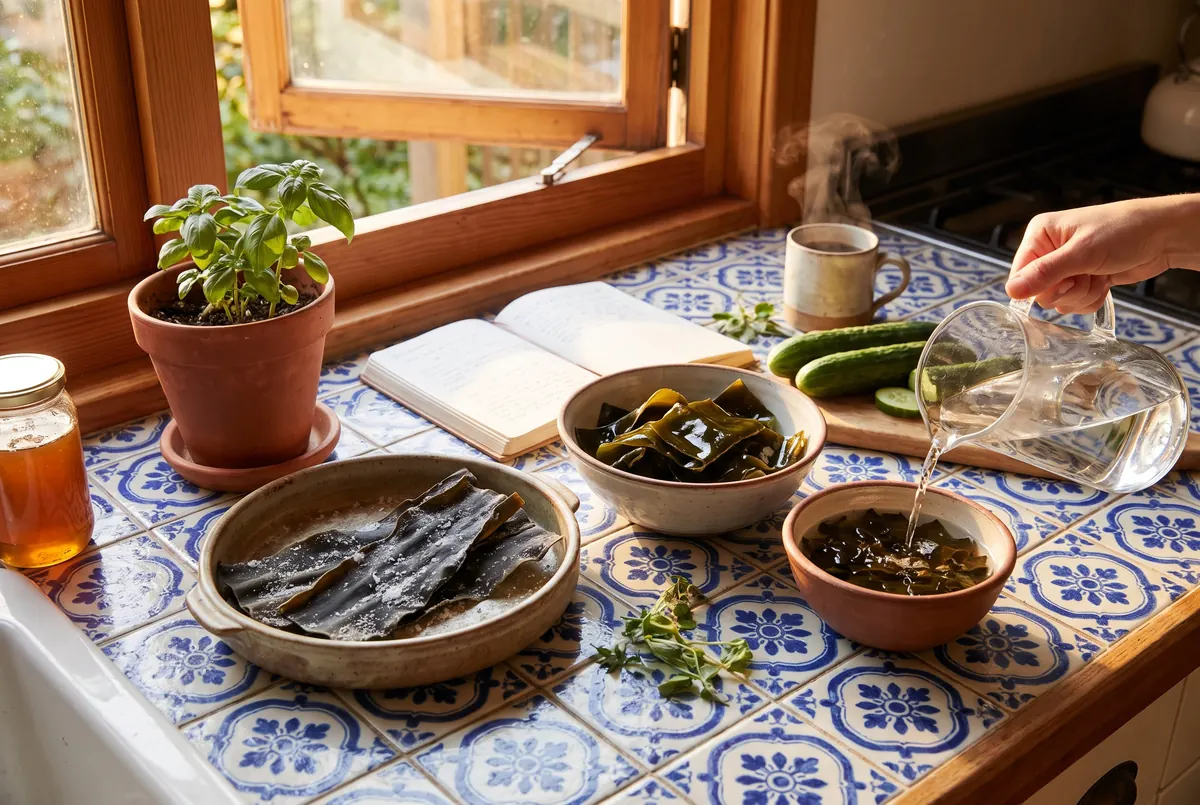
Soak in cold or lukewarm water; flakes go straight into a moist dish
Shelf life before opening
Several months, up to the date shown
Long, in a dry place, up to the date shown
After opening
In the fridge
Dry, tightly closed, away from moisture
Ideal use
Frequent cooking, raw salads and tartares
Occasional use, pantry reserve
Iodine
Varies by species; drops with soaking
Varies by species; drops with soaking
As you can see, the difference between dried and fresh seaweed lies mostly in how they enter your kitchen. So which one is better? As for dried seaweed vs fresh seaweed nutrition, neither form is "better for your health" than the other. The one that sleeps at the back of the cupboard, though, brings you nothing. The right seaweed is the one you will actually use.
What "fresh" and "dried" mean in the shop
Fresh seaweed: preserved in salt
The word is confusing: a "fresh" seaweed from the shop was not picked yesterday. It was harvested, then salted so it keeps for several months, and you will find it in a bucket or a bag. Before eating it, you desalt it, with a good rinse and then a short soak. At Biovie we offer four of them, organic and from Brittany: royal kombu, wakame, dulse and sea lettuce.
Dried seaweed: dehydrated, often at low temperature
A dried seaweed has lost its water. Think of a shirt rolled up at the bottom of a suitcase: you unfold it on arrival, it becomes a shirt again, but some creases remain.
Researchers measured those creases on sugar kelp (Saccharina latissima), air-dried at 25, 40 or 70 °C and then compared with the same seaweed freeze-dried (Stévant et al., 2018a). On composition, nothing to report: no difference in carbohydrates, amino acids, polyphenols, fucoxanthin or total minerals. On the other hand, the higher the temperature, the less the seaweed swelled back up when soaked, and the feel in the mouth changed between 25 and 70 °C. Only one species was tested, so let's keep that in mind.
Still, drying mostly affects texture. All the more reason to check the temperature on the label: our kombu flakes are dried at 40 °C, as their product page states, and our article on freeze-drying or dehydration compares the two techniques. As part of a varied and balanced diet and a healthy lifestyle, both forms have their place.
Taste and texture: two different experiences
Strips of wakame on cucumber slices, a squeeze of lemon, and the dish is ready. That is the kind of plate where fresh seaweed shows what it is made of: once desalted, it keeps a fleshy bite, almost like a crunchy vegetable. It is the ideal form for a raw salad or tartare, where the seaweed holds its own against the other ingredients instead of melting into the dish.
Once rehydrated, dried seaweed plays in another register, finer and softer. The flakes even skip the soaking: slipped into a raw sauce or soup, they rehydrate in the dish. For the rest, remember the creases in the shirt: the drying temperature changes the swelling, according to a study on sugar kelp (Stévant et al., 2018a).
At our place, one rule: we avoid cooking seaweed. Raw, rehydrated or added off the heat, yes; in a frying pan or a wok, never. It's not a dogma, it's a house habit, and you will do what you like with it. The only exception is broth, where kombu infuses just below the boil.
To discover the fresh form, organic fresh royal kombu from Brittany is a good starting point: a thick, generous brown seaweed that you cut into strips after desalting.
Unopened, salted fresh seaweed keeps for several months. Example: the batch of fresh royal kombu we have in stock in November 2026 carries a best-before date of 16 March 2027. A bucket bought in autumn therefore gets through the winter without trouble. Once opened, no discussion: it goes in the fridge.
Dried seaweed has an easier life, on one condition: staying dry. A badly closed bag next to the kettle, and the flakes end up stuck together in clumps. Moisture is their main enemy, because it softens them.
For opened dried seaweed, we recommend vacuum sealing in a jar with the BocUp kit. The principle has the simplicity I like in low-tech objects: a bell, a small manual pump, no electricity and no plastic bag, and the glass jars you already own, provided they have "shoulders" and a 65 or 84 mm lid. According to the manufacturer, dry foods then stay protected from moisture and moths. Of course, the vacuum replaces neither the fridge nor the freezer, and it does not sterilise.
The benefits of vacuum sealing at home go well beyond seaweed, from seeds to the leftovers of dinner.
Yield and price per serving: how to rehydrate dried seaweed and compare like with like
Ah, the price per kilo! Comparing that of dried seaweed with that of fresh seaweed is like comparing a bag of dry lentils with a jar of cooked lentils. Dried seaweed takes water back when soaked, fresh seaweed loses its salt when rinsed. The label does not tell you what will end up on your plate.
To compare fresh or dried seaweed, the only honest basis remains the weight of ready-to-eat seaweed. It's just common sense, and your kitchen scale is enough. The test takes four steps: weigh a handful of dried seaweed, soak it in cold or lukewarm water until it is soft, drain it and throw the water away, then weigh it again.
Same thing for fresh seaweed, before and after desalting. And to know how to rehydrate dried seaweed without getting it wrong, follow the product sheet, because the soaking time depends on the species and the thickness. The swelling also varies with the drying temperature (Stévant et al., 2018a), which is why I give you no universal ratio. Do the test once instead, at home, with your own seaweed: you will have your own benchmark.
Iodine: what the form and the preparation change
Let's come to the subject that makes people hesitate and to the question that comes up in ALL our Thursday lives without exception. All seaweeds contain iodine, in a very variable amount depending on the species and the processing, as Anses recalls in its opinion of 25 June 2018. The richest are the kelps, Laminaria and Saccharina (the kombu family), and one red seaweed, Gracilaria verrucosa.
EFSA sets the adequate iodine intake at 150 µg per day for adults and 200 µg during pregnancy and breastfeeding (EFSA, 2014). A microgram is one thousandth of a milligram: dust, invisible to the naked eye. The upper safety limit retained by Anses, a value set by EFSA, is 600 µg per day for adults. According to a study on kombu, eating it every day unsoaked would lead to excessive intakes (Stévant et al., 2018b).
Fortunately, the iodine does not stay quietly in the seaweed. Think of a tea bag: what it gives to the water, it no longer has. In sugar kelp, a laboratory soak in fresh water at 32 °C for 1 to 6 hours reduced the iodine by 84 to 88%, with a plateau from the first hour (Stévant et al., 2018b, taken up by Nielsen et al., 2020). In other words, most of the iodine ends up in the soaking water, hence the point of throwing it away.
And a quick rinse in cold water? It probably removes less, but I can't tell you how much: that effect has not been measured.
Industrial research goes further with blanching: raw sugar kelp contained 4,605 mg of iodine per kilo of dry matter, and 293 mg after 2 minutes in water at 80 °C, with a clear drop from 45 °C and 30 seconds (Nielsen et al., 2020). That is the gap between a full bucket and the bottom of a glass. A laboratory process, not kitchen advice: at home, we stick to soaking.
Hence the Anses advice: regular consumers of seaweed are better off favouring products with a lower iodine content, in particular brined ones. Seaweed preserved in salt comes close to the first category. The agency also advises against seaweed without medical advice in case of thyroid disorder, heart disease, kidney failure, iodine-based or lithium-based medication, pregnancy or breastfeeding (as a precaution).
Should we shun kombu, then? Not at all, that would be throwing the baby out with the bathwater (the soaking water, in this case). Kombu infused in a broth remains the most iodine-rich seaweed in your kitchen: to be used in moderation, as part of a varied and balanced diet and a healthy lifestyle. For realistic portions, see our article on how much seaweed per day; the question of heavy metals will soon have its own article.
Which seaweed for which use, budget and routine?
Rather than looking for the ideal form, which does not exist, start from your week: between fresh and dried seaweed, everything depends on the number of meals where you put seaweed.
You cook with seaweed several times a week
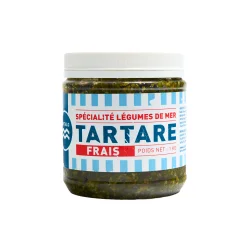
Then fresh seaweed is made for you: wakame, dulse, sea lettuce or kombu, in a salad or a raw tartare. A mini bucket in the fridge means a handful of seaweed available at every meal. At our place, we make the seaweed tartare in batches of 3 kilos, in an hour and a half to two hours over the month, and half of it goes in the freezer. We are not necessarily exemplary, but seaweed quickly becomes a reflex rather than an event.
Fresh or dried kombu, it hardly matters here: you let it infuse in hot water, below the boil, then remove it, like the tea bag from earlier. It is the only hot use I recommend for seaweed.
For maki rolls
Here, no dilemma. Raw-quality nori sheets are used as they are, without soaking: rolled dry, they soften on contact with the filling.
For recipe ideas, see our guide to cooking with seaweed, from kombu to dulse: as part of a varied and balanced diet and a healthy lifestyle, everyone finds their form, at their own pace.
Biovie's fresh seaweed is hand-harvested in Roscoff by Bretalg, France's first historic seaweed harvester (since 1991). Kombu, wakame, nori, dulse, sea lettuce and sea spaghetti are sold as a ready-to-eat tartare or in 500 g to 1 kg packs, with a texture and taste closer to the sea than dried versions. At €16.80 per kilo, our price is among the most competitive on the market for fresh seaweed harvested in France. To try, choose our discovery assortment of 4 organic seaweeds in 4 x 250 g; for regular cooking, the kilo works out much cheaper., 8
products
France, and Brittany in particular, has a well-structured edible seaweed industry. You will find salted fresh seaweed in organic shops as well as online, from producers or specialised retailers. Wherever you buy your fresh or dried seaweed, look at the origin and the organic mention: it is the first sorting step.
Asians have understood this for a long time, and we Europeans still have catching up to do. I remain convinced of one thing: seaweed does not need to come from the other side of the world to enter our kitchens, it grows on our coasts, and every bucket opened at your place makes this industry a little stronger. A handful, fresh or dried, in tonight's dish: that is already a start. The rest will come, at your own pace.
Frequently asked questions
Which seaweeds can you eat, fresh or dried?
Kombu, wakame, dulse, sea lettuce, nori and sea spaghetti are among the seaweeds you can eat, in salted fresh form, dried form or both. The form mostly affects the preparation: desalting for fresh seaweed, soaking for dried.
How do you cook dried seaweed?
You cook dried seaweed by rehydrating it in cold or lukewarm water until it is soft, then you drain it and throw the soaking water away. It is then added raw or off the heat, in a salad or a sauce. The only hot use we recommend: kombu broth, infused below the boil.
How long should you soak dried seaweed?
The soaking time for dried seaweed depends on the species and the thickness: follow the indication on the product sheet or the bag. The best benchmark remains touch, the seaweed is ready when it has become soft. Flakes, on the other hand, need no soaking and rehydrate directly in a moist preparation.
Does dried seaweed ever go bad?
Dried seaweed carries a best-before date and keeps for a long time, provided it stays dry: moisture is its main enemy, because it softens it. Keep it in a tightly closed jar or vacuum sealed with the BocUp kit, bearing in mind that the vacuum does not sterilise.
Do you need to soak nori sheets?
No, nori sheets are not soaked: they are used as they are for maki rolls. You roll them dry around the filling, and they soften by themselves on contact with the moist ingredients. Soaking would make them limp and hard to roll, which would defeat the whole point of the sheet.
Does salted fresh seaweed contain less iodine?
Rather, yes: Anses lists brined products among those with a lower iodine content, and salted fresh seaweed comes close to them. The species remains decisive, however. In all cases, soaking lowers the iodine, by 84 to 88% for a sugar kelp soaked at 32 °C in the laboratory.
Where can you buy fresh seaweed in France?
You will find salted fresh seaweed in organic shops as well as online, from Breton producers or specialised retailers, including Biovie. Brittany in particular has a structured edible seaweed industry. Check the origin and the organic mention, then keep the bucket in the fridge once opened.
The information presented in this article is provided for information purposes only and does not constitute medical advice. Consult a health professional before making any change to your diet or supplementation.