


Edible Seaweed: A Journey Through France, Europe's Leading Producer
Edible seaweed in France is a sector that exceeds 400 million euros in turnover, supports around 2,500 jobs directly and indirectly, and harvests 60,000 to 70,000 tons a year - 90% of it in Brittany, the largest seaweed field in Europe. From hand-harvesting with a sickle on the Roscoff foreshore to the plates of three-Michelin-starred chefs, you discover a whole terroir when you pull on the thread. As part of a varied and balanced diet, edible sea vegetables offer mineral and nutritional diversity that no other plant matches.
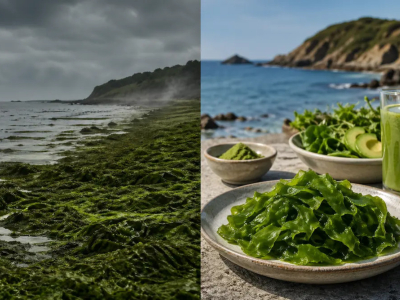
4 a.m. Tidal coefficient 105. The wind is coming from the northwest, biting cold. A seaweed harvester walks down the Roscoff foreshore with a headlamp, his waders clattering on the granite, and suddenly you realize you're walking through a field.
Except this field has no fence, no rows, no tractor. It's a field of kelp that uncovers itself twice a day to the grace of the moon.
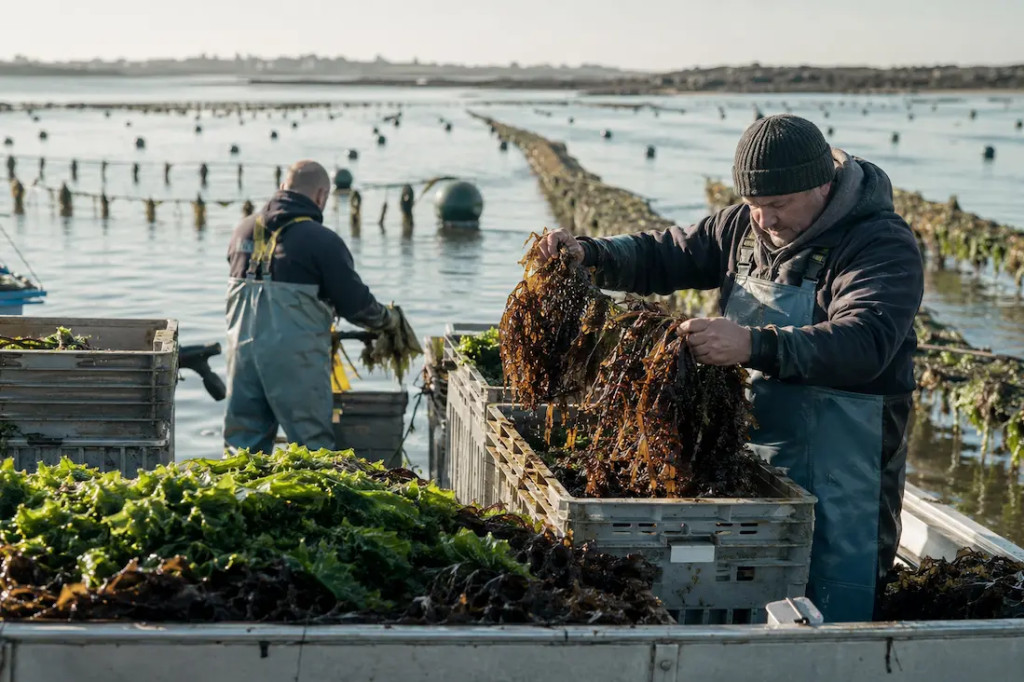
That's how your sea lettuce, your dulse, your royal kombu begin. Not in a factory. Not in a laboratory. On a flooded heath called the foreshore - the estran in Breton - where men and women, the goémoniers, walk down with the tides, sickle in hand.
This is an article I've wanted to write for a while. With Aurélie, we wrote Algues au quotidien (Gallimard/Alternatives, 2024), and the book received the Gourmand World Cookbook Award 2025 and the Prize of the French National Academy of Cuisine 2025. A double first for a 100% vegan book in French gastronomy. But what we didn't have time to tell in depth in the book is the sector itself: how France became, almost without anyone noticing, the European lung of edible seaweed. And how these marine plants travel from the foreshore to your fridge in a matter of days.
So here's the report. With the numbers that surprise, the analyses no one talks about, the chefs who are changing the game, and - above all - the complete journey of a sea lettuce from the Breton rock to your bowl on Sunday night.
France, Europe's leader in edible seaweed: numbers that surprise
When I say "France leads Europe in edible seaweed," I often see a doubtful look. Really? Not Norway? Not Brittany - but the Japanese?
Really. And for two reasons.
First, the volumes. 60,000 to 70,000 tons of seaweed are harvested every year in France, with 90% in Brittany. In image: those 60,000 tons are the equivalent weight of six Eiffel Towers. Pulled from the water, by hand for part of it, by boat for the rest. Every year. To the rhythm of the tides.
Then, the revenue. The seaweed sector now exceeds 400 million euros - the latest estimate from the ADEUPa (Brest Urban Planning Agency) goes as high as 424 million euros. To put that in everyday terms: it's the equivalent of the French honey market. Except for honey, everybody knows. For seaweed, nine French people out of ten still have no idea they're walking next to a treasure every time they go for a swim.
And behind these volumes, around 2,500 direct and indirect jobs in Brittany, 150 companies active across the harvest-and-processing chain, and a national count that goes beyond 264 actors identified in January 2025 by the CEVA (Centre for Algae Studies and Valorization, based in Pleubian, Côtes d'Armor). The Brest region alone gathers over 800 jobs. And momentum is building: in November 2025, the first edition of the Salon de l'Algue took place in Rennes, at the Halle de la Courrouze. Two days - Sunday for the public, Monday for professionals - to finally give visibility to a sector that has stayed too long under the radar.
Why this leading European position? Because Brittany is home to the largest seaweed field in Europe. Exceptional tidal range (up to 9 meters at spring tides), cold and well-mixed waters, rocky foreshore biodiversity of a rare richness. Norway produces more downstream tonnage from cultivated kelp, but it's mainly industrial kelp destined for alginates, agar and cosmetic applications - closer to Pacific kelp logic than to artisanal food. For organic edible sea vegetables, the species diversity and traceability of the Breton model remain unmatched in Europe.
One distinction worth making - often confused. Seaweed harvested by boat (kelp in diving or with a mechanical scoubidou) is mostly destined for industry. Seaweed harvested on foot, on the foreshore, with a sickle, is what ends up on your plate. That's the chain - organic edible seaweed - we're going to follow now.
Roscoff, an outstanding biotope in Europe
Why Roscoff is unique
The heart of this sector lies between Saint-Pol-de-Léon and the Île de Batz, on a few square kilometers of granite kissed by the English Channel.
Three factors converge at this exceptional biotope.
The tidal range. Roscoff has one of the most powerful tidal ranges in Europe - up to 9 meters at spring tides. In plain terms: the sea retreats hundreds of meters twice a day, exposing a rocky foreshore that only breathes air a few hours at a time. It's this permanent oscillation between immersion and emersion that selects a seaweed diversity few coastlines in the world can match.
The waters. The western English Channel at Roscoff: cold water, rich in nutrients, mixed by tidal currents and westerly winds. You never find stagnant water, so never chronic organic pollution. When you see a goémonier rinsing his sea lettuce directly on the foreshore in water that looks like it came out of a bottle, it's not staged. That's the reality of this coastline.
The research. The Roscoff Biological Station - a joint CNRS and Sorbonne University laboratory - turned 150 in 2022 and houses one of the world's reference teams in seaweed biology. It coordinates the European project GENIALG (Horizon 2020 Blue Growth, 2016): 19 public and private partners, 6 European countries, focused on two major species - sugar kelp Saccharina latissima and sea lettuce Ulva rigida. When you put a goémonier walking down the foreshore at 4 a.m. side by side with a Sorbonne University researcher sequencing the genome of a Saccharina, you have the whole French sector in a single image.
Personally, when I started getting seriously interested in seaweed 25 years ago - long before Biovie even existed - the Roscoff Station was already the reference. Today, it's recognized worldwide. And that's a big part of why Brittany stays ahead of everyone else in Europe for edible sea vegetables.
Which seaweed for which waters?
Seven species structure most of the edible seaweed consumption in France. Let me run through them quickly, with their Latin names - useful because common names shift between Brittany, Normandy and Japan.
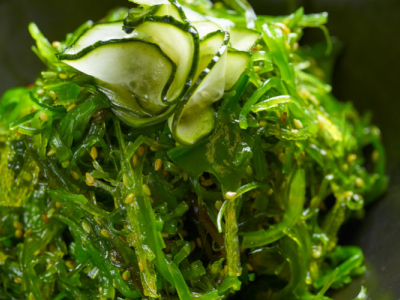
- Sea lettuce (Ulva sp.) - Edible green seaweed, flat, thin as silk paper. Fresh, iodized taste, very accessible. The perfect entry-level seaweed when you're starting out.
- Dulse (Palmaria palmata) - Edible red seaweed, thick blade. Marked umami taste, almost like cured meat when smoked. Rising star of bistronomic kitchens.
- Wakame (Undaria pinnatifida) - Edible brown seaweed. Originally from Asia, now well established along the Breton coast. Melting texture, mild flavor.
- Royal kombu (Saccharina latissima) - Edible brown seaweed, wide and long, mild. The base of Japanese umami broths.
- Breton kombu (Laminaria digitata) - More iodine-rich cousin of royal kombu. To use sparingly (high iodine load).
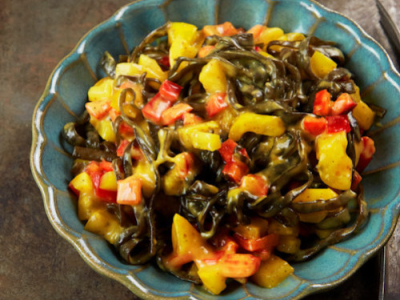
- Sea spaghetti (Himanthalia elongata) - Brown seaweed, long flat strands. Texture that recalls al dente green beans - hence the French name "haricot de mer."
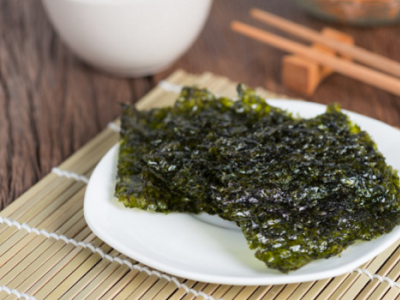
- Nori (Porphyra sp.) - Red seaweed. Same family as Japanese maki wrap, but here harvested fresh in Brittany.
You don't need to know all of them. But once you've identified sea lettuce + dulse + royal kombu, you already have the three pillars of a home kitchen with seaweed. The rest comes with appetite.
From the foreshore to the plate: the sector, step by step
This is the part I'd been waiting to write. Because the journey of a fresh sea lettuce is a model we should tell much more often. Everything happens within 50 km. Everything is done by hand, or almost. And in 48 hours, what was growing under the water is on your plate.
Step 1: foot harvesting with a sickle
6 a.m. Tidal coefficient above 70 (below that, the sea doesn't retreat enough). The professional seaweed harvesters of northern Finistère - those that Bretalg has worked with since the beginning of Biovie - walk down the foreshore. The sickle is the reference tool: a curved blade about twenty centimeters long, wooden handle, sharpened every morning.
The rule is to cut above the holdfast - the organ by which the seaweed is fixed to the rock. Not below, never. The holdfast contains the growth structures; if you cut above, the seaweed grows back within six to twelve months depending on the species. If you cut below, you destroy the strain. This simple rule - three decades of sector pedagogy - is what allows the same beds to be harvested year after year without depleting the foreshore.
Harvesting is regulated by prefectoral decrees, updated each year by the CRPMEM (Regional Committee for Maritime Fishing and Marine Farming) of Brittany. For 2026, a new decree (resolution No. 2025-016) came into force on January 1st. A few general rules:
- Harvesting allowed only from sunrise to sunset. No night work.
- No harvesting on Sundays or public holidays (except exceptional spring tides).
- Both feet on the ground - no diving for foreshore seaweed.
- Professional license required (private individuals have a foraging right limited to 5 kg per person per day, with no resale allowed).
And the species calendar, which varies with biology:
- Dulse (Palmaria palmata) - allowed from April 1st to December 31st.
- Pioka (Chondrus crispus + Mastocarpus stellatus) - from May 1st to October 31st.
- Nori (Porphyra sp.) - from May 1st to November 15th.
- Sea lettuce - widest window, dominant in spring-summer.
- Royal and Breton kombu - mostly summer harvests.
To put it in practice: a seaweed harvester doesn't go down every day. He watches the tide, the wind, the sky, the calendar, and only walks down on the right days. A monk's economy, and the guarantee of a bed that renews itself year after year.
Step 2: cleaning and sorting at the workshop
By 8 a.m., the morning harvest is already at the workshop. In Roscoff, the historic players are few but highly structured.
- Bretalg - founded in 1991, in Roscoff. Our historic supplier at Biovie. Pioneer of organic edible seaweed in France.
- Algoplus - founded in 1993, also in Roscoff. Artisanal cannery offering guided summer tours.
- Bord à bord - one of the first to make edible seaweed known in Brittany, specialized in preserves.
- Globe Export - another historic processor.
Simple on paper. Complicated in practice.
First step, rinsing. In Roscoff, the workshops pump seawater directly. The seaweed is rinsed in its natural medium, with no thermal or chemical shock. Concretely, what you see when you walk into the Bretalg workshop: a stainless steel conveyor belt, sea lettuces gliding past dripping wet, and two or three workers in white coats sorting by hand.
Second step, sorting. Everything not destined for the plate - epiphytes (tiny organisms attached to the seaweed), twigs, shell debris, sometimes a crustacean that hitched a ride - is removed visually. No machine replaces the eye and the hand. Slow, manual, and the guarantee of final quality.
Third step, salting. This is the heart of the Biovie process and of the "living food" philosophy. The seaweed is preserved in salt - enough salt to inhibit microbial development without resorting to heat, cooking or any additive. No thermal treatment. No added product. Just seaweed and organic salt from Aigues-Mortes in the Gard region, a stone's throw from where we live.
The alternative - low-temperature dehydration (around 40°C) - produces dried seaweed in the proper sense, shelf-stable for longer but with a loss of texture and color. Dehydration has its place. But for the experience closest to fresh seaweed, salting straight out of the foreshore is the royal road.
For context at Biovie: we made the choice from the very beginning to prioritize fresh salting under vacuum. It was logistically more demanding, but it was consistent with what Aurélie and I wanted to convey - a seaweed that looks like what it is on the rock.
Step 3: vacuum packing and the cold chain
Final stop at the workshop: vacuum packing. The salted seaweed is conditioned in soft transparent pouches, labeled, and shipped under controlled temperature. Six months of refrigerator storage, with no additive or preservative other than the natural salt.
This vacuum packing changes everything in the final result. Texture that stays fleshy. Color that stays intense - sea lettuce keeps its deep green, dulse its brick red, kombu its ochre robe. Taste that stays alive: iodine, umami, a subtle vegetal note.
In use, this is what many people discover with surprise when they open a pouch for the first time: this isn't dried seaweed, this is seaweed that just went through a salting step. A 5-minute desalting in cold water, and you recover the texture it had on the foreshore the morning of harvest.
Hence the philosophy of the fresh seaweed chain: fewer steps, less transformation, closer to the rock.
French Michelin chefs adopt seaweed: the Roellinger effect
When Hugo Roellinger picked up his third Michelin star in 2025, he took 600 reservations in one sweep for his restaurant Le Coquillage in Saint-Méloir-des-Ondes, a few kilometers from Cancale. The menu - a dozen-course journey called "Au gré du vent et de la lune" ("With the Whim of Wind and Moon") - rests on three pillars: the sea, the garden… and seaweed.
Hugo Roellinger removed meat from his menu several years ago. Not as a publicity move. Because his broths, his emulsions, his sauces draw their depth elsewhere: in fresh Breton seaweed, the market gardens of Cancale, and sustainable coastal fishing. It's an engaged, plant-and-marine cuisine that has been recognized at the highest level of French gastronomy.
His father, Olivier Roellinger, had earned three Michelin stars in 2006 before returning them in 2008 for personal reasons. Hugo picked up the torch and carried it further. The third star regained in 2025 is also the recognition of a terroir - the Emerald Coast - and of an ingredient - Breton seaweed - as a legitimate gastronomic foundation.
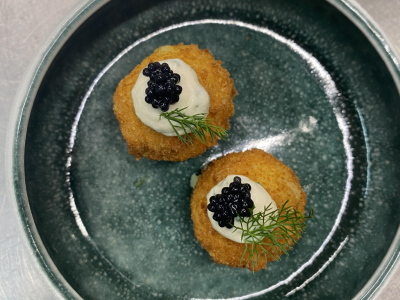
And he's not alone. In recent years, fresh seaweed has entered the kitchens of starred and bistronomic chefs across France. A few examples circulating in the trade press:
- Sea lettuce tartare - contemporary take on the classic Breton seaweed tartare. You see it in about ten starred tables of the Atlantic coast.
- Smoked dulse - used as "Atlantic bacon" or vegan bacon on buckwheat galettes, risottos, soft-boiled eggs. Surprising texture, deep umami.
- Royal kombu in umami broth - base of soups, revisited ramen, reduced sauces. The "Breton dashi" philosophy.
- Fresh nori - to finish a raw dish, the way you grate a truffle.
What struck me about the chefs is that none of them talk about seaweed as a "trendy" ingredient. They talk about it as a return home. As if we were rediscovering that France has a maritime terroir we long reserved for mussels and oysters, and that we're starting to widen.
Food safety: seaweed is more controlled than most fish
Are you hesitant because of heavy metals? Here's what no one is telling you clearly: French edible seaweed is more rigorously analyzed than the tuna at your supermarket.
The CSAVM + ANSES framework
The French edible seaweed sector created a Chamber of Algae and Marine Plants (CSAVM) as early as 1991, with a specific quality charter for member producers: salting, no additives, lot-by-lot traceability, regular sampling, approved harvest zones.
In 2010, ANSES (French Agency for Food, Environmental and Occupational Health & Safety) integrated edible seaweed into its CONTAMINE contaminant surveillance database, covering five main parameters: lead, mercury, total and inorganic arsenic, cadmium, iodine.
In 2019, after several years of work (May 2017 to July 2019, on 131 samples collected between 2009 and 2017), ANSES published its reference opinion on the maximum cadmium content in edible seaweed. Conclusion: cadmium levels in seaweed should be kept as low as possible and should not exceed 0.35 mg/kg of dry matter, all species and all consumption modes combined. This opinion is the reference today.
And ANSES didn't stop there. A new expertise has been underway since 2023, as part of a self-referral, to update recommendations in light of new 2018-2024 data. The CEVA's response to the 2019 opinion is also worth reading - it reminds us that organic seaweed is harvested in zones defined with IFREMER, far from potential pollution sources (estuaries, ports, intensive agricultural zones).
Seaweed vs. fish: numbers that no one talks about
Put this in perspective with supermarket fish.
For fish, there is no systematic lot-by-lot sampling plan comparable to that of the edible seaweed sector. Controls exist, but they are random, not systematic, occasional and driven by emerging sanitary risks. On mercury, ANSES has been recommending for years that consumption of large predators (bluefin tuna, swordfish, halibut, shark) be limited to one or two portions per week for adults, and with even stricter guidance for pregnant women and children. By the way, my article on this subject is published on Mediapart. The EFSA in Europe shares this concern on large pelagic predators.
For edible seaweed, the harvester himself controls his bed, within the framework of prefectoral decrees and the CSAVM charter. Add to that downstream controls at the workshop and ANSES feedback through multi-year plans.
And there's a last factor people often forget: physiological exposure. You consume 5 to 10 g of seaweed a day (fresh desalted weight) if you integrate it regularly into your diet. You consume 100 to 150 g of fish per portion. Even at comparable contaminant concentrations, exposure through seaweed is ten to twenty times lower.
So yes, you have to remain attentive to cadmium, especially on brown seaweed (kombu, wakame) which accumulates it more than green seaweed. But the idea that "seaweed is dangerous because of heavy metals" deserves to be reframed. Within reasonable daily consumption (2 to 5 g dry, or 10 to 20 g fresh desalted), you are far below risk thresholds, and your heavy-metal intake remains lower than a weekly portion of predatory fish.
Three simple recipes to bring fresh seaweed into your kitchen
You open your first pouch. You wonder where to start. Here are the three basics I recommend to anyone who's just beginning - and that you can prepare with little equipment and without changing your main habits.
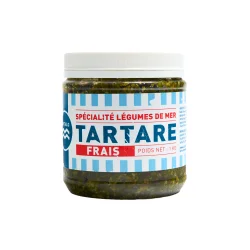
Sea lettuce tartare
For 4 people, count 40 g of fresh salted sea lettuce.
Desalt 5 minutes in cold water, drain, press lightly by hand. Chop finely with a knife. Add 2 tablespoons of crushed walnuts, 1 grated garlic clove, the zest and juice of half a yellow lemon, 3 tablespoons of extra-virgin olive oil, a pinch of pepper. Mix. Let marinate 1 hour in the fridge.
Serve on toasted bread, on raw endive, or alongside a plate of crudités. The next morning, leftovers become a tartine spread.
When customers who've started with seaweed write us a follow-up, this is often the recipe they mention as "the first one that convinced me." Sea lettuce tartare is also what comes closest to the fresh iodized taste of the foreshore.
Smoked dulse "Atlantic bacon" on buckwheat
For 4 people, count 50 g of fresh salted dulse.
Desalt 5 minutes, drain, dry in a cloth. Spread the pieces on the rack of a dehydrator at 50°C for 12 to 24 hours (or in the oven, door slightly ajar, same temperature, several hours until brittle). When out, brush lightly with sesame oil mixed with smoked paprika. Set aside.
Serve on a warm buckwheat galette with a few young shoots and a squeeze of lemon. Smoked dulse has a texture that surprises the first time - almost meat-like, crispy, deeply umami. With the buckwheat galette (a nod to the Breton terroir), you build a 100% Breton plant-based plate.
Royal kombu umami broth (in the spirit of Roellinger)
For 1 liter, count 8 to 10 g of fresh royal kombu.
No stress: the golden rule is low temperature. Put the kombu in 1 liter of cold water. Let it soak 30 minutes. Then bring it to a very gentle heat - water barely simmering, never boiling, maximum 60°C - for 15 minutes. Remove the kombu and reserve the broth.
You get a Breton dashi. Use it as a base for miso soup, revisited ramen, short sauce to finish steamed vegetables or a fish. A few drops of tamari and you have a deep umami emulsion without further cooking.
This is exactly the principle that chefs like Hugo Roellinger build their plant-based sauces on. And you can reproduce it at home in 45 minutes on Sunday morning for the week ahead.
If you want to test for three weeks what changes in your kitchen when you always have a pouch of sea lettuce, dulse and kombu on hand - sourced from Bretalg, vacuum-packed, ready to desalt - we have all three on the shelf: (fresh sea lettuce) and (fresh royal kombu).
Frequently asked questions
Is all seaweed edible?
No. Of the roughly 700 species recorded on the Breton coast, only about twenty are commercialized for food. The good news: no marine seaweed is toxic in the way of a poisonous mushroom. The main risk - when consuming a non-recommended species - is an unpleasant taste, a difficult texture, or too high an iodine load.
How much seaweed per day for an adult?
2 to 5 g of dry weight (or 10 to 20 g fresh desalted) per day is a reasonable range for a healthy adult. ANSES reminds us that total iodine intake should not exceed 600 µg per day for a healthy adult. Since some seaweed (kombu in particular) is very iodine-rich, you have to adapt dosage to species.
Fresh vacuum-packed or dried seaweed?
Both have their place. Fresh vacuum-packed salted seaweed preserves texture, color, polyphenols and original taste - the option closest to the rock. Dried seaweed is more practical to store, more concentrated in nutrients per gram, but loses some sensory freshness. Alternating both depending on use is the best strategy.
What about the thyroid?
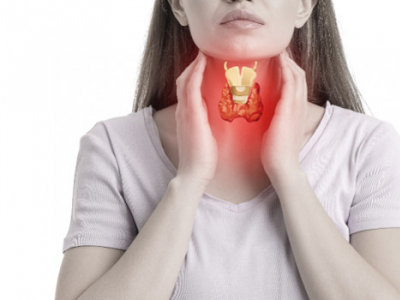
If you take thyroid medication (Levothyrox or equivalent) or have a diagnosed overactive thyroid, ask your doctor's advice before integrating very iodine-rich seaweed (kombu, wakame). Favor sea lettuce and dulse, much less iodine-rich. And in any case, integrate seaweed progressively, not in large amounts all at once.
And for pregnant or breastfeeding women?
Moderation. Pregnancy and breastfeeding are periods when iodine intake matters - but is also very sensitive. Small amounts (1 to 2 g dry per day), avoid very iodine-rich kombu, ask the advice of the professional following the pregnancy. Sea lettuce remains the gentlest option.
How to check that seaweed is really organic?
The Eurofeuille label (the European green logo with stars) must be present on the packaging, accompanied by the certifier code. For wild seaweed harvested on the foreshore, you also need an approved harvest zone and lot-by-lot traceability. Serious producers display this information clearly.
Where to buy fresh seaweed?
Three main channels: Biovie.fr, pioneer of fresh seaweed online distribution; specialized organic stores; fine grocers in major cities.
References
- CEVA - Panorama of the European seaweed industry. CEVA Blog, 2023-2024.
- Mer.gouv.fr - Roadmap on Seaweed Aquaculture in France, February 2025.
- ANSES (2019) - Opinion on maximum cadmium levels for seaweed intended for human consumption (ERCA2017SA0070).
- ANSES - Recommendations to limit cadmium exposure from edible seaweed consumption.
- Roscoff Biological Station (CNRS / Sorbonne University) - Project GENIALG: France, European leader for macroalgae biorefineries.
- ADEUPa - Socio-economic weight of the seaweed sector, Brest region.
- Michelin Guide (2025) - Le Coquillage, three Michelin stars: Hugo Roellinger.
- Salon de l'Algue 2025 - First national edition, Rennes (Halle de la Courrouze), 23-24 November 2025.
Last update: May 2026. Article reviewed by Éric Viard, founder of Biovie and ISTOM engineer (tropical agronomy), co-author of « Algues au quotidien » (Gallimard, 2024) - World's Best Cookbook, Gourmand Cookbook Awards 2025, and Best French Cookbook, French National Academy of Cuisine 2025.
The information presented in this article is provided for informational purposes only and does not constitute medical advice. Edible seaweed fits within the framework of a varied and balanced diet and a healthy lifestyle. If you take thyroid medication, are pregnant or breastfeeding, or have a chronic condition, consult a healthcare professional before any significant change to your diet.