Turn a bottle of supermarket olive oil around and read the small print: often it simply says "blend of olive oils from more than one country."The first time I really stopped to read that line, I realised it could cover half a dozen countries and a dozen different varieties - and you'd never know which ones. That's not fraud. It's simply how most of the shelf is made. And it changes everything you can honestly say about how an oil tastes. This article gives you a sharper eye for reading an olive oil label - and specifically what separates a genuine single-variety oil, like Coratina, from a blend.
If you also want to diversify the oils in your kitchen beyond olive, our article Why should oils be diversified? pairs well with this one.
Blending: the standard of the shelf
A blend is a mix of several olive varieties, or several already-pressed oils, brought together by a professional known as a blender. The trade calls this blending; in France it's also called coupage.
Why does this practice dominate the market so completely? For a very concrete, and fairly logical, reason: a single olive variety never gives exactly the same taste profile from one year to the next. Weather, how heavily the tree is bearing, and the harvest date all shift the bitterness, the pungency, the fruitiness. Blending exists precisely to smooth out those variations and guarantee a recognisable taste, year after year, at a controlled price. It's a genuine skill - comparable to what a cellar master does when building a regular cuvée from several grape varieties. A well-made blend is the work of a skilled blender, not a fraud.
What you lose, on the other hand, is varietal traceability. Once the oils are mixed, there's no reliable way to say which variety contributed what share of the result. The label can stay perfectly legal - the EU regulation governing the marketing of olive oil (Regulation (EU) No. 1308/2013, Annex VII, Part VIII) doesn't require a blend's varieties to be listed - without ever really saying much about what's actually in the bottle.
What a single-variety oil actually changes
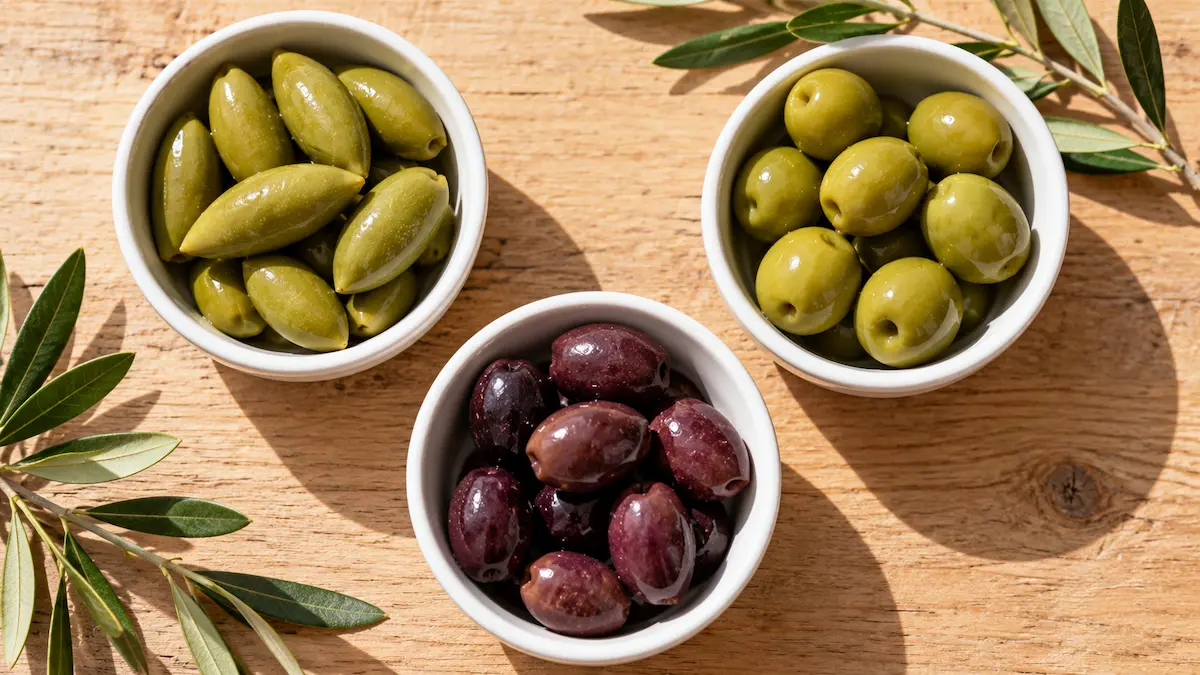
A monocultivar oil - also called single-variety or single-varietal - is pressed from one olive variety only, harvested and processed separately. The wine world's vocabulary helps here too: think of it as the equivalent of a single varietal wine facing down a blend of grape varieties. British readers might find an even closer analogy in whisky, coffee or tea: a single estate oil works on the same logic as a single malt, a single-origin coffee, or a single-estate tea - one source, no averaging out.
A reproducible sensory profile
With a single-variety oil, you know roughly what you're buying from one harvest to the next: a given variety always delivers the same aromatic family - more or less bitter, more or less pungent, with recurring notes (artichoke, fresh almond, cut grass). It's never identical down to the last detail - nature doesn't work that way - but it's recognisable.
A chemical signature, not just a marketing argument
This is the most interesting point. A study published in 2024 in the journal Foods (Molinu et al.) compared the phenolic composition of three single-variety oils - Bosana, Coratina and Frantoio - looking for typical traits specific to each cultivar. The result: certain correlations between families of phenolic molecules, notably between oleocanthal and oleacein, turned out to be variety-specific. In other words, "single variety" isn't just a sales pitch - it's a measurable chemical fingerprint, independent of terroir or vintage.
What you lose
It would be dishonest to present single-variety oil as a choice with no downside. It varies more from one harvest to the next - which is exactly what blending is designed to avoid. It generally costs more, because it relies on a dedicated grove and a traceability that has a cost. And its profile, sometimes very pronounced, doesn't suit every everyday use: a very bitter, very peppery Coratina isn't what you'd reach for in a mayonnaise.
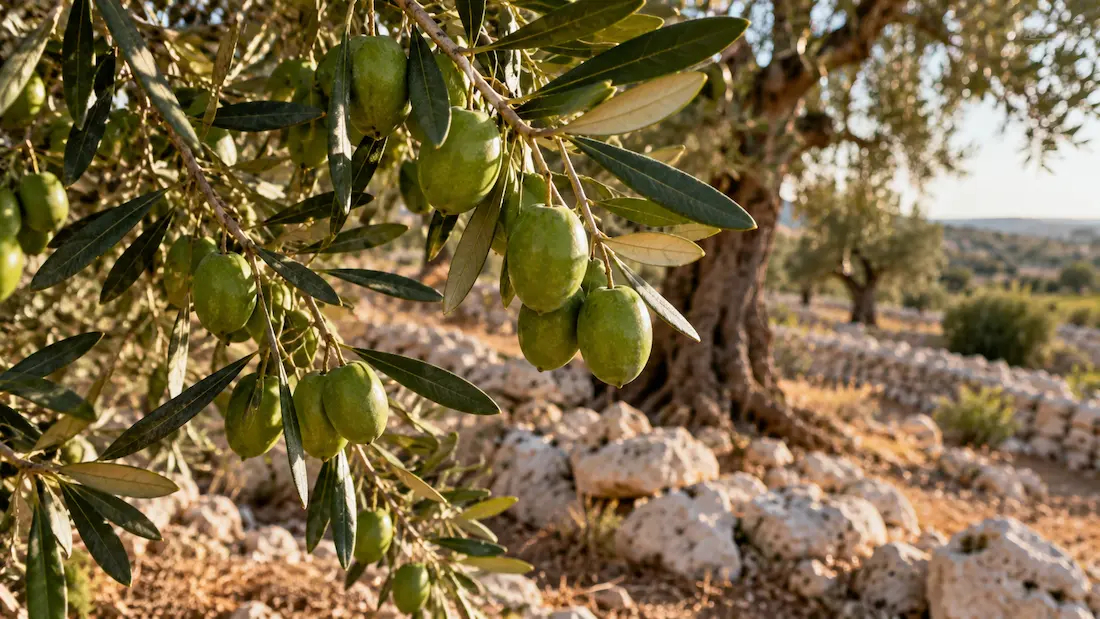
Coratina is a native variety of Puglia, in south-eastern Italy, grown especially around Bari. It's a robust tree that adapts well to the region's limestone soils - an agronomic trait that partly explains why local growers stay loyal to it.
The oil it gives has an intense green fruitiness, notes of artichoke and fresh almond, a frank bitterness and a distinct pungency that catches at the back of the throat. That pungency has an entertaining scientific history of its own. In 2005, researcher Gary K. Beauchamp, tasting a freshly pressed olive oil, recognised a sensation he'd felt years earlier after swallowing a solution of ibuprofen during another study. That hunch, published in the journal Nature, led to the identification of a molecule: oleocanthal, whose name combines oleo (oil), canth (stinging) and al (aldehyde). Let's be clear: this discovery is about a resemblance in mouthfeel, not a therapeutic effect of the product - we're claiming nothing more here than what the study actually shows.
Another characteristic of Coratina: how well it holds up over time. A study published in 2022 in the journal OCL (Macciola and De Leonardis) followed a single-variety Coratina oil stored for six years in metal tins, in the dark. Over that period, free acidity - a key quality indicator for olive oil - stayed between 0.2% and 0.4%, well under the 0.8% ceiling that defines the extra virgin category. That's a remarkable degree of long-term stability for a virgin oil, owed largely to this variety's naturally high content of antioxidant compounds.
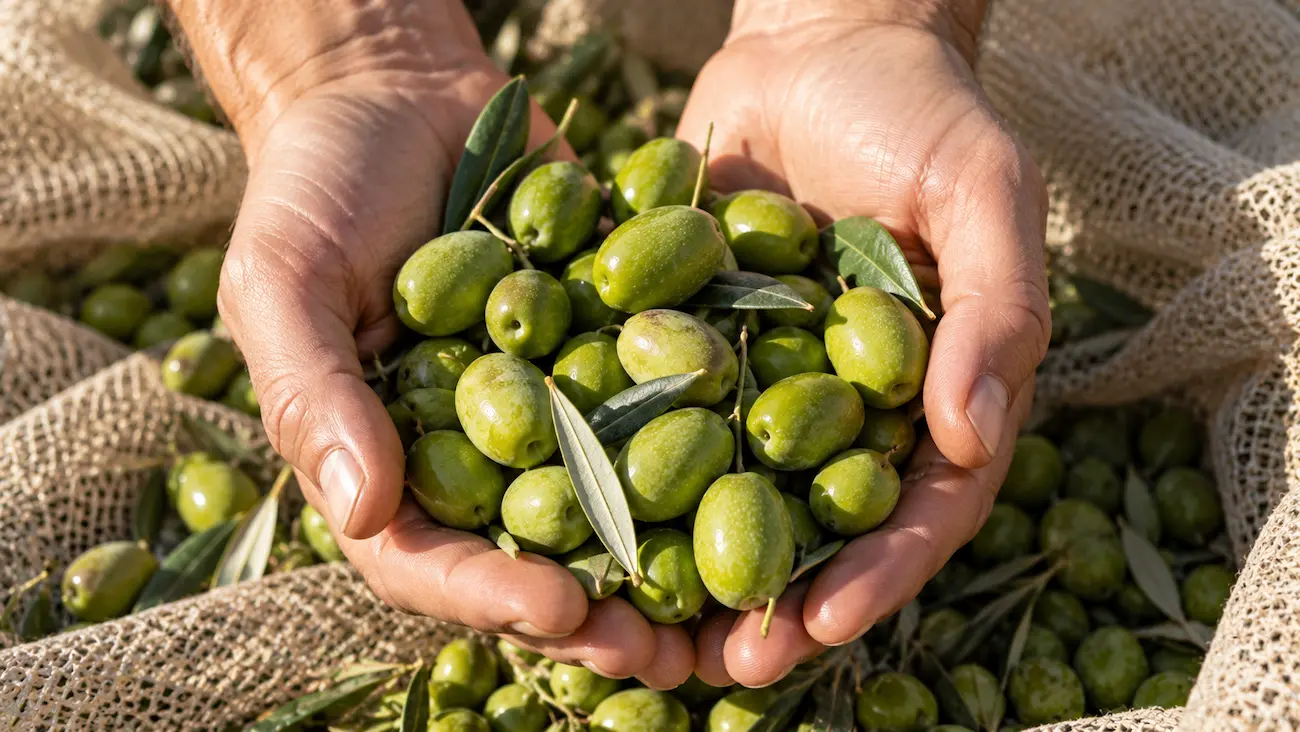
A green olive, picked early, yields less oil than a ripe one. That's a simple agronomic fact, but it has a consequence rarely spelled out: harvesting early means accepting a lower yield in exchange for a higher concentration of phenolic compounds. It's as much an economic choice as a taste choice - and it's one of the reasons a quality oil costs more than a high-yield one.
A 2021 study published in Food Chemistry (Del Coco et al.) illustrates this logic well. Researchers compared, on a Coratina oil from Puglia, two ripeness stages at harvest, using two extraction methods. In the ultrasound-assisted variant studied, tyrosol and hydroxytyrosol derivatives reached 900.8 mg/kg at early harvest, against 571.9 mg/kg at the later harvest - a clear gap. It should, however, be said honestly: the study's main focus was comparing two extraction processes, with harvest date only a secondary variable. That kind of nuance is what separates a careful reading of a scientific source from a simple copy-paste of its conclusion.
Spotting a genuine single-variety on a label
"Monocultivar" isn't a regulated term in the EU or the UK: anyone can print it, and it only binds the person claiming it. Here, very concretely, is what lets you tell a genuine single-variety oil apart from a marketing line:
The variety name spelled out in full - "Coratina", "Frantoio", "Picual" - not just a vague claim like "100% Italian".
A precise origin - a region, ideally a town or an estate - rather than a fog kept up around "EU / non-EU".
A displayed harvest date, distinct from the simple best-before date, which says nothing about when the oil was actually pressed.
An opaque container - tinted glass, metal or carton - protecting the oil from light, one of its main causes of degradation.
A producer who publishes their own lab analyses - acidity, peroxide value, polyphenol content - rather than adjectives alone.
These five points matter far more than the word "monocultivar" itself, which on its own guarantees nothing. They're also, incidentally, the same instincts that help you spot a genuine organic label rather than a marketing logo - something we cover in detail in our guide reliable organic labels: how to avoid fake ones.
An intense single-variety oil: everyday use
A Coratina, with its pronounced bitterness and pungency, lends itself more to a finishing drizzle than to cooking, which tones down some of these traits. In our kitchen, it earns its place on a hot bowl of red lentil soup, on finely cut raw vegetables - a little like in our living crudités sauce from the Hippocrates Institute - on a plant-based pâté, or drizzled over a fresh seaweed tartare: the pungency mellows in the cold and the fat, and it stops dominating a dish that already has character of its own. On a very neutral dish, though, it can quickly take over the whole plate - adjust the quantity to taste.
First cold-pressed virgin oils (camelina, flax, hemp) and organic spices dried below 42 °C make up this range: turmeric, ginger, Ceylon cinnamon (lower in coumarin than the Cassia sold commercially) and Bourbon vanilla. In cooking, turmeric pairs well with black pepper and a fat. Camelina or flax: camelina keeps better, while flax, with its stronger taste, oxidises faster once opened., 12
products
Coratina is an olive variety native to Puglia, in southern Italy, prized for producing an oil with intense green fruitiness, pronounced bitterness and a distinctive peppery finish, along with unusually good stability over time.
What is single-variety olive oil?
An oil pressed from one olive variety only, harvested and processed separately from any other - unlike a blend, which brings several varieties together to keep the taste consistent from year to year.
What's the difference between monocultivar and single-variety olive oil?
None: they're two ways of naming the same thing. "Monocultivar" is borrowed from Italian, while "single-variety" is the English-language term built around the word "variety". Both are used interchangeably.
Where is Coratina olive oil from?
Coratina is native to Puglia, in the south-east of Italy, an area particularly known for producing robust, high-polyphenol single-variety oils.
Why does Coratina olive oil have a peppery finish?
Because of oleocanthal, a molecule identified in 2005, whose mouthfeel resembles that of a solution of ibuprofen. The fresher an oil and the richer it is in polyphenols, the more pronounced this peppery bite tends to be.
Is a single-variety olive oil better than a blend?
Neither one is better as a rule: a well-made blend guarantees a day-to-day consistency that's genuinely useful, while a single-variety oil offers a traceability and a signature taste that a blend can't provide. The right choice depends on what you're after.
How can you tell if an olive oil is genuinely single-variety?
By checking five things on the label: the variety name spelled out in full, a precise origin, a harvest date, an opaque container, and a producer who publishes their own lab analyses.
Is Coratina olive oil good for you?
Like other extra virgin olive oils rich in polyphenols, Coratina oil can play a part within a varied, balanced diet and a healthy lifestyle - EU regulation specifically recognises a role for olive oil polyphenols in protecting blood lipids from oxidative stress, at a minimum intake level. That's a modest, well-defined claim, not a general health promise, and it doesn't replace medical advice.
Regulatory framework: Regulation (EU) No. 432/2012 · Regulation (EU) No. 1308/2013, Annex VII, Part VIII · Delegated Regulation (EU) 2022/2104. This framework is EU law; readers in the UK should note that retained/equivalent domestic rules, not the EU regulation itself, govern labelling on the British market.
Last update: September 2026. Article written and validated by Éric Viard, founder of Biovie since 2007 and ISTOM engineer ISTOM, co-author of « Algues au quotidien » (Gallimard, 2024) - World's Best Cookbook, Gourmand Cookbook Awards 2025, and Best French Cookbook, Académie Nationale de Cuisine 2025.
To sum up - as part of a varied, balanced diet and a healthy lifestyle, choosing an olive oil isn't only a question of price per litre. Knowing how to read a label - variety, origin, harvest date - gives you the means to choose with your eyes open, whether you go for a consistent blend or for a single-variety oil with real character, like Coratina.
The information in this article is provided for general interest and does not constitute medical advice. It should be read as part of a varied, balanced diet and a healthy lifestyle. Consult a healthcare professional before making any changes to your diet.