









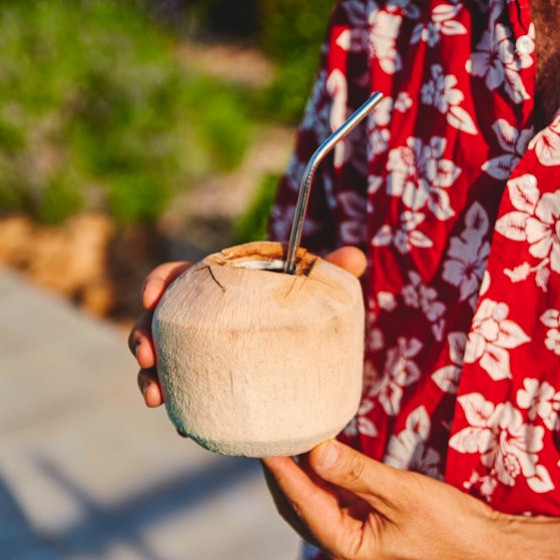
Fresh coconut water, extracted from young green nuts harvested before full maturity, is one of the most nutritionally consistent drinks I know - and I have been consuming it for over thirty years. It naturally contains potassium, magnesium, calcium and sodium, without additives or preservatives. But - and this is where it becomes important - not all products labeled "coconut water" are the same. The fresh, unpasteurized version is radically different from the industrial boxed coconut waters found everywhere. This comprehensive guide to coconut water gives you everything you need to know: composition, contraindications and practical consumption advice.
Share this article

Organic fresh coconut pallet (18 cartons of 9 coconuts)
€24.90 €27.66 NEXT RESTOCKING AT THE END OF OCTOBER
Fresh coconut water: nutritional composition and difference from the pasteurized version
Let's first look at what it actually contains.fresh coconut water. For 240 ml - which is one cup - here are the reference data (Source: USDA FoodData Central, 2019):
- Potassium : approximately 470 to 500 mg per 240 ml
- Magnesium : 15-20 mg
- Calcium : 57-60 mg
- Sodium : 30 mg
- Calories : 45-60 kcal only
- Carbohydrates : 11-12 g (natural sugars)
This profile is remarkable. Frankly, when compared to any commercial industrial sports drink - colorants, flavors, added sugars - there is no debate.
The pasteurization, practiced by almost all bottled brands, involves exposure to high temperatures. While it ensures microbiological sterility, it modifies several heat-sensitive compounds, including vitamin C.
That's why, at Biovie, we exclusively import the variety Nam Hom from Thailand - recognized as the most aromatic in the world. The coconuts arrive at your doorstep without any thermal treatment. Essie Cétévray, a loyal customer, sums it up: "their large quantity of truly delicious water, unlike the pasteurized coconut water from stores."
To go further on the whole coconut: the benefits of whole fresh organic coconut.
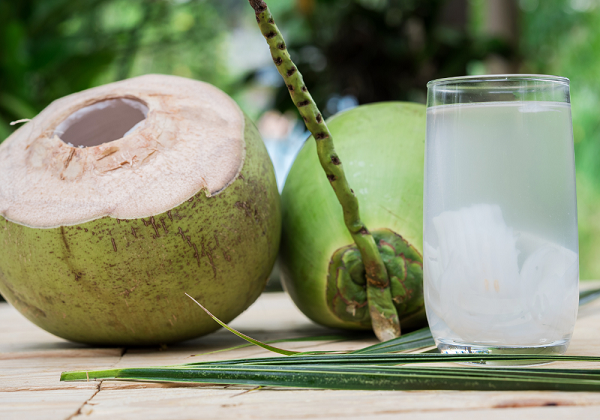
Coconut water, coconut milk, coconut nut water: do not confuse
The mix-up is common on the shelf, and it is not a minor one: we regularly see people pick up a carton of coconut milk thinking they are buying coconut water. The two only have the nut in common.
- Coconut water is the liquid naturally present inside the young, not-yet-fully-mature nut. Clear, very fluid: about 17 kcal, 3.7 g of carbohydrates and 350 mg of potassium per 100 ml. It is drunk as is, after exercise or as a smoothie base.
- Coconut milk is an emulsion obtained by pressing the white flesh of the ripe nut. White, creamy: 180 to 220 kcal and 17 to 20 g of fat per 100 ml. It is a cooking ingredient, not a hydration drink.
- Coconut nut water is just another name for coconut water. Same product.
Beyond 90 minutes of exercise: the limit to know
A crossover trial conducted on trained men (Kalman et al., Journal of the International Society of Sports Nutrition, 2012) compared fresh coconut water, coconut water from concentrate and a standard sports drink after exercise: all three performed similarly for everyday rehydration, and coconut water was the only one with no added sugar or additive. The nuance matters, however, for longer efforts: with about 105 mg of sodium per 100 ml, coconut water becomes insufficient beyond ninety minutes of exercise or in strong heat, when sodium losses through sweat accelerate. A pinch of unrefined sea salt in 300 ml of fresh coconut water is enough to correct this.
Seven key points about coconut water
1. Hydration and electrolytes
Fresh coconut water is a natural isotonic drink.
A randomized crossover study published in the journal Sports (MDPI, 2023) on 19 confirmed cyclists showed that coconut water offers performance comparable to commercial sports drinks for maintaining hydration during a 90-minute effort at moderate intensity (Meyler S. et al., 2023, DOI:10.3390/sports11090183).
Specifically, after your workout, a young fresh coconut provides potassium and magnesium, with no added coloring or flavoring. For natural solutions for hydration, consult our dedicated guide.

2. The potassium in coconut water
Coconut water naturally contains potassium (about 470 to 500 mg per 240 ml).
3. Caution: potassium and kidneys
⚠️ Important contraindication : Individuals suffering from kidney failure or hyperkalemia must strictly limit their potassium intake. Coconut water, which contains potassium, is not suitable for these individuals without prior medical advice.
4. The natural sugars in coconut water
A 240 ml cup of coconut water provides about 11 to 12 g of natural sugars, with no added sugar.
It fits into a balanced diet, in moderation.
5. Use on the skin
When applied topically, coconut water provides freshness and softness. You can incorporate it into a coconut-spirulina after-sun mask : a recipe that Aurélie uses regularly.
6. Calories
Fresh coconut water is naturally low in calories (45-60 kcal per 240 ml) and fat. It is an alternative to sugary drinks. Important clarification - and I want to be direct about this: Coconut water alone does not cause weight loss.. No serious study establishes a direct link between its consumption and significant weight loss. What can be said, however, is that it fits intelligently into a balanced diet by substituting refined sugar intake.
7. Why we only offer fresh water
Biovie has never offered pasteurized coconut water: our nuts arrive at your door without any heat treatment.
Coconut water on an empty stomach, after exercise, during pregnancy: when to consume it ?
Coconut water on an empty stomach: good idea ?
Drinking coconut water on an empty stomach is well tolerated by the vast majority of people. In the morning, after a night of fasting, it provides natural electrolytes (potassium, magnesium). It is a pleasant alternative to plain water to start the day. It is particularly appreciated in the summer or after a night of intense heat.
After physical exertion
Coconut water is a common hydration drink after exercise, as shown by the study by Meyler et al. (2023). It provides potassium and magnesium. Important nuance : after a very intense and prolonged effort - marathon, triathlon - sweating mainly leads to sodium losses, an electrolyte in which coconut water is relatively low (30 mg per 240 ml). In this specific case, supplementing with a natural source of sodium is recommended. For moderate efforts, fresh coconut water is ideal.
Coconut water and pregnancy
Coconut water is generally well tolerated during pregnancy. A 2024 review (Raza M., PMC11395342.) confirms its safety during pregnancy, provided it is fresh, unpasteurized, and without additives. As always, any significant dietary changes during pregnancy should be discussed with a healthcare professional.
To go further: our article on Living food and pregnancy.
How much to drink per day ?
There is no official acceptable daily intake (ADI) for coconut water. For a healthy adult, 240 to 480 ml per day is a reasonable intake. A fresh young Biovie coconut contains on average 400 to 600 ml of water depending on its size. Coconut water should not replace regular water consumption - it is a supplement, particularly during physical exertion, heat episodes, or recovery periods.
Coconut water: side effects and contraindications to know
Fresh coconut water is safe for the vast majority of healthy individuals. However, certain profiles require special attention - and I prefer to discuss them openly rather than ignore them.
Real contraindications:
- Renal insufficiency and hyperkalemia Coconut water contains potassium (about 470 to 500 mg per 240 ml). People whose kidneys do not properly filter this mineral should avoid it or consume it only on medical advice.
- Antihypertensive treatments and potassium-sparing diuretics : a potential interaction exists - consult your doctor before consuming it regularly.
- Diabetic people : 11 to 12 g of natural sugars per cup can add up. Moderation is advised.
Possible side effects:
- In cases of excessive consumption, bloating and digestive discomfort have been reported.
- Coconut water is not suitable as the sole source of rehydration after intense exercise with heavy sweating, due to its low sodium content.
Warning on industrial products: Many bottled coconut waters contain added sugars, flavors, or sweeteners. Read the labels. The only coconut water with intact nutritional properties is the one extracted directly from a fresh young coconut.
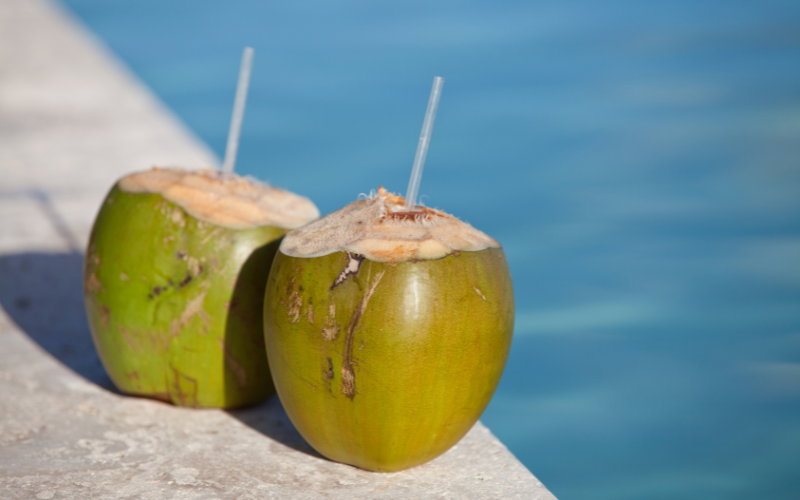
The full range Fresh coconut
Enjoy a gourmet and nutritious coconut flesh thanks to these Thai organic green coconuts, proposed with its machete for easy opening, 5 products

Coconut machete CoCoBio
€20.95
-10%

Organic fresh coconut pallet (18 cartons of 9 coconuts)
€24.90 €27.66
How to incorporate fresh coconut water into your raw diet
The simplest way is to drink the water directly from the opened coconut. This is the experience our customers often describe as a revelation compared to industrial versions. Dominique Garcia confirms: "fresh coconuts, they are all absolutely delicious, a pure delight."
Here are some other ways to enjoy our young organic fresh coconuts from Thailand :
- Coconut water kefir : by combining water with kefir grains, sugar, and a few simple ingredients, you get a natural and sparkling fermented drink → our coconut water kefir recipe
- Cold raw soup : ideal base for a raw curry and fresh coconut soup
- Cocktail : mixed with carrots, turmeric and ginger, in our coconut water cocktail recipe
- Raw sweet recipes : for some raw coconut-cocoa yogurts delicious and nutritious
- In smoothie : hydrating base for any tropical fruit smoothie. With lemon, it's particularly refreshing.
How to choose a genuinely good-quality coconut water?
This is the question that decides everything else: a poorly chosen coconut water cancels out most of the product's benefit. Six criteria are enough to decide in front of the shelf.
- A single ingredient on the label: coconut water. Any longer list is a warning sign.
- EU Organic Farming certification, which guarantees the absence of synthetic pesticides on nuts whose water concentrates agrochemical residues.
- Unpasteurised, or high-pressure processed (HPP): pressure replaces heat and better preserves fragile compounds. It is the least damaging process when some form of preservation is required.
- No flavouring, no added sugar, no acidity regulator.
- Packaging that protects against oxidation: opaque packaging, protected atmosphere.
- A traceable origin. Structured organic supply chains are found mainly in Thailand, Sri Lanka and Vietnam.
What's really in an industrial coconut water carton
Turn over any supermarket carton and read the ingredient list. You will often find sugar, synthetic ascorbic acid, "natural coconut flavouring" - and that last mention says a lot: when coconut water needs to be flavoured to taste like coconut, it is because the original flavour was lost during heating. Some products also add water to stretch the volume. The ideal list comes down to three words: coconut water.
Label claims that mean nothing
- "100% natural" is not an official label: this claim commits to nothing, neither on organic status, nor on additives, nor on pasteurisation.
- "Reconstituted coconut water" means a powder has been rehydrated. Neither the taste nor the nutritional profile compares to fresh water.
- "Green coconut water" plays on the outer colour of the nut and says nothing about its content. Look at the ingredients, not the packaging.
FAQ - Your questions about coconut water
Is it good to drink coconut water every day ?
Yes, for most healthy individuals, drinking 240 to 480 ml of fresh coconut water per day is perfectly suitable. It provides natural electrolytes and contributes to overall hydration. As part of a varied and balanced diet and a healthy lifestyle, it is a sensible habit. People with kidney failure or under specific medical treatment should consult a doctor before consuming it regularly.
What does fresh coconut water contain?
Fresh coconut water naturally contains potassium, magnesium, calcium and sodium, with no added sugar or additive. I drink it plain, straight from the nut, instead of a sugary drink.
Does coconut water make you gain weight ?
No, coconut water does not cause weight gain on its own. With only 45 to 60 kcal for 240 ml and a low fat content, it is less caloric than most fruit juices. It also does not directly cause weight loss - contrary to some claims circulating on the internet. It can be part of a balanced diet as a healthy alternative to sugary drinks.
What is the best time to drink coconut water ?
Coconut water can be consumed at any time of the day. It is readily drunk after physical exertion, in the morning on an empty stomach or during periods of intense heat. It can also be consumed in the evening - there are no documented contraindications related to the time of day for healthy individuals.
Can a pregnant woman drink coconut water ?
Yes, fresh coconut water is generally safe during pregnancy, as confirmed by a review published in 2024 (Raza M., PMC11395342). It is recommended to choose fresh, unpasteurized coconut water without added sugars. In case of doubt or a high-risk pregnancy, it is advisable to consult with a doctor or midwife.
Is coconut water dangerous for the kidneys ?
For healthy individuals, coconut water can be drunk like any other drink. However, people with kidney failure or hyperkalemia (excess potassium in the blood) should not consume it without medical advice, as its high potassium content (about 470-500 mg per 240 ml) can worsen their condition.
What is the difference between fresh coconut water and boxed coconut water?
Fresh coconut water comes straight from the nut and undergoes no heat treatment: it keeps its original taste. Boxed coconut water has almost always been pasteurised, is often reconstituted from concentrate, and is frequently corrected with sugar, flavourings or acidity regulators. The simplest benchmark remains the ingredient list: it should contain only one item.
Does coconut water replace a sports drink?
For a one-hour session or ordinary recovery, yes: the available trials place it on a par with a commercial sports drink, with no added sugar or additive. Beyond ninety minutes of intense exercise or in strong heat, its sodium becomes insufficient: add a pinch of unrefined sea salt to your glass.
References
- Meyler, S. et al. (2023). "Coconut Water: A Sports Drink Alternative?". . Sports (MDPI), 11(9), 183. DOI: 10.3390/sports11090183.
- Shi, S. et al. (2025). "Research Progress in Coconut Water: A Review of Nutritional Composition, Biological Activities, and Novel Processing Technologies". Foods (MDPI). PMC12072132.
- USDA FoodData Central (2019). Coconut water - nutritional data. . U.S. Department of Agriculture.
- Raza, M. (2024). Review on coconut water safety during pregnancy. PMC. PMC11395342.
Update: October 2026. Article approved by Eric Viard, founder of Biovie and engineer ISTOM, co-author of " Seaweed in everyday life "(Gallimard, 2024) -" Best cookbook in the world, Gourmand Cookbook Awards 2025, and Best cookbook in France, National Academy of Cuisine 2025.
The information presented in this article is provided for informational purposes only and does not constitute medical advice. Consult a qualified healthcare professional before making any changes to your diet or supplementation. As part of a varied and balanced diet and a healthy lifestyle.

