


Behind the search for "coconut water benefits" there is a very simple drink: the liquid inside a young coconut, which per 100 g is about 95% water, 19 kcal and 250 mg of potassium. After exercise, two small human trials put it on a par with water or a sports drink, and no more. I'm going over these figures as the founder of Biovie, who has imported these young coconuts.
When I started importing, there were coconuts in my fridge all the time. I tasted every shipment, because from one season to the next the nuts change: smaller, bigger, with a taste that is never quite the same from one nut to the next. Even today I open between ten and twelve a month, always with a machete (I've never left a finger behind, but further down I'll suggest some wiser tools).
And then there's what you read online. A drink this simple, and pages where the promises keep growing, where the figures contradict each other from one site to the next, without a single source ever being cited. It annoys me a little, I admit. So I did what my engineering studies at ISTOM taught me, and what I've done for every product since Biovie was created in 2007: go back to the data. I had already spent days and days hunting for studies for our big articles on seaweed; here, everything comes from the official USDA table and from published studies, numbered at the end of the article.
What is coconut water?
To picture it, think of a sealed flask that the coconut palm fills for its offspring. Inside: water, sugars, minerals, amino acids and plant hormones, everything a young seedling needs to get started. Researchers speak of the liquid endosperm of the young coconut, in other words the reserve the seed builds up for its future embryo (Yong et al., 2009).
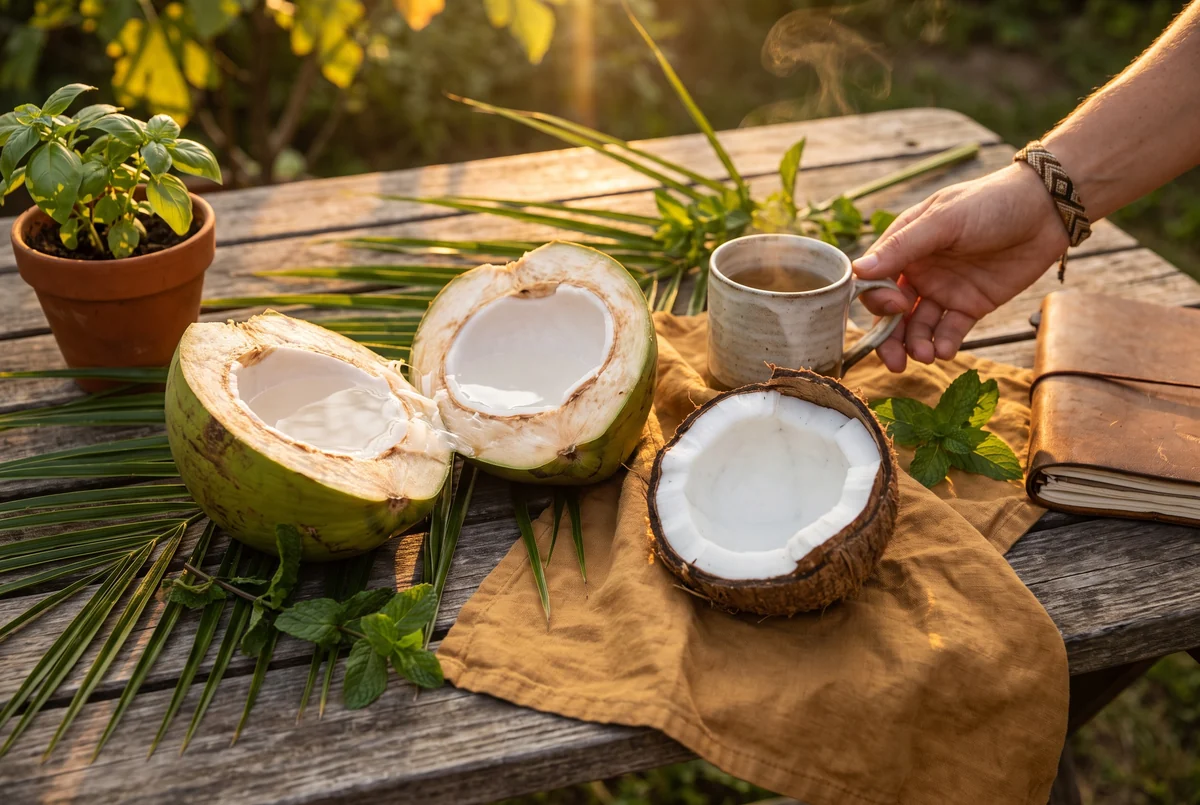
Nature packaged this reserve long before we did, with no plastic and no preservative. You just pierce it and it's ready. And while we're at it, let's clear up a common mix-up: it has nothing to do with coconut milk, which is made by pressing the white flesh of the nut. One is for drinking, the other for cooking.
This composition varies with the maturity of the nut and with its variety; the CIRAD review on coconut water (Prades et al., 2012) in fact finds dwarf varieties the best suited for a tasty water. That is exactly what I noticed when tasting the shipments: two coconuts from the same box never taste exactly alike. If you're searching for "coconut water benefits" or "benefits of coconut water", it's the same drink under another name. The flesh has its own article, for anyone who wants the benefits of coconut and coconut water together: the flesh of fresh coconut and its benefits.
Coconut water composition: the sourced figures
Type "coconut water benefits" into a search engine and, depending on the page, you'll read 4.1 g of sugar or 5 g of carbohydrates per 100 ml. Who to believe? Personally, I rely on the most solid reference I know, the official table of the US Department of Agriculture (USDA FoodData Central, entry 170174), which gives an average per 100 g. The column for a 250 ml glass is a Biovie calculation (values multiplied by 2.5, density taken as 1, rounded), so that you have in front of you what you actually drink.
| Nutrient | Per 100 g (USDA) | Per 250 ml glass (Biovie calculation) |
|---|---|---|
| Water | 94.99 g | about 237 g |
| Energy | 19 kcal | about 48 kcal |
| Protein | 0.72 g | about 1.8 g |
| Fat | 0.20 g | about 0.5 g |
| Carbohydrates | 3.71 g | about 9.3 g |
| of which sugars | 2.61 g | about 6.5 g |
| Fibre | 1.10 g | about 2.8 g |
| Potassium | 250 mg | about 625 mg |
| Sodium | 105 mg | about 263 mg |
| Magnesium | 25 mg | about 63 mg |
| Calcium | 24 mg | about 60 mg |
| Phosphorus | 20 mg | about 50 mg |
| Vitamin C | 2.4 mg | about 6 mg |
First observation, and there's nothing spectacular about it: it's mostly water, nearly 95%, with 2.61 g of sugars per 100 g. A big glass is about 48 kcal and 6.5 g of sugars. In the mouth, a lightly sweet drink, very far from the feel of a fruit juice.
So why are the figures online higher? First because maturity and variety shift the sugar and mineral content (Prades et al., 2012). Then because many published values concern commercial coconut waters, processed and sometimes sweetened: you compare a fresh nut with a carton, then wonder why it doesn't add up. A composition figure only means something if you know which nut, and which product, it is talking about.
On the mineral side, coconut water contains more potassium than sodium: 250 mg against 105 mg per 100 g. A 250 ml glass therefore provides about 625 mg of potassium, and a whole coconut drunk in one go can provide more. I like it when two unrelated sources agree: a British case report measured 65 mmol/L of potassium in the coconut water involved (Rees et al., 2012), or about 250 mg per 100 ml. The cross-check with the USDA is good.
Still, those 250 mg remain a table average, not an analysis of our coconuts. That's why I don't present coconut water as a "source of potassium" in the sense of European regulations, even though it would be tempting: I stick to its composition, to be placed as part of a varied and balanced diet and a healthy lifestyle.
That leaves vitamin C, which several sites call abundant. The USDA table gives 2.4 mg per 100 g. That's low, quite simply, and it doesn't matter: you open a coconut for the water, the freshness and the taste.
Coconut water benefits: what the studies show
What are the benefits of drinking coconut water? Short answer: it's a drink with 19 kcal per 100 g, made of 95% water, that contains 250 mg of potassium per 100 g. And in two small human trials, the participants who drank it after exercise rehydrated as they did with water or a sports drink.
Rehydrating after exercise: two human trials
The first trial (Saat et al., 2002) followed 8 healthy men. After exercise, they drank in turn fresh young coconut water, a carbohydrate and electrolyte drink, or water. The authors' conclusion: fresh coconut water can be used to rehydrate the whole body after exercise. No more, no less.
The second, by Kalman et al. (2012), goes into more detail. Twelve trained men exercised for 60 minutes on a treadmill, until they had lost about 1.7 kg, or 2% of their body mass. To get an idea, that's a little more than the weight of a big bottle of water, gone in sweat in one hour. Then, bottled water, pure coconut water, coconut water made from concentrate or a sports drink: whichever the drink, all of them regained their mass to a comparable degree. In the endurance test that followed, the time to exhaustion was 11.9, 12.3, 11.9 and 12.8 minutes depending on the drink. A difference judged not significant, meaning that chance is enough to explain it.
There is also a less expected result, which I want to give you: the participants reported more bloating and stomach discomfort with the coconut waters.
In a crossover trial like this one, each participant tests all the drinks, on different days: it's as if the same runner, on the same treadmill, tried four flasks one after the other. Each person serves as their own point of comparison, which smooths out the differences between individuals. The limit lies elsewhere: 8 and 12 men is a small sample, and the authors of the second trial themselves consider that a more demanding protocol would be needed.
These two trials say one simple thing: after exercise, coconut water is on a par with water and with a sports drink. For the search "coconut water benefits for sport", that's the honest answer. It's less spectacular than what you read here and there, but it has the merit of being true.
What the studies don't say (yet)
Slimming, immunity, skin, digestion: I looked, and I found no human trial that would allow these effects to be attributed to coconut water. No trial, no claim. Lauric acid, often put forward, concerns mainly the flesh and coconut oil, and the CIRAD review notes that few studies identify the compounds responsible for the effects attributed to coconut water (Prades et al., 2012). Of course, you can find that disappointing. Not me: coconut water doesn't need these promises. It's a drink that stands out for its simplicity, to be enjoyed for pleasure as part of a varied and balanced diet and a healthy lifestyle.
Fresh or bottled coconut water?
On the shelf, bottled or carton coconut water is most often pasteurised, and some of it is reconstituted from concentrate. I'm not going to put the carton on trial. There is nothing suspect about pasteurisation: it's what lets a fragile liquid last for months outside the cold. It does heat the drink, though, and to my palate, the taste shows it.
The Kalman et al. (2012) trial, incidentally, tested both commercial forms, pure and from concentrate: for rehydration, they were on a par. So the difference between fresh and processed isn't about that criterion, but about taste and the ingredient list. On a carton, what you want to read comes down to three words: coconut water.
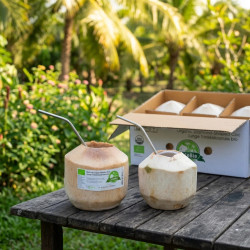
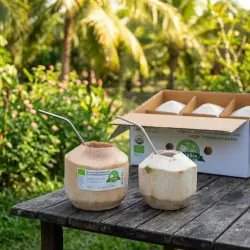
A fresh coconut, on the other hand, is drunk as it is. At Biovie, we import young coconuts of the Nam Hom variety from Thailand, which arrive with no heat processing at all, in a refrigerated container. And that container, as I learned the hard way, is the whole point: the day the cooling unit of one of ours broke down for two weeks at sea, the coconuts arrived inedible. With a fresh product, controlled cold matters more than speed.
One last reservation, more personal than medical. If your palate lives to the rhythm of sodas, your first fresh coconut may seem bland. It isn't the coconut that lacks taste: intense sugar saturates your reference points, and it takes a few weeks to retrain your taste.