



To find the best gravity water filter for tap water, with no socket and no plumber, you choose between two big families: the activated carbon jug, which mainly targets taste and chlorine, and the ceramic and carbon gravity filter, which also retains bacteria and particles; reverse osmosis without a pump, for its part, needs an installation under the sink. At Biovie, we built this page on public sources, health agencies and published studies, and I wrote it as an ISTOM engineer, attentive to the mechanism before the percentages.
Water that smells a little like a swimming pool, a pack of bottles waiting in the hallway, and the wish to filter without plugging anything in. You look at the packaging: they all promise 99% of something, rarely dated, almost never explained. Of what, measured how, and by whom?
I founded Biovie in 2007 and spent about ten years supporting farmers converting to organic, and that job left me with a reflex: a number delivered without its method, I distrust. I also have a soft spot for lowtech objects, the ones that work with a principle of physics seen at school, with no socket, no screen, no update. So I sorted each water filter without electricity by what it really retains, not by what it promises.
How do you choose the best gravity water filter for tap water?
Without electricity, two families dominate. The activated carbon jug mainly targets taste and chlorine. The gravity filter combines a porous ceramic and carbon: it also retains bacteria and particles. And reverse osmosis without a pump? It uses mains pressure, but sends part of the water to waste.
The principle of "no electricity" you already have in your kitchen: it is the drip coffee maker, minus the hot plate. The water poured in at the top goes through the paper by itself and ends up in the pot. A gravity filter does the same thing, with a filtering element sitting above a reservoir fitted with a small tap. Gravity does all the work. Nothing new under the sun, by the way: rainwater goes through the soil before reaching the groundwater, and nobody ever needed to plug in the Earth for that.
Before choosing: know what your water contains
A water filter without electricity is chosen against a target: retaining bacteria or aiming at PFAS does not call for the same technique. Now, French tap water is already monitored, and the results are public. So why filter water that is monitored? Sometimes, there is no reason. Sometimes, there is.
It all depends on the analyses for your town, and that is where to start. You can check the water quality of your town for free; the ranking of French cities shows the gaps, sometimes surprising, from one city to another, and a separate article details PFAS, pesticides and chlorine in tap water.
Since 12 January 2026, the European drinking water directive sets a limit of 0.1 µg/L for the sum of 20 PFAS, or 0.5 µg/L for total PFAS, at each Member State's choice (Directive (EU) 2020/2184). A microgram is one millionth of a gram: at these doses, nothing can be seen or tasted.
I remember the days when you got informed at the library and knowing your water took effort; today, the results are online, and ignorance has become a choice.
The 4 types of filters without electricity, and what each one retains
There are four types of water filters that work without a socket. Before you crown the best gravity water filter system, know that the table sticks to public sources, even if that leaves a few cells more cautious than the product sheets: I prefer a sober cell to an embellished one.
| Type | How the water passes | What it retains according to the sources | Upkeep |
|---|---|---|---|
| Activated carbon jug | By gravity, through a carbon cartridge | No proven risk; effectiveness cannot be assessed for every model (ANSES, 2017) | Cartridge to be changed on time, jug kept in the refrigerator |
| Ceramic and carbon gravity filter | By gravity, from the upper reservoir to the lower one | In tests, about 99% of E. coli and 90 to 99% of a virus surrogate (Brown and Sobsey, 2010) | Cleaning and changing the element according to the instructions |
| Reverse osmosis without a pump | By mains pressure, through a membrane | Almost complete removal of the PFAS tested, under-sink models (Herkert et al., 2020) | Installation under the sink, waste water |
| Filter bottle or straw | By suction or hand pressure | Not assessed by the sources cited here | Replacement filter according to the manufacturer |
Activated carbon jug
ANSES examined these jugs in an opinion dated October 2016 and published in 2017. The agency sees no proven risk in normal use, but its data do not allow it to assess the effectiveness of every model. It also points out a possible release of silver, sodium, potassium and ammonium, as well as a drop in pH.
Sodium and potassium come mostly from the plate, as part of a varied and balanced diet and a healthy lifestyle; with a low-sodium or low-potassium diet, the agency advises seeking medical advice.
Ceramic and carbon gravity filter
In a gravity water filter, the water goes through a fired clay with tiny pores, which retain bacteria and particles, and activated carbon that works on taste and odors. It is also called a filtering water dispenser: if you are hunting for the best countertop gravity water filter, this is the appliance that sits on the worktop, that you fill at the sink and serve yourself from at its little tap.
Reverse osmosis without a pump
A field study carried out in households in North Carolina showed that under-sink reverse osmosis removed almost all the PFAS measured (Herkert et al., 2020). The trade-off, and not a small one: a connection under the sink, and part of the water going to waste.
Filter bottle or straw
Designed for the backpack, the filter bottle helps out on a walk. For the kitchen, that is not its role. A blog guide explains how to filter water when hiking, and we sell replacement filters for bottles in packs of two, to be checked against your model.
PFAS filter without electricity: what do the measurements really say?
Not all PFAS react the same way to activated carbon, and that is where the whole difficulty lies. Picture activated carbon as a bramble hedge: a big wool sweater catches on every thorn, while a marble slips between the branches. Long-chain PFAS are the sweaters, short-chain ones the marbles, smaller and more mobile.
A field study illustrates it well, and I like this kind of study because it gets out of the lab: researchers measured 16 PFAS before and after filters in real use, in households in North Carolina (Herkert et al., 2020). Two-stage under-sink filters and reverse osmosis removed almost everything. Jugs and countertop, tap or refrigerator carbon filters gave variable results, better on long chains.
And then there is a surprise, a big one. For "whole-house" filters, installed where the water comes in, the PFAS content went up after the filter in 4 systems out of 8. One device in two was therefore doing the opposite of what was expected of it.
Honest limit: the study tested no ceramic gravity filter, and it covers a single US state. So I will not make it say what it does not say.
To compare all the techniques, including those that need a socket, our complete comparison of filtration solutions covers each option.
How does a ceramic gravity filter work?
A ceramic filter for tap water relies on a fired clay, porous like a flowerpot, often combined with activated carbon and sometimes with colloidal silver. How can a simple piece of terracotta retain a bacterium? By size, quite simply: its pores let the water through, while most bacteria stay caught in the wall. A sieve, but on a microscopic scale.
Researchers tested in the laboratory ceramic filters made in Cambodia, with rainwater and surface water loaded with E. coli and with bacteriophage MS2, a surrogate for viruses (Brown and Sobsey, 2010). Result: about 99% of E. coli retained on average and 90 to 99% of MS2, over more than 600 liters filtered. Out of 100 bacteria going in, only one came out on average. But the trial covered neither tap water nor chemical pollutants.
Another lesson from this trial, which I find delightful: adding silver nitrate did not improve effectiveness. Filtration comes down first to the pores of the clay. For jugs, ANSES notes that the silver released stays below the WHO guideline value of 100 µg/L, while asking for that value to be reviewed.
What remains is manufacturing quality, and there, not all filters are equal. The WHO evaluated 20 household water treatment products in the laboratory, including ceramic filters: some do not meet its criteria, and manufacturing remains the weak point (WHO, 2019). So what is the best gravity water filter? In absolute terms there is none, only filters whose maker publishes its laboratory analyses. Ask for them before buying. It is a reflex I also keep for our seeds: at our longtime supplier, nobody takes a silo on trust, a sample is sprouted on a tray and counted by hand. Scientific empiricism.
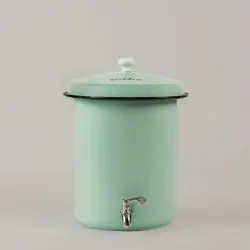
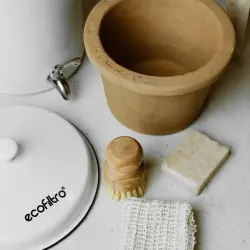
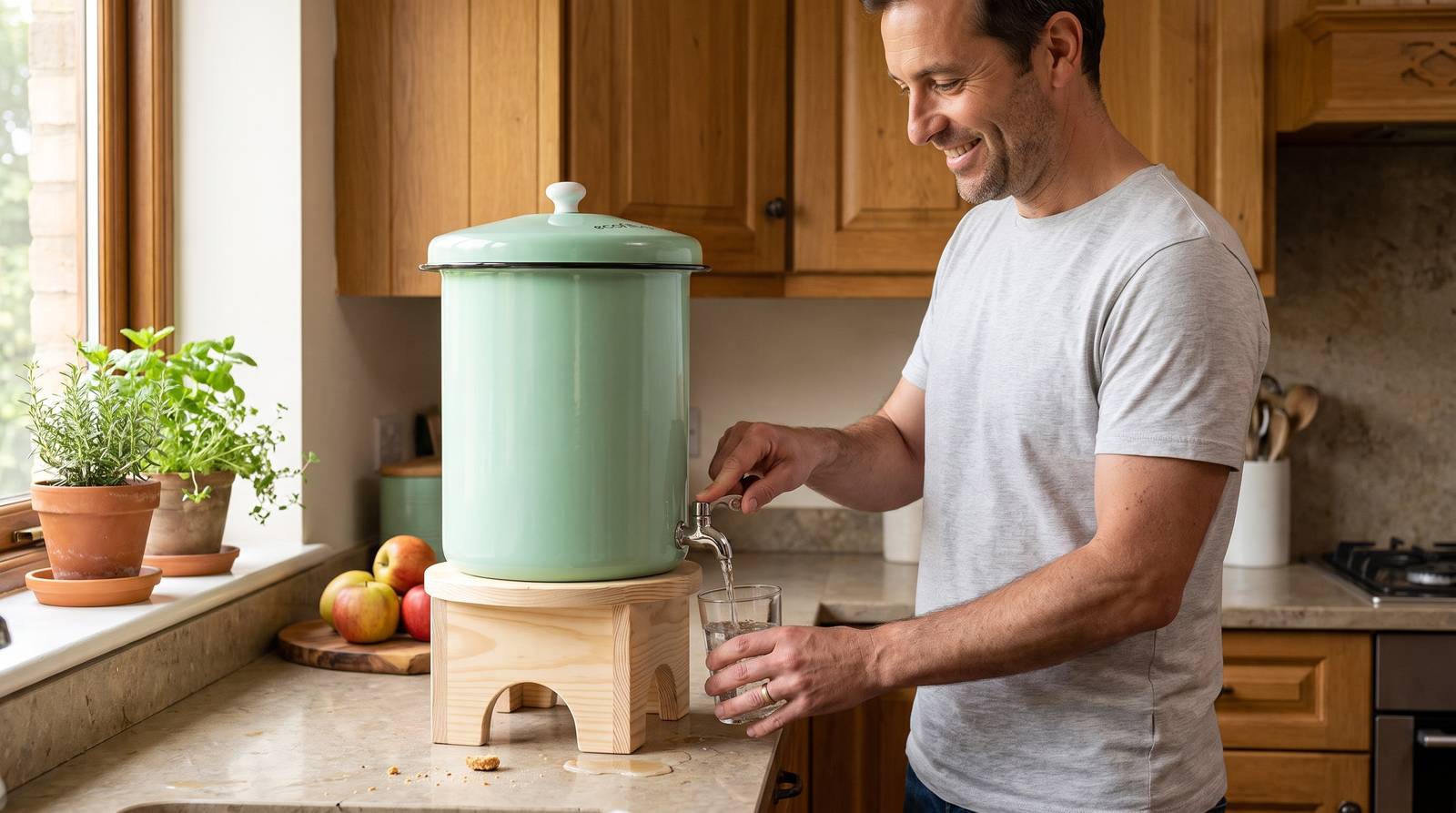
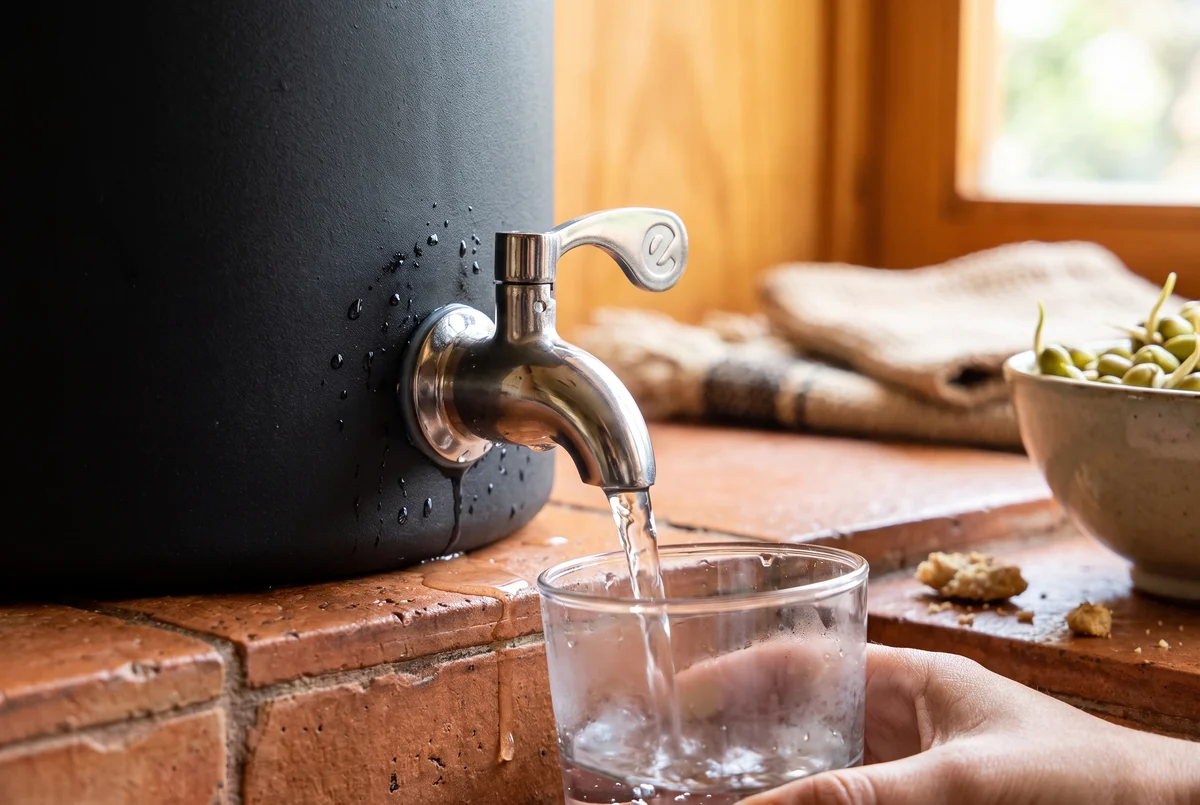
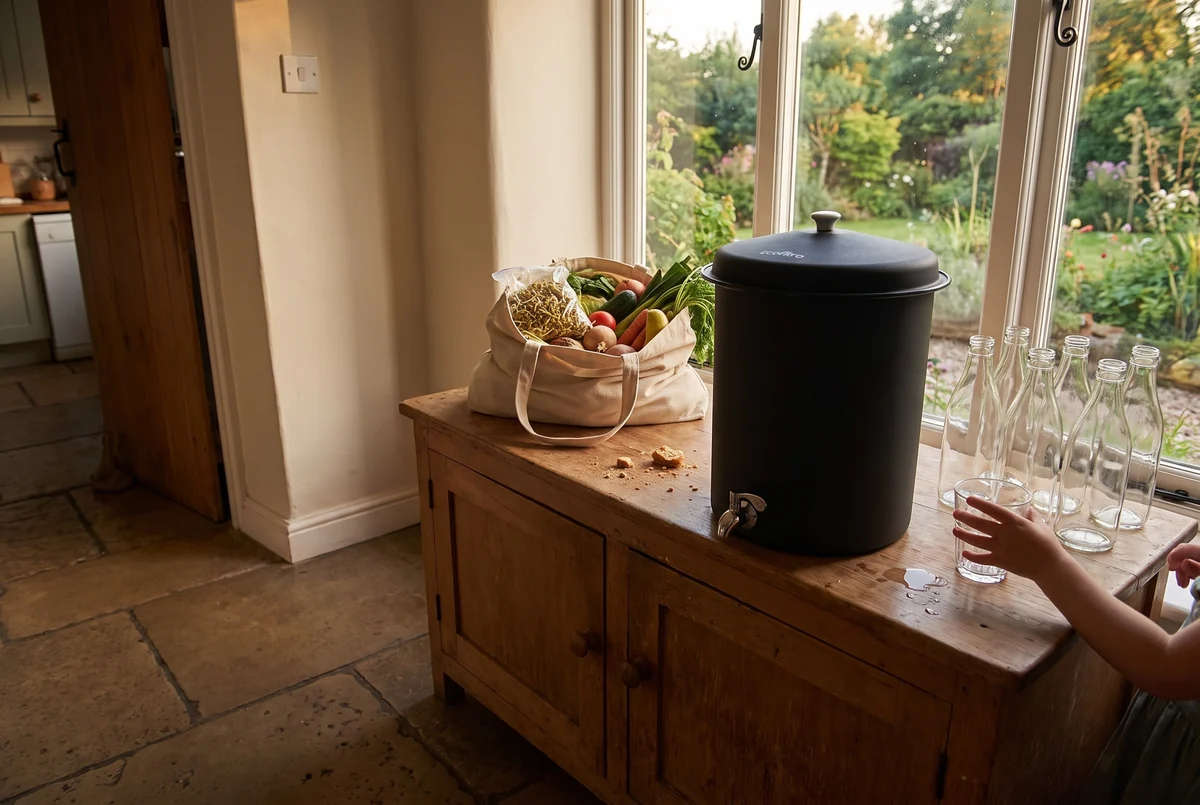
At Biovie, we sell the Ecofiltro 5 L black, and I give you what follows as it appears on its product sheet. Its filtering element combines clay, activated carbon and colloidal silver, in a vitrified steel reservoir with a stainless steel tap. It holds 5 liters (1.5 L in the filter, 3.5 L in the reservoir) and filters about 2 liters per hour, more slowly at the start, for up to 3 weeks. Enough to fill a jug while a meal is being prepared: it is not a tap, it is a rhythm.
According to the analyses published by the manufacturer (Measurlabs laboratory, December 2024), the element reduces long-chain PFAS, such as PFOS and PFOA, by about 99%, and short-chain ones by 55 to 75%. There are our sweaters and our marbles again: the big molecules cling to the carbon, the small ones get through more often. These figures come from a single report commissioned by the manufacturer, and I prefer to tell you so. One last point: the Ecofiltro does not retain all the limescale, it only reduces it. Part of the calcium therefore stays in the glass, in addition to the plate, as part of a varied and balanced diet and a healthy lifestyle.
The 5 L also exists in white, pink, mustard yellow and light blue, and in a 20 L version for large families.