Best Blender for Raw Soups and Plant Milks, Without Aiming for the Top of the Range
What is the best blender for raw food cooking? The one whose jar fits the amount you blend, with high speed and short cycles to keep the heating under control: for one or two people, a personal blender with small jars is often enough, with no need to aim for the top of the range. This Biovie page draws on published research and an opinion from Anses; I have been practicing living food myself since the early 2000s.
You are back from a raw food course, head full of silky soups and almond milks pressed by hand. In the workshop, everything went through a high-end, high-performance blender. Then you saw its price. Breathe.
Do you really need the workshop's motor to make a zucchini soup at home? I don't think so. The ISTOM engineer that I am has kept the habit of taking a mechanism apart before talking hardware (old habits die hard), and I did my first training in living food in 2005 and 2006, with the Hippocrates Health Institute. So my answer fits on one line: no, provided you know what you are asking of the machine.
What does a blender really do in raw food cooking?
For anyone discovering raw food (if the subject speaks to you, read our account of a raw foodist), the blender quickly becomes the tool you take out every day. So before asking yourself which is the best blender to buy, let's look at what really happens in the jar.
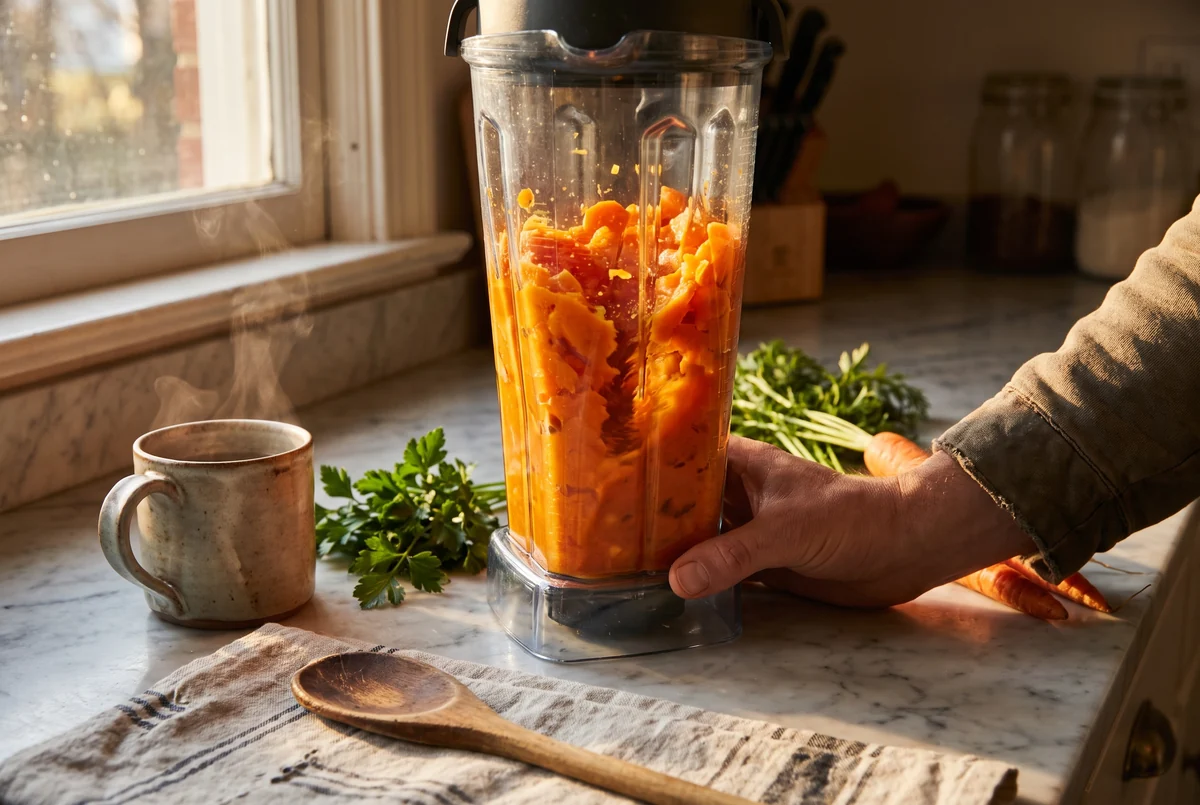
Take a raw carrot. Picture it as a warehouse full of tiny rigid cardboard boxes, each one closed around its pigments and sugars. Cooking softens the cardboard, like a crate left out in the rain: you then just press and it opens. In raw food, nothing softens it: only the blades open the boxes, and the more of them they tear, the silkier the soup becomes.
A team of researchers looked closely at this mechanism in the lab, on carrots put through simulated digestion (Lemmens et al., 2010). For raw or lightly cooked carrot, the amount of beta-carotene released depends strongly on particle size, much more than after cooking. I owe you honesty: the study is in vitro, it covers a single plant, and it says nothing about an effect in humans. The mechanism, though, speaks for itself.
On the plate, you surely felt it during the course: a coarsely blended soup leaves fibers on the tongue, a finely blended soup coats the spoon. So the fineness of the blend is a matter of mechanics far more than a chef's whim: it is what opens the cells.
I remain convinced of it: we are not what we eat, but what we absorb. The beta-carotene in raw carrots has its place as part of a varied and balanced diet and a healthy lifestyle, as long as the blades have opened the boxes.
The criteria that matter (and those that matter less)
On spec sheets, watts are printed in big letters. It is the easiest figure to compare, and rarely the most telling one for raw food cooking.
Power and speed
Watts measure the strength of the motor, its ability not to slow down when the preparation resists. Fine blending depends mostly on blade speed and jar shape, which together create a vortex. Think of the bathwater rushing toward the drain: the blender's vortex does the same, constantly pulling the pieces back toward the blades, again and again.
As a benchmark, the Hurom Power that we offer is rated at 900 W, 20,000 revolutions per minute and 6 stainless steel blades. You won't find a minimum power threshold here: I found no serious source to set one, and I'd rather tell you so than make one up. When you wonder which blender is best, speed and jar say more than watts.
Jar size and shape
A small, narrow jar blends a small quantity better than a large half-empty jar, where two ladles of soup spread out under the blades without forming a vortex. For a big family, it is the opposite: the large jar saves you from blending in several batches. But why pay for an enormous jar when you blend for two?
Glass is heavy and does not scratch, BPA-free Tritan plastic is light. The Hurom Power has two 500 ml jars and one 700 ml jar in BPA-free Tritan, which are dishwasher safe.
Friction heating
At high speed, the rubbing between the blades and the preparation produces heat, exactly like your hands rubbed together on a winter morning. It is an asset for a lukewarm soup, and something to watch if you want to stay cool.
On the Hurom Power, the spec sheet says that about 1 minute of blending gives a lukewarm soup, and that beyond that, it really heats up; an overheating protection looks after the motor. The high-end blender from the course doesn't escape the rule, by the way: it too heats the preparation if you let it run. Blend in short cycles and touch the jar between two: if it is hot under your hand, the soup is too.
Warranty, safety, parts
The Hurom Power comes with a 2-year warranty, and a sensor blocks start-up if the jar is badly fitted: two points to check on any model. The 700 ml jar alone and the 500 ml jar alone are also sold separately, and I care about that. A cracked jar should never doom a motor in perfect condition. Throwing away a whole appliance for a plastic part is the usual headlong rush of the way we consume.
How to pick the best blender for your use and your budget
To know which is the best blender for raw food cooking, start from the quantity you blend: a personal blender with small jars is enough for one or two people, a base blender with a large jar serves families, and a heating blender has no place, since it cooks.
Type of blender
What it does well
Limits
Who it's for
Compact personal blender (small jars)
Blends small quantities finely, easy to store
Several batches for a big table
1 to 2 people, everyday soups and milks
Base blender with a large jar
Large volumes in one go
Struggles with a small quantity at the bottom of the jar
Families
High-end, high-performance blender
Very fine textures, intensive use
High price; also heats the preparation if you run it long
Big families, very regular use
Heating blender
Cooked soups without a pot
It cooks: outside raw food cooking
Cooked cuisine
Immersion blender
Compact, blends directly in the container
More rustic texture, struggles with nuts
Rustic soups, backup tool
When you look for the best blender for soup, you quickly run into the question "which heating blender should I choose?" Really, so you'd need an appliance that cooks to do raw food cooking? A heating blender brings the preparation up to temperature to cook it, which takes it out of raw. For a raw soup, the gentle heat of friction is enough.
On budget, I owe you transparency: Biovie sells just one complete blender, the Hurom Power, a 900 W personal blender at €129. With its 500 and 700 ml jars, it is designed for one or two people: a big table will force you to blend in several batches. For a large family, a base blender will be more comfortable.
For a meal for two, on the other hand, it is exactly its home turf. The workshop machine remains a fine tool, built to run all day in front of a whole room of trainees; at your place, on a Tuesday evening, the need is not the same. You size the right appliance by the ladle (pun intended), far more than by the number of watts.
Homemade plant milks: what the blender does, what the bag does
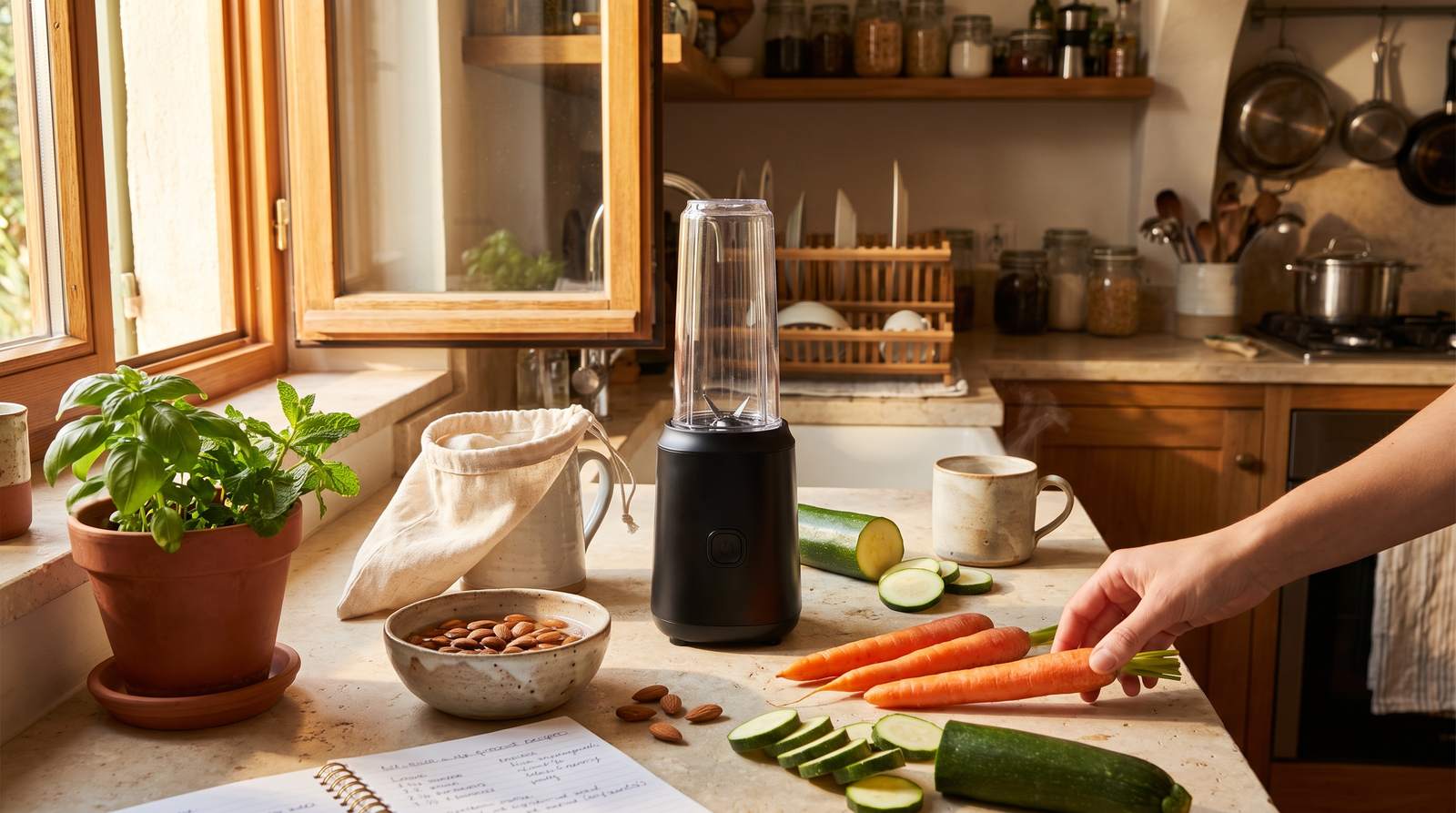
A homemade plant milk comes down to three steps: soak the nuts, blend them with water, then strain. The blender grinds, the bag separates. Even well blended, a milk keeps fibers in suspension: it is the plant milk bag, squeezed by hand, that makes it smooth. For the fabric and the mesh, see how to choose your plant milk bag well.
The Hurom Power spec sheet mentions almond and cashew milks; for the latter, our page on raw cashew nuts will give you ideas.
Soaking: useful for texture, not for "activating"
I'll be honest: I talked about "activated" almonds for a long time, like many people in living food, and I wrote it on this blog. A team checked in the lab, on almonds, hazelnuts, peanuts and walnuts, whole or chopped, soaked for 4 or 12 hours in water or salted water (Kumari et al., 2020). Phytates varied from -12% to +10%, minerals tended to drop, especially in chopped nuts, and the authors conclude that this "activation" does not improve bioavailability. It stings a little. But that's how we move forward.
In other words, as far as minerals go, soaking doesn't tip the balance. It keeps all its value in the kitchen: an almond full of water blends more easily, which matters for a small motor. Cashew nuts, for their part, were not tested.
What a homemade milk brings, and what it doesn't
A review compared store-bought almond, soy, rice and coconut drinks with cow's milk (Vanga and Raghavan, 2018). The soy drink is the closest to it, the almond one the least dense in nutrients. A homemade milk depends mostly on the amount of nuts put in the jar, and none of these sources gives its composition.
It finds its place as part of a varied and balanced diet and a healthy lifestyle, without replacing cow's milk; our article on essential nutrients for vegans gives the useful benchmarks.
And here, no nuance holds.
Plant drinks are not suitable for infants under one year old: they replace neither breast milk nor infant formula, as Anses recalls in its 2013 opinion.
How to make a silky raw soup with a modest blender?
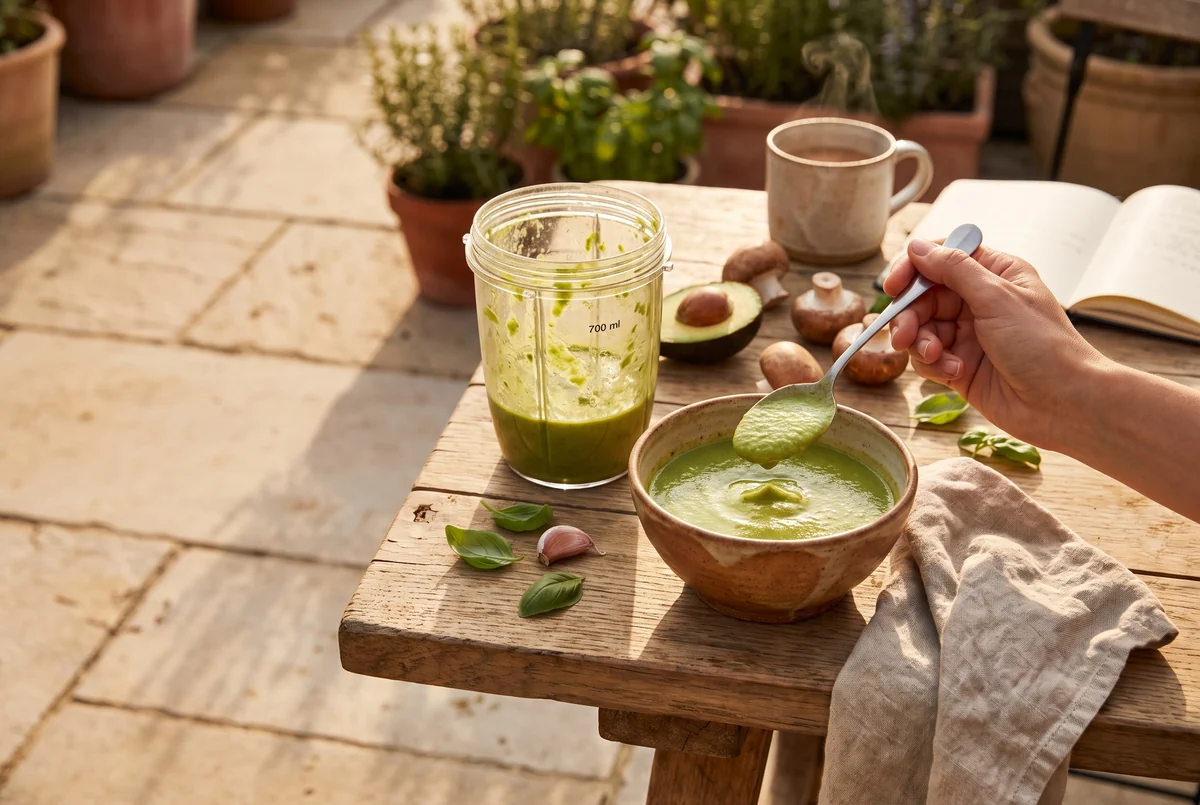
At our place, raw soup is often the meal for rushed evenings. Sometimes we get home at 6:50 pm, blend dried and fresh mushrooms, almond purée, avocado, a clove of garlic and lukewarm water: in five minutes, at 7:05 pm, we are eating a living soup. With a cooked soup, at that hour, we'd still be peeling vegetables.
And a well-blended raw soup is barely different from a regular soup. With a raw pea soup, by the way, you're better off not announcing to the family that it's raw. A modest blender just asks for a bit of method. Here is the order I follow:
Cut small, especially hard vegetables.
Pour in the liquid first, then the tender vegetables, then the harder ones: the blades immediately find something to spin in and the vortex forms.
Stay below the fill line.
Blend in short cycles rather than one long run.
For silkiness, add a soaked nut or an avocado.
On the Hurom Power, count 1 minute at most per cycle for a lukewarm soup; beyond that, friction really makes it heat up. Silkiness comes less from how long you blend than from the order of the ingredients and the fineness of the cut. In short, nothing magical: some order and a knife that cuts.
A raw vegetable soup fits easily into a varied and balanced diet and a healthy lifestyle. To vary the recipes, the book by Aurélie Viard, my wife, Mes semaines toutes crues, is a lovely way in (I'm not entirely objective, I admit).
Without preservatives or pasteurization, a raw soup or a homemade milk is kept in the refrigerator and consumed quickly. For lack of a reliable source, I won't give you a duration; when in doubt, prepare small quantities.
To gain a few days, we use vacuum sealing in a glass jar at home. The BocUp kit combines a bell and a small manual pump, with no electricity and no plastic bag, and works with your glass jars if they have "shoulders" and a 65 or 84 mm lid. Nothing else to buy, and that is exactly what I like about this kind of low-tech object. According to the manufacturer, fresh products keep up to 5 times longer under vacuum: a vegetable soup lasts 8 to 10 days instead of 2.
Enough to find Sunday's soup still good in the middle of the following week.
The same gesture protects from moisture and moths the dry almonds waiting for the next milk. Vacuum, however, replaces neither the refrigerator nor the freezer, and it does not sterilize. See our article on the benefits of vacuum sealing at home.
Checklist before you buy
Before settling the "best blender" question and reaching for your credit card, run through this list, thinking about your real week rather than the course demonstration.
How many people eat at home? The number of guests decides the size of the jar.
Your main use: soups rather than milks, or the reverse.
The ability to blend in short cycles, and how the appliance handles heating.
The jar material, glass or BPA-free plastic.
The warranty and spare parts, jars or blades sold separately.
Cleaning, because an appliance that is a pain to wash often ends up at the back of the cupboard.
And then, if a blender is already sleeping in your cupboard, start with it: a cucumber soup tonight, blended in little cycles, will tell you very quickly what it can do. Everyone at their own pace. And if you have a trick to keep an old blender running like on day one, write to me!
Frequently asked questions
What is the best appliance for making soups?
For a raw soup, it is a standard blender, with a small jar for one or two people or a large jar for a family. A heating blender is not suitable, since it cooks the preparation. An immersion blender remains an option if you like a more rustic texture, with some fibers in the mouth.
How much power does a good blender need?
No minimum power guarantees good blending: rotation speed, jar shape and blades matter as much as watts. As a benchmark, the Hurom Power is rated at 900 W and 20,000 revolutions per minute, which is enough for raw soups and plant milks for one or two people.
What is the best blender?
The best blender is the one that matches the quantity you blend and how you use it. For one or two people, a personal blender with small jars is enough; for a family, a base blender with a large jar is more practical. The table in this article compares five types of appliance by their strengths and limits.
Can a blender blend everything, nuts and hard vegetables included?
Yes, a blender can handle nuts and hard vegetables, as long as you give it a little help. Soak nuts to soften them, cut hard vegetables into small pieces, pour in the liquid first and blend in short cycles. These steps go easy on the motor and limit the heating of the preparation.
Do you need a heating blender to make soups?
No, not for a raw soup. A heating blender cooks the preparation, which goes against raw food cooking. For a lukewarm soup, the friction of the blades is enough: on the Hurom Power, about 1 minute of blending gives a lukewarm soup.
The information presented in this article is provided for information purposes only and does not constitute medical advice. Consult a healthcare professional before making any change to your diet or supplementation.