Chlorella vs spirulina: both are microalgae, and the FAO sees them as a serious avenue for tomorrow's food. A spirulina pond supplies about 20 times more protein than a soybean field of the same size and needs, for the same protein, a quarter of its water: it is for these yields, and because microalgae can be grown on marginal land, that the FAO takes them seriously. These orders of magnitude come from two FAO reports, published in 2008 and in 2021.
On 16 October 2026, the FAO celebrates World Food Day on the theme "Innovate today to nourish tomorrow" (FAO, 2026). Among the avenues it has studied for a long time, there is one you will never see with the naked eye: microalgae, whose place in food has interested the FAO for years.
As for me, I am an ISTOM engineer, I founded Biovie in 2007 and I co-wrote an entire book on algae: so I read these FAO reports with relish (and with a red pencil, because the figures going around about spirulina are rarely sourced). Here is the route: what the FAO puts forward, what its figures are worth, what is already in your kitchen and what remains in the lab.
Microalgae and food: what the FAO puts forward
Microalgae are seen as a food of the future because they can be grown in fresh or marine water, including on marginal land and in arid zones, and because spirulina produces far more protein per unit of area than conventional crops. That is the FAO's position (Habib et al., 2008; Cai et al., 2021).
In practice, a microalga is a tiny organism, made of a single cell or of filaments, that lives in water and captures light like a plant. The two you probably know, chlorella vs spirulina, do not actually belong to the same world. Spirulina is a cyanobacterium, chlorella a green microalga (Cai et al., 2021).
As early as 2008, the FAO judged that spirulina had "considerable potential", notably in small-scale farming, for nutrition, income and the environment (Habib et al., 2008). The words that catch my attention are "small-scale farming".
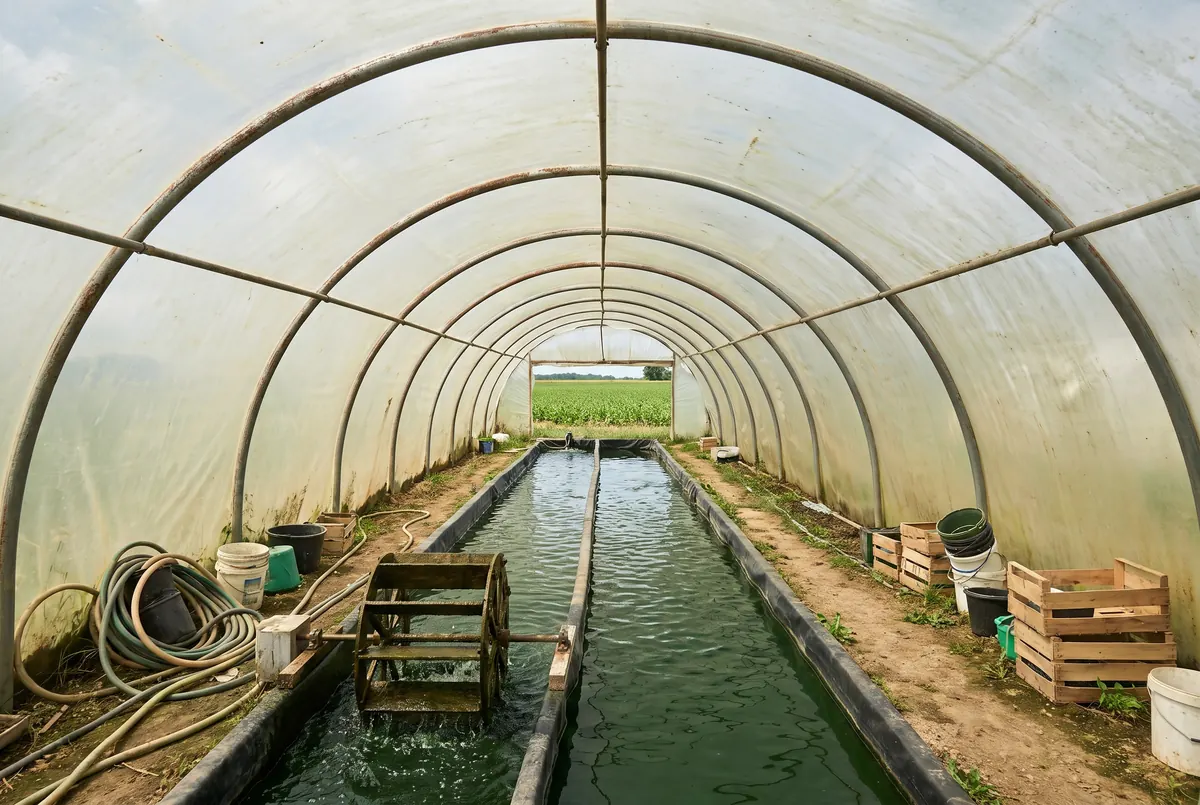
Take Lake Chad. The spirulina harvested there is eaten for its protein and micronutrients, and the FAO estimates that it has helped improve the nutritional status of local populations (Cai et al., 2021). No need for a laboratory or a photobioreactor: just a lake and people who know how to harvest.
That is the whole meaning of the expression "food of the future" applied to microalgae: a resource that is already harvested, and that the FAO would like to see put to better use.
Surface, water, protein: the FAO's figures and their limits
The FAO's comparisons are enough to make your head spin. Scaled to the same area, spirulina would supply about 20 times more protein than soy, 40 times more than maize and more than 200 times more than beef (Habib et al., 2008). In other words, a pond forty times smaller than a maize field would yield, on paper, the same amount of protein.
On water, the gap goes the same way. Here are the ratios published by the FAO in 2008:
Spirulina compared with
Protein per unit of area
Water for the same amount of protein
Soy
About 20 times more
25% of the water used by soy
Maize
40 times more
17% of the water used by maize
Beef
More than 200 times more
2% of the water used by beef
It would take about 2,100 litres of water to produce a kilo of spirulina protein (Habib et al., 2008). For an arid region, where every litre is counted, that is probably the argument that speaks the loudest.
What these figures really say
Honestly, I cite them with caution. These are orders of magnitude published in 2008, without a detailed primary source in the report, and they vary with climate and growing method. Read them as an indicative comparison, to be taken with a pinch of salt.
55%, 60%, 70%: why protein percentages vary
On plenty of websites you will read 60% in one place, "over 70%" in another, almost always without a source. The FAO report itself gives 55 to 70% of dry weight depending on the studies cited, and 59 to 65% in another passage, against 35% for dry soy (Habib et al., 2008). The USDA composition table gives 57.5 g of protein per 100 g of dried spirulina (USDA, 2019): a little over half of the powder, then.
Everyone is a little bit right. The gap comes down to the strain, the growing conditions and the analysis method: one spirulina is not another. And a figure without a source, even a correct one, tells you nothing about what is in your bag.
A global production that is still tiny
How can a food of the future weigh so little? In 2019, the world farmed and harvested 35.82 million tonnes of algae in wet weight, of which only 56,456 tonnes were microalgae (Cai et al., 2021). Spirulina accounts for 56,208 tonnes, grown in 10 countries; the rest, 248 tonnes, corresponds to four green microalgae produced in 4 countries.
Less than 0.2% of the farmed algae tonnage. That is tiny. Out of a thousand buckets of algae harvested worldwide, fewer than two would contain microalgae.
There you go, that is why the 2021 report speaks, right in its title, of "unlocking their potential": the place of microalgae in the world's food remains a niche, and spirulina fills almost all of it.
What is already in your kitchen: chlorella vs spirulina, and phycocyanin
Global tonnages stay abstract until you talk about the plate. Right, on to the plate. Three ingredients are already used in cooking, and you may have one in your cupboard.
Spirulina
Type "spirulina and chlorella benefits" into a search engine and you will land on lists of promises. I prefer to start from what is actually measured. Dried spirulina contains 57.5 g of protein and 28.5 mg of iron per 100 g (USDA, 2019).These are composition values: they describe what the powder contains, and nothing more.
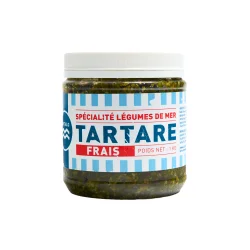
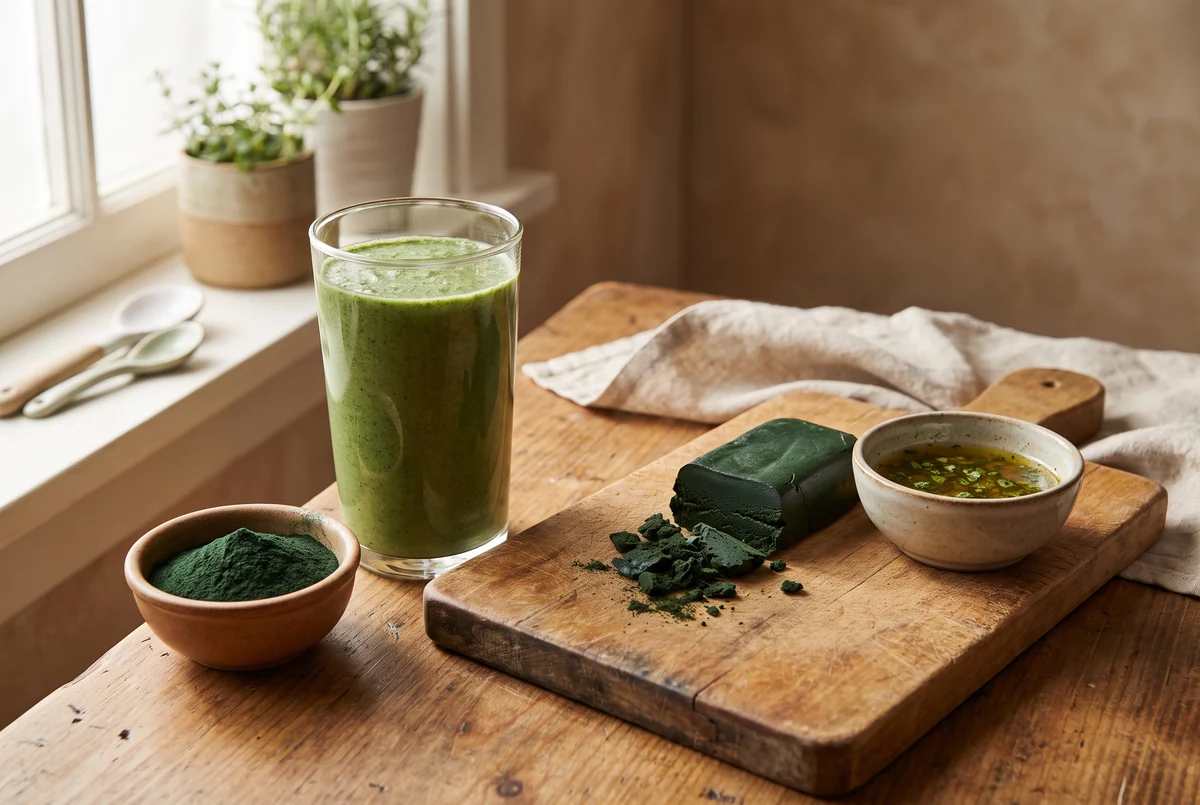
It is used in the kitchen like any other ingredient, as part of a varied and balanced diet and a healthy lifestyle. At Biovie, we offer it as a block of fresh spirulina or frozen in pucks, to crumble into a salad dressing or a smoothie. If you are wondering what the spirulina benefits are beyond its composition, I have gathered its uses and precautions in a complete guide; and if its taste puts you off, here is how to tame the taste of spirulina.
Chlorella
Chlorella, for its part, is a green microalga that was consumed in the European Union before 1997. In 2022, a consultation handled for the European Commission confirmed that chlorella, including Chlorella vulgaris and Chlorella sorokiniana, is not a "novel food", whether as a food supplement or as an ingredient in bakery products, pasta or drinks (European Commission, 2022). Put plainly, it has had a place on the European plate long enough to escape the procedures reserved for unprecedented foods.
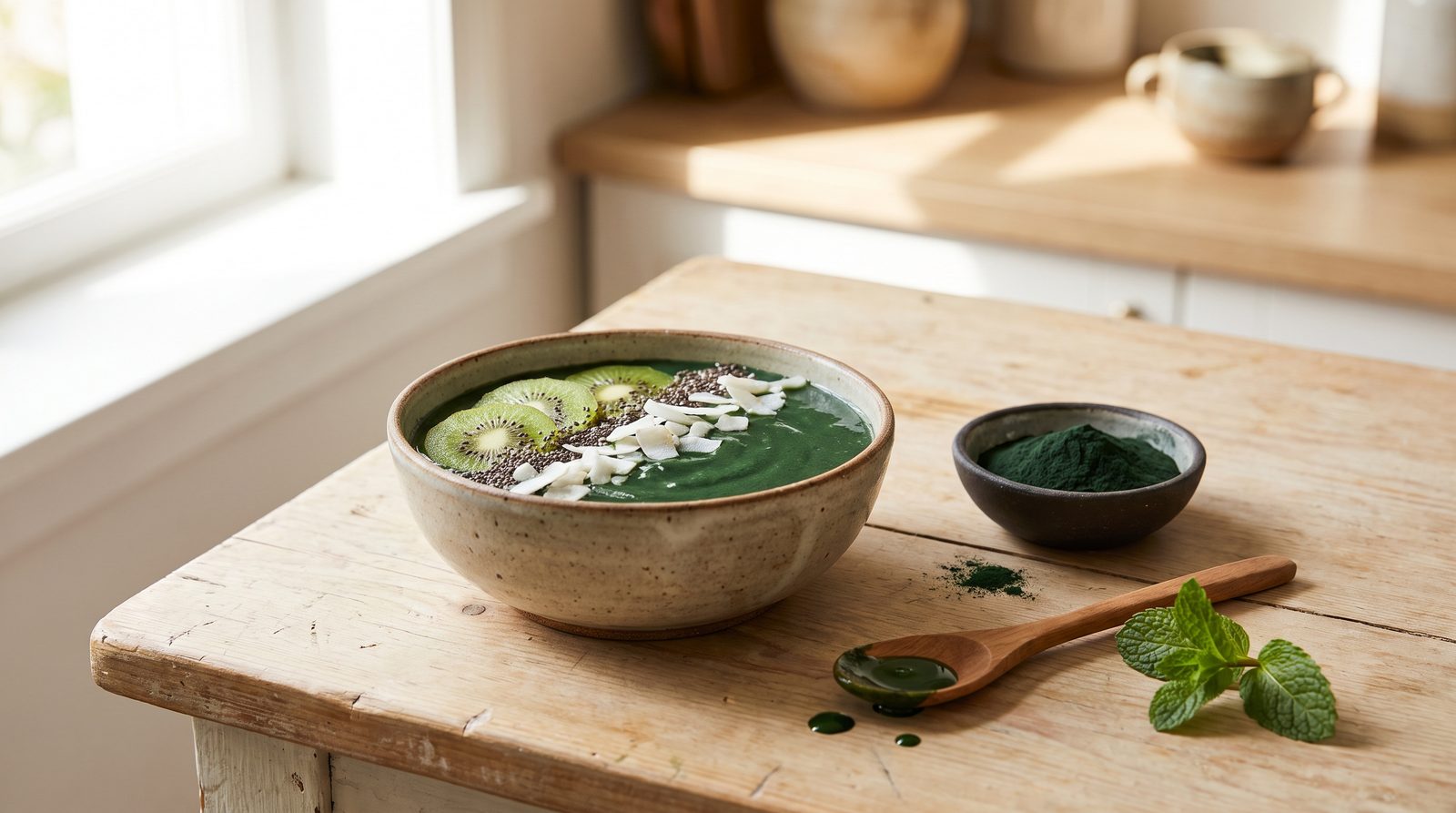
In the kitchen, its dark green powder slips into a smoothie or a fresh pasta dough. First step, no equipment or recipe needed: add a small amount to the juice or smoothie you already make, just enough to turn it green, as part of a varied and balanced diet and a healthy lifestyle.
Phycocyanin
Last comes phycocyanin, a vivid blue pigment used in the kitchen for its colour. It turns a homemade tigernut milk or a frosting lagoon blue. You will find it with us as phycocyanin powder, and I have explained elsewhere what is meant by blue spirulina.
To see chlorella vs spirulina (and phycocyanin) at a glance:
Criterion
Spirulina
Chlorella
Phycocyanin
What it is
A cyanobacterium
A green microalga, not a "novel food" in the EU
A blue pigment
Forms at Biovie
Fresh block, frozen pucks
Organic powder
Powder
In the kitchen
Salad dressings, smoothies
Smoothies, sauces, green pasta
Homemade tigernut milk, frostings
If you are just starting out with chlorella vs spirulina, chlorella powder is probably the easiest to get used to: it blends in a few seconds into what you already drink.
What remains in the lab: the example of vitamin B12
Picture a key that fits a lock perfectly, but does not turn it. That is pseudo-vitamin B12: a molecule that looks like the real one, that some assays count as such, but that our body cannot use.
We are not what we eat, but what we absorb.
In 1999, researchers analysed spirulina tablets in the laboratory. 83% of the B12-type compounds they contained were pseudo-B12, inactive in humans, and the microbiological assay overestimated the content 6 to 9 times (Watanabe et al., 1999). Which means that, on a label showing a nice amount of B12, most of it may be a key that does not turn.
So why do so many pages still list B12 among the strengths of spirulina? Largely because of that assay method, which does not tell the two forms apart.
Tomorrow's avenue does exist, though. In 2024, a team grew spirulina in a photobioreactor, under controlled lighting, and obtained 1.64 µg of active B12 per 100 g, against 0.7 to 1.5 µg per 100 g in beef (Tzachor et al., 2024). The study, published in 2024 and picked up by the media in late August 2026, recalls a reference requirement of 2.4 µg per day. On paper, it is a remarkable advance for those who eat plant-based.
But this is an experimental culture, with no trial in humans, and not a product you can buy.Commercial spirulina should not be regarded as a source of vitamin B12. Vegan since 1992, I know how much this question matters to those who eat as I do: all the more reason not to get the source wrong.
Quality and precautions: what ANSES says
A microalga grows in the water it is given: if that water is polluted, so is the harvest. Quality is everything.
In 2017, ANSES issued an opinion on spirulina after receiving 49 reports of adverse effects up to February of that year (ANSES, 2017). Its conclusion: "apart from the risk of contamination, spirulina does not appear to present a health risk at low doses (up to several grams per day)". Those 49 reports are precisely what allowed the agency to separate the risk linked to the ingredient from the one linked to its quality.
Its points of caution fit in a few lines:
contamination, by cyanotoxins, bacteria or metals such as lead, mercury and arsenic;
phenylketonuria, for which ANSES advises against spirulina;
an allergic background.
In reality, this is the only reservation that matters, and it concerns where the spirulina comes from far more than the ingredient itself. Consumed at low doses, as part of a varied and balanced diet and a healthy lifestyle, a quality spirulina is used like any other ingredient. The risk lies in the quality of the culture, hence the value of looking at the origin and the batch analyses. I have detailed how to choose a quality spirulina in a buying guide.
Algae in everyday life: the Global Seaweed Coalition and the future of the sector
In April 2023, the Safe Seaweed Coalition, launched by the UN Global Compact and the Lloyd's Register Foundation with the CNRS, became the Global Seaweed Coalition (UN Global Compact, 2023). It brings together nearly 1,000 members around one mission: bringing about a global seaweed industry, with science-based safety standards. With close to a thousand players around the same table, the subject is no longer a niche concern.
An important point: this coalition deals with marine algae, the macroalgae, and not with microalgae. It nevertheless shares the FAO's logic: produce more food, provided its safety is guaranteed. So of course, a coalition does not fill a plate, and the FAO's figures on spirulina date from 2008.
At Biovie, algae are a subject we care about deeply, that of Algues au quotidien, and I follow the French edible seaweed industry closely.
Let us hope that the next World Food Days find more microalgae in everyday food, and a few fewer promises on labels. In the meantime, the simplest step remains within your reach: a little chlorella or fresh spirulina in tomorrow morning's smoothie. Everyone at their own pace.
Why are microalgae considered a food of the future?
Because, according to the FAO, spirulina produces about 20 times more protein per unit of area than soy, with a quarter of its water for the same amount of protein. Microalgae can be grown in fresh or marine water, including on marginal land and in arid zones.
Is it good to eat spirulina every day?
According to ANSES (2017), consumption at low doses, up to several grams per day, does not appear to present a health risk, apart from the risk of contamination. Quality therefore comes first: a known origin, batch analyses, as part of a varied and balanced diet and a healthy lifestyle.
When should you not take spirulina?
ANSES advises against spirulina for people with phenylketonuria and for those with an allergic background. It also points to the risk of contamination (cyanotoxins, bacteria, metals) when the origin is doubtful. If in doubt, ask a healthcare professional for advice before consuming it.
What are the advantages and disadvantages of spirulina?
On the advantages side, its composition: 57.5 g of protein and 28.5 mg of iron per 100 g of dried spirulina, according to the USDA. On the limits side, it is not a reliable source of vitamin B12, because the B12 measured in it is mostly an inactive form, and a doubtful origin exposes you to contamination. Hence the importance of choosing it well.
What is the best time of day to consume spirulina?
No scientific data sets a best time. The simplest is to work it into a meal or a drink you already have, for example a smoothie in the morning or a salad dressing at lunch. What matters is the regularity that suits you, at your own pace, rather than a precise time.
What is the difference between spirulina and chlorella?
Spirulina is a cyanobacterium, chlorella a green microalga, according to the FAO. Both are already consumed in Europe: the European Commission confirmed in 2022 that chlorella is not a novel food. In the kitchen, fresh spirulina slips into salad dressings, chlorella powder into smoothies and green pasta.
The information presented in this article is provided for information purposes only and does not constitute medical advice. Consult a healthcare professional before making any change to your diet or supplementation.