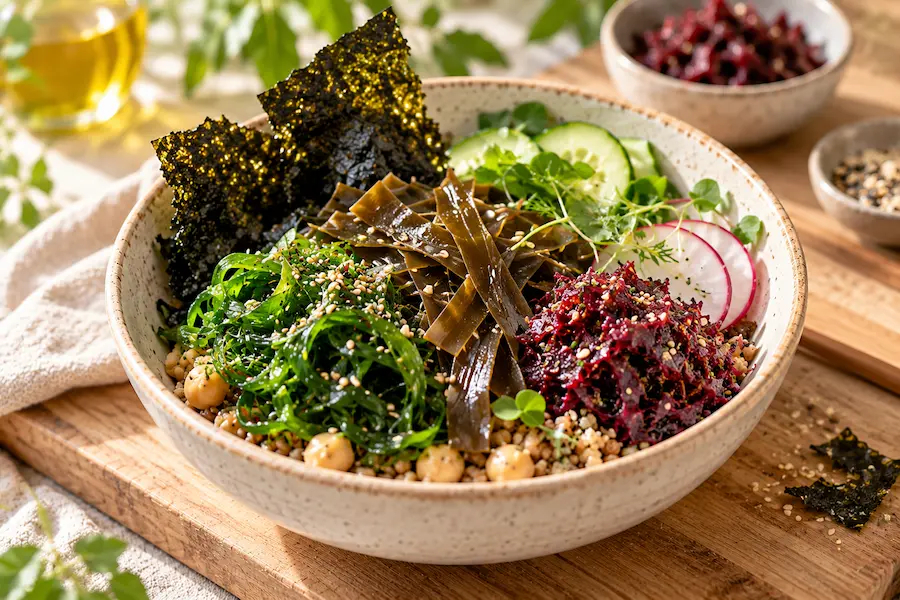
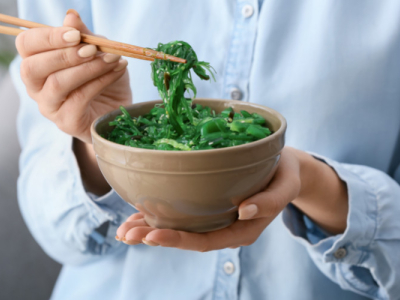
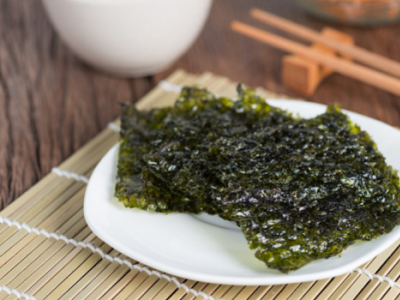
Umami is the fifth basic taste, alongside sweet, salty, sour and bitter: that round, deep savoriness you get from a slow-simmered stock or a well-aged parmesan. It was first identified in a seaweed, kombu, back in 1908. Cooking with seaweed starts with learning to use that umami: one seaweed, one job, one dose. With Aurélie, we spent an entire book, Algues au quotidien (Gallimard, 2024), figuring out how to bring seaweed into everyday cooking.
Honestly, this is something that's struck me for years: most people only ever meet seaweed as a supplement, swallowed each morning without ever being tasted. That's a shame, because seaweed is first and foremost a cooking ingredient — and one of the few that naturally delivers umami, with no stock cube, no cheese, nothing but a little water and patience.
If you've been putting off learning to cook with seaweed, this is a good week to start. As the son of a baker who earned France's Meilleur Ouvrier de France title, I grew up with a simple idea: an ingredient is judged in the mouth first. So let's talk taste. Not nutrients, not supplements. Taste.
Umami, the fifth taste nobody quite knows how to name
You already know the feeling. A soup that's "missing something" even though it's salty enough. A tomato sauce that suddenly turns round and satisfying after an extra hour of simmering. That "something" is umami.
One image helps explain it. If salt is the volume knob on a song, umami is the bass line: you don't always notice it, but without it the track sounds hollow. The word comes from the Japanese umai, "delicious." English never really settled on its own word for it, probably because Western cooking has been using it forever — veal stock, aged cheese, slow-cooked tomatoes — without ever naming it.
Kikunae Ikeda, a bowl of kombu broth, and one molecule
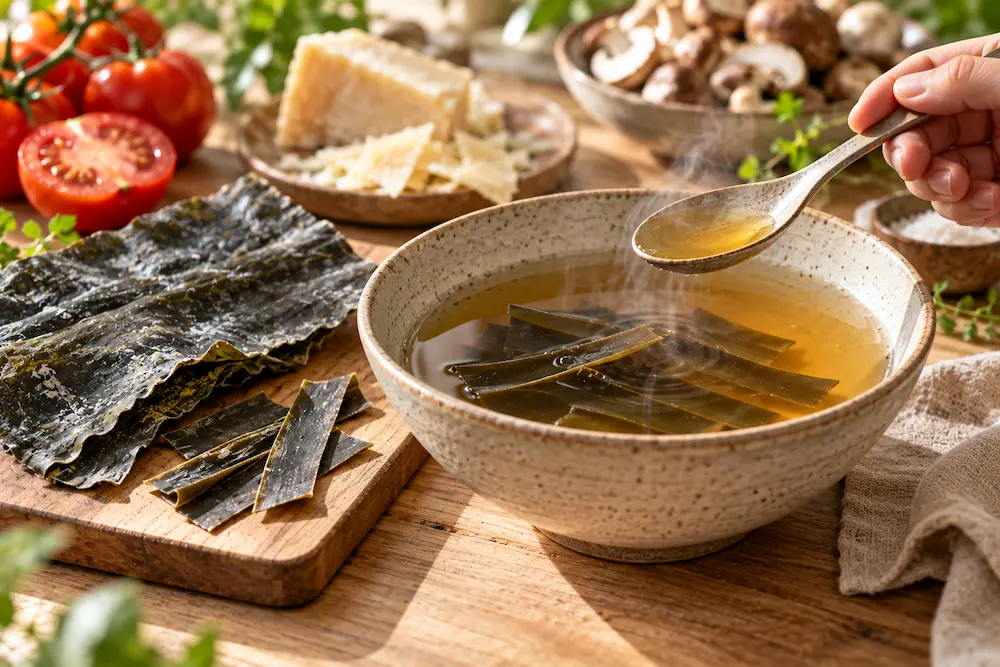
The story starts in Tokyo. In 1907–1908, chemist Kikunae Ikeda set out to analyze the kombu that forms the base of dashi, the foundational stock of Japanese cooking. He isolated what was behind that particular flavor: the sodium salt of glutamic acid, better known as glutamate. He named the sensation "umami." Japanese researcher Kenzo Kurihara retraced this entire history in a 2009 review published in the American Journal of Clinical Nutrition (Kurihara, 2009).
It took nearly a century for the science to fully catch up. It was physiology and molecular biology research, mostly between the 1980s and 2000s, that established umami as a genuine fifth basic taste, complete with its own receptors on the tongue. In other words, this isn't a chef's trend — it's a full-fledged sense, on par with sweet or salty.
How much umami is actually in a piece of seaweed?
The Umami Information Center, which compiles published measurements, gives some telling figures. Ma-kombu contains between 1,610 and 3,050 mg of free glutamate per 100 g. Aged parmesan, often cited as Europe's benchmark, sits between 1,200 and 1,680 mg. Fresh tomato comes in at 150 to 250 mg (Umami Information Center).
What that translates to on your plate: when you taste a well-made kombu broth, you get the same "it has body" impression that grated parmesan gives to a bowl of pasta. Without any cheese. One honest caveat: these figures come from Japanese kombu, the most extensively studied variety — they're a useful order of magnitude, not an exact number for every seaweed.
Seaweed glutamate vs. flavor-enhancer glutamate: what's the actual difference?
This question comes up a lot, and it's a fair one. Chemically, it's the same molecule: monosodium glutamate, the flavor enhancer known as additive E621, was developed directly out of Ikeda's discovery. The difference isn't in the molecule — it's in what comes with it, and in who controls the dose. In kombu, the glutamate arrives bundled with the whole seaweed: its marine aromas, its texture, and you decide how much to use. In a processed product, the enhancer is often there to give depth to ingredients that don't have much of their own. That's it. No need to villainize one to appreciate the other.
Danish biophysicist Ole G. Mouritsen, who has spent years researching the science of flavor, makes the case that plant-forward cooking has a lot to gain from closing its "umami gap." In a 2025 review co-written with Minaka Ono, he points out that certain seaweeds carry strong umami potential — a real asset for plant-centered cuisine (Ono & Mouritsen, 2025). And that's the right way to think about seaweed in the kitchen: it doesn't replace an ingredient, it adds depth to everything else on the plate.
One seaweed, one job: a quick equivalence guide
Out of all the edible seaweeds out there, four are enough to get started. And forget the idea of "eating seaweed" as a category. Think instead: what job do I want this ingredient to do in this dish? Each seaweed has its own role, the same way each spice in your cabinet does. Here's the shorthand I give people just starting out.
Kombu — job: stocks, legumes, anything that simmers. Familiar equivalent: a stock cube, or a parmesan rind dropped into a soup. Starting dose: 5 g per 500 ml of water.
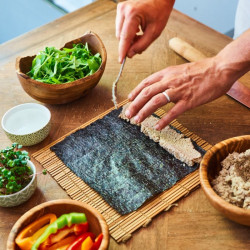
Nori — job: crunch, in sheet or crumbled form. Familiar equivalent: toasted breadcrumbs, gomasio, chips. Starting dose: half a sheet, crumbled, per plate.
Wakame — job: texture, in salads or soup. Familiar equivalent: baby spinach — tender with a little bite. Starting dose: 10 g of dried flakes, about 60 g once rehydrated.
Dulse — job: smokiness, best pan-fried. Familiar equivalent: bacon bits, in plant form. Starting dose: one or two pinches as a condiment, or a small handful pan-fried.
Kombu, the base of every good stock
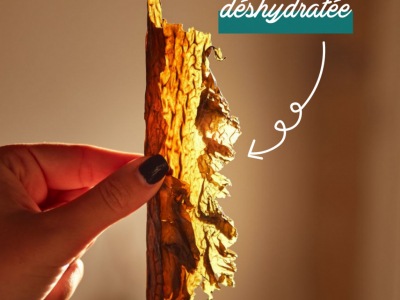
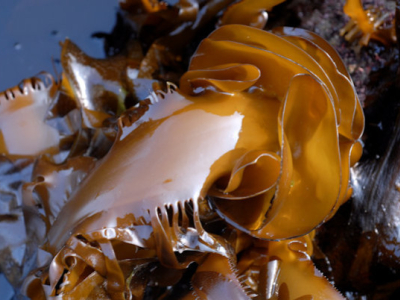
This is Ikeda's seaweed, the one carrying the most umami. Its thick, leathery leaf isn't really meant to be eaten as-is — it's meant to be steeped. One piece dropped into your cooking water, and your vegetable stock moves up a category. If you only ever try one seaweed to discover what umami tastes like, make it this one. We cover how to use it in detail in our article on dehydrated kombu seaweed.
If you want to spend two or three weeks noticing what a single piece does to your soups and lentils, here's the whole-leaf kombu we select, harvested in Brittany and low-temperature dried.
Everyone knows it wrapped around a maki roll, but nori has another life. Crumbled over stir-fried vegetables, rice, or avocado, it brings a marine crunch and an almost toasted note. Passed for a few seconds in a dry pan, it turns as brittle as a chip. Our nori sheets, dried below 45°C, work well for both, and you'll find more ideas in our article on nori as an appetizer star.
Wakame, the texture
Wakame is the seaweed of miso soup and cucumber salads. Its flavor is mild, barely marine, and its texture does all the work: silky in a soup, tender-crisp in a salad. It's often the seaweed that wins over people who thought they "didn't like seaweed." Our dehydrated wakame flakes rehydrate in a few minutes in cold water. For more on this one, see our full wakame guide.
Dulse, the smoky one
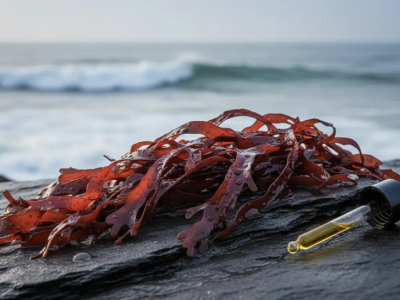
Raw, dulse tastes faintly nutty and a touch peppery — far less "marine" than people expect. But it's in the pan that it really surprises. In 2015, Chris Langdon, a professor at Oregon State University who'd been growing a dulse strain for fifteen years, summed up his experience this way: "When you fry it, it tastes like bacon, not seaweed" (Oregon State University, 2015). Pan-fried for a minute or two in a little oil, dulse turns crisp and smoky — our plant-based bacon bit. We offer fresh Brittany dulse, and our article on dulse covers more ground. To compare all four seaweeds side by side, this dulse, wakame, sea lettuce and sea bean guide is a good place to start.
Umami in practice: kombu in your legume cooking water
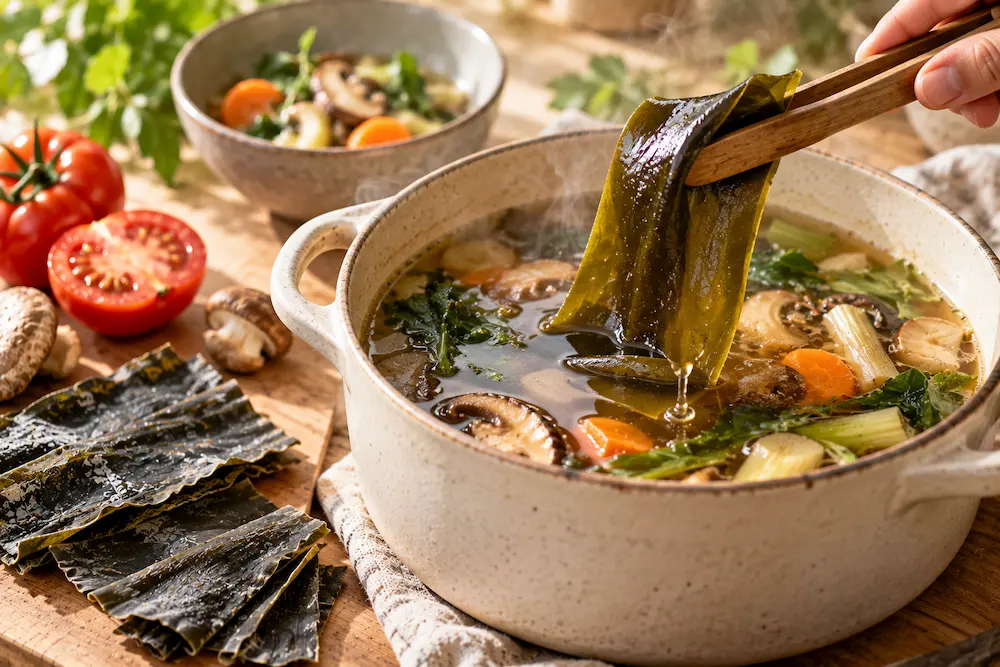
The whole thing rests on one simple idea. Kombu's glutamate isn't extracted by force — it's extracted by time. Think of a tea bag steeping, not a potato being boiled. Warm or hot water, never a rolling boil, slowly dissolves the flavor compounds, and the stock builds up over the minutes.
Vegetable dashi, in three steps
Drop a 5 g piece of kombu into 500 ml of cold water and let it soak for 20 minutes.
Warm it gently over medium heat.
Pull the kombu out just before it boils, as soon as small bubbles start forming at the bottom of the pot.
That's it. You now have a base for miso soup, a noodle broth, a pot of rice, or a sauce. If you're rushed in the morning, an even simpler variation: kombu in cold water, left in the fridge overnight. By evening, your stock is ready.
Another trick worth knowing: add one or two dried shiitake mushrooms alongside the kombu. Kurihara notes that the glutamate and the compounds in dried shiitake (guanylate) act in synergy (Kurihara, 2009). In practice, one plus one doesn't equal two: together, they reach an intensity neither one hits alone. That's the secret behind plant-based stocks with as much body as a classic one.
A slice of kombu in your lentils, chickpeas, or beans
This is the move I recommend first, because it takes no extra effort at all. Cooking legumes? Drop a roughly 5 cm piece of kombu into the water at the start, from cold. Let it simmer gently, as usual, no hard boil. At the end, pull it out — or chop it finely and stir it through the legumes.
The result? Lentils with flavor before you've even seasoned them. What you'll notice most is a roundness in the mouth that makes the dish taste more "cooked," even though you've added nothing but a piece of seaweed. Thirty seconds of effort, and the difference is obvious from the first spoonful.
Season with umami before you season with salt
One habit worth building: taste before you salt. Seaweed already brings its own marine salinity, and umami creates that sense of fullness that, more often than not, means you'll want less salt, not more. Start with none, adjust at the end. It's simple common sense — let the ingredient speak before you correct it.
And keep a sense of proportion. Seaweed earns its place as part of a varied, balanced diet and a healthy lifestyle: a few grams here and there to lift a dish, not bowlfuls. For a broader look at seaweed and its uses in the kitchen, our overview of seaweed and microalgae covers the wider picture.
Don't worry, these are the most common ones, and they're easy to fix. There's no failure here, just experiments.
Mistake #1: using too much
The excitement of discovery pushes people to pile it on, generously. Bad idea. Over-dosed seaweed drowns the whole dish in a tide-pool flavor, and that's exactly how people wrongly convince themselves they "don't like seaweed." Start small: a sliver, a pinch, half a sheet. You can add more once your palate is asking for it. Think of spices: nobody dumps a full tablespoon of cumin into a soup for four.
Mistake #2: boiling the kombu
This is the most common mistake, and the most understandable one: the assumption is that boiling extracts more. It's the opposite. The Institute of Culinary Education in New York puts it plainly: pushed to too high a temperature, kombu releases bitter compounds that ruin the stock (ICE, 2024). Its texture also turns slimy. A gentle simmer, yes — a rolling boil, no: that's kombu's golden rule.
Mistake #3: mixing up dried and rehydrated weight
A recipe calls for "50 g of wakame"? Everything hinges on whether that's dried or rehydrated, and the gap is huge. Our wakame flakes gain roughly six times their weight once rehydrated: a 150 g bag becomes about 900 g of ready-to-eat seaweed. Using 50 g of dried wakame where a recipe meant rehydrated means using six times too much. To put that in kitchen terms: 10 g of dried flakes is plenty for a salad to share. The habit to build: always check which state a recipe is talking about.
If you want to spend a month testing what these three seaweeds do to your soups, salads and legumes, our whole range of dried seaweed is right here, from kombu to wakame.
Practical FAQ: umami and cooking with seaweed
What is umami taste?
Umami is the fifth basic taste, alongside sweet, salty, sour and bitter. It's the round, deep flavor of a good stock, an aged parmesan, or a ripe tomato, driven mainly by glutamate. It was identified in 1908 by Japanese chemist Kikunae Ikeda in kombu seaweed.
What are the five basic tastes?
Sweet, salty, sour, bitter and umami. Umami was recognized as a full basic taste through physiology and molecular biology research carried out mostly between the 1980s and 2000s.
How do you get umami flavor in plant-based cooking?
The simplest way is to steep a piece of kombu (5 g per 500 ml of water) without letting it boil, then use that stock as a base. Adding one or two dried shiitake mushrooms strengthens the effect further, thanks to the synergy between their compounds and kombu's glutamate.
How do you cook with dried seaweed?
Kombu is steeped in hot water without boiling, wakame rehydrates in a few minutes in cold water, nori is used as-is or crumbled, and dulse is sprinkled on as a condiment or pan-fried until crisp. Always start with small amounts.
Should you boil kombu?
No. Past a gentle simmer, kombu releases bitter compounds and turns slimy. Pull it out just before it boils for a dashi, and let it simmer gently alongside legumes.
Which seaweed should beginners start with?
Wakame, for its mild flavor and pleasant texture, or kombu, to discover umami in a stock. As part of a varied, balanced diet and a healthy lifestyle, a few grams are enough to lift a dish.
Dried or rehydrated seaweed: how do you convert the quantities?
Wakame flakes gain roughly six times their weight once rehydrated: 10 g dried yields about 60 g ready to eat. Always check whether a recipe means dried or rehydrated weight.
Going further: seaweed as an everyday ingredient
This guide is, of course, far from exhaustive. Think of it as a starting point. With Aurélie, we wrote Algues au quotidien (Gallimard, 2024) for exactly this reason: to turn seaweed into an everyday ingredient rather than a curiosity. The book won World's Best Cookbook at the 2025 Gourmand World Cookbook Awards and France's Best Cookbook from the Académie Nationale de Cuisine. If you'd rather listen than read, our Algues au quotidien podcast picks up where the book leaves off.
This week, try something simple: a slice of kombu in your next pot of lentils, and taste the difference. No dogma, no big overhaul — just seaweed in the right place, as part of a varied, balanced diet and a healthy lifestyle. Try it once, and it sticks.
The information in this article is provided for informational purposes only and does not constitute medical advice. Consult a healthcare professional before making any changes to your diet or supplementation.