

August ends the way it always does: impossible schedules return, the first classroom colds start circulating by the second week, and that end-of-day exhaustion settles over the whole house without warning. Before you fill the cart with drugstore boxes, there's something else worth trying first. Something that grows on your counter while you sleep.
Here's the reading contract, right away. Ten minutes on a Sunday, once a week, not a minute more. No miracle promise: you'll see, I'm mostly going to tell you what sprouting does not do. That's the part missing from most advice online, and it's the part that lets you decide with real information instead of hype.
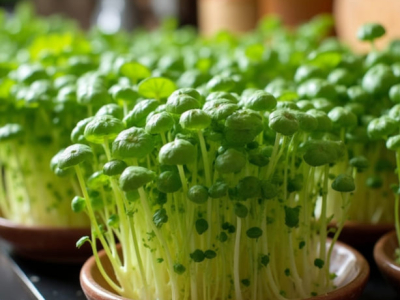
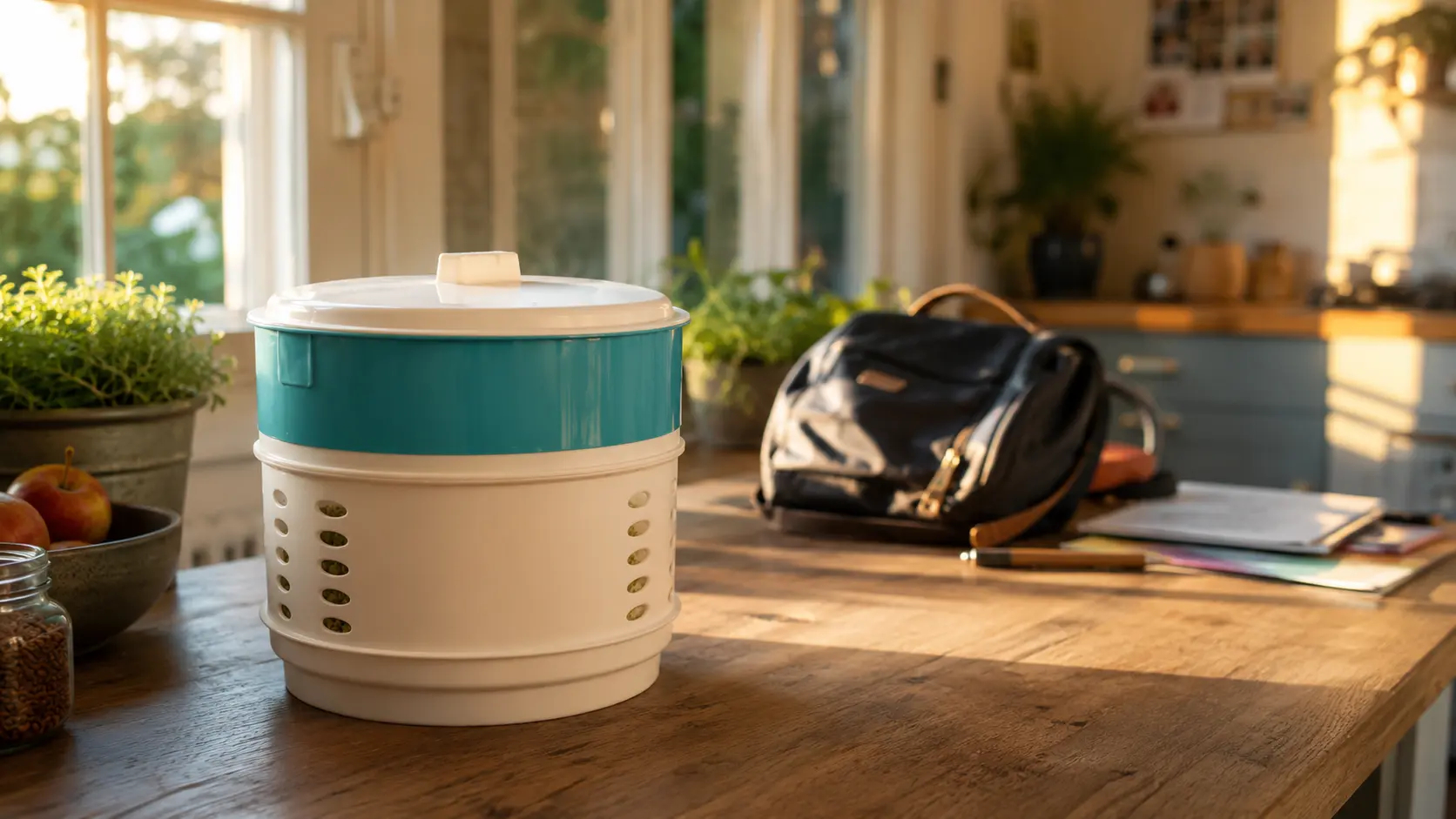
Learning how to grow sprouts, in practice, means ten minutes of active work a week: rinsing the trays, measuring, soaking, starting the cycle, cleaning up, planning the week. The rest — two to seven days depending on the variety — happens without you. If you already run a Sunday meal-prep routine, this slots right in: one more jar next to the grain containers and the cut vegetables, restocking lunchboxes all week instead of one big batch-cooked tray. A sprouter has been running in our kitchen since 2007, the year Biovie was founded, and it's the only food routine I've kept without interruption across thirty years of practice. Not because it's virtuous. Because it's short.
How to Grow Sprouts in 10 Minutes, Sunday Night: The Exact Routine
The ten-minute figure isn't a sales pitch. It's the result of an honest stopwatch test, separating what needs you physically present from what runs on its own. Confusing the two is reason number one people quit: they read "5 days to sprout" and hear "5 days of work."
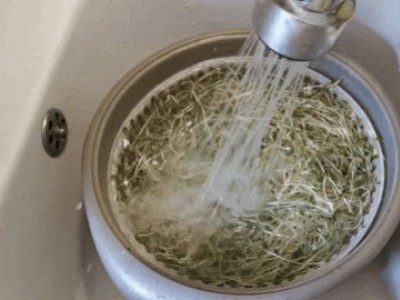
- Minute 0 to 2 — rinsing the trays. You pull the trays from the previous cycle, run them under hot water, and scrub. Two minutes, stopwatch in hand, for three tiers. It's the single most important step in the whole routine, and I'll come back to it below: a poorly rinsed tray means a failed cycle, and sometimes a smell that puts you off starting again.
- Minute 2 to 3 — measuring. Two to three tablespoons of dry seeds per tray (roughly ⅛ to 3⁄16 cup), never more. Seeds swell enormously, and an overloaded tray can't breathe. If you remember one beginner rule, make it this one.
- Minute 3 to 3.5 — soaking. Thirty seconds to cover the seeds with clean water. Then you walk away. Soaking takes eight to twelve hours, you sleep through it, and it costs zero minutes of your budget.
- Minute 3.5 to 4.5 — starting the cycle. You drain, spread the seeds out, and start the sprouter. One minute.
- Minute 4.5 to 7.5 — cleaning the counter. Three minutes, max. Seed jar closed, dish towel, sponge. Not glamorous, but it's what makes you start again next Sunday without a sigh.
- Minute 7.5 to 10 — planning the week. Two and a half minutes to decide what you'll harvest, and when. A fast variety early in the week, a slow one for Friday. This is the moment a single action turns into a habit — and the only moment that actually requires thinking.
Total: ten minutes of active work. The rest of the week, all that's left is rinsing — and that's exactly where everything gets decided.
Sophie Clerc, a longtime customer, puts it better than I can: "For years now, my trusty EasyGreen has delivered my daily ration of seeds, which I sprout as a mix to make life simpler. I couldn't do without it anymore! [...] the value for money on these products is absolutely unbeatable."
If you want the rinsing step itself broken down in detail — the one that prevents mold — I've described it step by step in How to Rinse Sprouted Seeds the Easy Way. And if you're starting from zero, with no sprouter and no experience, the full tutorial is here: Sprouted Seeds: All the Benefits and How to Grow Them at Home. This article assumes you already know the basics — it's about organizing a routine, not technique.
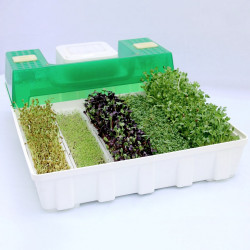
If you want to test the version that actually survives a hectic school term, an automatic sprouter is what makes the difference — the one we've distributed since Biovie was founded. If you're just starting out, our GeoJar starter sprouter is unbeatable value.
€269.00
Out-of-Stock
Easygreen Light automatic sprouter
Why an Automatic Seed Sprouter Changes the Time Math
Let's be clear: a glass jar with a piece of cheesecloth works perfectly. It costs nothing, it sprouts just as well, and for years that's all I used. I'm not going to tell you otherwise just to sell you a gadget.
What a jar demands, to keep sprouting seeds year-round, is discipline: rinse twice a day, morning and evening, every day. Thirty seconds each time. In July, that's easy. In September, with a kid who forgot their gym bag and an 8:30 video call, it's the step that gets skipped. And once it's skipped twice, the cycle is lost.
Automation doesn't remove the step — it removes the mental load of remembering it. That's a difference in kind, not degree. Translated into daily life: you stop thinking about your seeds, which is exactly why you're still eating them in November.
Henri Arsivaud, three weeks after buying his: "We've had the sprouter running for 3 weeks now. It's changed our lives. The seeds grow much better, the sprouts are even better. We don't regret this purchase at all."
Two machines in the catalog, two logics. The EasyGreen Light (€269) is electric, three tiers, programmed watering. The EasyGreen Sol autonomous seed sprouter (€139) is the only low-tech sprouter in the world that runs a full week with no electricity, using gravity and a siphon effect, and it's made in Nîmes, France. The full comparison is in What's the Best Seed Sprouter for Sprouted Seeds?
What Sprouting Really Changes (and What It Doesn't)
This is the section most sprouting content online skips. You'll read everywhere that sprouting "multiplies vitamins by 600%" and "supercharges minerals." The measured reality is more interesting, and more nuanced.
What's solidly established: sprouting brings phytic acid down. Phytic acid is the molecule seeds use to store phosphorus; by binding to iron, zinc, and magnesium, it makes them less available to us. Picture a clamp holding the mineral shut: sprouting activates an enzyme, phytase, that loosens the clamp. In wheat sprouted 48 to 120 hours at 26°C (about 79°F), a team at KU Leuven measured a 25 to 40% drop in phytates (Huyskens et al., 2025). In broccoli sprouts, a Romanian team recorded a phytic acid reduction of up to 82.20% (Dragomir et al., 2026).
What's far less settled: what your body actually does with that. And this is where honesty matters. In the same wheat study, bioaccessibility — what becomes soluble in a reconstructed digestive tract — rose by a factor of 1.5 to 2.7 for iron and 1.6 to 2.3 for zinc. But when researchers moved to the next step, where cultured human intestinal cells (the Caco-2 model) actually had to absorb the mineral, zinc did gain a factor of 1.6 ... and iron gained nothing at all. No measurable increase after 120 hours of sprouting.
One methodological note, because it matters: this is entirely in vitro work. Cells in a dish, not people at a table. A useful model, never proof of an effect in humans.
A 2022 UK review in Nutrition Bulletin (Elliott et al.) reaches the same cautious conclusion across cereals and legumes as a whole: yes, phytase activates, but the extent depends on species, cultivar, duration, and temperature — and bioavailability studies are too scarce to predict the real-world effect. Worth noting, for transparency: the lead author works for a food industry company. That doesn't invalidate the review, but it's worth stating plainly.
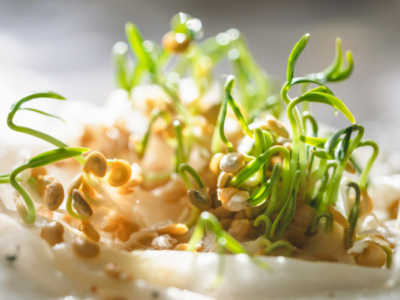
Where the gain is clear and reproducible is vitamin C and folate. A 2012 Chinese study published in the Journal of Agricultural and Food Chemistry (Shohag et al.) tracked germination day by day: vitamin C is undetectable in the dry seed and reaches 29 mg/100 g fresh weight in soybean sprouts by day four, 27.7 mg in mung bean. Folate peaks at the same point — 815.2 µg/100 g for soy, 3.5 times the starting seed — then drops off sharply. In practical terms, for your week: harvest day isn't a minor detail, it's a peak that passes.
What does that change at the table? A handful of sprouts added to a plate you already eat, not a treatment. As part of a varied and balanced diet and a healthy lifestyle, it's one more contribution, not a replacement.
The full documented benefits of sprouted seeds are covered in our reference guide on the blog — I won't duplicate it here.
How to Grow Sprouts: Which Seeds to Choose for a Back-to-School Week
Four varieties, maximum. Beyond that, you stop keeping up. The criterion isn't "the most nutrient-dense" — it's the one that actually ends up in the lunchbox: mild taste, crisp texture, short cycle.
- Alfalfa. Mild, slightly sweet, almost neutral flavor. Five to seven days. This is the gateway seed, the one that puts no one off. 40 g pouch (1.4 oz) for €2.80.
- Radish. Three to four days, distinctly crunchy, with a mild kick that many kids surprisingly like because it's short and to the point. 30 g doypack (1 oz) for €1.90, or 500 g (17.6 oz) for €9.24 once the family is hooked.
- Broccoli. Short cycle, mild flavor, and the most thoroughly documented variety for composition: the sprouts test at 30.33 g protein per 100 g and 424.40 mg total polyphenols per 100 g (Dragomir et al., 2026). 13 g doypack for €1.90, 300 g for €11.45.
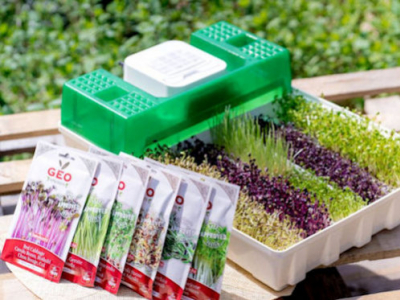
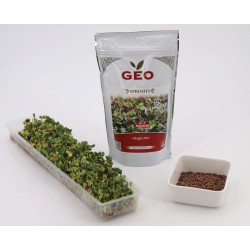
- A ready-made mix, so you're not deciding every week. The Adagio Mix (20% broccoli, 50% Chinese pink radish, 30% clover) in a 350 g doypack for €15.90, about €45.43 per kilo.
If broccoli's sulfur compounds interest you, I've dedicated a full piece to it: our complete guide to sulforaphane. For exact sprouting times variety by variety, the sprouting chart is downloadable here: Sprouting Time Chart for Seeds. And the full list of twenty-four varieties is in our reference guide — no need to repeat it here.
A word on lentils, since the question comes up: they sprout beautifully, and France's Ciqual food composition database carries a full entry for them, but we don't sell lentils intended for sprouting. I'd rather tell you than let you go looking.
For a back-to-school start with no weekly decision-making, this is the mix I'd recommend: one decision, made once.
Getting Kids on Board
Mix them in rather than isolating them. A small portion of sprouts in their own compartment, next to the raw vegetables, is a test a kid can reject at a glance. The same sprouts tucked into a sandwich filling go by without comment.
Start with the mildest. Alfalfa first, always. Radish comes later, once the crunch feels familiar.
Count to three. A new food is rarely accepted on the first try. Three spaced-out exposures, no pressure, no negotiating, no "just one bite." Offer it, take it away, offer it again. Everyone moves at their own pace — kids especially.
I don't have a customer story to share on this specific angle, so I won't invent one. What I can point you to are the recipes that work best in our house: 9 Easy Raw Recipes Your Kids Will Love.
The Food-Safety Protocol: 4 Non-Negotiable Rules
A sprout is a ready-to-eat food that's spent several days warm and moist. Those are exactly the conditions bacteria like. That's not a reason to give up on sprouting — it's a reason to be strict about four things. This is also where US shoppers tend to be, rightly, more cautious than most: sprout-related Salmonella and E. coli recalls make headlines here more often than in Europe, and the FDA maintains specific guidance on raw sprouts for exactly that reason. The rules below track the same home food-safety guidance issued by European agencies — France's Anses and the European Food Safety Authority (EFSA) — because the underlying microbiology doesn't change at the border.
- Clean the sprouter with hot water between every cycle. Not "when it looks dirty": between every single cycle, no exceptions.
- Wash your hands before and after handling seeds and sprouts.
- Rinse regularly throughout the cycle, and drain thoroughly. Standing water is the enemy.
- Eat within 72 hours of harvest. You can store them in the refrigerator, in a ventilated container (never a sealed jar) — sprouting will continue slowly.
These four rules reflect the home food-safety recommendations issued by Anses in its July 7, 2011 opinion, and align with the same risk assessment published by EFSA's Panel on Biological Hazards that year — cited in full in the References section below.
Morning Spirulina: What It Delivers, What It Doesn't
Gael Vittoz, a customer for fifteen years, makes the transition better than I could: "I discovered Biovie more than 15 years ago when I bought an automatic sprouter. [...] The seeds for sprouting, the seawater, the barley grass juice, the spirulina, and the nori sheets are absolute essentials — exceptional quality, and raw."
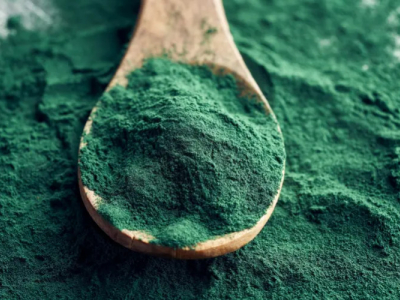
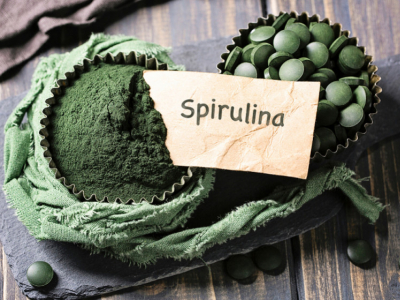
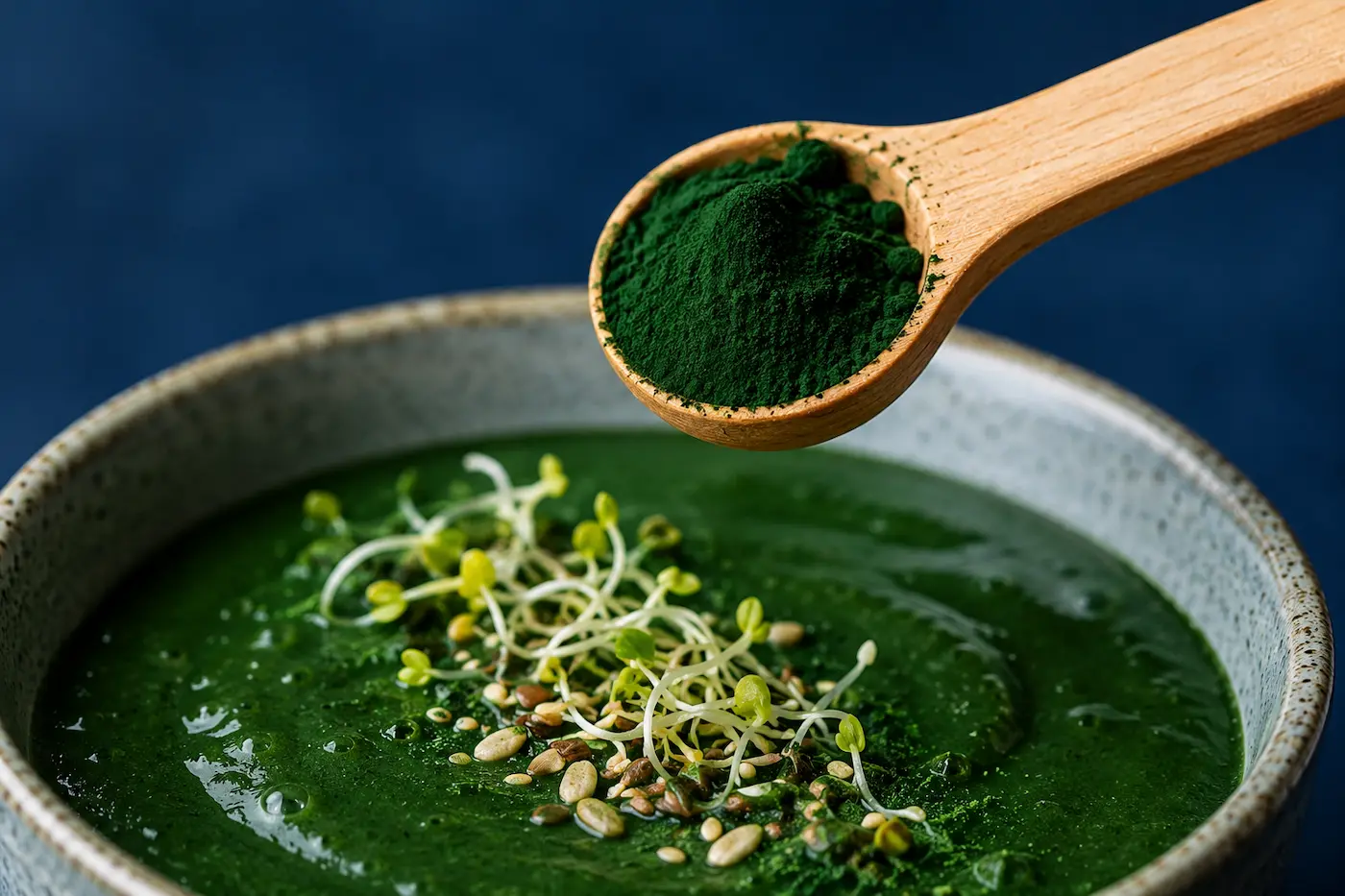
Spirulina is the other piece of the back-to-school routine, and among its well-documented spirulina benefits is a nutrient density so spectacular per 100 g that the numbers become misleading if you don't scale them down.
Let's start by correcting the most widely repeated figure online. You'll read "28.5 mg of iron per 100 g" everywhere. That figure comes from an older version of France's Ciqual food composition database. The current Anses table gives, for dried or dehydrated spirulina (code 11086), 80.6 mg of iron per 100 g — with a range of 17 to 170 mg. A tenfold gap between extremes. It's an agricultural product, not a factory-calibrated powder, and its composition depends on the growing basin, the season, and the drying process.
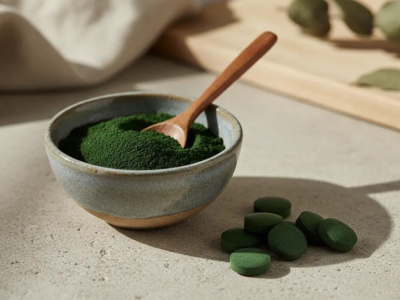
Next, scale everything down to the actual dose. Nobody eats 100 g of spirulina. The usual dose is 1 to 5 g a day. At 3 g a day (roughly 1 rounded teaspoon), using the Ciqual average, you're looking at about 2.4 mg of iron: the scale of a food that contributes, not one that corrects a deficiency. Protein follows the same logic — 60.4 g/100 g becomes about 1.8 g in your spoon. Translated into perception: spirulina is a nutritional condiment, not a serving.
What's known in humans is modest, and I'll tell it to you straight. A randomized, double-blind, placebo-controlled trial published in 2023 in Clinical Nutrition ESPEN (Moradi et al.) gave 1 g of spirulina a day for eight weeks to 80 adults. Serum iron rose significantly (p = 0.04) versus placebo. Two major caveats: these adults had ulcerative colitis — they were neither children nor healthy adults — and ferritin, which measures iron stores, didn't move. The authors themselves conclude in conditional terms.
To go further: Spirulina and Immunity: 12 Scientific Studies and Spirulina: The Complete Guide to Scientifically Proven Benefits.
If you want to test what six weeks of it does to your fall mornings, our spirulina powder comes in a 500 g pouch (17.6 oz) — enough for five months at 3 g a day. One level teaspoon in a smoothie, no more, and as part of a varied and balanced diet and a healthy lifestyle.

Cost Per Serving: Sprouting and Spirulina vs. the Vitamin Aisle
Let's set the method before the numbers, or the comparison isn't worth anything.
The assumptions. A family running three trays a week, at 15 g (about 2 to 3 tablespoons) of dry seeds per tray, so 45 g a week. One person taking 3 g of spirulina a day. Prices checked on biovie.fr and at online drugstores on August 16, 2026.
The cost of consumables. The Adagio Mix works out to €45.43 per kilo (350 g for €15.90). Forty-five grams a week comes to €2.04 of seeds a week, or €8.85 a month. Spirulina powder, at €55.80 per kilo (500 g for €27.90), used at 3 g a day, comes to €5.02 a month. Total: €13.87 a month, roughly €41.60 over a school quarter.
The cost of the comparison. At online drugstores, a monthly adult multivitamin course runs €5.19 to €19.49; vitamin C, €3.49 to €16.89; iron, €6.49 to €13.99; magnesium, €4.49 to €13.49. A mid-range basket of all four runs around €31.80 a month per adult, or roughly €95 over the quarter.
The gap, and the payback. About €18 a month per adult. On that basis, the EasyGreen Sol (€139) pays for itself in a little under eight months; the EasyGreen Light (€269) in around fifteen months. In other words: over a single back-to-school quarter, the sprouter doesn't pay for itself. It does over a year. I'd rather tell you that clearly than sell you savings that don't show up on your timeline.
Three things this calculation doesn't say, and that are worth keeping in mind. Discounted prices are common at online drugstores, and those markdowns aren't permanent. Multiplying by the number of people in the household is debatable — iron, in particular, shouldn't be given to everyone indiscriminately. And above all, a sprouter is not a treatment, and a supplement prescribed by a doctor isn't something you replace. If someone in your household takes prescription iron, this comparison doesn't apply to them.
Catherine, on Trustpilot: "In stores, seeds for sprouting are often overpriced compared to Biovie! And sprouted seeds are an incredibly nutrient-rich food, excellent for health."
Two related reads on this angle: Sprouted Seeds and Preparedness: Affordable, Long-Lasting Food for Everyone and Eating Living Food on a Tight Budget. For the full price breakdown on spirulina by format: Spirulina Prices: €30 to €70 per Kilo Depending on the Form.
To start without committing €15.90 to a single variety, the "Essentials" pack bundles five doypacks — fenugreek, alfalfa, mung bean, broccoli, mustard, 228 g total (8 oz) — for €9.50. It's the cheapest way to find out what your household actually likes before buying in bulk.
Your Back-to-School Sprouting Questions
How long does it take to grow sprouts?
Between 2 and 7 days depending on the variety. Radish and broccoli are ready in 3 to 4 days, mung bean in 2 to 3 days, alfalfa needs 5 to 7 days. The active work, meanwhile, stays at ten minutes a week: the rest of the time, the seed works on its own.
How many sprouts should I eat a day?
Two to four tablespoons a day per adult, roughly 30 to 50 g (1 to 1.75 oz) of fresh sprouts. For a child, start with one tablespoon mixed into a dish they already like. As part of a varied and balanced diet and a healthy lifestyle, this is an addition to a plate, not a meal on its own.
What are the benefits of eating sprouts?
The clearest, best-documented sprouted seeds benefits are a drop in phytic acid — which frees up iron, zinc, and magnesium that were otherwise bound up — and a sharp rise in vitamin C and folate around the fourth day of growth. What's much less settled is how much of that translates into better absorption in your body: the research on that specific step is still thin. The fuller picture, with sources, is in our reference guide linked above. Sprouted seeds are a nutrient-dense addition to a meal, not a cure for anything.
Do sprouts reduce belly fat?
No study cited in this article supports that claim, and we're not going to invent one to sound persuasive. Sprouts bring genuinely useful nutrients to a plate, but no serious research ties them to targeted fat loss. If that's the goal, the honest answer is that overall diet and activity matter far more than any single ingredient.
Can raw sprouts be given to a child?
Yes, with real care about hygiene and sourcing. For young children, pregnant women, people who are immunocompromised, and older adults, the recommended precaution is a brief cooking step: 70°C (158°F) for 2 minutes is enough — a quick pass in a pan or a hot soup, for example. If you're unsure about a specific situation, ask your doctor.
How often should sprouted seeds be rinsed?
At least twice a day when sprouting manually, morning and evening, with thorough draining each time. An automatic sprouter handles these rinses for you — that's its main job, far more than the space it saves.
How long do sprouted seeds keep?
Eat them within 48 hours of harvest for the best quality, kept in the refrigerator in a ventilated container, never sealed airtight. Rinse them each day you keep them.
Do I need a seed sprouter, or is a jar enough?
A glass jar with cheesecloth is perfectly enough to grow sprouts, and it costs nothing. A sprouter doesn't improve germination — it removes the obligation to remember rinsing twice a day, which is the real point where a busy back-to-school routine falls apart.
Does spirulina provide vitamin B12?
No. The Anses Ciqual database lists 0 µg of vitamin B12 for dried spirulina, and Anses notes it isn't a reliable B12 source: the form present is mostly an inactive analog. If you exclude animal products from your diet, your B12 needs to come from somewhere else.
References
- Huyskens, M., et al. (2025). "The impact of wheat sprouting on iron and zinc bioaccessibility and bioavailability to Caco-2 cells". Food Chemistry, 495(Pt 2), 146332.
- Elliott, H., Woods, P., Green, B.D., Nugent, A.P. (2022). "Can sprouting reduce phytate and improve the nutritional composition and nutrient bioaccessibility in cereals and legumes?". Nutrition Bulletin, 47(2), 138-156.
- Dragomir, C.N., et al. (2026). "Germination as a Sustainable Green Pre-Treatment for the Recovery and Enhancement of High-Value Compounds in Broccoli and Kale". Molecules, 31(2), 350.
- Shohag, M.J.I., Wei, Y., Yang, X. (2012). "Changes of folate and other potential health-promoting phytochemicals in legume seeds as affected by germination". Journal of Agricultural and Food Chemistry, 60(36), 9137-9143.
- Moradi, S., et al. (2023). "The effects of spirulina supplementation on serum iron and ferritin, anemia parameters, and fecal occult blood in adults with ulcerative colitis: A randomized, double-blinded, placebo-controlled trial". Clinical Nutrition ESPEN, 57, 755-763.
- Anses (2011). "Avis relatif aux cas de syndromes hémolytiques et urémiques observés en France en juin 2011, suspectés d'être liés à la consommation de graines germées" — saisine 2011-SA-0158.
- EFSA Panel on Biological Hazards (2011). "Scientific Opinion on the risk posed by Shiga toxin-producing Escherichia coli (STEC) and other pathogenic bacteria in seeds and sprouted seeds". EFSA Journal, 9(11), 2424.
- Anses (2017). "Avis relatif aux risques liés à la consommation de compléments alimentaires contenant de la spiruline" — saisine 2014-SA-0096.
- Anses — Table Ciqual 2025, aliment 11086 « Spiruline (Spirulina sp.), séchée ou déshydratée ».
- Anses — Table Ciqual 2025, aliment 20521 « Graine germée de lentille, fraîche, crue ».
Update: August 2026. Article written and reviewed by Eric Viard, founder of Biovie since 2007 and ISTOM engineer, co-author of "Algues au quotidien" (Gallimard, 2024) — World's Best Cookbook, Gourmand Cookbook Awards 2025, and Best French Cookbook, Académie Nationale de Cuisine 2025.
The information presented in this article is provided for informational purposes only and does not constitute medical advice. Consult a healthcare professional before making any changes to your diet or supplementation.