Turmeric, cordyceps and acai benefits: real synergy or passing trend?
Type “turmeric cordyceps acai benefits” into a search engine and you land on ten pages that each cover a single ingredient, and for good reason: no published human trial tests this trio. The only really documented combination is turmeric with black pepper. I'll walk you through what each ingredient has actually shown.
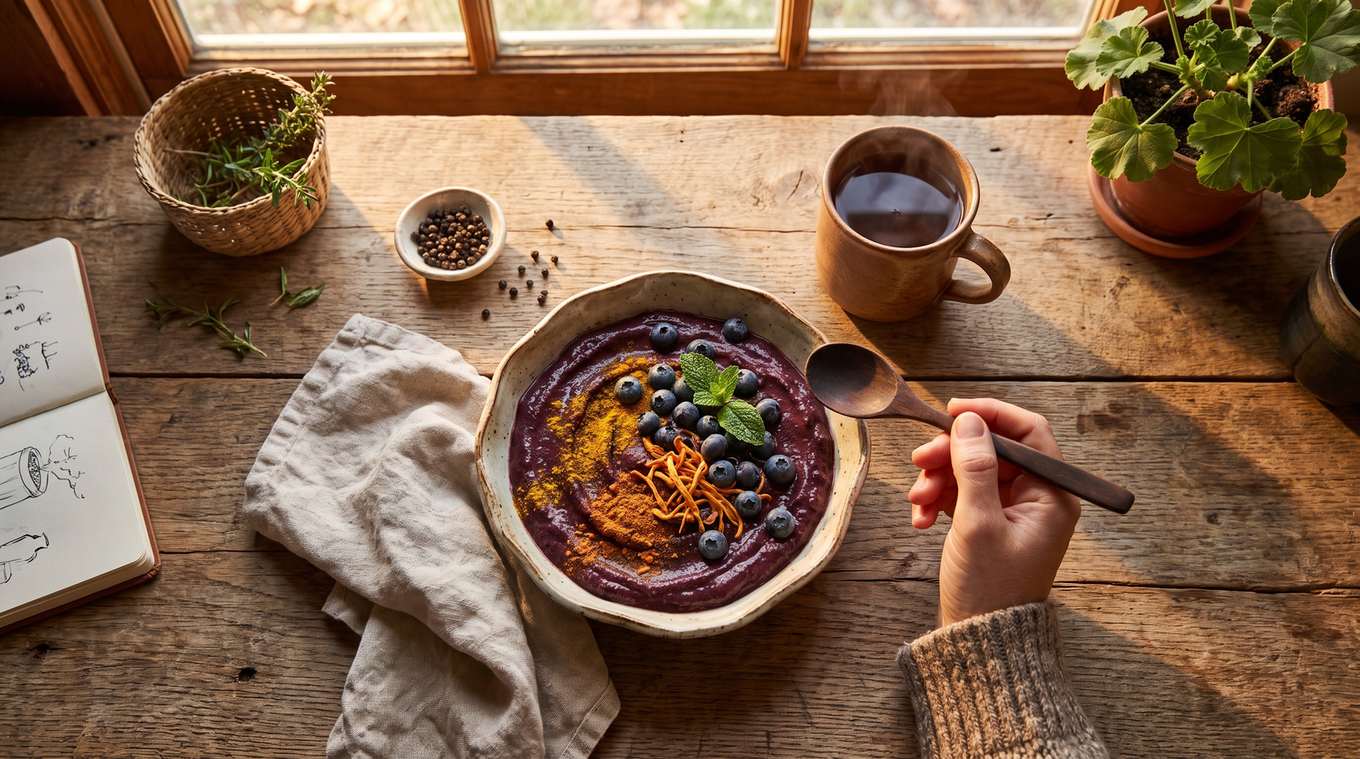
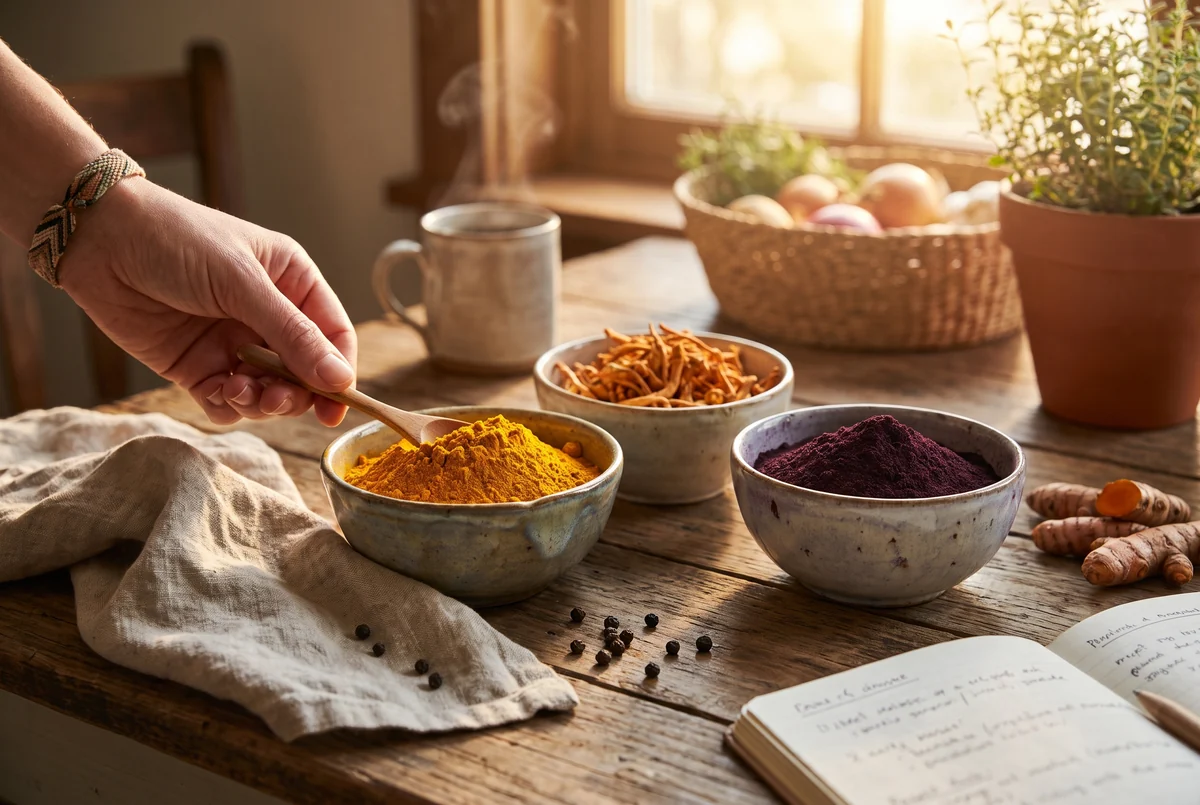
The mix is all over social media right now: a bowl of acai so deep purple it looks almost black, sprinkled with turmeric and cordyceps, and a caption with that dreamy word, “synergy”. Does 1 + 1 + 1 really add up to more than 3?
I'm an ISTOM engineer and I founded Biovie in 2007. Here are my conclusions as of 27 October 2026 for this trio, based on human trials and on the opinions of ANSES and EFSA. The result: to date there is not a single human trial on the three taken together at the same time (which would make a good idea for a study, by the way!).
Turmeric, cordyceps, acai: is there a proven synergy?
No, no synergy has been proven: no published human trial tests turmeric, cordyceps and acai together. Each has its own data, more or less solid, and we'll look at them one by one. The only well-studied combination on the subject is turmeric with the piperine in black pepper (Shoba et al., 1998).
In science, the word synergy has a precise meaning, far more demanding than a caption under a photo: the effect of the ingredients taken together exceeds the sum of their effects taken separately. Think of a pair of scissors. One blade on its own cuts very little, two blades assembled slice through a sheet of paper effortlessly. Three knives lined up side by side in a drawer, though, don't make a pair of scissors. They stay three knives.
To claim that a mix does better than its ingredients, you therefore need a trial that compares the mix with each ingredient taken alone, using the same measurements. For the turmeric, cordyceps and acai synergy, that trial doesn't exist. Synergy remains an untested hypothesis. Neither a proof nor a nonsense: a hypothesis.
That said, putting turmeric, cordyceps mushroom and acai berry together in one bowl is not absurd at all. It's simply that the benefits of turmeric, cordyceps and acai are judged ingredient by ingredient. And for turmeric, everything starts with a story of absorption, which I also cover in the article on curcumin and its bioavailability.
Turmeric: a golden pigment that is poorly absorbed, and how to help it
Curcumin is the pigment that gives turmeric its golden colour, the one that stays on your fingers. It has a flaw that researchers know well: our body makes poor use of it. This is called bioavailability, in other words the share of what you swallow that actually reaches the blood. For curcumin, that share is small, because it is poorly absorbed, then quickly transformed and eliminated (Hewlings and Kalman, 2017). The image that comes to mind is a leaky bucket: you pour in a lot, and very little is left at the bottom.
The figures speak for themselves. In volunteers (the study abstract doesn't say how many), 2 g of curcumin alone gave undetectable or very low blood levels. Add 20 mg of piperine, the molecule that gives black pepper its bite, and bioavailability rises by 2,000%, against 154% in rats (Shoba et al., 1998). Two thousand percent is the move from almost nothing to an amount that can finally be measured in the blood, even though the study evaluates no effect on health. The bucket still leaks, but we've plugged a good share of the holes.
You are not what you eat, but what you absorb.In practice, combine turmeric and black pepper during a meal, with a fat. For more ideas, see the ways to use turmeric. Turmeric goes into your dishes as part of a varied and balanced diet and a healthy lifestyle.
Cordyceps: encouraging but contrasting human trials
As for cordyceps benefits, the three human trials selected all address the same question, the link between cordyceps and athletic performance, and they don't tell quite the same story.
The first trial (Chen et al., 2010) followed 20 adults aged 50 to 75 for 12 weeks, double-blind against placebo (neither the participants nor the researchers knew who was taking what, which avoids finding what you hoped to find), with 333 mg of Cs-4, a Cordyceps sinensis preparation, three times a day. The metabolic threshold rose by 10.5% (from 0.83 to 0.93 L/min) and the ventilatory threshold by 8.5% (from 1.25 to 1.36 L/min). You know this threshold without realising it: it's the moment, on a hill, when the effort tips over and your breathing gets shorter. VO2max, for its part, didn't move. And this is a pilot study.
Second trial (Hirsch et al., 2017), a different mushroom: 28 young adults, randomised double-blind, took 4 g a day of a mushroom blend containing Cordyceps militaris, another species. After one week, nothing different in VO2max. At three weeks, in the 10 people still followed, VO2max gained 4.8 ml/kg/min and time to exhaustion 69.8 seconds, a little over a minute held on at the end of the effort.
Third trial (Parcell et al., 2004), and here it's a different tune. In 22 trained cyclists, 3 g of Cs-4 a day for 5 weeks had no effect on aerobic capacity or on the time trial, in this randomised placebo-controlled trial.
So, who do you believe? All three, in reality. Untrained older adults don't have the same room for improvement as cyclists already close to their maximum, and a mushroom blend is not Cs-4 alone.
One honest caveat, and I won't repeat it: these trials remain small. They are nonetheless genuine controlled trials in humans, and the signal seen in older adults deserves to be followed.
Acai is the berry of an Amazonian palm, so dark a purple that it looks almost black. A laboratory analysis of its freeze-dried powder (Schauss et al., 2006) found 3.19 mg of anthocyanins and 12.89 mg of proanthocyanidins per gram of dry matter. The anthocyanins of the acai berry are precisely the pigments that give it that colour, pigments studied for their antioxidant activity.
And then there's the surprise, the one you don't expect from a berry: the fat. Monounsaturated fatty acids make up 60.2% of its fatty acids, with oleic acid, the one that also dominates in olive oil, accounting for 53.9% on its own. On the fat side, this little berry makes you think of an olive more than a red fruit.
On acai berry benefits in humans, however, the data are thin, very thin. In a pilot study (Udani et al., 2011), 10 overweight adults took 100 g of pulp twice a day for a month, with no control group: their fasting blood glucose and insulin went down (p < 0.02), as did their total cholesterol (p = 0.03).
This “p” turns up everywhere and is rarely explained. A p of 0.03 means that you would have about 3 chances in 100 of seeing such a difference if nothing were really going on. Without a control group, however, there's no way to know whether acai is the cause or whether these 10 people changed something else in their daily life that month.
A useful point, in the interest of transparency: Biovie doesn't sell acai, which you'll find as frozen pulp or as powder in shops.
Benefits of turmeric, cordyceps and acai: what we really know
I've put it all together at a glance, ingredient by ingredient: what each has shown in humans or in the laboratory, and above all what these data don't prove. The last row is the shortest, and it's the most important.
Ingredient
What it contains
Best human data
What it does not prove
Turmeric
Curcumin, poorly absorbed on its own
Bioavailability +2,000% with 20 mg of piperine (Shoba et al., 1998)
An effect on health, not measured
Cordyceps
Mushroom studied as preparations (Cs-4, blends)
Metabolic threshold +10.5% in 20 adults aged 50 to 75 (Chen et al., 2010)
An effect in athletes: nothing in 22 trained cyclists (Parcell et al., 2004)
Acai
3.19 mg/g of anthocyanins, 60.2% monounsaturated fatty acids (Schauss et al., 2006)
Pilot study in 10 overweight adults (Udani et al., 2011)
That acai is the cause: no control group
The trio
All three together
No published study
Any announced “synergy”
Each row stands up on its own. Adding up results obtained in different populations and with different preparations doesn't make a synergy. We're back to our three knives in the drawer. For the trio, the box stays empty, and that is information in itself.
Combining all three day to day: a simple bowl
First step, the lowest one: the next time you put turmeric in a dish, add a pinch of black pepper and a drizzle of oil. Nothing to buy, two seconds more.
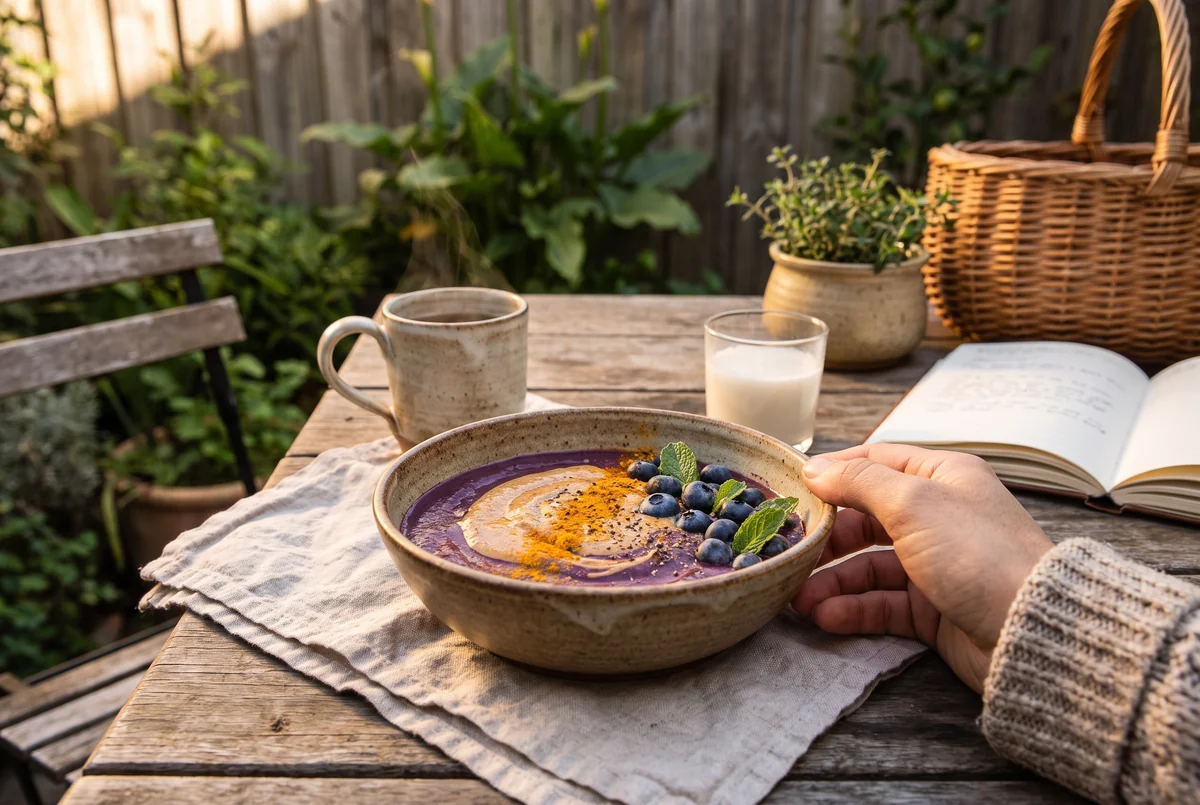
For the full bowl, which I offer as a base to adapt to your taste and to what you have in your cupboards, count on:
frozen acai pulp;
a level teaspoon of turmeric powder (about 3 g) and a pinch of black pepper;
a fat: nut butter, or an oil macerate of turmeric made with the Elixir powder;
a splash of homemade tigernut milk or store-bought plant milk.
We add, we don't take anything away, and everyone at their own pace. This bowl is a tasty way to bring the three together; no combined effect has been measured, and I promise you none. As for acai bowl benefits, that's as far as the evidence goes. It fits in as part of a varied and balanced diet and a healthy lifestyle.
That leaves the storage of powders. At home, for the chai latte, we grind the spices at the last moment in a mini blender, and the difference from ready-ground spices, which oxidise, is absolutely incredible. Powders lose their aromas to air and light, and fear moisture: vacuum sealing in a glass jar is the method we recommend at Biovie. The complete BocUp kit combines bells and a small hand pump, with no electricity and no plastic bag, and works with the glass jars you already have, if they have “shoulders” and a 65 or 84 mm lid. Dry foods stay there protected from moisture and moths.
Keep in mind that the vacuum replaces neither the fridge nor the freezer, and that it doesn't sterilise. It's all explained in our article on vacuum sealing at home.
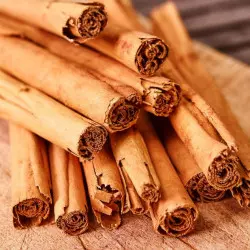
First cold-pressed virgin oils (camelina, flax, hemp) and organic spices dried below 42 °C make up this range: turmeric, ginger, Ceylon cinnamon (lower in coumarin than the Cassia sold commercially) and Bourbon vanilla. In cooking, turmeric pairs well with black pepper and a fat. Camelina or flax: camelina keeps better, while flax, with its stronger taste, oxidises faster once opened., 12
products
Let's turn to the safeguards, because a spice on your plate and a concentrated supplement are not the same story. EFSA set an acceptable daily intake (ADI) for curcumin of 3 mg per kilo of body weight per day (EFSA, 2010), which is 180 mg a day for a person weighing 60 kg.
In France, ANSES recorded more than 100 reports of adverse effects linked to supplements containing turmeric, including 15 cases of hepatitis (ANSES, 2022). It advises not exceeding 153 mg of curcumin a day from supplements for an adult of 60 kg, and estimates culinary intake at about 27 mg a day in heavy consumers.
These figures don't contradict each other, even if it looks that way. Think of a budget: 180 mg for the whole day, all sources combined, of which 153 mg are left for supplements; the 27 mg from the kitchen stay well below. Even in heavy consumers, the spice used in cooking stays clearly under the acceptable daily intake.
ANSES also points out that formulas with increased bioavailability (piperine, micelles, phytosomes) may present risks, even below the ADI. That's the flip side: what you gain in absorption, you may also gain in risk. Pepper on your plate, yes; concentrated supplements, with caution.
On the turmeric side, contraindications to know: without medical advice, it's best to avoid these supplements in case of bile duct disorders, anticoagulant therapy, cancer therapy or immunosuppressant therapy. As part of a varied and balanced diet and a healthy lifestyle, turmeric remains first and foremost a spice.
I would really like to see a serious trial one day on the benefits of turmeric, cordyceps and acai taken together. The day it happens, we'll know, and I'll tell you about it here. In the meantime, the pinch of pepper on tonight's turmeric remains the best-documented gesture in this article. And if you come across that trial before I do, write to me!
Frequently asked questions
What are the contraindications of turmeric?
Turmeric supplements are best avoided without medical advice in case of bile duct disorders, anticoagulant therapy, cancer therapy or immunosuppressant therapy, according to ANSES. Be careful with concentrated formulas too. The spice used in cooking stays, for its part, well below the acceptable daily intake.
Can you take turmeric in the evening?
Yes, nothing rules it out: no study sets an ideal time of day. What matters more is to take it during a meal, with a fat and a pinch of black pepper, because curcumin is poorly absorbed on its own. Evening suits it very well, at dinner.
What is the difference between turmeric and Curcuma longa?
None: it's the same plant. Curcuma longa is its botanical name, in Latin, the one scientists use; “turmeric” is its everyday name in the kitchen. Both refer to the same golden spice, the one that contains the curcumin studied in the bioavailability trials.
What are the properties of acai berries?
Freeze-dried acai powder contains 3.19 mg of anthocyanins per gram of dry matter, pigments studied for their antioxidant activity, and 12.89 mg/g of proanthocyanidins, according to a laboratory analysis published in 2006. Its fatty acids are 60.2% monounsaturated. These figures describe its composition and measure no effect in humans.
Can you eat acai every day?
No long-term study allows a firm answer. One pilot study gave 100 g of pulp twice a day for a month to 10 overweight adults, with no control group. In practice, acai fits in like any other fruit, as part of a varied and balanced diet and a healthy lifestyle.
How do you eat acai?
The simplest way is in a bowl, with blended frozen pulp, or as a powder stirred into a smoothie. You can add a level teaspoon of turmeric (about 3 g), a pinch of black pepper, a fat such as a nut butter, and cordyceps at the dose shown on the label.
The information presented in this article is provided for information purposes only and does not constitute medical advice. Consult a healthcare professional before making any change to your diet or supplementation.