You can spend an hour a week under the hands of a physiotherapist trained in manual lymphatic drainage. It is useful, sometimes essential - I have nothing against it. But what you drink three times a day, and what you put on your plate at lunch and dinner, weighs more than that single hour.
Why? Because your lymph is 95% water. And that 95% does not come out of the tap in the massage room. It comes out of your kitchen.
This is an article I have wanted to write for a long time. With Aurélie, we have made lymphatic detox through food a background routine - not an aggressive three-day cure you give up on, but a calm logic that settles in over time. And since the topic is saturated on search engines by massage techniques, I wanted to set down in black and white what the science documents on the drinks and foods side, and what we ourselves have come to keep, after eighteen years of practice at Biovie.
Why work on your lymph without touching massage
Before going any further, I want to be clear. Manual lymphatic drainage - the kind practised by physiotherapists or some naturopaths - has a genuine place. For secondary lymphoedema following lymph-node clearance after breast cancer, for instance, it is even the reference treatment (Royal Marsden NHS, Cleveland Clinic).
But that is a pathological situation. For 99% of the people who type "lymphatic detox" into Google because their legs feel heavier by the end of the day, who wake up with puffy eyelids, or who feel sluggish coming out of winter, the priority lever is not massage. In practice, it is what you send through your digestive tract, and what you drink, that keeps the lymph system moving day to day.
That is the angle of this article. Not a knee-jerk anti-massage stance - a reframing of priorities. And a natural entry point towards our organs of elimination, those eliminatory organs for which the lymph is the great silent collector.
How the lymphatic system really works (and why water matters so much)
Your lymph is made up of 95% water. Under-hydrated, it thickens. In everyday experience, this shows up as that diffuse feeling of light but persistent swelling, of legs that "pull" by the end of the day, of a slightly puffy face on waking - nothing dramatic in isolation, but something that settles in and that you eventually start to treat as normal.
Now, unlike the blood system, which has a heart to pump it, the lymphatic system has no pump of its own. It depends on three things: muscular movement (walking, above all), diaphragmatic breathing (a deep in-breath literally draws the lymph up towards the thoracic duct) and hydration. Without these three levers, the lymph stagnates - hence the central role of an active life and of what you drink.
The lymphatic system carries three main things: cellular waste (before it rejoins the venous circulation to be eliminated by the liver and kidneys), immune cells (B and T lymphocytes, which patrol the lymph nodes) and - less well known - the fats absorbed in the gut via the lacteals. This last function, the digestion of fats, is what explains why 60 to 70% of the lymphatic tissue in your body is found... in the intestinal wall. This is what we call the GALT, gut-associated lymphoid tissue. Put into perception: what you eat directly moves your lymph.
The 1.5-2 L rule: how much water for fluid lymph?
The ANSES recommends 1.5 L of fluids a day for a sedentary adult in a temperate climate, rising to 2 or 2.5 L as soon as you move around a little or it gets warm. It is a minimum threshold, not an athletic target. And the "invisible" water in fruit, vegetables and soups counts towards the total.
To put this back into your daily life: if you end your day with a half-finished 500 ml bottle and a coffee in the morning, you are well below the threshold. And it is not by drinking a litre in one go at 10 pm to "catch up" that you will get there - it is by spreading it out: a large glass on waking, a herbal tea mid-morning, a bottle of water that follows you all day.
The drinks that genuinely support your lymph
No miracle drink. But a palette of drinks whose effect on lymph circulation, or on the factors that slow it down, is documented by science. It is a palette, not a prescription - you pick according to your season, how you feel and your day.
Filtering and hydrogenating your water: Ecofiltro and Mizora
A drink is, first of all, its water. And tap water, in France, is technically drinkable - the ARS monitors it, the standards are met. But "drinkable" does not mean optimal. Depending on the region, you find residual chlorine (that characteristic swimming-pool taste), traces of pesticides and pharmaceutical residues that treatment plants do not fully filter out, and microplastics that are increasingly documented in European mains water.
The "filter your water" lever is one of the most effective for supporting background drainage. The reasoning is simple: what you do not load in upstream, your liver and your lymph do not have to unload downstream.
At home, we use an Ecofiltro gravity filter. The principle is old and elegant: a microporous ceramic candle, made from clay, wood sawdust and natural colloidal silver, which retains by physical filtration everything larger than 0.2 micron - bacteria, microplastics, chlorine, a large part of the pharmaceutical residues. No electricity, no disposable cartridge every three months, just a periodic brushing of the ceramic. The water flows by gravity into the lower tank and you serve yourself as from a jug. It is slow (count on 2 to 3 litres an hour), it is silent, and it turns decent tap water into genuinely high-quality drinking water. Aurélie and I have used it at home for eight years - it is our everyday water for everything: drinks, herbal teas, soups, coffee.
One notch further in the approach: hydrogenated water. That is, water in which molecular hydrogen (H₂) has been dissolved at a concentration high enough for the biological effect to be measurable - ideally between 1.2 and 1.6 ppm. The first studies on the antioxidant properties of molecular hydrogen date back to 2007 (Ohsawa et al., Nature Medicine), and more than 1,500 scientific publications have followed on the subject. The particular feature of H₂ is that it is a selective antioxidant: it specifically neutralises the most aggressive radicals (hydroxyl, peroxynitrite) without interfering with the reactive species useful for cell signalling. Put into perception: you reduce background tissue oxidative stress without short-circuiting the pathways your body needs to keep active.
And for the lymph, the benefit is indirect but real: a less inflamed terrain means a less overloaded lymphatic system, and therefore freer circulation.
To produce your hydrogenated water yourself, we use a Mizora electrolytic bottle. You fill it with your Ecofiltro-filtered water, you run a 5-to-10-minute cycle, and the electrolysis dissolves the H₂ into the water. You drink it within the following 15-20 minutes - beyond that, the hydrogen gradually escapes, as is the nature of a gas. What users most often report with regular use is a feeling of faster recovery after physical effort, and - for those with restless sleep - a calmer drift into sleep when the bottle is taken in the hour before bed.
A sensible serving: 500 ml to 1 L of hydrogenated water a day, ideally early in the morning or around a sports session. There is no need to drink everything hydrogenated - the aim is to cover part of your total intake, not to replace ordinary hydration. The combo we suggest to our customers: Ecofiltro for the daily base, Mizora for the high-value-added window. For the science behind molecular hydrogen, I refer you to our dedicated article: molecular hydrogen: the science behind the waters that have changed lives.
Isotonic and hypertonic marine plasma
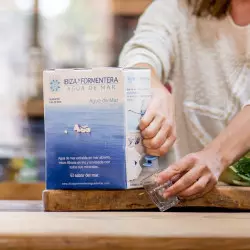
Beyond filtered water, there is marine plasma - seawater cold-microfiltered at 0.22 micron, in its isotonic version (diluted by one third, so at a concentration equivalent to that of body fluids) or hypertonic (pure seawater, more remineralising). At Biovie, since 2019, we have worked with Ibiza Agua de Mar, which draws its water off the coast of the Balearic Islands.
Isotonic marine plasma provides the 78 minerals and trace elements present in the ocean, in a directly bioavailable form. What this changes in practice: the osmotic balance of your cells - that subtle balance which determines whether fluids circulate correctly between the intracellular and the interstitial compartments - is better maintained. And it is precisely this osmotic balance that conditions the fluidity of the lymph.
Personally, every morning I take 20 ml of hypotonic marine plasma - the gentlest version, diluted from the hypertonic with four to five volumes of filtered water. Taken on an empty stomach, in the first minute after getting up, before anything else.
As part of a varied and balanced diet and a healthy lifestyle, marine plasma contributes to remineralisation.
Lacto-fermented birch sap: the spring drink
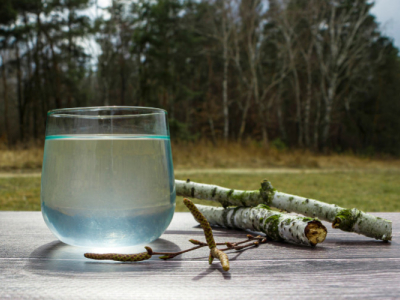
In March and April, in the forests of the Pyrenees and north-eastern France, birch sap is harvested at the foot of the tree. It is an old European tradition that you also find in Russia, in the Baltic states, in Scandinavia. And it is not some neo-naturopath's fad - the European pharmacopoeia ranks birch (Betula pendula) among the reference drainage plants (HMPC monograph, EMA).
Fresh sap poses a practical problem: it keeps for only a few days. Either you stabilise it with alcohol, or you add sugar, or - and this is the path we chose at Biovie with La Sève Cathare - you lacto-ferment it. Lacto-fermented, it keeps for several months at room temperature, with no added alcohol, no added sugar, and it gains in bioavailability because the fermentation pre-digests certain compounds.
On composition: trace elements (manganese, zinc, magnesium), flavonoids, betulin and betulinic acid (birch's specific bioactive compounds). An in vitro study published in 2011 in the Journal of Ethnopharmacology showed that the aqueous leaf extract of Betula pendula inhibited the proliferation of inflammatory lymphocytes (Gründemann et al., 2011). A more recent study, in 2024, on white birch leaf extract, observed in urinary metabolomics in the rat a fine renal modulation - less a crude diuresis than a deep metabolic clean-out (PMC12300340, 2024).
Traditionally used to support elimination, lacto-fermented birch sap is taken as a 21-day course, at 100 to 150 ml a day on an empty stomach in the morning. The ideal time is March-April - coming out of winter, exactly when the body needs it and when the tree gives it.
Green tea provides catechins, the most studied of which is EGCG (epigallocatechin gallate). Documented antioxidant properties, a mild diuretic effect. Without getting into any therapeutic claim: for someone who usually drinks two coffees and a soft drink during the day, swapping one of the two for a green tea brewed for 3-4 minutes maximum (beyond that, it is bitter and too tannic) is a net gain for your lymph.
A practical note: if you are sensitive to caffeine, have it before 4 pm. If you take iron as a supplement, separate it by at least two hours from the tea (the tannins in tea block iron absorption).
Infusions of draining plants: dandelion, nettle, birch leaves
This is the great classic. And it works. Dandelion (Taraxacum officinale) is listed in the European HMPC monograph for its traditional use in supporting eliminatory functions. Nettle (Urtica dioica), likewise. Birch leaves (Betula pendula folium), likewise.
A recipe we use at home outside the sap season: three plants in equal parts (dandelion, nettle, dried birch leaves), two teaspoons for 250 ml of simmering water, infused for 8 minutes with a lid on. One or two cups a day, as a three-week course.
No "fat-burner" herbal tea with 19 plants and loud marketing - three simple plants, properly infused, work better.
Ginger and lemon water: the morning draining drink
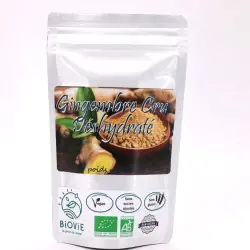
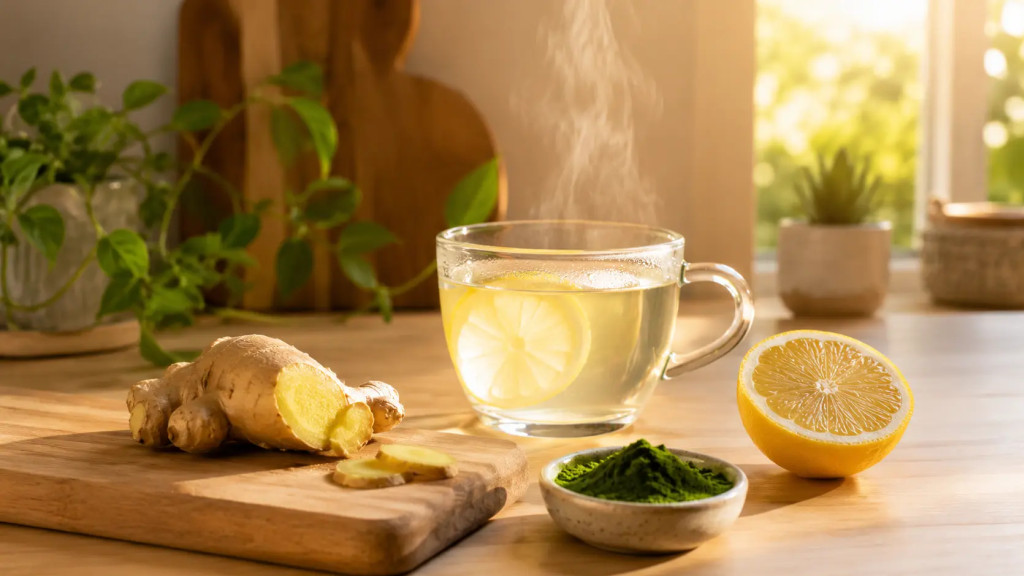
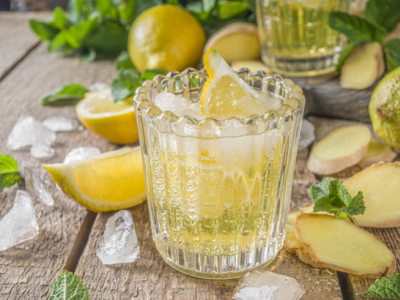
This has been my dawn drink since well before Biovie. 250 ml of warm water (Ecofiltro-filtered at our place), the juice of half a lemon, a centimetre of freshly grated ginger infused for five minutes. On an empty stomach. Before anything else.
Ginger provides gingerol, a documented anti-inflammatory (HMPC dossier). The lemon provides vitamin C and its mild acidity activates bile secretion. Together, it is a gentle digestive start-up that wakes the eliminatory organs without aggression. For the full recipe and its 6 documented benefits: ginger and lemon water: the detox recipe with 6 benefits.
By the way, I have a tip to share with you - a little hack that saves me five minutes every morning, and that makes sure I keep the routine going over time. I regularly prepare several ice-cube trays with fresh organic lemon juice. And likewise, I extract the ginger juice with our Hurom juicer and keep several trays of it in the freezer too. That way, I make my morning drink in less than a minute: just two or three lemon-juice cubes, one ginger-juice cube, and warm filtered water on top. It melts gently, it is ready in five minutes, and the taste quality is far superior to a lemon you squeezed half-asleep at the sink.
The 4 food families that support lymphatic drainage
If you fill your plate with these four families of foods for lymphatic drainage, you have already done 80% of the work. The rest - the herbal teas, the cures, the massages - comes to complete it, not to replace it.
Leafy greens and chlorophyll (chlorella, spirulina)
Chlorophyll, that green pigment which allows plants to turn light into sugars, has a fascinating molecular structure: it is almost identical to that of human haemoglobin. Except that, instead of an iron atom at its centre, it has a magnesium atom. This is what earns it, in popular language, the nickname "green blood".
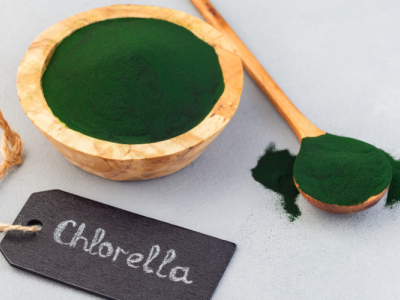
On the lymph side, what interests me in particular is chlorella. A freshwater microalga that we consume as a powder or in flakes - never as tablets at our place, because tablets concentrate the alga but lose part of its bioavailability, and because we are keen for you to see what you eat.
Chlorella has a documented feature: its cell wall (the sporopollenin) has a capacity to chelate heavy metals. A study published by Merino et al. (2021) documented its effect on the elimination of arsenic and lead. What this changes for the lymph: everything wandering in the interstitial fluids that the liver would struggle to handle on its own is, in part, captured by the chlorella and removed via the digestive route. Put into perception: less overload in the circuit, and therefore lymph that circulates more freely.
In practice: start gently, half a teaspoon (about 1.5 g) in the morning in a glass of water or a smoothie, then build up gradually to 3 g a day over two to three weeks. No need to take 10 g - the effective dose is modest.
I talk about it at length, in fact, with Aurélie in Algues au quotidien (Gallimard / Alternatives 2024) - chlorella has a chapter of its own.
Polyphenols are a family of plant molecules with much-studied antioxidant properties. For the lymph, what interests us is their action on the tone of the lymphangion - the contractile unit of the lymphatic vessels, that small segment which contracts rhythmically to push the lymph towards the upper body.
A narrative review published in the International Journal of Molecular Sciences in 2022 (Mortimer et al., PMC9710411) lists the dietary compounds with a documented action on lymphoedema: hydroxytyrosol (olive and olive oil), hesperidin (citrus, particularly the white pith between the zest and the flesh), anthocyanins (blueberries, blackberries, blackcurrants), grape flavonoids. The action is anti-inflammatory and tones the lymphangion - not a "magic" effect, a quiet but real dietary effect.
What this looks like day to day: a handful of blueberries or blackberries at 5 pm, a kiwi in the morning, two spoonfuls of extra-virgin olive oil on the salad, a cherry tomato picked along the way. Nothing spectacular, but accumulated over time - that is what moves the needle.
Lacto-fermented vegetables: the gut-lymph connection
I come back to it because, for me, it is the most underrated lever. 60 to 70% of the body's lymphatic tissue is found in the intestinal wall (the GALT). What this means in practice: your gut microbiota - the community of bacteria living in your digestive tract - is in permanent dialogue with your lymphocytes. When the microbiota is in good shape, the GALT is calm. When it is in dysbiosis, the GALT becomes inflamed, and that is what you feel: bloating, immune fatigue, diffuse swelling.
Lacto-fermented vegetables - raw sauerkraut, kimchi, mixed vegetables in jars - provide live bacteria (mainly lactobacilli), post-biotics (the compounds produced by fermentation, which have their own benefit), and a fibre that is already partly pre-digested and therefore gentler on a sensitive gut.
The common mistake is to eat a mountain of it all at once. Two to three tablespoons per meal is plenty - beyond that, the salt content and the effect of the fermentation can cause discomfort.
And - house rule - shop-bought pasteurised sauerkraut does not count. Pasteurised = dead bacteria = a cooked acidic vegetable, not a living food.
Sodium (salt) holds water in the extracellular compartment. Potassium does the opposite: it favours its renal elimination. The Na/K ratio in a modern Western diet is heavily skewed in favour of sodium - the ANSES estimates the average French intake at 8-10 g of salt a day against a recommendation of 5 g maximum.
A practical tip: replacing a portion of white bread with half an avocado on a slice of wholemeal bread at breakfast is a gain of 400 mg of potassium with no effort.
The 5 foods to limit (the counter-poison)
You can multiply the draining herbal teas in the evening, but if alongside that you salt your dishes at the end of cooking - that is, at the point where the salt no longer dissolves and your palate asks for more of it to register the taste - you are back to square one.
Five families to moderate, without dogmatism.
Added salt beyond the 5 g/day recommended by the ANSES (the salt that hides above all in industrial bread, charcuterie, mature cheeses, ready meals). Refined sugar, because the hyperinsulinism it causes favours water and sodium retention. Ultra-processed products classed as NOVA 4 - those whose ingredient list reads like a chemistry lesson. Alcohol, which dehydrates and overloads the liver, and therefore indirectly the lymph. And an excess of animal protein, which acidifies the tissue terrain and increases the load on the eliminatory organs.
When to see a doctor: the genuine warning signs
A lymph that stagnates can be felt. But certain signs are never treated at the plate.
If you notice a persistent oedema that does not resolve within 48 hours, asymmetric (one limb more swollen than the other), painful, accompanied by fever, redness, heat, unexplained weight loss, or if you feel a fixed, hard, painless lymph node that does not disappear after two weeks - see a doctor. Your GP first, then an angiologist or haematologist depending on what they recommend (NHS Lymphoedema).
These signs do not belong to the "lifestyle" sphere. They call for medical assessment. No food, no cure, no home massage replaces that consultation. It is precisely because the dietary levers are so effective on background drainage that you need to know how to recognise what lies outside their scope.
The lymph routine on a plate: a typical day
Here is what it looks like, in practice, in one of my days. Not an ideal day photographed for Instagram - a standard day, in June 2026.
All day long, the water we drink is filtered with the Ecofiltro, and systematically run through the Mizora.
On waking (7 am): 250 ml of warm hydrogenated water, the juice of half a lemon, a centimetre of freshly grated ginger, infused for five minutes. Drunk slowly before taking anything else.
Breakfast (8 am): half a teaspoon of chlorella powder diluted in a glass of filtered water, followed by a tiger-nut flake porridge with a hemp drink or tiger nut drink, a spoonful of almond purée, a handful of blueberries.
Mid-morning (10:30 am): in season (March-April), 100 ml of lacto-fermented birch sap. Out of season, a cup of dandelion-nettle-birch-leaf infusion.
Lunch (1 pm): a large plate of raw green salad, two tablespoons of lacto-fermented vegetables (beetroot-cabbage or raw sauerkraut), a portion of plant protein (lentils, chickpeas, lacto-fermented tofu), a drizzle of extra-virgin olive oil, sprouted seeds.
Afternoon snack (4 pm): a handful of activated almonds with raisins and blueberries, or a kiwi and a banana.
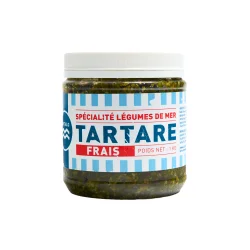
Evening (7:30 pm): in the style of Irène Grosjean, a raw soup of garden peas or mushrooms, an avocado with seaweed tartare, sometimes 20 ml of hypotonic marine plasma.
Opt for an organic, healthy and chlorine-free shower thanks to the integral water filter without cartridges with retro-cleaning system. Filtration and dynamization., 17
products
There is no single draining drink, but a combination. Science and practice converge towards: sufficient hydration (1.5 to 2 L a day of filtered water), chlorella to relieve the circulation of heavy metals, lacto-fermented birch sap as a spring course, and the traditional draining plants (dandelion, nettle, birch leaves) as an infusion. Combined with a diet rich in polyphenols and lacto-fermented vegetables.
How can you detox your lymphatic system?
Before the drinks, the base water: filtered (ideally a ceramic gravity filter such as Ecofiltro) and hydrogenated (such as Mizora) as standard. Then: hypotonic marine plasma daily for gentle remineralisation; lacto-fermented birch sap as a spring course; green tea for the catechins; infusions of dandelion, nettle and birch leaves as a three-week course.
How do I drain my lymphatic system myself?
The classic comes down to two gestures. A daily infusion of dandelion-nettle-birch-leaves as a three-week course in spring. And an alternating hot-cold foot bath in the evening: three minutes in hot water, thirty seconds in cold water, repeated five times. Simple, free, effective for circulation in the extremities.
What are signs your lymphatic system is blocked?
A few common signs: a feeling of heavy legs at the end of the day, puffy eyelids on waking, fingers that "swell up" (rings that leave a mark), persistent morning fatigue, skin that marks easily (the imprint of an elastic that lingers), a feeling of diffuse swelling with no identifiable cause. These signs are not a diagnosis - they are indicators to cross-check. Any persistent or asymmetric sign calls for a medical consultation.
Should you also have manual drainage alongside food?
Yes, it has its place. Manual drainage performed by a trained physiotherapist is useful, especially as a complement to a seasonal course. But it is a one-off intervention (once a week at best) whereas food works three times a day. The practical hierarchy: you first put in place the dietary base, then you add the manual layer on top if you feel the need.
How long does a nutritional lymph protocol take?
Three weeks minimum for an effect to be felt - it takes time for habits to settle and for the body to adjust. The ideal is to work in seasonal courses: a spring course with birch sap (March-April), an autumn course with the draining plants as an infusion (September-October). Between courses, you keep filtered hydration and lacto-fermented vegetables as a background routine.
Are there any contraindications?
Yes, several precautions to be aware of. During pregnancy and breastfeeding: no intensive course of draining plants without medical advice (dandelion, nettle and birch are contraindicated or to be supervised). On diuretic, anticoagulant or antihypertensive treatment: medical advice is mandatory (risk of interaction). In cases of kidney or heart failure: no hypertonic marine plasma without medical follow-up. Birch pollen allergy: caution with birch sap (cross-reactions possible).
Does lymphatic detox through food make you lose weight?
No. And we need to be clear about that. Lymph that circulates better can give a feeling of local de-puffing - a less puffy face, less heavy legs - but it is not a loss of body fat. It is a fluid rebalancing. For genuine weight loss, the subject lies elsewhere: energy balance, sleep quality, physical activity. Drainage supports the terrain; it is not a slimming diet.
In summary: your lymph routine on a plate in 5 points
Hydrate with between 1.5 and 2 litres a day of filtered (Ecofiltro) and hydrogenated (Mizora) water, topped up with herbal teas and marine plasma on a daily basis. Eat five portions of vegetables a day, including at least one raw and lacto-fermented. Put polyphenols into your everyday life: berries, citrus, grapes, olive oil. Do a seasonal course of lacto-fermented birch sap in March-April. And reduce - without drama, but without complacency - added salt, refined sugar, alcohol and ultra-processed products.
It is a background logic, not a three-day cure. And it is precisely because it is calm that it works over time.
The information presented in this article is provided for informational purposes and does not constitute medical advice. Consult a healthcare professional before making any change to your diet or your supplementation, particularly in the case of pregnancy, breastfeeding, ongoing medical treatment, or a history of kidney or heart conditions. Food supplements are not a substitute for a varied and balanced diet and a healthy lifestyle.