







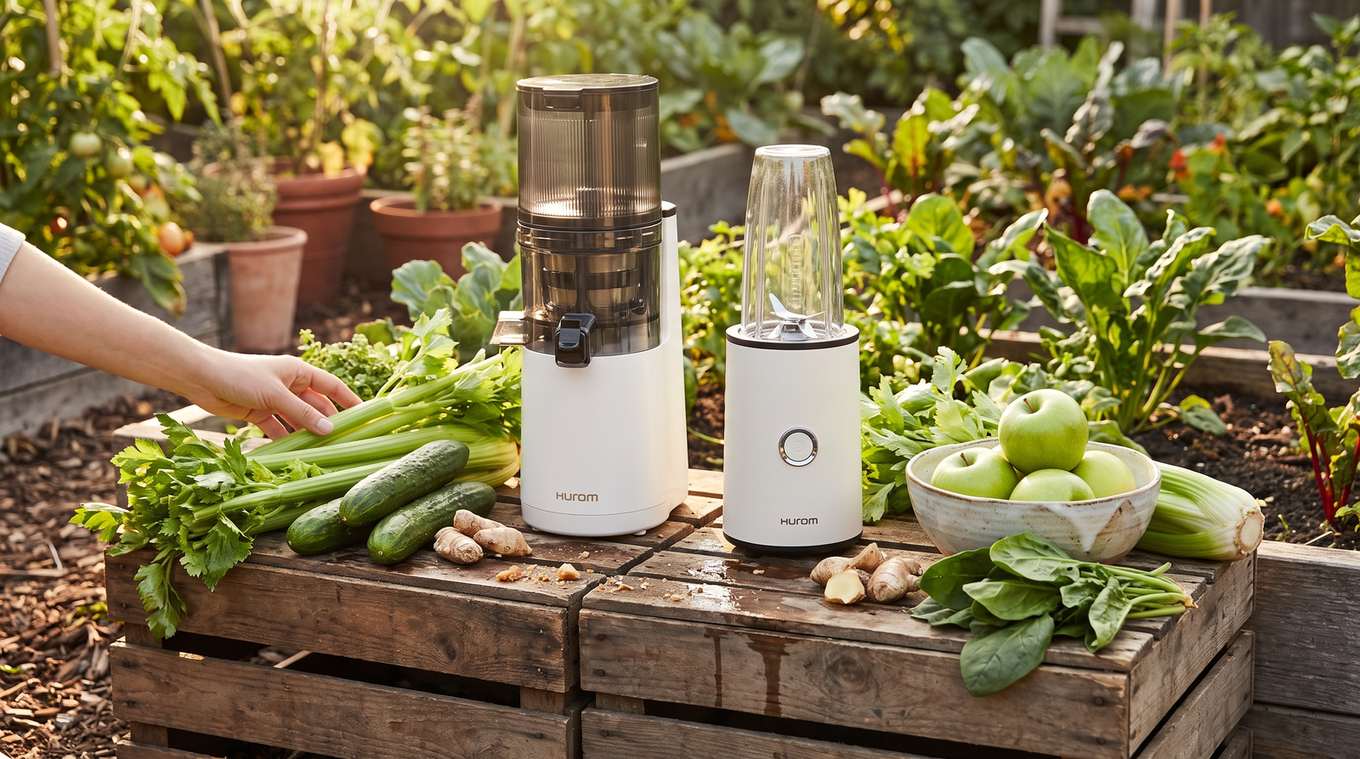
Put a carrot through a blender and it ends up whole in the glass; in a slow juicer, it splits into clear juice and dry pulp. There you go, that is the difference between a blender and a juicer: one grinds and keeps the fibre, the other presses and sets it aside. At Biovie we sell both, and to settle juicer vs blender, which is better, this page draws on seven sources, without taking sides.
Two questions come back constantly at customer service: how to make soy milk in a blender, and which juicer to pick to get started with juices. Since we sell both appliances, I have no interest in pushing you towards one rather than the other, and that makes it comfortable to write honestly. Vegan since 1992, into living food since the early 2000s, an ISTOM engineer, I have kept an agronomist's reflex: look at the mechanism before listening to the sales pitch (and there is plenty of pitch around juicers).
So let's look at what really happens inside the bowl.
Juicer vs blender, which is better? Two motions, two drinks
The difference between a blender and a juicer comes down to the motion. A blender spins blades at top speed and pulverises the whole plant, fibre included, into a thick drink. A juicer takes its time: a slow auger turns, crushes, presses, and the juice comes out one side while the pulp leaves by the other. I like the image of an orchard in autumn. The blender is the food mill that reduces a whole apple to a fine purée; the juicer is the old winemaker's press, which slowly squeezes the harvest and leaves the pomace behind. One keeps the framework of the plant, the other keeps only the sap. The whole question of the choice is there: what do you want to find in your glass?
What a blender does
In a blender, nothing is lost: everything that goes into the bowl comes out in the glass, thick and velvety. Without a little water or a nice juicy fruit, the blades just spin in the void. It is the appliance for quick meals. We sometimes walk in the door at 6:50 pm and eat a living soup at 7:05 pm: dried and fresh mushrooms, almond purée, avocado, a clove of garlic and warm water, a blitz of the blender, and dinner is served.
What a juicer does
Here, the pace changes. A slow auger turns, crushes the plant against a strainer and pushes the almost dry pulp towards a separate outlet. The juice flows out the other side, clear, and most of the insoluble fibre stays in the pulp. Green leaves and fresh herbs go through leaf by leaf, without protest.
And the centrifugal juicer?
The centrifugal juicer, the third wheel, grates the plant and throws the shreds against a basket spinning very fast. I won't dwell on it here: I explain the difference between a centrifugal juicer and a slow juicer in a dedicated article.
Fibre and nutrients: what the studies really say
Let's say it straight away: on juicer vs blender, which is better, there is no absolute winner. It all depends on what you press and what you measure, and that is exactly what makes these studies interesting to read closely.
The fibre stays in the blender glass
A team compared three methods in the laboratory, including the blender and the slow juicer, on 19 common vegetables, identifying 85 metabolites, that is, as many molecules picked out one by one in the glass (Wang et al., 2020). Blended juices contained the most alpha-amylase inhibitors (an enzyme that breaks starch down into sugars), which the team links to their fibre content. The authors name no winner: the blender for fibre-rich drinks, the slow juicer for antioxidant-rich juices. I like that honesty.
Vitamin C and polyphenols: the edge goes to the slow auger, but not everywhere
On those same vegetables, the blender gave the lowest levels of vitamin C and phenols. The authors probably attribute this to heating under the blades, without having shown it, and I give it to you as it is. The slow juicer obtained the highest levels on most of the vegetables tested, with exceptions.
With grapes, the gap becomes spectacular. An in vitro study measures 326.8 mg tannic acid equivalent of total polyphenols per 100 mL with the slow juicer, against 90.3 with the centrifugal juicer and 47.1 in the flesh of the fruit (Kim et al., 2017): more than three times as much as with the centrifugal juicer, in the same glass. Vitamin C follows the order slow juicer, blender, centrifugal juicer, then flesh. And the yield reaches 79.1% against 45.0% for the centrifugal juicer, almost twice as much juice from the same bunch (the blender stands apart, since its "juice" is diluted there with an equal weight of water, hence a yield of 100%).
And then there is the study that disturbs, which I won't sweep under the rug: on fruit juices, one team finds no significant difference between cold pressing and a centrifugal juicer (Khaksar et al., 2019). How can two serious laboratories diverge that much? The explanation is fairly down to earth: you don't press an apple like a spinach leaf, appliances and measurement methods change from one team to another, and that study doesn't even test the blender. A study on one food never tells the whole story of an appliance.
Blood sugar: what two small studies measured
The glycaemic index measures how fast a food makes blood sugar rise. In 19 healthy volunteers, a fruit mix put through a blender-type appliance called a "nutrient extractor" showed an index of 32.7 ± 8.5, against 66.2 ± 8.2 for the same whole fruits, roughly half (Redfern et al., 2017, a trial published as a letter). For mango alone, however, no difference (37.6 against 31.1, in 9 volunteers), and the authors admit they do not know the mechanism.
In 20 healthy young adults, a second team measured a lower blood sugar peak and area under the curve with blended apple and blackberries than with the whole fruits (Crummett and Grosso, 2022).
Now, let's stay lucid: the measurements are taken with a glucose meter, on small groups of healthy volunteers. This work shows that blending does not "destroy" the fruit, not that a smoothie acts on blood sugar.
As for official guidelines, the recommendations of Santé publique France, relayed by the Ministry of Health, set freshly pressed fruit juices at one glass a day at most for an adult, half a glass for a child, and clearly distinguish industrial juices, "rich in sugars and low in fibre". A glass of fresh juice has its place as part of a varied and balanced diet and a healthy lifestyle, alongside whole fruit.
What each appliance lets you prepare
Beyond the figures, what will matter at your place is what you feel like preparing on a Tuesday evening, coming home from work.
With the blender: smoothies, raw soups, sauces
The blender is a bit like the Swiss army knife of living cuisine. The morning smoothie, of course, but also gazpacho, basil pesto or a creamy sprouted seed sauce that wakes up a plate of raw vegetables. The blender keeps the whole plant, and it is the simplest tool for eating living food every day.
With the juicer: vegetable and green juices
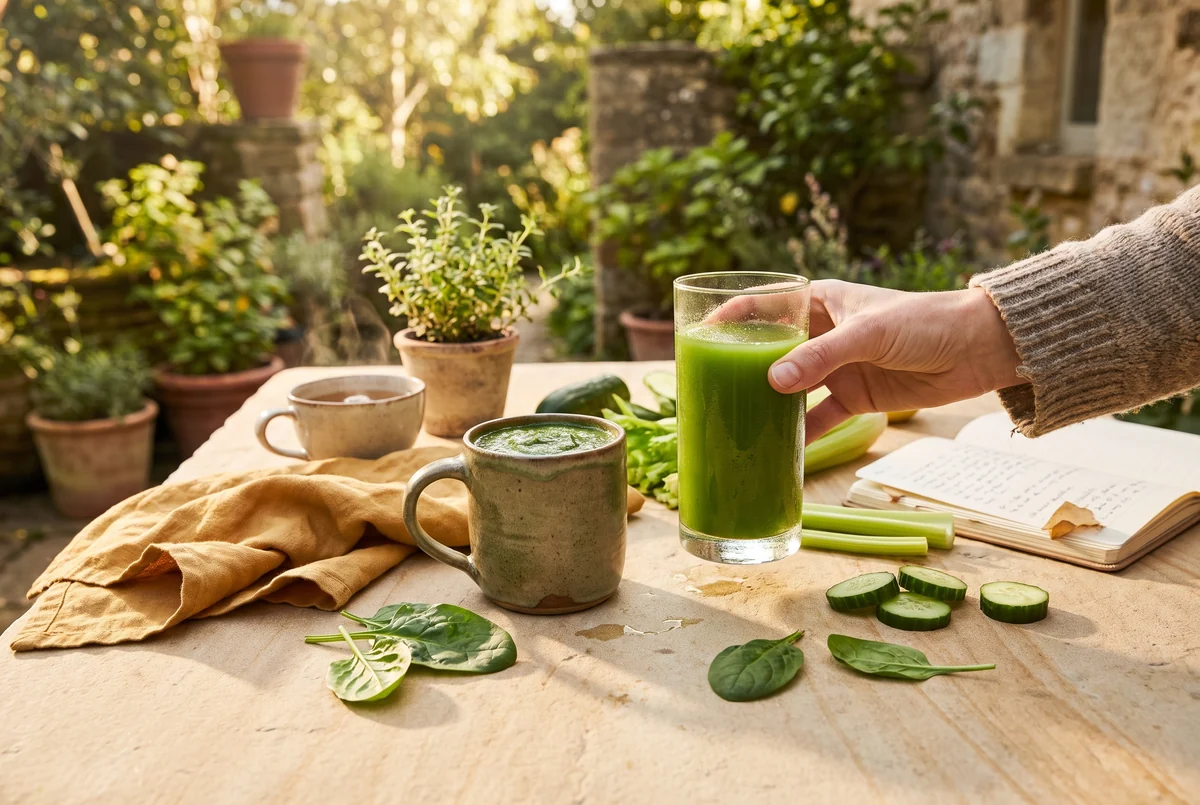
The juicer takes over for green vegetable juices: celery, cucumber, spinach, a piece of ginger, a few herbs. It turns a bunch of celery into a glass of fluid juice that you drink without chewing. For variety, here are our juicer juice recipes.
Plant milks: blend, then strain
The principle comes in two steps. For a plant milk in the blender, you blend the soaked seed or nut with water, then take the time to strain it with a plant milk bag; homemade tiger nut milk lends itself very well to the exercise. We don't sell any ready-made plant milk, by the way: in my eyes, a milk you can make at home in a few minutes has little to gain from travelling in a carton. Some juicers also accept soaked nuts, your model's manual will tell you.
The case of soy milk
Let's come to soy, and here the raw-food devotee that I am is going to ask you to get out the saucepan. The raw bean contains trypsin inhibitors, the enzyme that breaks proteins down during digestion. In an in vitro study on soy milk, their activity goes from 10% (raw soy) to 3% after conventional heating and to 1% in the microwave, and protein digestibility increases by 11% and 7% (Vagadia et al., 2018). Heating therefore divides this activity by at least three.
Yes, reading "cook" from my pen may come as a surprise. I own it: raw is not a religion. You are not what you eat, but what you absorb, and for soy, that goes through the saucepan. For homemade soy milk: soak, blend, strain, then cook, whatever the appliance. Well cooked, it has its place as part of a varied and balanced diet and a healthy lifestyle.
Day to day: cleaning, noise, space, budget
An appliance that sleeps at the back of the cupboard is useless, and it is very often the cleaning, far more than the recipe, that decides its fate. Who feels like scraping dried pulp off a strainer on a Monday night? Nobody, and me first.
On the blender side, it is quickly settled: the jar and its blade base rinse in one motion, with a little hot water and a drop of soap blended for a few seconds. The easiest juicer to clean is first of all one that you rinse straight away, before the pulp dries in the mesh of the strainer. To know how to clean a juicer, remember the order: each part under the tap, then the strainer with the brush, the manufacturer's manual having the last word for the rest. The real criterion of ease is the number of parts and the shape of the strainer.
Noise matters too. Blades spinning very fast make more noise than a slow auger, which counts if you prepare your drink while the house sleeps. For space, measure your corner of worktop: an appliance you have to take out of the cupboard every time ends up never coming out at all. As for budget, compare the product sheets for equal use, since the two appliances do not do the same job: pitting their prices against each other is a bit like comparing a saucepan and a colander.
| Criterion | Blender | Juicer |
|---|---|---|
| Texture | Thick, velvety | Fluid, clear |
| Fibre | Kept in the glass | Set aside with the pulp |
| Preparations | Smoothies, raw soups, sauces, pesto | Vegetable and green juices |
| Plant milks | Blend, then strain with a milk bag | Depends on the model's manual |
| Cleaning | Jar and blades, quick rinse | More parts, strainer to brush |
| Noise | Louder (fast blades) | Quieter (slow auger) |
| Space | One base and one jar | Depends on the model |
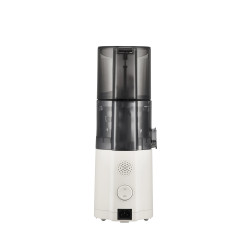
To go further, I have gathered the criteria for choosing a juicer in a separate article. At Biovie, the juicer we offer is the Hurom E30ST, whose product page gives the details.