Irish Moss (Sea Moss): the red algae, homemade gel and 6 raw recipes
Irish Moss, a small edible algae
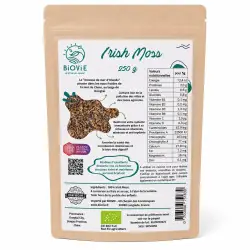
For years, many customers have been asking us to Irish MossOr Irish mossTo create delicious raw and plant-based desserts. As we listen to your requests, we have finally listed it. Beyond its culinary assets, this small edible seaweed holds many secrets that we will share with you in this article.
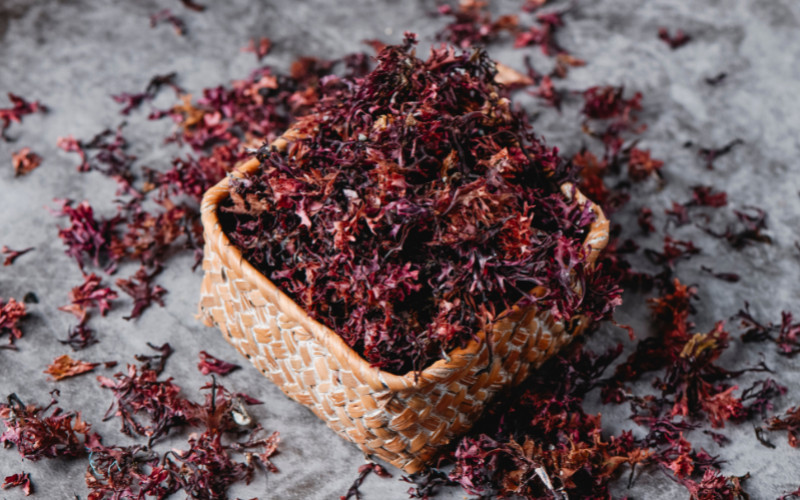
The ocean offers us many edible algae. Among them, the Irish Moss, or Chondrus crispus, is a red algae. Often also called "Sea Moss" or "Carrageenan Moss",this marine plant shares similarities with others algae and well-known leafy sea vegetables, such as kelp or the Dulse. .
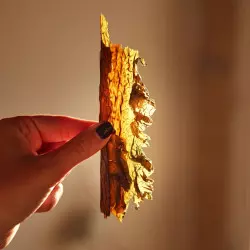
This algae naturally thrives along the rocky coasts of the Atlantic, flourishing mainly between North America and Europe. In its fresh state, it is characterized by its soft and cartilaginous texture, and Its colors range from yellowish-green to red, including dark purple or purplish-brown.. Beyond its botanical characteristics, the'Irish Moss has a rich history: it has been consumed for centuries in Ireland.
His place in theliving food and plant-based is experiencing remarkable growth. Irish Moss is gaining recognition and popularity in Western countries, particularly among health-conscious communities and enthusiasts of Veganism. It is now perceived as a versatile and valuable ingredient for those who prioritize a natural nutrition, unprocessed and plant-based.
Interest in Irish Moss comes mainly from its use in plant-based and raw cooking, where it replaces animal gelatin.
Irish Moss is a natural thickener. Here is its composition, based on available nutritional data.
Minerals
Irish Moss contains minerals, including:
Iodine: Irish Moss contains iodine, in a highly variable amount (see the note below).
Iron: A 20-gram serving of raw Irish Moss can provide 10% of the daily intake recommended in iron.
Magnesium: Provides 7% of the daily value per 20 grams.
Calcium: Provides 1% of the daily value per 20 grams.
Zinc: Provides 4% of the daily value per 20 grams.
Other minerals: Irish Moss also contains phosphorus (2% DV per 20g), of Copper (3% DV per 20g), as well as potassium, of the manganese, of the selenium, of the sulfur, of the Brome and the sodium.
Other components
Beyond vitamins and minerals, Irish Moss contains the following components:
Polysaccharides: The main component is the carrageenan, which represents 55% of its dry weight. Carrageenan is a natural thickening and stabilizing agent (E407/E407a) widely used in the food industry.
Proteins and amino acids: Although it has only a modest protein content (nearly 10% of its dry weight; 0.5 g per 20 g when raw), Irish Moss contains essential amino acids, including taurine.
Fibers: 0.5 g per 20 g raw.
Calories, fat, and sugars
Irish Moss provides 10 kcal per 20 g (49 kcal per 100 g), 0 g of fat per 20 g (0.16 g per 100 g) and 0 g of sugars per 20 g (0.61 g per 100 g).
For better visualization, here is a simplified overview of the nutritional profile of this seaweed for a typical serving:
Table 1: Simplified Nutritional Profile of Irish Moss (for 20g / 4 tablespoons of raw gel)
Nutritional Component
Quantity (for 20g)
% of the Daily Value (DV)
Calories
10
Proteins
0.5 grams
Total Lipids
0 grams
Total Carbohydrates
3 grams
Fibers
0.5 grams
Total Sugars
0 grams
Calcium
1% VQ
Iron
10% VQ
Magnesium
7% ABV
Phosphorus
2% VQ
Zinc
4% ABV
Copper
3% VAT
Iodine
Variable
Highly variable content: see the note below
Important note on iodine:The iodine content of Irish Moss can vary significantly depending on its growing environment. It is crucial to consume Irish Moss in moderation to avoid excessive iodine intake, which can have adverse effects on the thyroid.
This table presents the composition of Irish Moss. It is a reminder of the importance of moderate consumption, particularly regarding iodine.
Iodine in Irish Moss
The iodine content must be monitored: an excess can have deleterious effects on thyroid function. The iodine content of the seaweed, including Irish Moss, is extremely variable, ranging from 11 to 6118 µg/g of dry weight. This variability depends on factors such as the species of algae, the part of the plant, the growth stage, the season, and the geographical location. Therefore, the consumption of Irish Moss should be approached with caution and moderation. For individuals with a history of thyroid disorders, it is imperative to consult a healthcare professional before incorporating Irish Moss into their diet. Irish Moss is therefore a food to be consumed with discernment.
Irish Moss in Plant-Based and Raw Cuisine: An Ethical Alternative
Irish Moss is an extraordinarily versatile ingredient, particularly appreciated in plant-based and raw cuisine. Its ability to transform into a mucilaginous gel makes it an ideal substitute for animal gelatin, providing an ethical dimension to many preparations.
A. An ideal substitute for animal gelatin: ethical advantage and gelling properties
In the world of vegan cuisine, finding effective and ethical alternatives to animal-derived ingredients is a constant quest. Gelatin, traditionally derived from animal bones and tissues, poses a challenge for vegan and vegetarian diets. This is where Irish Moss comes in as an elegant and powerful solution.
The secret of its gelling properties lies in its natural compound, carrageenan. He is responsible for the characteristic gelatinous texture of Irish Moss once it is transformed into gel. This property allows for the creation of creamy, thick, and gelled textures without compromising ethical convictions.
Compared to other plant-based substitutes like agar-agar (also derived from algae), Irish Moss gel offers a softer and more supple texture, blending better into creamy preparations like mousses or ice creams.. Agar-agar, on the other hand, tends to give a firmer and more brittle texture. Additionally, Irish Moss gel is perceived as a "fresher" and less processed option than powdered agar-agar, which aligns with the values of raw food diets.
B. Preparation of Irish Moss Gel (base for all recipes)
Before starting, you will need to prepare Irish Moss gel, which is the most common and versatile form of this seaweed in cooking.
Ingredients:
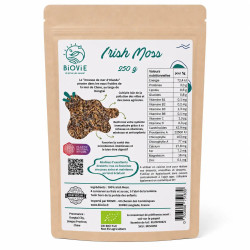
50 g (about 1/2 cup) of dried Irish Moss
Filtered water (for soaking and mixing)
Instructions:
Cleaning: Rinse the dried Irish Moss thoroughly under cold running water for several minutes. Gently rub it to remove any sand, salt, or marine debris. The "oceanic" smell will diminish as you rinse it.
Soaking: Place the rinsed Irish Moss in a large bowl and generously cover it with filtered water. The seaweed will swell considerably. Let it soak in the refrigerator for at least 4 to 12 hours, or ideally overnight, until it becomes soft, translucent, and gelatinous.
Mixing: Drain the soaking water (you can keep it if you wish). For 1.5 cups of hydrated Irish Moss (obtained from about 1/2 cup dry), add 180 ml (3/4 cup) of filtered water into a high-powered blender.
Transformation into gel: Blend at high speed for 1 to 2 minutes until you achieve a perfectly smooth and gelatinous consistency, without any lumps.
Cooling and preservation: Pour the obtained gel into an airtight glass jar. Refrigerate for at least 2 to 3 hours to allow it to set completely. Irish Moss gel can be stored in the refrigerator for 2 to 3 weeks (or up to 1 month) and can be frozen for up to 3 months (or 6 months) for later use.
C. 6 Raw and Plant-Based Recipes with Irish Moss
1- Intense chocolate pudding with Irish Moss
This rich and creamy pudding is a delicious alternative to traditional desserts, without dairy products or animal gelatin.
In a blender, Combine all the ingredients: Irish Moss gel, banana, mango, spinach, plant milk, hemp seeds, marine plasma (if used), and ice cubes.
Blend at high speed until you achieve a smooth and uniform consistency.
Pour into a large glass and enjoy immediately.
3- Creamy Lemon & Herb Dressing with Irish Moss
This plant-based and raw dressing is perfect for binding your salads and vegetables, providing a rich texture and a touch of freshness without excessive oil.
Ingredients:
2 tablespoons of Irish Moss gel
60 ml (1/4 cup) of Biovie activated almond puree (or tahini)
Juice of half a lemon (about 2 tablespoons)
1 tablespoon of nutritional yeast (for a cheesy flavor)
1 small clove of garlic, finely chopped
2 tablespoons of filtered water (adjust for consistency)
1 teaspoon of organic blueberry vinegar and Biovie sea water (optional, for a tangy and mineral touch)
In a small bowl or blender, combine the Irish Moss gel, almond puree, lemon juice, nutritional yeast, garlic, water, and the vinegar(if used).
Whisk or blend until you achieve a smooth and creamy consistency. Add more water if the dressing is too thick. Season with salt and pepper to taste. Stir in fresh herbs if desired.
Serve on your salads, raw vegetables, or as a dip. Keeps in the refrigerator for several days.
4- Creamy Brazil nut faux-cheese with herbs and Irish Moss
A ethical and delicious alternative to traditional cheeses, perfect for vegetable platters or toasts.
Ingredients:
1 cup (approximately 150 g) of Biovie Brazil nuts (soaked for at least 6 hours, rinsed and drained)
2 tablespoons of Irish Moss gel
60 ml (1/4 cup) of filtered water
1 tablespoon of lemon juice
1 tablespoon of nutritional yeast
1/2 teaspoon of garlic powder
1/4 teaspoon of sea salt
Chopped fresh herbs (chives, parsley, dill) or dried (oregano, thyme) to taste
Instructions:
In a powerful blender, combine the soaked and drained Brazil nuts, Irish Moss gel, filtered water, lemon juice, nutritional yeast, garlic powder, and salt.
Mix until you achieve a very smooth and creamy paste, scraping the sides if necessary. The consistency should be like that of fresh cheese.
Incorporate the chopped herbs by hand or blend very briefly to mix them.
Transfer the faux cheese into a small container or a mold lined with parchment paper.
Refrigerate for at least 2 to 3 hours to allow it to firm up.
Serve with raw crackers, vegetables, or as a spread. Keeps in the refrigerator for 5 to 7 days.
5- Gummy candies with Irish Moss and red fruits
Fun treats, perfect for children and adults.
Ingredients:
120 ml (1/2 cup) of Irish Moss gel
1 cup of fresh or frozen red fruits (strawberries, raspberries, blueberries, blackberries) or a mix of Biovie freeze-dried açaí berry powder and other Biovie freeze-dried fruits (Pineapples, Mangoes) (rehydrated if necessary)
2 to 4 tablespoons of maple syrup, date syrup, or another natural sweetener (adjust to taste)
60 ml (1/4 cup) of filtered water (adjust according to the consistency of the fruits)
Instructions:
In a powerful blender, combine the Irish Moss gel, red fruits (fresh or rehydrated), the sweetener, and filtered water.
Blend until you achieve a very smooth and homogeneous puree.
Adjust the amount of water to achieve the desired consistency (more liquid for a jelly, thicker for candies).
Pour the mixture into silicone molds (small candy molds, ice cube trays) or into a shallow dish lined with parchment paper.
Refrigerate for at least 2 to 4 hours, or until the candies are well set.
Unmold the candies or cut the jelly into small squares. Store in an airtight container in the refrigerator.
6- Comforting raw vegetable soup with Irish Moss
A cold soup, ideal for hot days, rich in flavors.
Ingredients:
60 ml (1/4 cup) of Irish Moss gel
480 ml (2 cups) of raw vegetable broth (you can use homemade broth or Biovie organic raw superfood broth)
In a powerful blender, combine the Irish Moss gel, vegetable broth, cucumber, bell pepper, tomato, avocado, garlic, ginger, dried seaweed, and lemon juice.
Blend until you achieve a smooth and creamy consistency. If you prefer a more textured soup, blend for a shorter time.
Season with salt and pepper to taste.
Pour the soup into bowls and garnish with fresh herbs.
Serve immediately or refrigerate for a refreshing cold soup.
These applications demonstrate the versatility of Irish Moss gel, which ethically replaces animal gelatin, aligning with the principles of raw food and the values of Biovie.
Conclusion
Irish Moss is much more than just a thickener: it is an edible red algae. It is mainly suited to raw, plant-based cooking, notably to replace animal gelatin. By incorporating Irish Moss into your cooking, you are making an ethical and delicious choice.
At Biovie, our dried seaweed is dried at a low temperature (40 °C) to preserve its nutrients, and it goes straight into a dish without any long soaking: wakame (iodine, calcium), nori (protein, B12, perfect for sushi), kombu (potassium, fucoidan), dulse (iron, potassium) and sea lettuce (iron, calcium). To get started, nori sheets are the easiest to use; to season your everyday dishes, the dehydrated gourmet mix combines several varieties in one box; curly wakame is ideal for travel thanks to its light, compact format. Between wakame, dulse and sea lettuce, it is best to start with wakame or sea lettuce, both mild in taste, before moving on to dulse, which has a stronger, more iodine-rich flavour., 10
products
Q1: What is Irish Moss and where does it come from ?
R1: Irish Moss, or Chondrus crispus, is an edible red seaweed that grows abundantly on the rocky coasts of the Atlantic, particularly between North America and Europe.
Q2: What is Irish Moss used for?
R2: Irish Moss is a red algae that contains iodine; it is mostly used in cooking as a plant-based gelling agent.
Q4: How to use Irish Moss in plant-based and raw cuisine ?
R4: Irish Moss is very versatile in plant-based and raw cooking, especially in gel form. It can be used as an ethical substitute for animal gelatin to thicken dessert creams, smoothies, sauces, and plant-based cheeses. It provides a creamy and gelling texture.
Q5: Are there any precautions to take when consuming Irish Moss ?
R5: Yes, it is important to consume Irish Moss in moderation due to its variable iodine content. Excessive iodine intake can affect the thyroid. It is also crucial to choose quality products that have been tested for the absence of heavy metals and other contaminants, and to consult a healthcare professional if you have thyroid conditions or are undergoing treatment.