We add protein everywhere, even to coffee and bottled water: so how much protein is too much, and can you really eat too much protein? So far, no benefit has been shown beyond the benchmark of 0.83 g per kilo per day. The signals that raise questions come mostly from animals or from associations in humans, with no proof of cause. This Biovie page draws on the EFSA and ANSES benchmarks and on a scientific review of 355 references published in 2026.
For decades, the only question was "am I getting enough?" Aging researchers are now asking the other one. A useful clarification: an excess of protein "in the blood" or "in the urine" is a medical test result, with no direct link to your plate, and something to discuss with your doctor.
Around the age of 20, I met someone who had eaten plant-based since birth: it was a real surprise for me, since I had always been told that animal products were needed to be healthy. The ISTOM engineer in me likes to take a mechanism apart before believing in it, and this series of articles on protein is here to set the record straight.
Why is there protein everywhere?
How did we end up putting protein even in water? Two drivers explain this "more and more", with no need to suspect a conspiracy. The first comes from old age.
As we age, increasing protein is widely recommended (Knopf and Lamming, 2026). The European society for clinical nutrition (ESPEN) advises 1.0 to 1.3 g per kilo per day for older people (Ni Lochlainn et al., 2023). For 70 kg, that makes 70 to 91 g of protein a day.
And then there is sports culture. A meta-analysis, which adds up the results of many trials, no longer shows an average gain in lean mass beyond about 1.62 g per kilo per day in adults who do resistance training (Morton et al., 2018). For 70 kg, that makes about 113 g a day, or more than a kilo of soaked then cooked lentils.
I talk about this in the article on plant protein for vegan athletes, and I have told elsewhere how the idea protein = meat took hold. All that time, almost nobody asked whether it was possible to eat too much protein.
Key takeaway: for a long time we tried to avoid a shortfall, and the question of too much is very recent.
What the 2026 review says about protein restriction
What is a literature review?
Think of a librarian who sorts 355 books by theme without writing a single one. That is the job of a literature review. Knopf and Lamming, from the University of Wisconsin-Madison, ran no new experiment: they gathered and organized 355 references published by others.
As for protein restriction, it means eating less protein than usual, without necessarily eating less overall. It is like lowering a single line of your budget and leaving the others untouched.
What the authors found, and in whom
Their finding fits in one sentence. While increasing protein is recommended as we age, the data on protein restriction are piling up in the opposite direction. In a variety of organisms, it is associated with better metabolic health, a longer healthy life and a longer life overall. These organisms are mainly yeast, flies and rodents.
Metabolism is the kitchen and the workshop of every cell: everything that turns your plate into energy and building materials.
Not the pile of bricks, the three bricks inside it
A protein is like a wall built from 20 kinds of bricks, which we call amino acids. According to the review, restricting just three of these bricks reproduces a good part of the effects. Methionine is the brick that contains sulfur. Isoleucine and valine are two "branched-chain" bricks, cousins of the leucine so dear to athletes.

Key takeaway: on protein and aging, the review suggests that the composition of the amino acid mix matters as much as its quantity, at least in animals.
FGF21: the signal that rises when protein drops
A messenger hormone
FGF21 is a hormone, in other words a chemical messenger: a sort of text message sent by the liver to the rest of the body saying "protein is running short, adapt". In rats and mice, a low-protein diet makes it climb about 10-fold in the blood (Laeger et al., 2014). It is not the drop in calories that triggers the signal, it is the drop in protein. Tenfold is going from a whisper to a phone ringing.
In humans too, the signal goes up. In a small trial, volunteers fed 5% protein saw their FGF21 rise by 171% on day 28, with 8 to 9 people per group (Laeger et al., 2014). In another trial, it went on average from 131.55 to 260.33 picograms per milliliter (Fontana et al., 2016). In other words, this messenger roughly doubled in a few weeks.
A lead, not a proof
We know the signal goes up. We still don't know whether it explains, in humans, any effects on aging.
A messenger that gets agitated doesn't tell you what the body actually does with the message.
The cell's fuel gauge
Another sensor studied by researchers: AMPK, an enzyme in our cells. Think of a car's fuel gauge: when reserves run low, it lights up and gives the order to repair and tidy up rather than build. A review proposes it as the conductor of the effects of physical exercise on cell aging (Carapeto and Aguayo-Mazzucato, 2021). This review is about exercise and does not deal with protein: I cite it to help you grasp the mechanism.
Key takeaway: the body has sensors that react to what is missing, and this is a research lead rather than a user manual.
Too much protein: what this research does not say
Yeast, flies, mice: why it isn't you
Most of the solid data come from yeast, flies and rodents. A lab mouse lives a few years in a cage, with the same pellet every day. You, you live through eight decades. A result obtained in mice therefore can't be carried over as is to a human life.
Human trials: a few weeks
The Fontana et al. (2016) trial brought together 38 slightly overweight men, drawn by lot, as if by coin toss, to form two similar groups. Nineteen ate 7 to 9% of their energy as protein, at equal calories, for 43 days on average. For 2,000 kcal a day, 8% makes 40 g of protein: less than the benchmark for a 60 kg adult, which is 50 g.
In this group, weight fell by 2.62 kg, fat mass by 1.37 kg and fasting blood glucose (the sugar in your blood in the morning) by 7 mg/dl. About six weeks, men only, markers rather than diseases: these are the limits of this trial. Knopf and Lamming acknowledge it themselves: human trials remain short and few.
The British twins: associated with is not caused by
A British team studied 3,302 twins aged 60 and over, enrolled in the TwinsUK registry (Ni Lochlainn et al., 2023). Average age: 72.1 years, with 89% women. Sarcopenia is the loss of muscle and strength with age, a bit like a wool sweater that shrinks with every wash.
Above 1.3 g of protein per kilo per day, the odds ratio for sarcopenia reached 2.04 compared with an intake of 1.0 to 1.3 g/kg. Put simply, these people had about twice the "chances" of being in the sarcopenia group. The confidence interval (95% CI) ran from 1.21 to 3.44: it is the range where the true value probably lies. The p was 0.008 (the probability of seeing such a gap by chance alone if there were no link), and the smaller it is, the less chance explains the result.
For 70 kg, 1.3 g/kg makes 91 g of protein: about 600 g of soaked then cooked lentils (54 g) and 200 g of firm tofu (35 g), the rest coming from the rest of the plate (USDA FoodData Central).
This study is cross-sectional: a photo taken at a given moment. A person who is losing muscle is often advised to eat more protein. In the photo, we therefore see both together, but nothing says which of the two came first in these people's lives.
There you go: that's why "associated with" does not mean "caused by". Two more limits come on top: a sample made up very largely of women, and sarcopenia that was uncommon in the group studied. The authors also note that their result runs against the ESPEN recommendation.
Same question, two ages, two answers
An observational study looks without changing anything, like a naturalist who takes notes without intervening. This is the case of an American cohort followed for 18 years (Levine et al., 2014): among 50 to 65 year-olds, a high protein intake was associated with a 75% higher overall mortality. After 65, it was the opposite. The figure is striking, but it describes a population and not a personal risk.
The same question therefore gets two answers depending on age. The 2026 review also sets pregnancy and very old age apart, as their needs remain to be settled. After 65 or in case of illness, talk to your doctor.
Key takeaway: in humans, we have clues and associations, with no proof that anyone needs to eat less protein.
And on a plant-based plate?
Plant sources have a different amino acid profile from animal sources. I have detailed elsewhere what plant proteins really allow. In Levine's cohort, the associations with mortality were weakened or disappeared when the proteins were of plant origin. Once again, this is an association.
An association, even an encouraging one, does not prove that plant proteins protect. As for the risk of eating too much plant protein, the same benchmark applies whatever the origin.
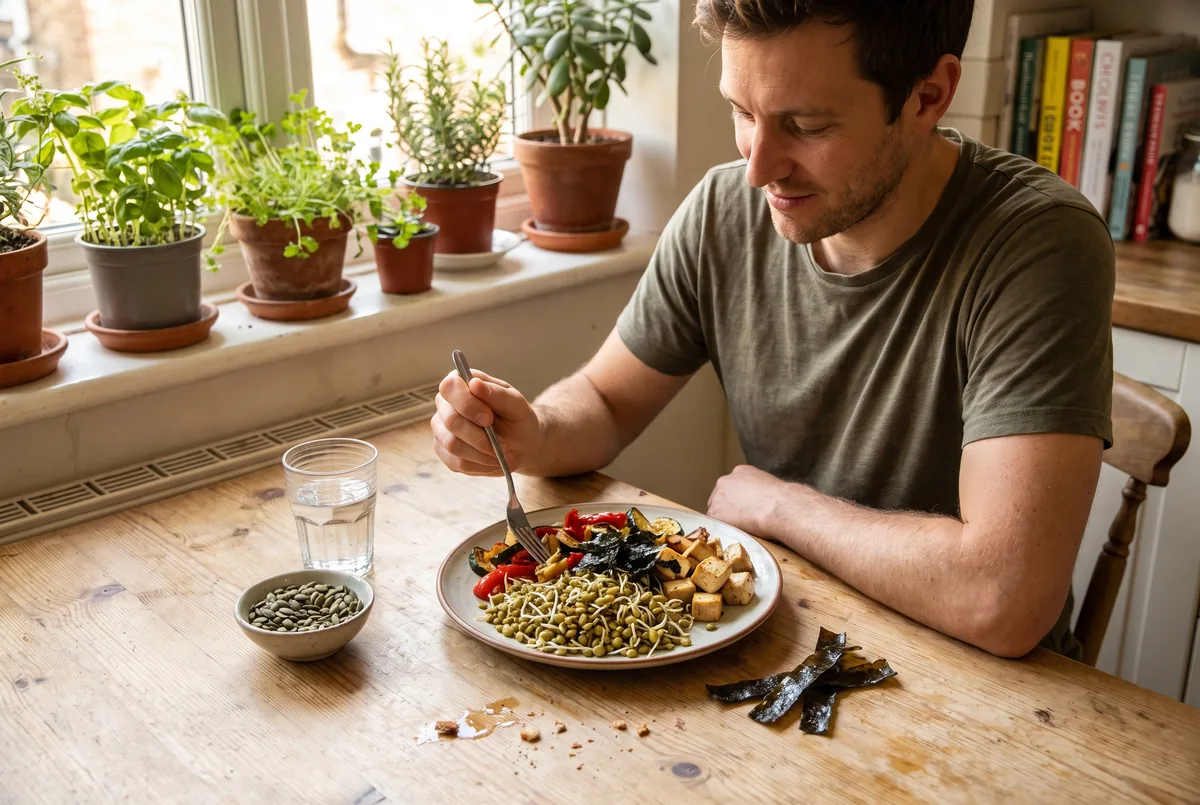
In practice, a varied plate is enough: legumes always soaked then cooked, seeds and seaweed (raw or rehydrated, added off the heat). To go further, here is a way to sort fact from fiction on plant proteins, as well as a page on nori and its protein.
Key takeaway: a varied plant-based plate covers the benchmark without trying to exceed it, as part of a varied and balanced diet and a healthy lifestyle.
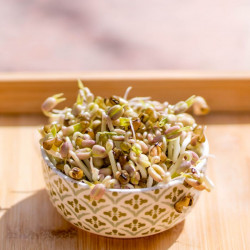
These legumes have a second life, one I have practiced for more than thirty years: sprouted. Three days in a jar, water rinsed twice a day, and the mung bean or the adzuki wakes up. Sprouting does not make protein out of nothing: it sets off the transformation of the seed's reserves and lowers its phytate content, those compounds that slow the absorption of certain minerals. It is a way of adding something to your plate rather than taking something away, as part of a varied and balanced diet and a healthy lifestyle.