









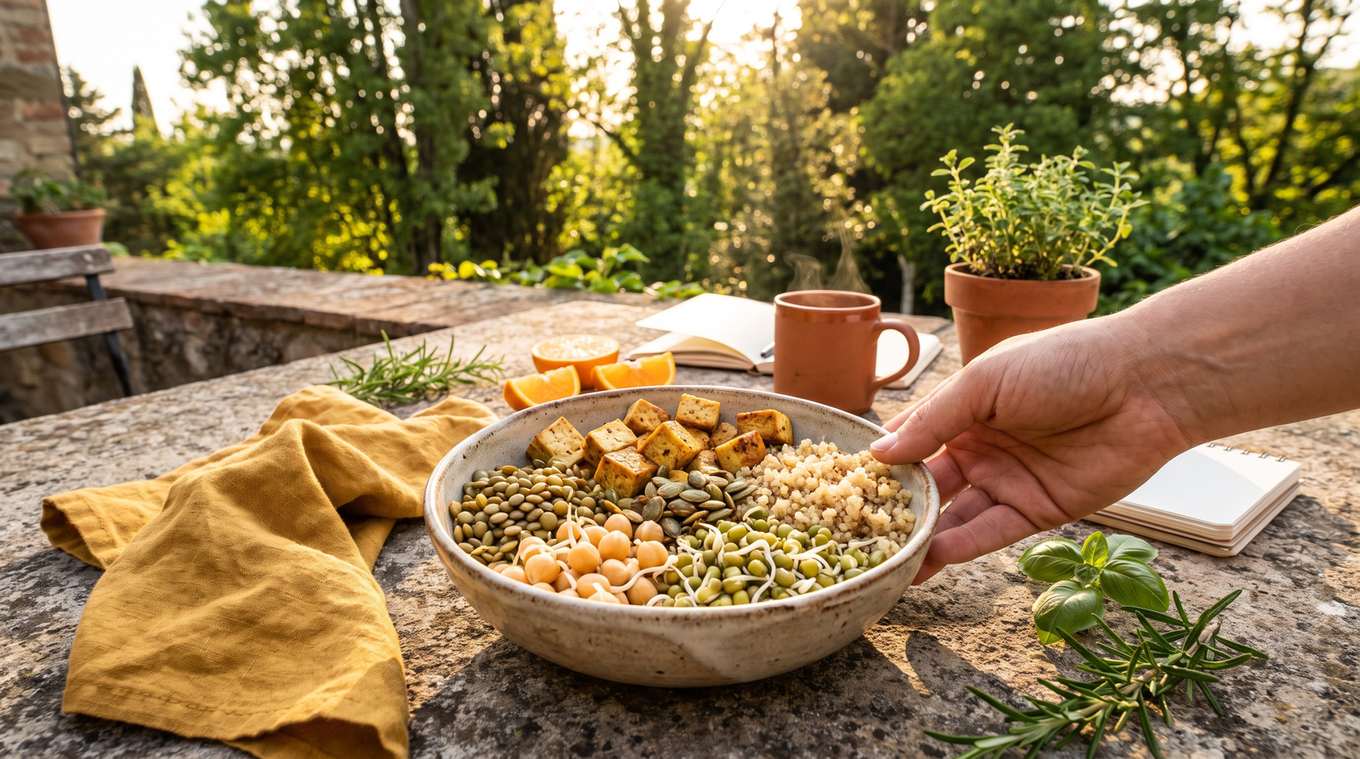
A bonobo spends its days climbing and hanging from branches on a mostly plant-based diet: so yes, when it comes to plant based protein for muscle building, plant proteins are enough for everyday muscle, as long as the plate is varied and the quantity sufficient, and recent human trials point the same way. At Biovie, we built this third and last instalment of our protein series from sixteen references, from ANSES to nutrition journals.
Will I waste away if I give up meat? The fear is very common, in the person themselves or in their circle, often at the very first family dinner.
I understand it all the better because I shared it. The son of a baker, with a Dutch mother who put milk on the table morning, noon and night, I grew up with the idea, never discussed, that you needed animal products to be healthy. Then around age 20, I met someone who had eaten plant-based since birth. A shock. I'd been lied to. Vegan since 1992, an ISTOM engineer, I kept one reflex from it: go and look at the numbers rather than the slogans.
I'm happy to leave bodybuilding to the gyms. The question that interests me is far more down to earth: is plant-based eating enough for functional, healthy muscles, the ones that carry the shopping or climb the stairs?
Bonobos: functional muscles on a mostly plant-based diet
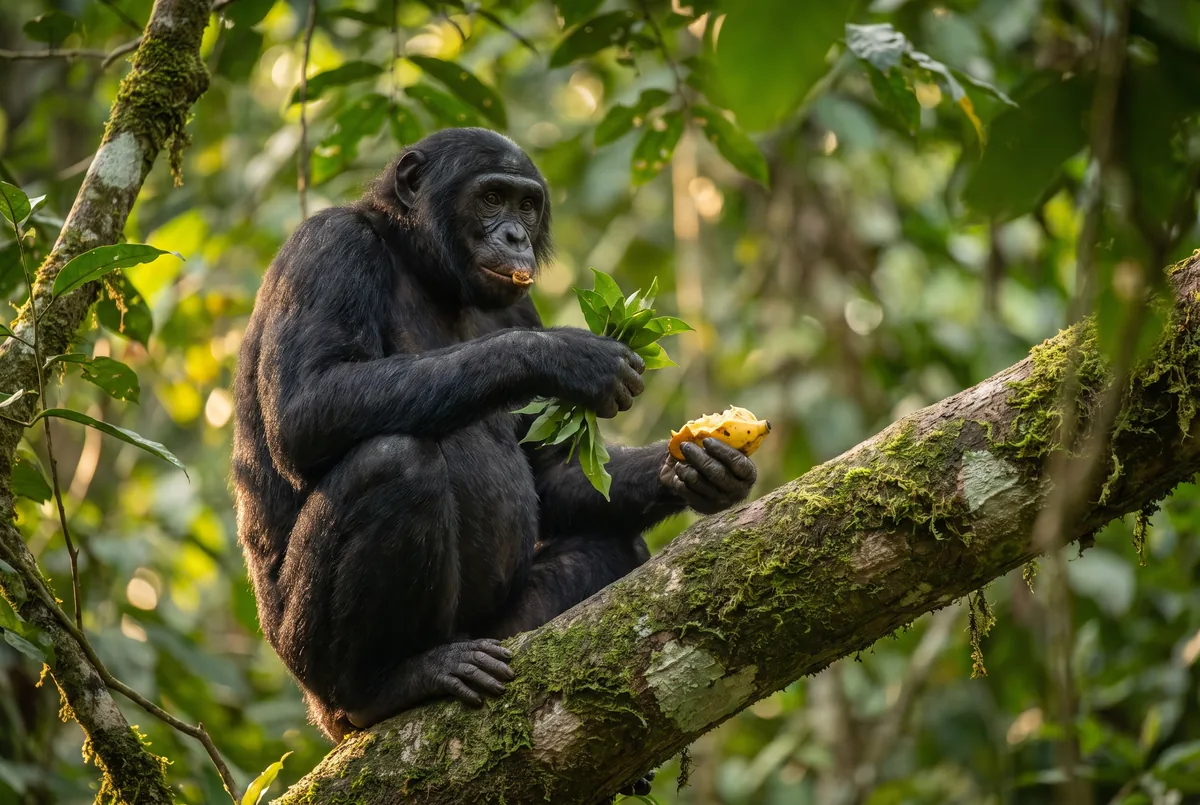
Take the bonobo, one of our closest cousins. Slim, agile, and muscular enough to haul itself from branch to branch without ever setting foot in a gym (or in a butcher's, or hardly). It keeps up that musculature on a mostly plant-based diet, which makes it a precious witness for anyone wondering about plant based protein for muscle building. Before looking for answers at the bottom of a shaker, let's see what nature does.
What the dissection of 13 bonobos shows
Zihlman and Bolter did thankless but precious work: comparing the body composition of 13 dissected bonobos with that of humans (Zihlman and Bolter, 2015). Over the course of human evolution, relative muscle mass decreased and shifted toward the lower limbs, while fat mass increased in both sexes. Weight for weight, the bonobo therefore carries proportionally more muscle than we do, and not in the same place. We traded climber's arms for walker's legs.
Why our legs are more muscular than theirs
Warrener measured 20 lower limb muscles by MRI in 28 people, 14 women and 14 men (Warrener, 2024). What she observes has a scholarly name, positive allometry, for a very simple idea: when the body is heavier, the cross-section of the leg muscles grows faster than the weight itself. A bit like a bridge whose piers you would reinforce more than proportionally every time you add a lane. Only the gluteal muscles are an exception, and the author reads in this the trace of the strength demands of upright walking.
Our legs therefore tell the story of how we get around, not of what is on our plate: this work says nothing about diet.
Mostly plant-based, not 100% plant-based
I care about this nuance, because it would be tempting (and dishonest) to enlist bonobos under the vegan banner. The isotope analysis of their hair, in wild bonobos at LuiKotale (Democratic Republic of the Congo), indicates a marginal animal intake: plants are their main source of protein (Oelze et al., 2011). Bonobos are not vegan for all that: they also eat invertebrates and occasionally hunt vertebrates.
A study published on 22 October 2026, covering 10 years of observation of two LuiKotale communities, describes vertebrate prey split between small terrestrial ungulates (42%) and arboreal primates (43%), mostly red colobus (77% of the primates caught), with an important role for females (Hohmann et al., 2026). These percentages describe the hunting record, not the menu: the place of meat in their total diet is not quantified. The right phrase therefore remains "mostly plant-based", and it is enough for the argument: a mostly plant-based diet allows functional musculature.
Maintaining your muscles or aiming for hypertrophy: two different questions
Maintaining your muscles, and building new ones by force, are two quite distinct goals. At Biovie, we talk about the first, not about bodybuilding.
For daily protein needs, the nutritional reference from ANSES for healthy adults is 0.83 g per kilo of body weight. For a person weighing 60 kg, that gives 49.8 g of protein per day, and for 70 kg, 58.1 g. That is far, very far, from the bodybuilding figures that circulate online, and it fits effortlessly into a day of ordinary foods.
In recent muscle trials, intakes rose to 1.8 to 2 g per kilo per day: normal, since these were intensive training protocols (Monteyne et al., 2023), not benchmarks for carrying your shopping bags. For those wondering whether you can build muscle without meat, the answer starts with quantity, well before the origin of the protein. With age, needs may change: talk to your doctor.
Protein contributes to the growth and maintenance of muscle mass, as part of a varied and balanced diet and a healthy lifestyle. Quantity first, then, and the label after.
Plant Based Protein for Muscle Building: What Do Recent Human Studies Show?
Yes. In a 10-week trial in young adults who were training, a high-protein vegan diet gave the same gain in thigh muscle volume as an omnivorous diet (+8.3% in both groups). Total protein quantity and training matter more than where the protein comes from.
To track muscle, researchers measure myofibrillar protein synthesis. The term is scary, the idea much less: imagine a permanent building site where new bricks are marked with a tracer to count how many are laid each day.
Vegan versus omnivore for 10 weeks
In a first phase (16 young adults, 3 days, 1.8 g of protein per kilo per day), synthesis in the trained leg reached 2.46% per day in omnivores against 2.62% in vegans, a non-significant difference (Monteyne et al., 2023). Translation: both teams of bricklayers were laying their bricks at the same pace.
The second phase is more telling, because it lasts. 22 young adults trained 5 days out of 7 for 10 weeks, at about 2 g per kilo per day. Lean mass gain was 2.6 kg in omnivores and 3.1 kg in vegans, thigh volume increased by 8.3% in both groups, and strength progressed comparably. No difference is significant. One twelfth more thigh volume in ten weeks, whatever the diet: that is not nothing.
The limits are real: small numbers, young adults, high intakes, and a vegan diet rich in mycoprotein, a protein from a fungus. We won't make this trial say more than it says.
A pea and canola blend against whey
Lim and colleagues ran a randomized, double-blind crossover trial in 8 young adults, 4 men and 4 women, 7 of whom tested the plant blend alone (Lim et al., 2024). Behind this jargon hide common-sense precautions: chance sets the order of the drinks, nobody knows which one is being served, and everyone tries them all to become their own control. Like comparing two pairs of shoes on the same feet.
Each drink provided 20 g of protein: plant blend (88% pea, 12% canola) at 1.5 g of leucine, the same blend enriched to 3.0 g, or whey at 3.0 g. The blend alone stimulated muscle less than whey (p = 0.046), but once enriched with leucine, it no longer differs significantly from it (p = 0.052). The plant drink started with a delay, and the leucine boost brought it back into the pack, without our being able to say it crossed the line at the same time.
This "p" indicates how far a gap could be down to chance, and by convention we speak of a significant difference below 0.05. At 0.052, just above the threshold, we can conclude neither a proven equality nor a difference. Eight young participants, drinks whose amino acids were not analyzed, an effect measured over the short term: that is the exact frame, no more, no less.
What these studies do not say
One caveat, just one, but it matters. These trials involve a few dozen trained young adults and say nothing directly about a person over 60. They show that plant-based eating is enough when the quantity is there, and none claims it would be superior. I won't claim it either.
Leucine: a signal, not the only key
What is leucine?
Leucine is an essential amino acid: your body cannot make it, it has to find it on the plate. Let's go back to our building site. Leucine is the switch that turns on the floodlights and tells the crews it is time to get going. A switch lays no bricks: without the other amino acids, the lit-up site stays empty.
Do you need a leucine threshold at every meal?
In the sports literature, a leucine "threshold" per meal is often mentioned, which is why leucine from plant proteins takes up so much room in locker-room discussions. Two sourced benchmarks help find your way: the whey drink in Lim's trial provided 3.0 g of leucine (Lim et al., 2024), and a 100% plant-based modeling study aimed for about 2.75 g per meal (Goldman et al., 2024).
A systematic review, that is, a piece of work that gathers and compares the available studies on a precise question, examined this link in young and older adults (Wilkinson et al., 2023). Leucine dose is associated with the muscle's response after exercise in older adults, but not in young people. No blood leucine measurement strongly predicts this response, and no threshold appears in the older group.
Rather reassuring after 60, in the end. Main meals generous in protein make sense, without chasing a magic number.
What a 100% plant-based modeling study says
Goldman, Warbeck and Karlsen composed, on a computer, entirely plant-based menus adjusted to the energy needs of male bodybuilders. These menus reach about 1.8 g of protein per kilo per day and about 2.75 g of leucine per meal, simply with larger portions of everyday foods. No magic powder, just fuller plates. I owe you the limits too: a model with no participants, bodybuilders, vitamin D not covered and sodium above the limits.
Seaweed, fresh or dried: what it really provides
I've reached the chapter closest to my heart. I've been defending seaweed for years, and that is exactly why I give you the real portions rather than the figures that make eyes light up. Part of my protein, I go and fetch from the sea, and not only from spirulina: there are fresh sea vegetables, the ones you desalt and eat raw, and dried seaweed, which is exactly the same with the water removed.
Fresh sea vegetables: a food, not a powder
Fresh seaweed is eaten by the handful, like a salad, not by the pinch. The values below come from the American USDA database, per 100 g of fresh seaweed (USDA FoodData Central).
| Fresh seaweed (100 g) | Protein | Leucine |
|---|---|---|
| Nori (Porphyra) | 5.81 g | 0.50 g |
| Wakame | 3.03 g | 0.26 g |
| Kombu (kelp) | 1.68 g | 0.08 g |
A usual portion of 30 to 50 g of desalted fresh seaweed therefore provides between 0.5 and 3 g of protein, and between 0.03 and 0.25 g of leucine depending on the seaweed. That is a long way from the 40% protein quoted in brochures, and that is normal: a fresh seaweed is made of 80 to 85% seawater. The spectacular percentages always apply to dry weight, never to what you have on your plate.
What I get out of it comes down to three things: extra protein, minerals drawn straight from seawater, and variety. Fresh seaweed is eaten raw, rinsed and desalted for a few minutes, in a salad or chopped over vegetables: I don't cook it, except in a broth. Protein contributes to the growth and maintenance of muscle mass, as part of a varied and balanced diet and a healthy lifestyle.
Dried seaweed: the same, minus the water
Take the water out of that same nori and you get a sheet that comes in at around 39% protein, which matches the 30 to 50% range found in the literature on red seaweed and which I detailed in my article on the proteins in nori. A portion of 10 to 15 g of dried nori, that is four to six sheets, provides about 4 to 6 g of protein and 0.3 to 0.5 g of leucine. For dulse, the measured contents range from 11.9% of dry weight in summer to 21.9% in winter and spring (Galland-Irmouli et al., 1999), or about 0.6 to 1.1 g of protein for 5 g of flakes.
Dried seaweed therefore plays in the seeds' league: a few grams of protein per portion, no more. It is not the main dish, and repeated every day it is not nothing either. That is exactly the place I give it in my kitchen.
Spirulina: very concentrated, but eaten in pinches
Spirulina often comes up in bodybuilding questions, with an impressive figure: 57.5 g of protein and 4.95 g of leucine per 100 g of dried spirulina, or about 8.6% leucine in its protein (USDA FoodData Central). On paper, more than half of its weight is protein. Enough to make you dream.
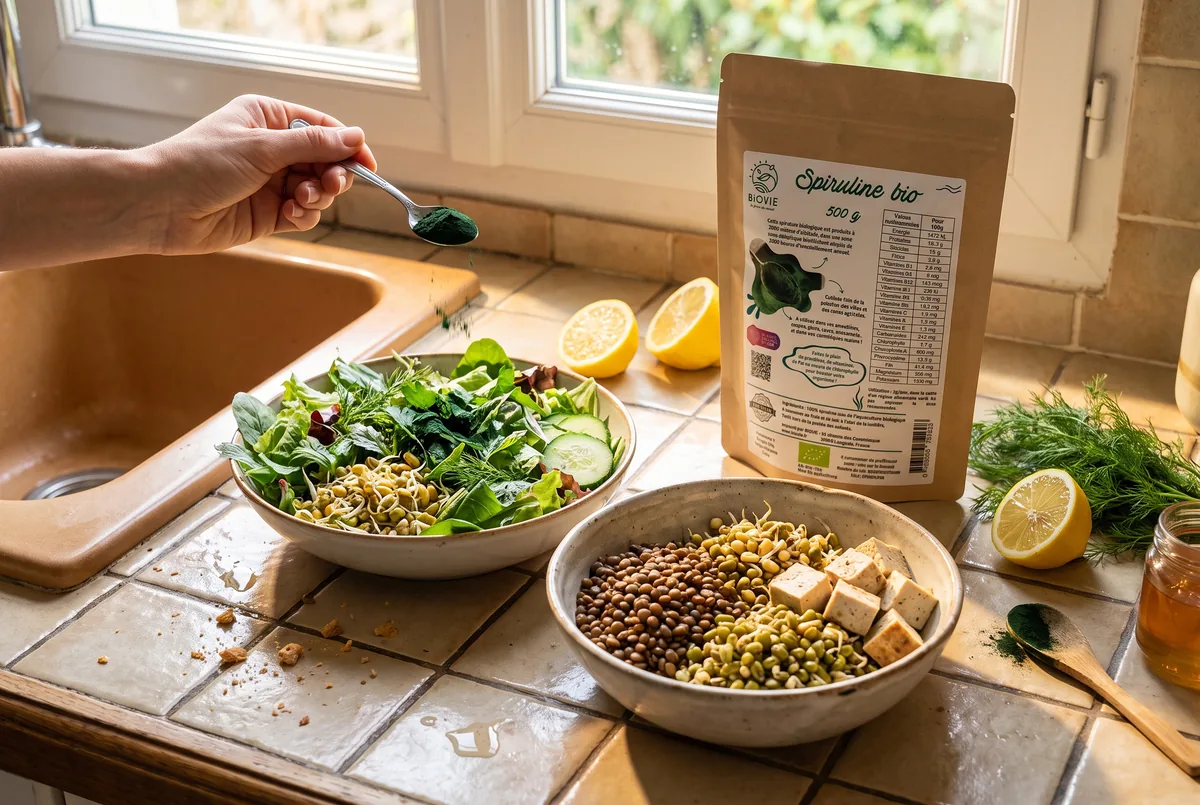
Except that nobody eats 100 g of spirulina. Nobody. A real portion is counted in a few grams:
| Spirulina portion | Protein | Leucine |
|---|---|---|
| 5 g | 2.9 g | 0.25 g |
| 10 g | 5.8 g | 0.50 g |
| 56 g | 32 g | 2.8 g (about the 2.75 g per meal benchmark) |
To reach the leucine of one meal with spirulina alone, you would need about 56 g of dry powder, which is unrealistic. That is more than ten times the usual 5 g portion. On this precise point, the skeptics are right.
Fresh, dried or powdered, seaweed rounds out the plate with extra protein, minerals drawn from seawater and diversity; the base of the meals lies elsewhere, in legumes and tofu. A handful of desalted fresh seaweed in a salad, a few sheets of nori, dulse flakes, a pinch of spirulina on an already served dish: that is how I go about it, every day, and it ends up counting over a day.
Beyond leucine: complementarity, minerals and research leads
Plant proteins complement each other
You may have heard that you had to pair cereals and legumes at every meal, scale in hand. According to ANSES, cereals are low in lysine and legumes in sulfur amino acids, but intakes in France are varied enough that it is not necessary to combine the two at every meal. Complementarity is therefore played out over the day, with no calculation at each plate. Hemp or pumpkin seeds diversify the profile further, and another article goes back over the absorption of plant proteins. As part of a varied and balanced diet and a healthy lifestyle, this diversity is built at your own pace.
Iron and zinc: preparation matters
Here, I'm not going to pretend: it is a real issue. According to the expert appraisal published by ANSES in 2025, vegan men struggle to cover their zinc needs, and the iron status of vegetarians is less favorable. Traditional preparation methods reduce phytates, those compounds in seeds that hinder the absorption of both minerals (Gibson et al., 2018). Soaking chickpeas the night before, as traditional kitchens have long done, therefore has a real reason to exist. At Biovie, legumes are always presented soaked before cooking, following a traditional preparation practice.
Vitamin C provided by foods favors the absorption of non-heme iron, the iron from plants, when it is consumed at the same meal (Lim et al., 2013): a squeeze of lemon on the lentils, for example, a tiny gesture. You are not what you eat, but what you absorb. I come back to this in more detail, with other examples of foods, in my article on the iron in seaweed.
"Anabolic" polyphenols: leads, not promises
These leads make bodybuilding forums fantasize, so let's look them in the face. Ursolic acid, spotted thanks to genetic signatures of human muscle, reduced atrophy and favored hypertrophy in mice (Kunkel et al., 2011). Epicatechin gave, in a small 7-day human proof of concept with no described control group, a preliminary signal on grip strength and on the follistatin/myostatin ratio (Gutierrez-Salmean et al., 2014). Apigenin and quercetin are also among the molecules being studied.
None of this is demonstrated in humans, and these are not claims validated by EFSA. Leads, then, interesting to follow, not promises to stock in the medicine cabinet. I don't recommend any supplement for muscle: if the question arises, talk to your doctor.
Vitamin B12: honest vigilance
That leaves vitamin B12, which I never pass over in silence, because a talk about plant-based eating that forgets it loses all credibility: ANSES stresses the difficulty, for vegans, in covering their needs. It is a real point of vigilance, to discuss with your doctor. I have placed it among the essential nutrients for vegans.
An entirely plant-based day at 60 g of protein
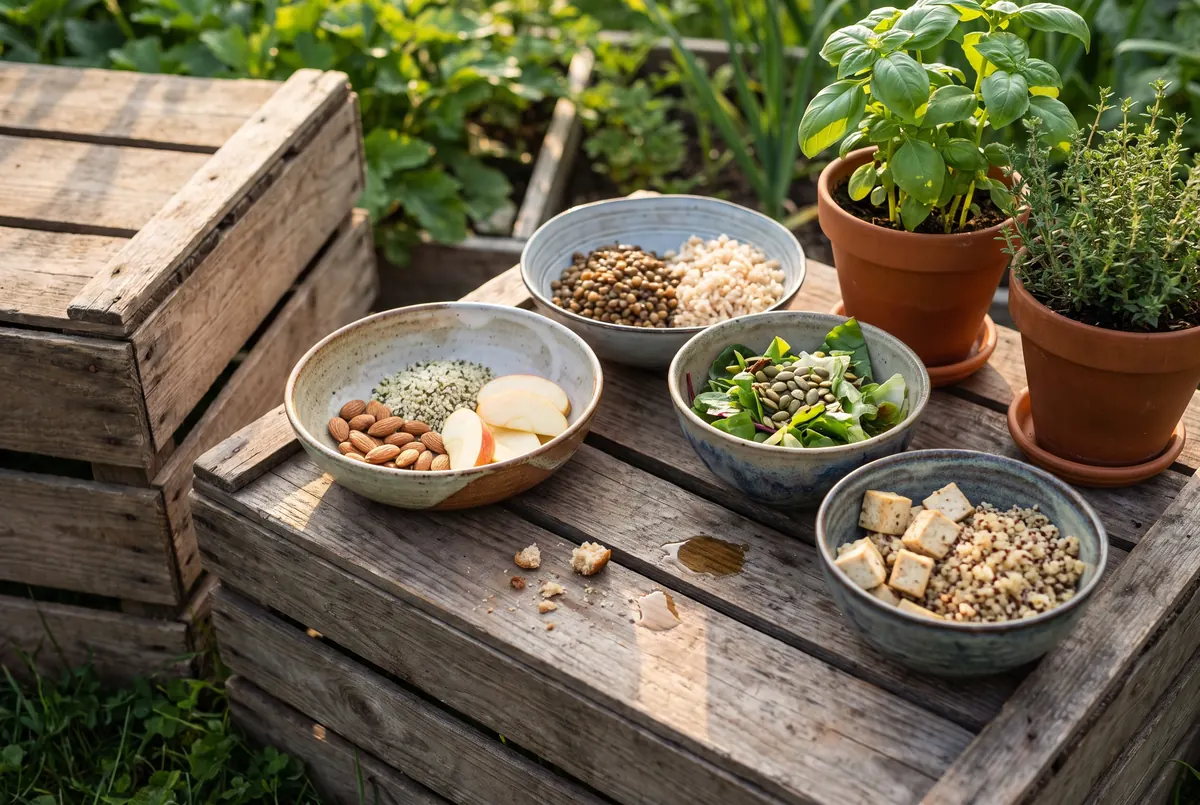
Enough theory, let's move on to the grams, food by food, the way you would do your accounts on a corner of the table. The values come from the American USDA database per 100 g (USDA FoodData Central), and the lentils, soaked before cooking as always with us, are counted with the value measured on lentils boiled in water.
| Meal | Foods | Protein | Leucine |
|---|---|---|---|
| Breakfast | Almonds 30 g (6.4 g; 0.44 g) and hulled hemp seeds 20 g (6.3 g; 0.43 g), with a piece of fruit not counted | 12.7 g | 0.87 g |
| Lunch | Cooked lentils 150 g (13.5 g; 0.98 g) and cooked brown rice 150 g (4.1 g; 0.32 g) | 17.6 g | 1.30 g |
| Snack | Pumpkin seeds 15 g (4.5 g; 0.36 g) and spirulina 5 g on a salad or in a juice (2.9 g; 0.25 g) | 7.4 g | 0.61 g |
| Dinner | Firm tofu 100 g (17.3 g; 1.39 g) and cooked quinoa 100 g (4.4 g; 0.26 g) | 21.7 g | 1.65 g |
| Total | Not counting vegetables or fruit | 59.4 g | 4.4 g |
The total reaches 59.4 g of protein and 4.4 g of leucine, not counting vegetables or fruit. That is a little more than the reference for a 70 kg person (58.1 g), with foods you can find in any organic grocery. No shaker, no clever calculation.
At my place, this day also includes seaweed, and I give you its exact weight: a 30 g handful of desalted fresh seaweed in a salad and 5 g of dried nori crumbled over dinner add about 2.9 g of protein in total, enough to round the day up to a little over 62 g. You can see the order of magnitude: a real contribution, modest, and one that comes back every day.
Leucine per meal, between 0.6 and 1.7 g, stays below the benchmarks of the trials, and that is the honest point of this calculation. Slightly more generous portions of legumes or tofu at the main meals are enough to get closer, as the 100% plant-based modeling study by Goldman shows (Goldman et al., 2024).
For vegans, ANSES proposes benchmarks of 120 g of pulses and 50 g of nuts and oilseeds per day (ANSES, 2025). Protein contributes to the growth and maintenance of muscle mass, and lentils as well as tofu provide a good share of it, as part of a varied and balanced diet and a healthy lifestyle. It is also the direction taken by the thinking on plant-based eating in the European recommendations.
No need to turn everything upside down tomorrow morning. Start with 30 g of almonds, a small handful, at the breakfast you already have, and keep the rest of your habits. The rest will come.
What the bonobos and the studies tell your plate
If I had to keep just three findings from all this reading, they would be these:
- Total protein quantity and variety on the plate matter more than where the protein comes from.
- Leucine is a signal, to be looked after mostly at the main meals.
- Seaweed rounds things out, fresh or dried, and I don't deprive myself of it.
Plant based protein for muscle building and everyday muscle therefore get along fine, provided the plate is sufficient and varied. No more, no less.
Everyone moves at their own pace, and you add before you remove: one more soaked legume this week, 15 g of pumpkin seeds on a salad the next. The boy raised on bread and milk that I was would have liked to read all this earlier. Let's hope that in twenty years, the question "will I waste away if I give up meat?" will make everyone smile, a bit as it would make a bonobo smile.
And if you put together your own plant-based day, write to me: I'm curious to see your numbers!
Frequently asked questions
Can you build muscle with plant proteins?
Yes. In a 10-week trial in 22 young adults who were training, a high-protein vegan diet gave the same gain in thigh volume as an omnivorous diet, that is +8.3% in both groups. Total protein quantity and training matter more than where the protein comes from.
Where do you find protein for muscles when eating plant-based?
In legumes, tofu, seeds and whole grains. Per 100 g, according to the USDA, firm tofu provides 17.3 g of protein, cooked lentils (after soaking) 9.02 g, pumpkin seeds 30.2 g and hulled hemp seeds 31.6 g. A day combining these foods reaches 59.4 g of protein.
What are the sources of plant protein?
The main sources of plant protein are pulses, always soaked before cooking, such as lentils and chickpeas, soy in the form of tofu, nuts and seeds (almonds, hemp, pumpkin) and whole grains. For vegans, ANSES proposes benchmarks of 120 g of pulses and 50 g of nuts and oilseeds per day.
Do you need to reach a leucine threshold at every meal?
No threshold has been demonstrated. A 2023 systematic review associates leucine dose with the muscle response in older adults, but not in young people, without identifying a threshold. Main meals generous in legumes or tofu bring you closer to the benchmarks used in the studies.
Is seaweed a source of protein?
Yes, on its own scale. According to the USDA, 100 g of fresh seaweed provides 5.81 g of protein for nori, 3.03 g for wakame and 1.68 g for kombu, and 10 to 15 g of dried nori provides 4 to 6 g. It is a real contribution that rounds out the plate every day, without replacing legumes or tofu at the main meals.
Should you choose fresh or dried seaweed?
They are the same seaweed: the dried version is simply the fresh version stripped of 80 to 85% of its water, hence more concentrated by weight. Fresh seaweed is eaten rinsed and desalted, raw in a salad or chopped over vegetables; dried seaweed is crumbled as flakes or sheets over an already served dish.
Is spirulina a good source of protein?
It is very concentrated, with 57.5 g of protein per 100 g of dried spirulina according to the USDA, but a real 5 g portion provides only 2.9 g. It therefore rounds out the plate, on a salad or in a juice, without replacing legumes or tofu at the main meals.
How much spirulina would you need for the leucine of one meal?
About 56 g of dry spirulina for 2.75 g of leucine, the per-meal benchmark of a 100% plant-based modeling study published in 2024. That is more than ten times the usual 5 g portion, which is unrealistic day to day: the leucine in meals comes rather from legumes and tofu.
Do bonobos eat meat?
A little, but the animal share remains marginal: the isotope analysis of their hair indicates that plants are their main source of protein. They also eat invertebrates and occasionally hunt vertebrates, mostly small ungulates and monkeys such as the red colobus, according to a study published in October 2026.
References
- Zihlman A.L., Bolter D.R. (2015). Body composition in Pan paniscus compared with Homo sapiens has implications for changes during human evolution. PNAS, 112(24):7466-7471.
- Warrener A. (2024). Human lower limb muscle cross sectional area scales with positive allometry reflecting bipedal evolutionary history. Frontiers in Earth Science, 11:1301411.
- Oelze V.M., Fuller B.T., Richards M.P., Fruth B., Surbeck M., Hublin J.J., Hohmann G. (2011). Exploring the contribution and significance of animal protein in the diet of bonobos by stable isotope ratio analysis of hair. PNAS, 108(24):9792-9797.
- Hohmann G., Bessone M., Balduccio N., Decina F., Deville T., Pashchevskaya S., Soliday V., Stewart K., Fruth B. (2026). Females shape hunting of vertebrates in wild bonobos. Current Biology.
- ANSES (2007). Protéines : rôle, sources et apports recommandés. ANSES.
- ANSES (2025). Régimes végétariens : effets sur la santé et repères alimentaires. ANSES.
- Monteyne A.J., Coelho M.O.C., Murton A.J., Abdelrahman D.R., Blackwell J.R., Koscien C.P., Knapp K.M., Fulford J., Finnigan T.J.A., Dirks M.L., Stephens F.B., Wall B.T. (2023). Vegan and Omnivorous High Protein Diets Support Comparable Daily Myofibrillar Protein Synthesis Rates and Skeletal Muscle Hypertrophy in Young Adults. The Journal of Nutrition, 153(6):1680-1695.
- Lim C., Janssen T.A.H., Currier B.S., Paramanantharajah N., McKendry J., Abou Sawan S., Phillips S.M. (2024). Muscle Protein Synthesis in Response to Plant-Based Protein Isolates With and Without Added Leucine Versus Whey Protein in Young Men and Women. Current Developments in Nutrition, 8(6):103769.
- Wilkinson K., Koscien C.P., Monteyne A.J., Wall B.T., Stephens F.B. (2023). Association of postprandial postexercise muscle protein synthesis rates with dietary leucine: A systematic review. Physiological Reports, 11(15):e15775.
- Goldman D., Warbeck C., Karlsen M. (2024). Completely Plant-Based Diets That Meet Energy Requirements for Resistance Training Can Supply Enough Protein and Leucine to Maximize Hypertrophy and Strength in Male Bodybuilders: A Modeling Study. Nutrients, 16(8):1122.
- USDA Agricultural Research Service (2019). FoodData Central (SR Legacy): Seaweed, spirulina, dried (FDC 170495), seaweed, laver, raw (FDC 168458), seaweed, wakame, raw (FDC 170496), seaweed, kelp, raw (FDC 168457), with cooked lentils, cooked chickpeas, firm tofu, cooked quinoa, cooked brown rice, almonds, hulled hemp seeds and pumpkin seeds. USDA FoodData Central.
- Galland-Irmouli A.V., Fleurence J., Lamghari R., Luçon M., Rouxel C., Barbaroux O., Bronowicki J.P., Villaume C., Guéant J.L. (1999). Nutritional value of proteins from edible seaweed Palmaria palmata (dulse). The Journal of Nutritional Biochemistry, 10(6):353-359.
- Gibson R.S., Raboy V., King J.C. (2018). Implications of phytate in plant-based foods for iron and zinc bioavailability, setting dietary requirements, and formulating programs and policies. Nutrition Reviews, 76(11):793-804.
- Lim K.H.C., Riddell L.J., Nowson C.A., Booth A.O., Szymlek-Gay E.A. (2013). Iron and Zinc Nutrition in the Economically-Developed World: A Review. Nutrients, 5(8):3184-3211.
- Kunkel S.D., Suneja M., Ebert S.M., Bongers K.S., Fox D.K., Malmberg S.E., Alipour F., Shields R.K., Adams C.M. (2011). mRNA expression signatures of human skeletal muscle atrophy identify a natural compound that increases muscle mass. Cell Metabolism, 13(6):627-638.
- Gutierrez-Salmean G., Ciaraldi T.P., Nogueira L., Barboza J., Taub P.R., Hogan M.C., Henry R.R., Meaney E., Villarreal F., Ceballos G., Ramirez-Sanchez I. (2014). Effects of (-)-epicatechin on molecular modulators of skeletal muscle growth and differentiation. The Journal of Nutritional Biochemistry, 25(1):91-94.
Updated: November 2026. Article written and validated by Éric Viard, founder of Biovie since 2007 and ISTOM engineer, co-author of « Algues au quotidien » (Gallimard, 2024), Best Cookbook in the World, Gourmand Cookbook Awards 2025, and Best Cookbook in France, Académie Nationale de Cuisine 2025.
The information presented in this article is provided for information purposes only and does not constitute medical advice. Consult a healthcare professional before making any change to your diet or supplementation.