









When I met Aurélie, I had been vegetarian for a very long time, and her family wondered: do vegetarians get enough protein? They were sure I wouldn't make it past 45 and would end up sick and full of deficiencies. I'm 54 now, and I feel better than I did at 20. To the question "how much protein per day?", ANSES answers 0.83 g per kilo of body weight for a healthy adult, about 50 g for 60 kg, and a varied, well-planned plant-based diet can cover that need, according to the Academy of Nutrition and Dietetics. At Biovie, we built this page on twelve public sources, from opinions of ANSES and the EFSA to the work of nutrition historians.
I tell this as lived experience, and lived experience proves nothing for anyone else (every body has its own story, and I would never turn mine into a rule for anybody). Still, I know this worry from the inside. As a young adult, I met someone who had eaten plant-based since birth, and it was a shock: I had always been led to believe that animal products were necessary for good health. I'd been lied to, or rather, I'd been told what others had themselves learned. I have eaten plant-based since the early 1990s, I'm an ISTOM engineer and I founded Biovie in 2007, so I've had time to turn the question over. Where does this certainty come from, that without meat you're bound to run short of protein?
The answer has nothing to do with a law of nature. It's a story, made of a confusion between quantity and quality, of norms set too high and copied for decades, of laboratory rats and of habits nobody bothered to revisit.
Why do we associate protein with meat?
In an ordinary Western fridge, what is most concentrated in protein is almost always of animal origin. The shortcut made itself. There is a part of this that is true and that we should honestly acknowledge: these foods are very concentrated in protein, and ANSES notes that their digestibility is slightly higher than that of plant proteins.
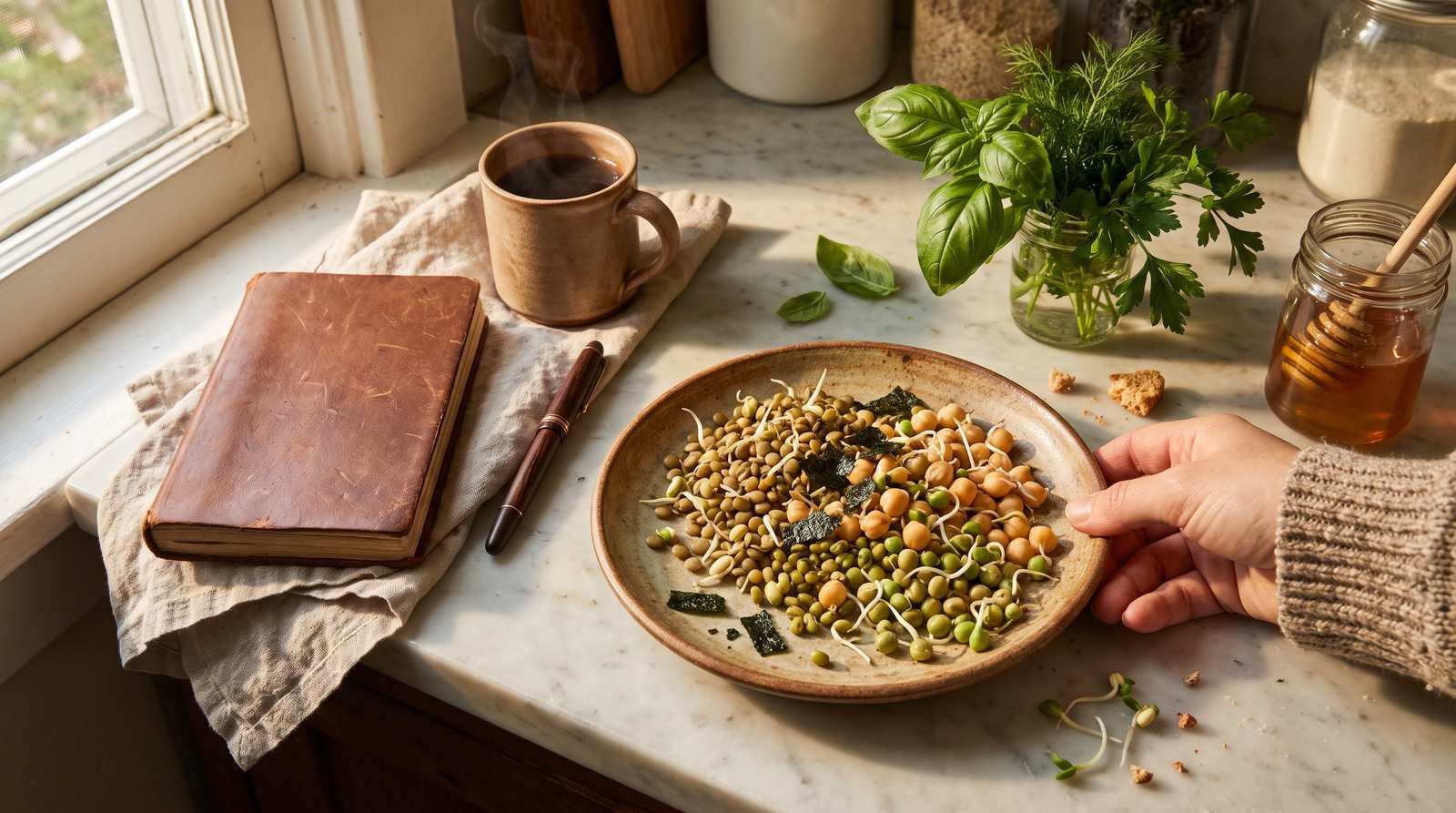
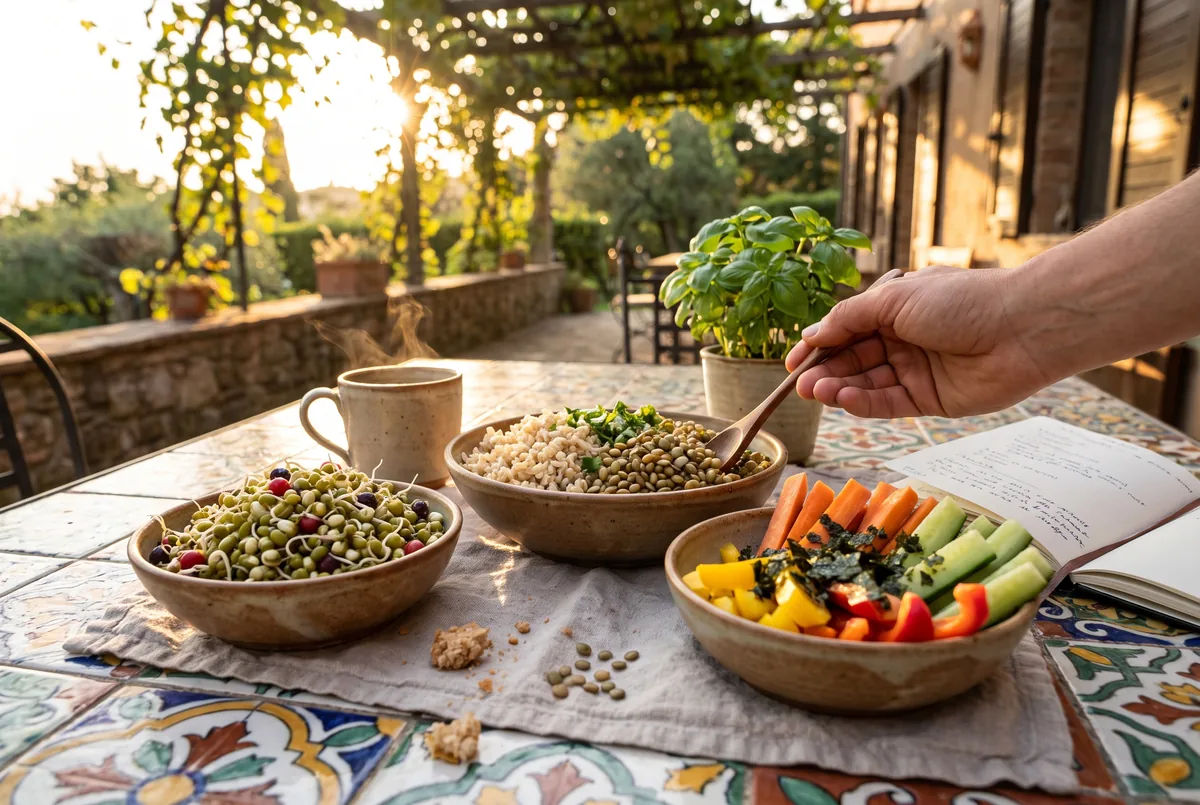
But "rich in protein" doesn't mean "the only possible source". A high content tells you how much there is, not that you can't do without it. Soaked and cooked legumes, seeds, cereals and seaweed also provide protein, and that is how you build a plate of protein without meat. For a long time, though, when you asked how much protein per day you needed, the answer came in grams of meat.
If you want a closer look at the share of protein or carbohydrates in plant foods, we devoted a whole article to it.
118 g a day: the figures that set the norm
The word "protein" appears in 1838, and it takes only a few decades for a number to get attached to it (Blaxter and Garnett, 2022). That number is the ration of a worker. Not of everybody.

Carl von Voit and the worker's ration
In Munich, Carl von Voit (1831-1908) proposed a reference ration in the 1870s: 118 g of protein a day for a worker doing moderate work, 145 g for hard labor. Voit made clear that other groups needed less, but his successors turned 118 g into a yardstick, and anything below it was called a "poor man's diet", the Armenkost. Imagine the force of that word: eating less meant eating like a poor person. Yet 118 g was hard to reach without a lot of meat. Never mind: in the 1880s, meat became in Germany a pillar of what was then called the "rational diet". Rational, no less! To give you the scale, 118 g is more than double today's ANSES reference for a person weighing 60 kg.
Atwater and university rowing
Across the Atlantic, Atwater, a student of Voit, observed university rowing crews eating 155 g of protein a day and saw it as confirmation. The catch? Those rowers ate at a special table where meat was pushed. The reasoning goes in circles: you feed athletes a lot of meat, then conclude from their plates that a lot of protein is needed. It's a bit like measuring the sugar needs of a whole country by counting the cakes at a birthday party.
Atwater then published the first recommendation of the US Department of Agriculture (USDA): 125 g a day, more than double the USDA's current recommendation, according to Blaxter and Garnett. In the 1890s, the USDA was still advising workers to eat more than 110 g (Carpenter, 1986).
Chittenden: half is enough
In 1904, at Yale, Russell Chittenden did something very simple: he went and checked. He published Physiological Economy in Nutrition (Chittenden, 1904), after following small groups of men, among them soldiers and athletes, who kept their vigor on about half of the usual intake (Carpenter, 1986).
His tool is called nitrogen balance. You compare the nitrogen eaten with the nitrogen excreted: if they match, the body isn't losing protein. It's like reading a bank statement: as long as what comes in covers what goes out, the balance doesn't drop, even with a more modest salary than expected.
So as early as 1904, it was known that half of the usual intake of the time could be enough. The story could have ended there. Well, no. Type "how much protein per day" into a search engine today and you'll still come across figures climbing to 100 g and more, presented without a word on where they come from. As if Chittenden had never existed.
Quantity versus quality: when "rich" meant "better"
Before Voit, there is Liebig. For this chemist, nitrogenous foods build tissues, and protein is the source of muscular energy (Blaxter and Garnett, 2022; Carpenter, 1986). In his logic, meat becomes the food that contains everything needed to rebuild flesh: to put it only slightly simply, whoever eats muscle rebuilds muscle.
His ideas made their way into the kitchen and into advertising. They then settled into beliefs about meat, and they stayed there, even after Liebig himself abandoned his theory. He had changed his mind, the public hadn't. A theory can die in the laboratories and go on living for a long time in the kitchens. I won't throw stones at a 19th-century chemist: you can't blame him for not knowing what science has learned since.
This is where the confusion takes hold. In the 19th century, "contains a lot of protein" and "is the best source" become almost synonymous, when they are two different questions. The first is about quantity, the second about quality. And quality is what matters when you wonder how to get protein without meat: knowing which bricks a protein is made of, and whether the body finds them all.
The Yale rats and the birth of "complete" proteins
In 1914, Osborne and Mendel published in the Journal of Biological Chemistry a series of experiments on growing rats (Osborne et al., 1914). Fed on zein alone, the protein of maize, the young rats stagnate. Two amino acids, tryptophan and lysine, both have to be added for growth to resume. With wheat gliadin, it is lysine that is missing; once it is added, the rats start growing again.

An essential amino acid is a brick the body can't make: it has to come from the plate. Think of an old wooden barrel whose staves aren't all the same height. Pour water in: it never rises above the shortest one, and the rest spills over the top. In an isolated protein, the scarcest amino acid plays the role of that short stave, and it sets the level for everything else.
This is where the words "complete" and "incomplete" come from, and they have done a lot of damage in people's heads. Should we conclude that plant proteins are second-rate? Not at all.
Still, this experiment has to be read with its limits. These were rapidly growing rats, whose needs have little to do with those of an adult human, and they received an isolated protein, never a real meal. Who eats pure zein for breakfast? Above all, the experiment shows the opposite of a dead end: you just have to supply the missing stave for everything to get going again, and that is the very principle of complementarity.
So what are complete protein sources? Complete plant proteins often come less from a single food than from an assembly made over the course of your meals. I often repeat it: we are not what we eat, but what we assimilate. For how the body digests these proteins, I refer you to our article on the assimilation of plant proteins.
Do you need to combine cereals and legumes at every meal?
ANSES's answer is no, and that's good news for everyone who juggled rice and lentils at every meal. The agency points out that cereals are low in lysine and legumes in sulfur amino acids, two shortfalls that make up for each other. Since our protein sources are diversified, nothing justifies, in its view, recommending a systematic combination of cereals and legumes at every meal. It also acknowledges that animal proteins have slightly higher digestibility, and it's fair to repeat that here.
To judge the quality of a protein, the FAO recommended a new method in 2013, DIAAS, in place of PDCAAS, in use since 1989 (FAO, 2013). DIAAS measures the digestibility of each amino acid, one by one, at the end of the small intestine. In other words, you no longer judge a protein as a block: you look at each brick separately, the way you would check each stave of the barrel.
So complementarity happens over the day, through variety, rather than meal by meal. Soaked lentils at noon, rice or buckwheat in the evening, and the assembly happens by itself, without a calculator, as part of a varied and balanced diet and a healthy lifestyle.
The first step is a modest one. Tonight, you can put a handful of lentils or chickpeas to soak in a bowl of water for tomorrow: a few seconds of effort and a night of waiting, nothing more if you already have some in the cupboard.
Combining foods, by the way, has nothing to do with the food-combining diet, which raises a completely different question.
Ideologies and habits: why the norm lasted
A scientific norm doesn't last for decades on its figures alone. It needs something else: symbols. Blaxter and Garnett show that meat was long associated with strength, courage and reason, and that heavy meat consumption in the United States or Germany, among other places, was read as a justification of colonial domination. Eating a lot of meat then passed for a sign of social superiority.
The figures of the time point the same way. After the Boer War (1899-1902), between 40 and 60% of British volunteers failed the height requirement, against about 10% in 1845: two to three candidates out of five turned down, where one in ten had been half a century earlier. Experts blamed a lack of protein, especially from meat and milk. The perfect culprit was ready-made.
In the United States, the "meat versus rice" argument was even used against Asian workers. A matter of nutrition had become a matter of identity, and an identity isn't revised like a table of figures.
I know this from having lived it on my own small scale. As a baker's son, I was "raised on gluten all through childhood", and my mother, who is Dutch, put milk on the table morning, noon and night. Nobody saw a theory in it: it was home, it was just how things were. I've moved completely away from it since, and I've learned that explaining your choice with love is enough for those close to you to respect it.
It reminds me of that old fable of the family recipe where the two ends of the dish were cut off before cooking it, generation after generation. Why? Nobody knew. Until the day someone asks the grandmother, who explains that her pot was simply too small. Voit's 118 g met a similar fate: a norm of its time, copied long after everyone forgot where it came from. Nobody lies in this story. Simply, nobody checked.
If you're looking today to eat less meat without deficiencies, at your own pace, our five-step guide starts from exactly there.
Do vegetarians get enough protein? How much per day, according to today's authorities
For a healthy adult, ANSES uses 0.83 g of protein per kilo of body weight per day, about 50 g for a person weighing 60 kg. After 65, it uses about 1 g per kilo per day, according to its 2019 opinion.
With 50 g, you're at less than half of Voit's 118 g. Between the Munich worker's ration of the 1870s and today's reference, the bar has been cut by more than half.
The EFSA, the European Food Safety Authority, reached the same reference of 0.83 g per kilo per day in 2012. It estimates the average requirement at 0.66 g per kilo, then sets the reference higher to cover almost the whole population, including people who need a little more than the average. It's the principle of the door you design for the tallest people in the house rather than for average height: nobody bumps their head.
On protein needs after 65, the EFSA keeps 0.83 g per kilo, whereas ANSES used 1 g per kilo beyond 65. This is a difference in method between two agencies, which ANSES itself points out in its opinion.
Here is what these two benchmarks give by body weight, for anyone wondering how much protein per day fits their build:
| Weight | Healthy adult (0.83 g/kg/day) | After 65 (1 g/kg/day) |
|---|---|---|
| 50 kg | 41.5 g | 50 g |
| 60 kg | 49.8 g | 60 g |
| 70 kg | 58.1 g | 70 g |
| 80 kg | 66.4 g | 80 g |
| 90 kg | 74.7 g | 90 g |
Calculated from ANSES references (0.83 g/kg/day for adults, 1 g/kg/day after 65), for a healthy adult, excluding pregnancy, illness or intense sport.
That leaves the question at the heart of it all, the one that worried Aurélie's family so much. In the United States, the Academy of Nutrition and Dietetics concluded in 2025 that well-planned vegetarian and vegan diets meet the nutritional needs of adults, excluding pregnancy and breastfeeding (Raj et al., 2025). A well-planned plant-based diet can therefore cover an adult's protein needs, as part of a varied and balanced diet and a healthy lifestyle.
One honest note of caution, though: vitamin B12 is the classic watch point of a plant-based diet, and it's a topic to raise with your doctor or a dietitian. This watch point doesn't undermine the rest: it simply calls for follow-up.
Benchmarks also move the other way with age: a baby's protein needs follow other rules.
What if the real question were too much?
This whole history turns on one fear: not getting enough. For a few years now, research has been asking the question the other way round, and that reversal deserves to be told honestly, without turning it into an instruction.
A 2026 review on protein restriction
In 2026, two researchers at the University of Wisconsin-Madison, Bailey Knopf and Dudley Lamming, published a review in Cell Press Blue devoted to protein restriction and aging (Knopf and Lamming, 2026). A review is not a new experiment: it is a synthesis, gathering and ordering what hundreds of teams each found on their own. This one draws on more than 350 references.
Their observation fits in one sentence: while higher protein intake is recommended almost everywhere as we age, the data are piling up the other way. In yeast, flies and rodents, reducing protein goes hand in hand with better metabolic health and a longer life. The authors add a point that interests me a great deal: it is not only quantity that counts, it is composition. Restricting three amino acids in particular, methionine, isoleucine and valine, reproduces a good share of the observed effects. What counts is not the volume of the post, but what is written in certain letters.
The caveats are substantial, and I am not going to hide them. Most of the solid data come from laboratory animals, not from humans followed for decades. The human trials cited are short and involve few participants. The authors themselves recall that the question of requirements remains open for certain groups, older adults among them. This is a research direction, not a dietary instruction.
The British twins: when more does not mean better
Closer to home, one study looked at 3,302 British twins aged 60 and over, followed by the TwinsUK registry (Ni Lochlainn et al., 2023). Mean age 72, 89% women. The researchers compared protein intake with sarcopenia, that is, the loss of muscle mass and strength that sometimes comes with age.
The result runs against intuition. Compared with an intake of 1.0 to 1.3 g per kilo per day, an intake above 1.3 g per kilo was associated with twice the odds of sarcopenia (odds ratio 2.04; 95% confidence interval 1.21 to 3.44; p = 0.008), and with low muscle mass being more frequent (1.76). Conversely, a low intake appeared protective for muscle mass (0.52). An odds ratio of 2 is a way of saying that a situation is about twice as frequent in one group as in the other; it says nothing about cause.
And that is exactly where we should stop. This study observes at a single point in time: it shows a link, not a cause. The arrow can perfectly well point the other way: someone losing muscle is often advised to increase their protein, and there they are, counted among the heavy consumers. The sample is overwhelmingly female, and sarcopenia affected only 4.3% of participants. I quote this work because it calls for caution on both sides, not because it settles anything.
The best-documented lever is not on the plate
While we argue over grams, another lever enjoys far broader agreement. A review published in Aging brought together the effects of exercise on the aging of cells and tissues (Carapeto and Aguayo-Mazzucato, 2021). It describes how physical activity acts on the major mechanisms of cellular aging, and proposes AMPK as the conductor of these effects.
AMPK is the cell's fuel gauge. When reserves drop, it lights up and gives the order to clear up and repair rather than build at all costs. Moving presses on that gauge; piling on protein does not.
What I take from these three pieces of work fits in one sentence: the ANSES reference is a marker to reach, not a floor to exceed by as much as possible. Eating more protein is not automatically better, and taking the stairs probably counts for more than the tenth scoop of powder. All of this holds as part of a varied, balanced diet and a healthy lifestyle, and if you are over 65 or live with a chronic condition, that is a conversation to have with your doctor, not with a blog article.
What about muscle?
That leaves muscle. The fear of "wasting away" on a plant-based diet is probably the most persistent of all, and it deserves better than a quick sentence at the end of an article. In the next part of this series, we'll talk about leucine and what today's laboratory rats teach us. The bonobos will have their say too.
The figures have changed since Voit; it's up to habits to catch up. And I'm hopeful that in a few years the question "but where do you get your protein?" will make people smile, like the grandmother's pot that was too small. And if you've been served other ready-made phrases about protein, write to me!
Frequently asked questions
Do vegetarians get enough protein?
Not when the diet is varied and well planned: according to the Academy of Nutrition and Dietetics (2025), well-planned vegetarian and vegan diets meet the nutritional needs of adults, excluding pregnancy and breastfeeding. This holds as part of a varied and balanced diet and a healthy lifestyle, with particular attention to vitamin B12.
Do you need to combine cereals and legumes at every meal?
No, variety is enough. ANSES points out that cereals are low in lysine and legumes in sulfur amino acids, but that since our protein sources are diversified, nothing justifies recommending a systematic combination. Soaked legumes at one meal and cereals at another complement each other over the day.
How much protein per day?
For a healthy adult, ANSES uses 0.83 g of protein per kilo of body weight per day, about 50 g for 60 kg. After 65, its 2019 opinion uses about 1 g per kilo. These benchmarks apply to healthy adults, excluding pregnancy or illness.
Are animal proteins better?
Not to the point of being indispensable: they are more concentrated in protein and their digestibility is slightly higher, according to ANSES. Varied plant proteins, spread over the day, are enough to cover an adult's needs. The FAO has recommended since 2013 judging quality amino acid by amino acid, with the DIAAS method.
Where does the figure of 100 g a day come from?
It comes from 19th-century norms: Carl von Voit set 118 g of protein a day for moderate work, then Atwater published the first American recommendation at 125 g. As early as 1904, Chittenden showed that about half of the usual intake is enough, but these high figures kept circulating for decades.
Do protein needs change at menopause or after 65?
After 65, ANSES uses about 1 g of protein per kilo per day, against 0.83 g for younger adults. Its 2019 opinion covers women from menopause and men over 65. The EFSA, for its part, keeps 0.83 g per kilo for older people.
How much protein to build muscle?
The answer deserves an article of its own: it's the subject of the third part of our protein series, devoted to muscle and leucine. The ANSES benchmarks presented here apply to healthy adults, excluding intense sport. For building muscle, I prefer to give no figure before having set out the subject properly.
Can you eat too much protein?
Authorities set no numerical upper limit, but several recent studies call for nuance. A 2026 review drawing on more than 350 references describes metabolic benefits associated with protein restriction, mostly in animals (Knopf and Lamming, 2026). Among 3,302 British twins over 60, an intake above 1.3 g per kilo per day was associated with twice as much sarcopenia, without any cause being established (Ni Lochlainn et al., 2023). Going beyond the ANSES reference therefore brings no demonstrated benefit.
References
- Blaxter T., Garnett T. (2022). Primed for power: a short cultural history of protein. TABLE (University of Oxford, SLU, Wageningen).
- Carpenter K.J. (1986). The history of enthusiasm for protein. The Journal of Nutrition, 116(7):1364-1370.
- Chittenden R.H. (1904). Physiological Economy in Nutrition, with special reference to the minimal proteid requirement of the healthy man. Book, digitized edition by Project Gutenberg.
- Osborne T.B., Mendel L.B., Ferry E.L., Wakeman A.J. (1914). Amino-acids in nutrition and growth. Journal of Biological Chemistry, 17(3):325-349.
- FAO (2013). Dietary protein quality evaluation in human nutrition: report of an FAO Expert Consultation. FAO Food and Nutrition Paper 92, Rome.
- ANSES. Protéines : rôle, sources et apports recommandés. ANSES, institutional page accessed in November 2026.
- EFSA Panel on Dietetic Products, Nutrition and Allergies (NDA) (2012). Scientific Opinion on Dietary Reference Values for protein. EFSA Journal, 10(2):2557.
- ANSES (2019). Avis relatif à l'actualisation des repères alimentaires du PNNS pour les femmes dès la ménopause et les hommes de plus de 65 ans (saisine 2017-SA-0143). ANSES.
- Raj S., Guest N.S., Landry M.J., Mangels A.R., Pawlak R., Rozga M. (2025). Vegetarian Dietary Patterns for Adults: A Position Paper of the Academy of Nutrition and Dietetics. Journal of the Academy of Nutrition and Dietetics, 125(6):831-846.e2.
- Knopf B.A., Lamming D.W. (2026). The hallmarks of protein and amino acid restriction in aging and longevity. Cell Press Blue, 1(5):100079.
- Ni Lochlainn M., Bowyer R.C.E., Welch A.A., Whelan K., Steves C.J. (2023). Higher dietary protein intake is associated with sarcopenia in older British twins. Age and Ageing, 52(2):afad018.
- Carapeto P.V., Aguayo-Mazzucato C. (2021). Effects of exercise on cellular and tissue aging. Aging (Albany NY), 13(10):14522-14543.
Updated: November 2026. Article written and validated by Éric Viard, founder of Biovie since 2007 and ISTOM engineer, co-author of “Algues au quotidien” (Gallimard, 2024), Best Cookbook in the World, Gourmand Cookbook Awards 2025, and Best Cookbook in France, Académie Nationale de Cuisine 2025.
The information presented in this article is provided for informational purposes and does not constitute medical advice. Consult a healthcare professional before changing your diet or taking any supplement.