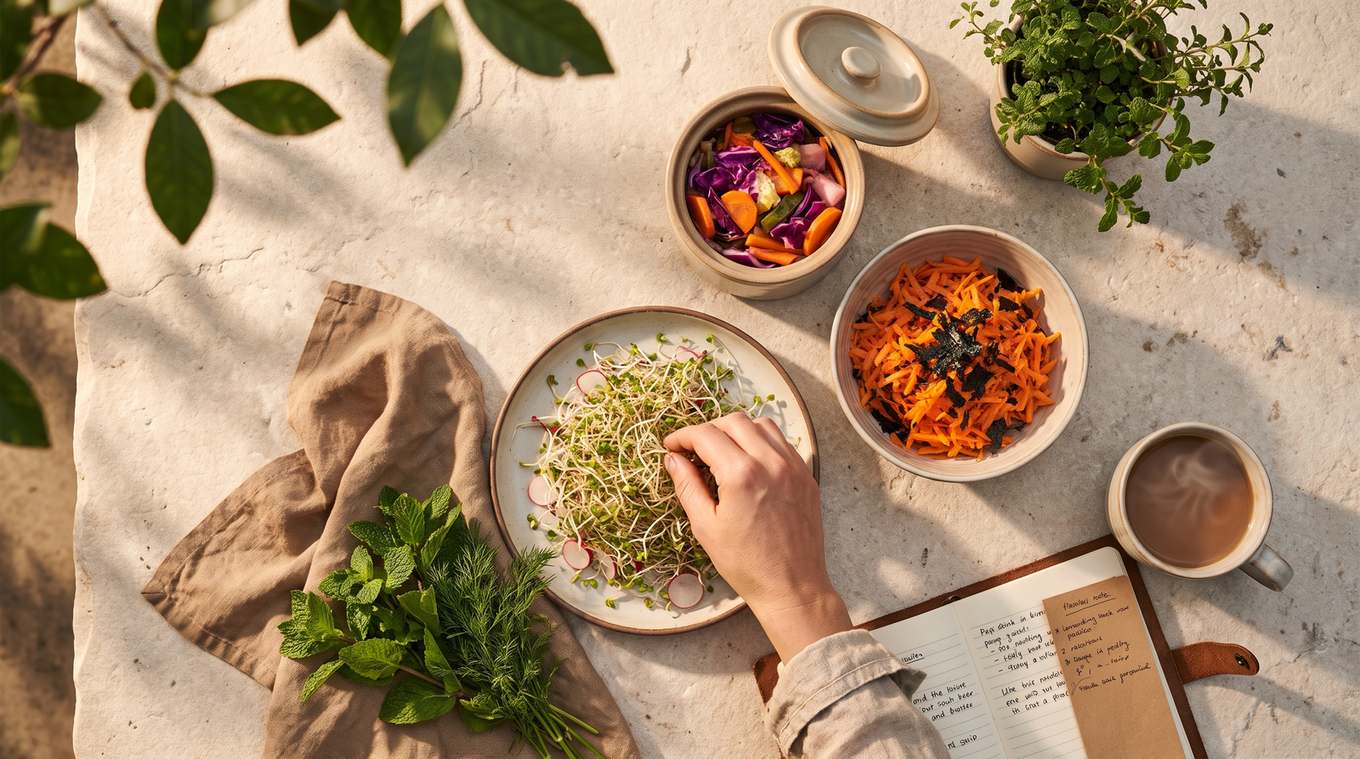
The gut microbiome is the community of micro-organisms, mostly bacteria, living in your digestive tract: about 38 trillion of them, roughly as many as your own cells. What you put on your plate, especially a variety of plants with their fibre, and fermented foods, is associated in studies with a more diverse gut microbiome. At Biovie, we built this page on eight scientific and public sources, which I reread with my eye as an ISTOM engineer.
For a long time we kept repeating that our bacteria outnumbered our cells ten to one. In 2016, three researchers had the very simple idea of redoing the sum, and they landed on a ratio close to one to one (Sender et al., 2016).
Don't worry, the essentials don't change. How many there are matters less than what you give them to eat. And there, your plate has the final say, the everyday one.
Gut microbiome: what are we talking about?
What is the gut microbiome? A definition in a few words
The human gut microbiome is the community of micro-organisms, mostly bacteria, that live in the digestive tract, mainly in the colon. A living community that feeds in large part on our leftovers: what we can't digest ourselves, starting with certain fibres.
Three words are in circulation, and we happily mix them up. The "microbiota" is those micro-organisms themselves. "Gut flora" is its old name, which many people still use. The "microbiome", strictly speaking, refers rather to all their genes and their living environment (in everyday talk, "gut microbiome" is simply what most people say for the whole thing).
How many bacteria, really?
The 2016 calculation starts from a 70 kg "reference man". It arrives at about 38 trillion bacteria for 30 trillion human cells, with a total bacterial mass of about 0.2 kg (Sender et al., 2016). In other words, roughly one bacterium per cell, and the weight of a nice apple, where we were still talking about a kilo, the weight of a bag of sugar.
Where did that famous "ten to one" come from? From an old estimate, copied from book to book, a bit like that roast whose ends were always cut off because grandma's pan was too small. The 2016 authors went back to the volume of the colon and the density of bacteria it holds, and the figure melted away.
I like this kind of correction. As an ISTOM engineer by training, I enjoy seeing a figure repeated out of habit finally recalculated, even when the story loses a bit of its spectacle.
What your bacteria eat: fibre and plant diversity
Fibre, the meal of your bacteria
Every time you sit down to eat, you are also feeding an invisible table of 38 trillion guests. They make do with what you can't digest. Part of the fibre reaches the colon undigested, and it is the bacteria that ferment it.
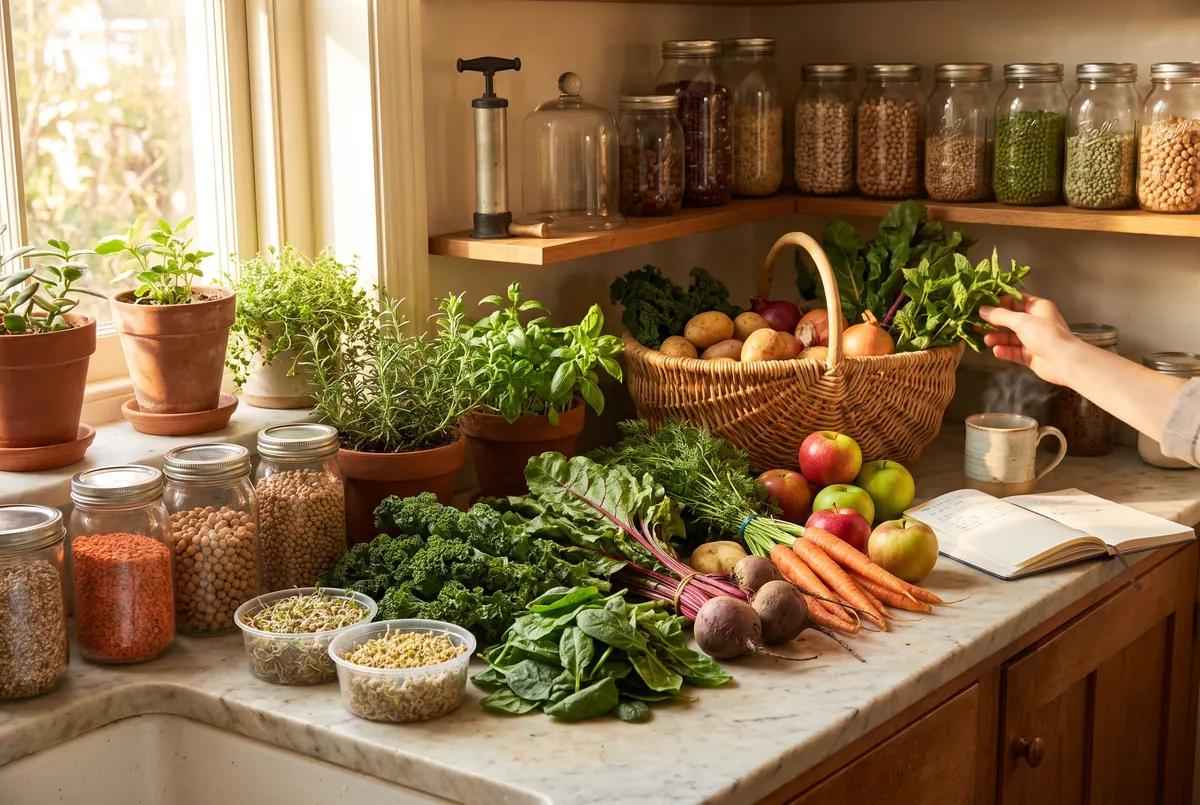
Scientists have a word for this. According to the consensus of ISAPP, an international scientific association, a prebiotic is "a substrate that is selectively utilized by host microorganisms conferring a health benefit" (Gibson et al., 2017). "Selectively" is the important word: it's a meal reserved for certain of our bacteria, not a buffet open to all.
Now, we are short on fibre. According to the Anses INCA 3 survey (2014 to 2015, 3,157 adults aged 18 to 79), French adults eat 20 g a day on average, when Anses recommends 30 g (Anses, 2017). Out of three portions of fibre expected, the average plate serves only two.
As part of a varied and balanced diet and a healthy lifestyle, this fibre comes from vegetables, fruit, pulses that are soaked then cooked, wholegrain cereals and seeds: the ordinary contents of a market basket.
30 plants a week: what the study says
The American Gut project studied the microbiome of more than 10,000 participants, enough to populate a small town (McDonald et al., 2018). Those who ate more than 30 types of plants a week had a higher bacterial diversity than those who ate fewer than 10. And here's a detail that speaks to the vegan I have been since 1992: the diversity of plants told you more than the "vegan" or "omnivore" label.
One reading precaution, only one. This is an observational study, which shows an association without proving cause and effect. Other habits may play a part.
Thirty sounds huge, until the day you start counting. Parsley counts. So does a pinch of sprouted seeds, and so do Tuesday's lentils or the seaweed flakes on grated carrots. Put a wildflower meadow next to a maize field: which one is home to more life? It's just common sense, observing nature.
Fermented foods: what the Stanford trial shows
The protocol, in plain words
In 2021, a Stanford team published in Cell a trial that I find remarkably clear (Wastyk et al., 2021). Thirty-six healthy adults were randomly assigned to one of two 10-week diets, one rich in fermented foods, the other rich in fibre. In the first group, participants worked up to about 6 servings of fermented foods a day, with foods such as sauerkraut or kombucha. Six servings! That's fermented food at every meal, and a little more in between.
Why draw lots? Because if everyone chose their own group, the sauerkraut lovers would drift towards the fermented foods by themselves, with all their other habits in their luggage. By leaving the allocation to chance, the researchers get two groups that are comparable at the start, so a difference at the end has a good chance of coming from the diet itself.
And there, the results clearly diverge. In the fermented foods group, the diversity of the microbiome rose steadily, and 19 inflammatory proteins measured in the blood went down, including interleukin 6. On the fibre side, diversity stayed stable on average, none of those 19 proteins went down, and responses varied depending on the starting diversity. Picture a blood test at the start, another at the end, and in only one of the two groups, 19 lines of the results going down. Admit it's surprising: fibre, which is presented everywhere as the meal of the bacteria, did not move diversity over the length of the trial.
Now the limit, because we should be honest to the end. Thirty-six healthy people is a fairly full classroom, and this proof of concept measures no disease risk. Nobody there was correcting an imbalance of the gut microbiome: it is a research lead, not a health claim validated by EFSA. A nice lead, all the same.
| Stanford trial (Wastyk et al., 2021) | Fermented foods group | Fibre group |
|---|---|---|
| Participants | Healthy adults, randomly assigned (36 in total) | Healthy adults, randomly assigned (36 in total) |
| Length of the diet | 10 weeks | 10 weeks |
| Microbiome diversity | Steady increase | Stable on average, variable depending on starting diversity |
| 19 inflammatory proteins in the blood | Down, including interleukin 6 | None down |
Fermented does not mean probiotic
More words we happily mix up. In a consensus published in 2021, ISAPP defines fermented foods as "foods made through desired microbial growth and enzymatic conversions of food components" (Marco et al., 2021). The definition rests on how the food is made, without requiring that live micro-organisms still be present on the plate. The same text, incidentally, distinguishes fermented foods from probiotics.
In the kitchen, it works out like this: a raw lacto-fermented vegetable is not the equivalent of the same vegetable heated afterwards, even if both remain, by definition, fermented foods.
And a tip learned the hard way: always start a lactofermentation with fresh, healthy vegetables. With vegetables that are already damaged, rot wins the race, and you end up with a walking stink bomb. Tested for you, and I don't wish it on you.
Sprouted seeds and seaweed: two sources of diversity
Sprouted seeds: variety, and hygiene
As a student at ISTOM, I had rented a room with no kitchen, and no right to use the shared kitchen. No matter, I took up sprouted seeds in a big way, to have something fresh all the same. I've kept one conviction from it: you can start with no means at all.
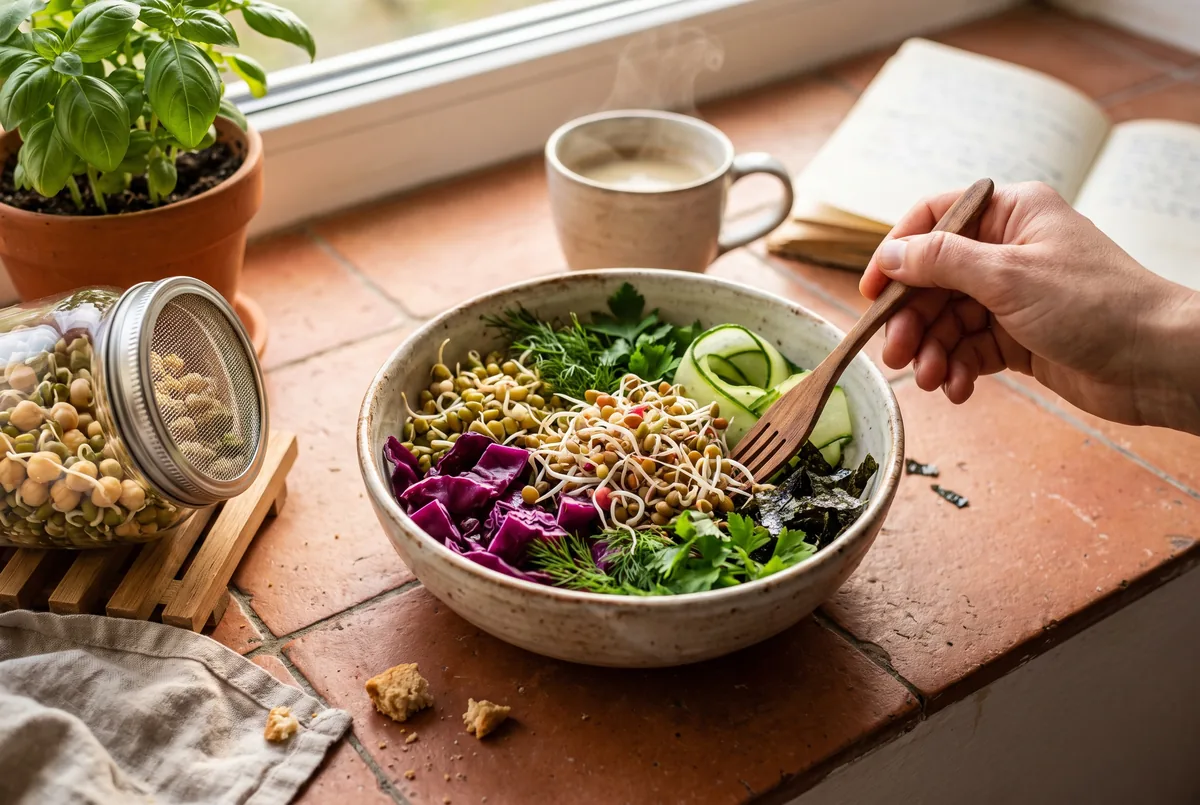
As for the gut microbiome, I prefer to be clear: none of the studies used here tests sprouted seeds themselves. Their interest, in this article, lies in the diversity they add. A pinch of sprouted radish or lentils, and there you go: more plants in the week, the very ones the American Gut study was counting (McDonald et al., 2018).
Hygiene, on the other hand, is not up for debate. According to an EFSA scientific opinion published in 2011, contamination of dry seeds is the most likely initial source of outbreaks linked to sprouted seeds, and the warmth and humidity of germination allow the bacteria present to multiply. The habits that follow are still simple:
- seeds intended for sprouting;
- rinses with drinking water;
- a clean sprouter, washed between batches, even when you're in a hurry;
- keeping them cool as soon as the sprouts are ready, as for any fragile vegetable.
For vulnerable people, medical advice is needed before eating them.
Seaweed: raw, as flakes or in a broth
Seaweed brings something else, from the sea: complex polysaccharides, long chains of sugars that research is studying as potential prebiotics (Cherry et al., 2019). The leading review on the subject concludes that controlled trials in humans are now needed. I'm telling you as it is, rather than getting ahead of the science. While we wait for those trials, seaweed brings what it already brings to the table: one more plant in the week, and an iodine-rich taste that wakes up a salad.
Preparation matters too. Personally, I cook seaweed as little as possible: flakes added off the heat, rehydrated seaweed in a salad or a tartare, kombu steeped just below boiling point for a broth. Never pan-fried, never in a wok. As part of a varied and balanced diet and a healthy lifestyle, a few flakes on your raw vegetables are enough to bring the sea into your week.
A week of living plate, at your own pace
So, how do you improve your gut health without turning everything upside down? My answer comes down to one principle: we add rather than remove, and everyone goes at their own pace. No big clear-out, no list of banned foods. Aim first for diversity, the kind the American Gut study measured (McDonald et al., 2018). Here is one possible week, as part of a varied and balanced diet and a healthy lifestyle:
- Monday, lentils or radish seeds soak in a jar; after that, a rinse every day.
- Tuesday, raw lacto-fermented vegetables next to the usual dish.
- Chickpeas soaked the night before, then cooked, join Wednesday's salad.
- Thursday: seaweed flakes on grated carrots.
- Friday, the first sprouts are ready, and you can count your plants for the week, herbs included, just to see.
- In the following weeks, a second fermented food in the day, then a third.
You see, nothing complicated. The real effort lies in regularity: rinsing the seeds every day and remembering the jar of fermented foods. And a less successful week changes nothing. Think of roly-poly toys, those weighted figures that always come back upright: you drift off course one party evening, a pizza with friends, then you come back.
To keep up this rhythm, you need stocks of seeds for sprouting and dried pulses. At Biovie, we recommend keeping them vacuum-sealed in glass jars with the BocUp kit: a bell and a small hand pump, with no electricity and no plastic bag. Low tech the way I like it, which adapts to the jars you already have if they have "shoulders" and a 65 or 84 mm lid.
Dry foods stay there, safe from humidity and moths. According to the manufacturer, fresh produce keeps up to 5 times longer: a homemade vegetable soup lasts 8 to 10 days instead of 2, enough to finish it the Monday after Sunday's batch. Two reminders all the same: vacuum does not replace the fridge or the freezer, and it does not sterilise. Also avoid vacuum-sealing a ferment in progress: it gives off gas, and your jar would soon remind you of it.
If the subject interests you, here is how to keep your food vacuum-sealed day to day.
To go further with a book, we have picked the one by Justine Lamboley, "Santé intestinale : retrouvez le confort digestif en 6 semaines".