Does Mushroom Coffee Have Caffeine? The Honest Answer
It is one of the questions you send us most often: is mushroom coffee actually caffeine-free?
The short answer is that most of the time, it is not. Most mushroom coffees on the market deliver between 40 and 75 mg of caffeine per 240 ml cup, compared with roughly 95 mg for a drip coffee. That is clearly less than a regular cup. It is not zero. And the difference is worth understanding, especially if you turned to these products precisely to cut back on caffeine.
I trained as an engineer at ISTOM, and I have spent my working life reading formulations and processes. So let's take the time to go through it properly: how caffeine actually acts on your sleep, what the studies really show, what the mushrooms bring to the cup, and how to read a label with your eyes open.
Does mushroom coffee have caffeine? What is really in the cup
Let's start with the simplest part: the composition.
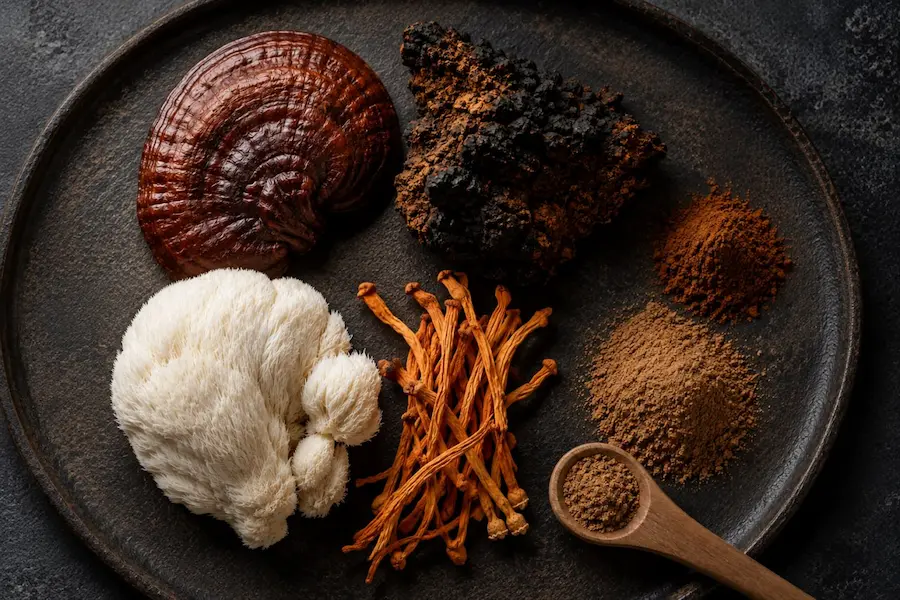
In the vast majority of cases, a mushroom coffee is an instant coffee to which mushroom powders or extracts have been added - usually lion's mane, reishi, chaga or cordyceps. The base is still coffee, with the caffeine that comes with it.
On the pack, one detail gives it away. European regulation requires ingredients to be listed in descending order of weight. When "instant coffee" or "soluble coffee" appears first, it is the most abundant ingredient in the product. The mushrooms, listed after it, necessarily weigh less.
Measurements published in early 2024 by a US consumer magazine give useful orders of magnitude: 48 mg of caffeine per cup for one of the best-selling brands, and 50 mg for another. So we are somewhere around half a drip coffee. That is a genuine reduction. It simply is not a removal.
Why do manufacturers build their products this way? The reason is technical, and perfectly understandable. Coffee brings two things that are very hard to replace: the roasted aroma, which your palate recognises instantly, and the stimulating effect you feel within the first few minutes. A drink that offers neither disappoints on the very first cup. Starting from a coffee base is therefore the safest route for a manufacturer.
This is not a deception, it is a trade-off. But it is a trade-off worth knowing about before you buy, because it completely changes what the product can do for you.
How caffeine works on sleep, explained simply
Adenosine, or your built-in tiredness meter
To understand caffeine, you first have to understand what it interferes with.
From the moment you wake up, your brain produces and accumulates a small molecule called adenosine. The further the day goes, the higher its concentration climbs. Picture a basin slowly filling up, hour after hour: that is your sleep pressure. Once the level is high enough, you feel the urge to sleep.
Adenosine works by docking onto attachment points on the surface of your neurons, called receptors - the A1 and A2A receptors in this case. Think of them as locks. When adenosine, the right key, slides into the lock and turns it, the message gets through: time to slow down.
Caffeine has a molecular shape close enough to adenosine's to slide into the same lock - without turning it. It takes up the space, and the real key can no longer fit. The tiredness message stops being delivered.
It is worth grasping what that implies: caffeine does not reduce your fatigue, it stops you perceiving it.Meanwhile, the basin keeps on filling. It is a little like taping over the oil light on a dashboard: the light goes out, the oil level does not change.
Work published in Nature Communications in 2021 - carried out in mice, let's be precise about that - described in fine detail how this build-up of adenosine records your sleep history and talks to the body's internal clock.
Half-life, and why it differs so much from one person to the next
The second useful idea, and the one most often misread: half-life.
The half-life of a substance is the time your body takes to clear half of it. Watch out for the trap: it is not the time after which everything has gone. If the half-life is 5 hours, half the dose is still there after 5 hours, a quarter after 10 hours, an eighth after 15 hours. Elimination happens in successive steps, and the tail of the curve is long.
That clearance rests mainly on a liver enzyme, CYP1A2 - a kind of molecular dismantling workshop. And depending on the genetic variant you inherit on the gene that codes for it, that workshop runs faster or slower. We distinguish fast, intermediate and slow metabolisers.
The gap is considerable: caffeine's half-life sits around 2 to 4 hours in fast metabolisers, and can reach 6 to 8 hours or more in slow ones.
Which is exactly why your coworker's 4 pm coffee is nothing like your 4 pm coffee. If you are one of those people who "can't handle coffee", that is neither imagined sensitivity nor fragility: it is a difference in liver biochemistry, and it is well documented.
What the studies actually show - dose and timing
Here I want to be precise, because this is the point where a lot of articles overreach. The available data does not say that one small cup in the morning wrecks your night. It says something more nuanced, and more useful.
A trial published in 2025 in the journal SLEEP compared two doses - 100 mg and 400 mg of caffeine - taken 12, 8 or 4 hours before bedtime, in 23 participants. The protocol deserves a word of explanation, because it is what makes the result solid: it was randomised (the order of conditions drawn at random), double-blind (neither the participant nor the researcher knew who was getting what) and crossover (each participant went through every condition, and therefore acts as their own control). For a question like this one, that is the most reliable design there is.
The result: at 100 mg, no significant effect on sleep, even when the dose was taken 4 hours before bed. At 400 mg, however, falling asleep is delayed and the organisation of sleep cycles shifts as soon as the dose lands within the 12 hours before bedtime, with clearly more fragmented sleep inside 8 hours.
In other words, and it is worth saying plainly: a 50 mg cup of mushroom coffee in the morning is very unlikely to be the cause of your difficult nights.
Timing matters as much as dose. The trial by Drake and colleagues, published in 2013 in the Journal of Clinical Sleep Medicine, showed that a 400 mg dose taken 6 hours before bed costs more than an hour of total sleep. The most striking detail in that study: the participants had no idea. Their sleep, measured objectively, had deteriorated; their own perception flagged nothing at all.
Finally, for the wider view, the meta-analysis by Gardiner and colleagues, published in 2023 in Sleep Medicine Reviews, pooled 24 studies on the subject. A meta-analysis brings together the results of several pieces of work to draw out a trend more robust than any one of them alone. The averages it found: 45 minutes less total sleep, 7 % of sleep efficiency lost, 9 more minutes to fall asleep, 12 more minutes awake during the night and around 11 minutes less deep sleep. With one very telling benchmark: every extra hour between your last cup and bedtime buys back around 2.8 minutes of sleep.
Translated into how it feels, those minutes do not add up to a sleepless night. They add up to a foggy wake-up, a morning coffee that becomes non-negotiable, and that sense of never fully catching up.
For the official reference points, EFSA - the European Food Safety Authority - considers that 400 mg per day and 200 mg in a single intake raise no safety concern for healthy adults. Those are safety thresholds, not sleep-quality thresholds: the two questions are separate. We have covered elsewhere why residual caffeine erodes sleep when it accumulates or arrives late in the day, along with caffeine's half-life and the timing of your last cup.
What to take away
It is the daily total that counts, not the single cup. 50 mg in the morning barely registers. 50 mg, plus a tea, plus a square of chocolate, plus a second cup at 4 pm is a different sum entirely.
The timing of your last intake is the most effective lever - and the easiest one to adjust.
Your metabolising speed is your own. If you are a slow metaboliser, the published averages are not describing you.
If you would like a hot drink that steps out of this equation altogether, our organic roasted lupin coffee is prepared exactly like coffee - espresso machine, moka pot or filter - and contains no caffeine.
What functional mushrooms do, and what they do not do
Lion's mane, cordyceps, reishi: where the research stands
Let me be straightforward about this: these mushrooms interest me a great deal, and we sell them. They have a long history and a genuine richness in studied compounds, beta-glucans in particular.
Lion's mane (Hericium erinaceus) is the one where the work is furthest along. A study published in Nutrients in November 2023, run double-blind on 41 adults, observed a faster reaction time on the Stroop test 60 minutes after a single 1.8 g dose.
Two points of explanation, because these details are what give the result its meaning. The Stroop test is a classic exercise in cognitive psychology: you display the name of a colour printed in ink of a different colour - the word "red" printed in blue - and ask the person to name the ink, not the word. It measures the ability to inhibit an automatic response, and therefore mental sharpness. As for the p = 0.005 reported by the authors, it means there would be roughly 5 chances in 1,000 of seeing a gap that size if the product had no effect at all. That is a statistically solid result.
That said, the authors describe it as a pilot study, on a modest sample. It is an encouraging signal that needs confirming, and I would rather present it to you that way.The point to hold on to above all is the dose: 1.8 g. We will come back to it, because that is where everything is decided. We have gone into what lion's mane really does in a dedicated article.
Cordyceps has accompanied the peoples of the Tibetan plateau for centuries and holds a long-standing place in Chinese herbal tradition, where it is associated with a notion of endurance. Modern research is interested in its role in energy metabolism. What makes it interesting to me is precisely that the energy of cordyceps does not come through a stimulant.
Reishi, finally, has run through East Asian traditions for close to two millennia.
What these three mushrooms have in common is revealing: their logic is not the logic of a stimulant. They do not press the accelerator, they support the ground you stand on. As part of a varied and balanced diet and a healthy lifestyle, that is an approach that makes sense.
Why they do not cancel out caffeine
Here is a point that becomes much clearer once you have the adenosine mechanism in mind.
No functional mushroom speeds up the work of CYP1A2. None frees the receptors occupied by caffeine. None accelerates the clearance of the molecule.
That is not a weakness: it is simply not their mode of action. You do not ask a mushroom to play antidote - you ask it to support your ground over time, and that is what it does. Combining the two poses no problem in itself; it simply does not remove the caffeine that is there.
One useful nuance, by the way: you may well feel fewer jitters with a mushroom coffee than with a drip coffee, quite simply because the dose is lower. But the jitters you feel in the morning and the effect on your night are two different things: the night-time effect depends on how much is still circulating in your blood at bedtime, not on how you felt at 9 am.
The dosage question
Let's go back to the figure from the study: 1.8 g of lion's mane.
Now take a blend off the shelf and do the arithmetic with me. Many advertise a few hundred milligrams of a "mushroom complex" - a single global figure, spread across 5 to 10 species. Divide it up and each mushroom accounts for a few tens of milligrams. That puts you two orders of magnitude below the studied dose, which is to say around a hundred times less.
This is a point I care about, because it produces an outcome that damages everyone: someone tries a very lightly dosed blend, feels nothing, and concludes that lion's mane is useless. It was not the ingredient that was at fault, it was the quantity.
The second thing to look at is more technical but easy to grasp: does the product contain a standardised extract or mycelium biomass grown on grain?
An extract is obtained by steeping the mushroom in hot water to dissolve its compounds, then concentrating the liquid. A "10:1" ratio means it took 10 kg of dried mushroom to obtain 1 kg of extract - so one gram of extract corresponds to about ten grams of raw material.
Mycelium biomass on grain is something else: the mycelium - the thread-like part of the mushroom - is grown on a cereal substrate, then the whole thing is milled and sold together. The substrate is part of the mix, which means a notable share of the powder is starch.
Both forms are legitimate, and both appear under the single word "mushroom" on the label. But they do not deliver the same amount of active material, and without a stated dose and a stated form, there is no way to compare two products.
Reading a mushroom coffee label: five quick checks
No chemistry degree required. Five reflexes, in order, are enough to place a product.
The first ingredient on the list. Since the order is descending, it tells you what you are mostly buying. "Instant coffee" or "soluble coffee" in first position means the base is coffee. A genuinely caffeine-free drink contains none at all.
The word "decaffeinated". It signals a large reduction, not a removal: a decaf is never at zero caffeine and keeps a residual fraction.
The form and the dose of the mushrooms. A stated extraction ratio (10:1, for instance) and a dose in milligrams per serving give you something you can compare. A global "complex" with no per-species breakdown gives you far less.
The other sources of caffeine. Guarana, green tea extract, yerba mate, cacao: these ingredients bring caffeine without the word "coffee" appearing anywhere on the pack. Guarana is a particularly concentrated one.
The total. Instant coffee, guarana and green tea in the same product add up - and it is worth counting them into your day.
Thirty seconds in the aisle, or three clicks on a product page, and you know what you are dealing with.
What changes with a truly caffeine-free base
Let me be clear from the outset: I am not suggesting anyone should quit coffee. Everyone has their own rhythm, and an espresso shared on a terrace is a pleasure too. It is simply that if you are looking for a drink that frees you from caffeine, it may as well actually do it.
You no longer have to watch the clock
This is the most direct benefit, and the one the data supports best. Since the effect on sleep depends on dose and timing, a caffeine-free drink simply makes the equation disappear. No more mental arithmetic at 4 pm.
The energy curve flattens out
Coffee draws a characteristic curve: a climb, then a descent. That famous mid-afternoon crash is not a biological inevitability - it is the second half of the morning's curve. And the natural reflex when it hits is a second cup, which draws another climb, therefore another crash, and so on.
Without caffeine, the curve flattens. Less high in the morning, in all honesty: a lupin coffee does not replace a ristretto on that front. But also less low in the afternoon. Across a full day, many people gain in steadiness what they give up in intensity.
A 5 pm cup becomes possible again
This is the simplest test of all: a cup in the late afternoon, without giving it a second thought.
Our Tikawa is an organic lupin coffee, roasted in Bavaria at our partner Loffee, from sweet blue lupin seeds - one hundred per cent lupin, no coffee, no guarana, no green tea. So no caffeine. It is prepared exactly like coffee, and the pouch holds 720 g.
If you would like to bring mushrooms into it, the logic becomes far easier to read: you start from a neutral base and you control what you add. Our Focus Pack brings together Tikawa Classique and a water-soluble 10:1 concentrated extract of organic lion's mane. You mix the two pouches once when they arrive and end up with 792 g of blend enriched at 10 % extract. Set against the benchmarks above, one gram of 10:1 extract corresponds to around 10 g of raw material - a very different order of magnitude from a few tens of milligrams per species.
Siegfried R., a French customer, writes to us: "Since discovering Biovie and living foods, my health has changed. I feel lighter, more energetic, with a real sense of calm day to day."
If you would like to try it over three weeks - long enough to see what it changes about your end of day - here it is.
No, and that is probably the main reason transitions fail.
Stopping abruptly triggers a well-described withdrawal syndrome: headaches from the second day, irritability, rebound fatigue. The mechanism makes perfect sense given what we have just seen: faced with a daily presence of caffeine, the brain builds more adenosine receptors to compensate. When the caffeine vanishes all at once, those extra receptors receive the tiredness signal at full strength. The adjustment takes a few days.
So it is not a failure, it is an adaptation phase - but on the third morning of a headache, most people plug the coffee machine back in, and it is hard to blame them.
What works is a gradual transition over two to three weeks. You start by replacing the latest cup of the day, the 3 pm or 4 pm one, which weighs most on your night. You keep the morning one. The following week, you replace the late-morning cup. And so on. We have described the full method for stopping coffee without suffering.
There are no failures, only experiments. A transition that succeeds in a month beats one abandoned in a week.
My own morning routine
A personal word, since it is fair to want to know whether the person writing this actually applies what he explains.
I am the son of a baker - a Meilleur Ouvrier de France - and of a Dutch mother. I grew up on bread and milk, with the childhood ailments that came with it. At 53, I am in better shape than I was at 20. Nothing spectacular about it: thirty years of gradual adjustments, and a great many labels read.
My engineering training at ISTOM left me with one stubborn reflex: before adopting a product, I want to know where the raw material comes from, how it was processed, and at what dose it is present. That is not suspicion, it is methodical curiosity - observe before you conclude.
In practice, my morning is a Tikawa latte:
one serving of Tikawa prepared like coffee, as an espresso or in a moka pot;
15 cl of homemade tiger nut milk, warmed and frothed - I soak chufa overnight, blend, and strain through a nut milk bag; failing that, a shop-bought plant milk works perfectly well;
a pinch of cinnamon.
On the choice of milk: I do not use oat. Almond or coconut are perfectly fine as a second choice, but tiger nut is my preference, for its taste and because you can make it yourself.
Thirty seconds of preparation, inside a gesture you already make every morning. And the same cup is still an option at 5 pm.
Mushroom coffee: precautions and contraindications
For most healthy adults, caffeine in moderate amounts poses no difficulty. Some situations do call for particular attention.
Pregnancy and breastfeeding. EFSA advises not exceeding 200 mg of caffeine per day from all sources combined. A caffeinated mushroom coffee counts towards that total, just like a coffee or a tea.
Children and adolescents. EFSA considers the data insufficient to set a safe threshold, and ANSES recommends avoiding caffeinated drinks in this age group.
Anxiety disorders, palpitations, rhythm disorders, uncontrolled high blood pressure. ANSES likewise recommends avoiding caffeine in people with cardiovascular, psychiatric or neurological conditions, as well as in people sensitive to caffeine.
Gastro-oesophageal reflux. Caffeine relaxes the lower oesophageal sphincter, which tends to accentuate symptoms.
Slow metabolisers. If a late-morning cup is enough to disturb your night, move your last intake earlier rather than adjusting the dose.
On the mushroom side: reishi is not advised alongside anticoagulant treatment, and people allergic to mushrooms should naturally abstain. In case of kidney insufficiency or long-term medication, ask your doctor for advice.
In every case, this is meant as part of a varied and balanced diet and a healthy lifestyle.
Frequently asked questions about mushroom coffee
Does mushroom coffee have caffeine?
Yes, in the great majority of cases. Most blends rest on an instant coffee base and deliver 40 to 75 mg of caffeine per 240 ml cup, compared with roughly 95 mg for a drip coffee. Only products built on a coffee-free base - chicory, lupin, barley - are genuinely free of it. The first ingredient on the list tells you straight away.
How much caffeine is in mushroom coffee?
Between 40 and 75 mg per 240 ml cup for most products on the market, against roughly 95 mg for a drip coffee. Measurements published in early 2024 by a US consumer magazine reported 48 mg per cup for one of the best-selling brands and 50 mg for another. That is around half a regular coffee, which is a real reduction but not a removal.
What are the benefits of mushroom coffee?
Two distinct aspects. On one hand, a lower caffeine dose than a regular coffee. On the other, what the mushrooms bring: a study published in Nutrients in 2023 observed, in 41 adults given 1.8 g of lion's mane, a faster reaction time on the Stroop test at 60 minutes. The dose is decisive: the product still has to deliver a comparable quantity.
What is the downside to mushroom coffee?
Mainly a residual caffeine content that often goes unnoticed, a mushroom dose frequently far below the one used in studies, and a high price that can reach 35 € a pouch. Add to that the lack of precision on the form used: standardised extract or mycelium biomass on grain. These are formulation questions, not questions about the quality of the mushrooms themselves.
Does mushroom coffee affect sleep?
Not on its own, if you drink it in the morning. A randomised trial published in SLEEP in 2025 found no significant effect on sleep at 100 mg of caffeine, even 4 hours before bed, whereas at 400 mg disruption appears up to 12 hours before. What counts is your daily total, the timing of your last intake and your own metabolising speed.
Which mushroom can replace coffee?
No mushroom replaces coffee on its own: they bring neither the roasted aroma nor the stimulation. The caffeine-free alternatives are roasted plant bases - lupin, chicory, barley. Functional mushrooms are then added to them.
Can you drink mushroom coffee every day?
Yes for a healthy adult, staying within EFSA's reference points: 400 mg of caffeine per day and 200 mg per intake, all sources combined. If the product is genuinely caffeine-free, the question no longer arises.
What are the contraindications of mushroom coffee?
Pregnancy and breastfeeding beyond 200 mg of caffeine per day, children and adolescents, anxiety disorders, heart rhythm disorders, uncontrolled high blood pressure, reflux. On the mushroom side: anticoagulant treatment for reishi, mushroom allergy, kidney insufficiency. If in doubt, speak to a healthcare professional.
Prisca T., nutritional therapist: "I am constantly looking for organic, ethical and effective products. I have been ordering from Biovie for several years and it is one of the few sites I trust absolutely."
The information presented in this article is provided for informational purposes and does not constitute medical advice. Consult a healthcare professional before making any change to your diet or your supplementation. As part of a varied and balanced diet and a healthy lifestyle.