Kefir or kombucha: complete guide to choosing the ideal fermented drink
Kefir is ideal if you are looking for maximum probiotic power (up to 60 different strains), while kombucha is better suited for its antioxidants and its refreshing tangy taste. At Biovie, after 18 years of supporting living food enthusiasts, we have found that the choice depends above all on your health profile and your goals.
Honestly, this is THE question we have been asked most often for years. Aurélie and I drink both regularly (even if, admittedly, we make fruit kefir mostly in summer), and we have learned to use them in a complementary way depending on the time of day and what the body needs. This guide will help you see clearly and make the choice that really suits you.
Comparison at a glance: kefir vs kombucha
Before going into detail, here is what to remember about these two stars of fermented drinks. Fermented foods have their place in a varied diet, but these two drinks have very distinct profiles.
Probiotics: Kefir wins by a wide margin with 40 to 60 strains of beneficial bacteria and yeasts, compared with only 5 to 10 for kombucha. By comparison, a standard yogurt contains only 2.
Antioxidants: Advantage kombucha. The tea polyphenols are largely preserved during fermentation, an asset for those interested in these compounds.
Preparation time: Kefir ferments in just 24 to 48 hours, while kombucha calls for patience with 7 to 14 days of fermentation.
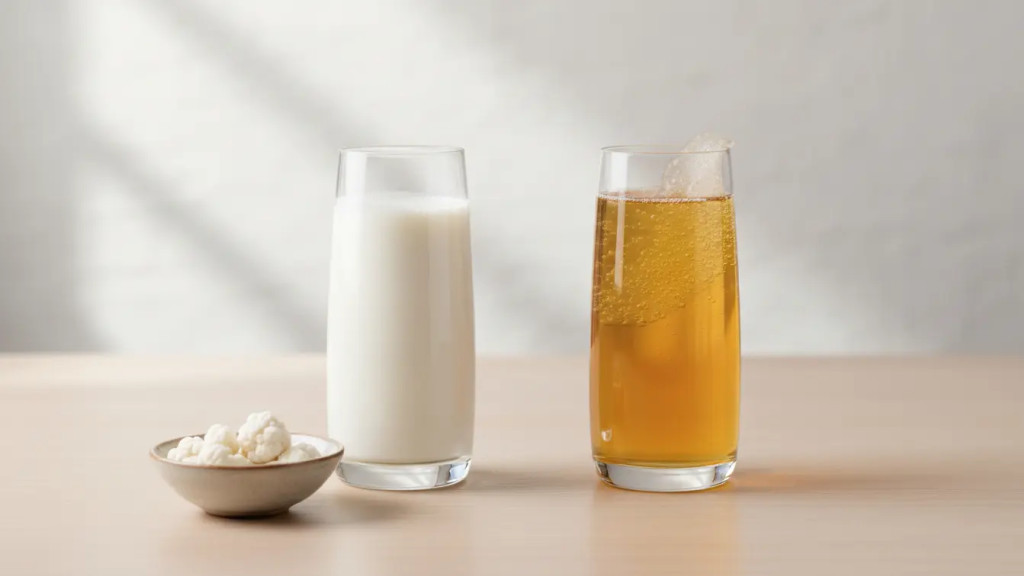
Taste: Kefir is rather neutral to slightly tangy, kombucha is distinctly tangy and naturally sparkling.
Caffeine: Kefir contains none, kombucha does since it is made from tea.
Calories: Kombucha is slightly lower in calories (30 to 50 kcal per 250ml versus 50 to 80 kcal for kefir).
That's the summary. Now let's explore each of these fermented drinks in detail.
What is kefir? Origins and varieties
The different types of kefir
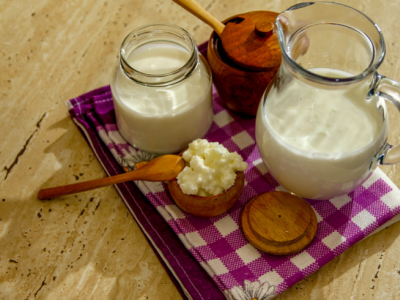
Kefir is above all a story of grains. These small gelatinous clusters look like miniature cauliflower and contain a complex ecosystem of bacteria and yeasts living in symbiosis. The origin of these grains goes back thousands of years to the Caucasus mountains, where shepherds used them to ferment the milk of their herds.
Milk kefir is the most traditional. It turns milk (cow, goat or sheep) into a creamy, slightly sparkling and tangy drink. It is the one that provides the most calcium and vitamin B12.
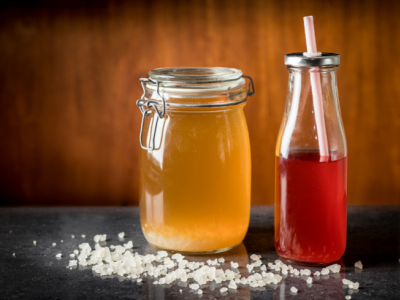
Fruit kefir, also called tibicos, is the lactose-free version. The same grains (or specific grains) are used to ferment sugared water with dried fruit. The result is a sparkling, refreshing drink, ideal for those who do not consume dairy products.
Coconut water kefir is an exotic variant that we discovered during our travels in Asia. Coconut water brings its own minerals and gives a slightly sweet, tropical drink. To make a successful coconut water kefir, the technique is similar to classic fruit kefir.
To get started, living, active fruit kefir grains are essential. They are the basis of everything.
To compare formats and discover the rest of the range, browse our Ferments range.
The fast fermentation process (24-48h)
What really sets kefir apart from other fermented drinks is how quickly it is made. In just 24 to 48 hours, you get a drink that is ready to enjoy.
In practice, the process is disarmingly simple: you place your grains in the liquid (milk or sugared water), cover with a cloth, and wait at room temperature. The bacteria and yeasts do all the work. After 24 hours, you strain, keep your grains for the next batch, and that's it!
This simplicity makes it an ideal starting point for those who want to make homemade fruit kefir without any fuss. People often start here before moving on to longer fermentations.
Kombucha is an ancient drink of Asian origin, probably born in China before spreading to Japan and Russia. Unlike kefir, which uses grains, kombucha is made with a SCOBY.
SCOBY stands for "Symbiotic Culture Of Bacteria and Yeast". Visually, it is a kind of gelatinous disc floating on the surface of sweetened tea. It is also called the "kombucha mother" because it reproduces: with each fermentation, a new layer forms on top of the old one.
The Biovie kombucha mother, carefully cultivated, helps you succeed with your first fermentation. We spent years selecting particularly vigorous and tolerant strains, with a 95% success rate for our customers from the very first attempt.
You can also create your own kombucha mother from a bottle of store-bought kombucha, but the process is longer and less certain.
Kombucha calls for patience. Allow 7 to 14 days of fermentation depending on room temperature and the acidity you want.
The process starts with making sweetened tea (black or green tea, preferably with white sugar - the SCOBY does not much like unrefined sugars). Once the tea has cooled, you add the SCOBY and a little starter liquid (kombucha from a previous fermentation or cider vinegar).
Then it's a matter of patience. The first fermentation lasts about a week. You can then do a second fermentation in the bottle with fruit or herbs to get more fizz and a variety of flavours.
This patience is rewarded with a unique drink that cannot be reproduced with kefir: a complex tangy taste, slightly vinegary, naturally sparkling, with notes that vary according to the tea used and the flavourings added.
Compared profiles: probiotics, antioxidants and nutrition
Probiotic richness: advantage kefir
This is where kefir really stands out. With 40 to 60 different strains of beneficial bacteria and yeasts, it breaks every record among natural probiotic drinks. Kombucha, by comparison, contains only 5 to 10.
To put these figures into perspective: a standard supermarket yogurt usually contains 2 probiotic strains. Kefir therefore potentially offers 30 times more microbial diversity.
This diversity is of great interest to researchers. Our gut microbiota is a complex ecosystem, and dietary variety is one of the avenues being studied. To go further, we have devoted an article to natural probiotics, to include in a varied and balanced diet.
Antioxidant power: advantage kombucha
Kombucha has its own card to play. Because it is made from tea (black or green), it retains a large part of the polyphenols - antioxidant compounds widely studied in nutrition.
These polyphenols also interest athletes. After intense exercise, the body produces more free radicals, and research is looking at the role of dietary polyphenols in recovery, with no definitive conclusion to date. Some specialist publications, such as Decathlon Conseils Sport, also mention kombucha for endurance athletes.
Detailed nutritional profile
Beyond probiotics and antioxidants, these two fermented drinks have distinct nutritional profiles.
Milk kefir provides calcium and vitamin B12, an interesting option for vegetarians; calcium is needed for the maintenance of normal bones. Milk proteins are also present, partially pre-digested by fermentation.
Kombucha, for its part, provides no significant protein but contains caffeine (about half that of the original tea) and organic acids produced during fermentation.
Which profile, which drink? A personalised guide
This is the section I find most useful. Because beyond the theory, what really matters is knowing which drink matches YOUR needs.
For athletes
If you are an athlete, kombucha is a low-calorie, thirst-quenching drink after exercise, with the polyphenols of tea. But milk kefir is not to be outdone with its proteins, which contribute to the maintenance of muscle mass.
My advice: kombucha after exercise to quench your thirst, milk kefir in the morning for the protein.
For pregnant or breastfeeding women
Caution is required here. Kombucha contains caffeine and a residual level of alcohol (generally between 0.5% and 2%, according to UFC Que Choisir). For this reason, many pregnant women prefer fruit kefir, which contains neither caffeine nor significant alcohol.
Milk kefir may also be suitable, provided it is made with pasteurised milk and under impeccable hygiene conditions.
For seniors
Milk kefir is particularly interesting for older people. Its calcium and vitamin B12 content meets needs that are often poorly covered after 65. In addition, fermentation makes lactose easier to digest, even for those who usually tolerate it poorly.
For digestive issues
This is clearly kefir territory. Its exceptional richness in micro-organisms (remember: up to 60 strains) makes it the most diverse fermented drink, and research is studying its link with the gut flora.
For 18 years, we have been supporting thousands of living food enthusiasts. Our observation: many of those who add kefir to their routine adopt it for good.
Be careful, however, to start gradually. In the first few days, bloating may occur. This is normal: the microbiota is adapting. Start with 100ml a day and increase gradually.
Kefir, kombucha and weight management: what you need to know
Fruit kefir is lower in calories than milk kefir and provides probiotics, which can fit into a balanced diet. That does not make it a slimming product.
Kombucha, which is low in calories, can also be a good replacement for sodas and sweetened fruit juices as part of a varied and balanced diet.
For the lactose intolerant
Fruit kefir (tibicos) is the obvious solution: no milk, no lactose, no problem.
But did you know that milk kefir fermented for longer (48h instead of 24h) is often well tolerated even by people sensitive to lactose? Extended fermentation allows the bacteria to pre-digest a large part of the lactose.
Taste and ease of preparation: the two criteria that often decide
Comparing profiles is one thing. In practice, what decides which drink you will still be drinking in six months is its taste and the time it demands of you. Here is what you need to decide.
Which one tastes better?
It all depends on the recipe, the ingredients and the fermentation time, but the broad lines are stable. Kombucha is tangier and fizzier, with notes of tea and, at the end of fermentation, aromas reminiscent of cider or alcohol-free beer. Kefir is milder: lactic and creamy for milk kefir, distinctly fruity and light for fruit kefir.
In other words: if you are looking for a soda substitute, kombucha will appeal to you more; if you are looking for a mild drink to include at breakfast or in a smoothie, fruit kefir is the more natural choice. The most honest approach is still to taste both before choosing - preferences in this area cannot be predicted.
Which one is easier to make at home?
Kefir clearly wins on this front. Simply put the grains in sugared water (or milk) and leave to ferment for 24 to 48 hours at room temperature: two days later, the drink is ready. The complete fruit kefir pack brings together the grains and everything you need to get started without looking elsewhere.
Kombucha requires one more step and more patience: you first make sweetened tea, let it cool, then add the mother (the SCOBY) for a fermentation of five to six days with the complete kombucha pack - sometimes up to two weeks depending on the strain, the room temperature and the acidity you are looking for.
Two clarifications that avoid disappointment, and that we are often asked about:
The cultures are not interchangeable: you cannot make kombucha with kefir grains, nor kefir with a kombucha mother. They are two distinct microbial ecosystems.
Milk kefir grains are not the same as fruit kefir grains: same name, two different cultures, two different drinks.
In both cases, the ingredients remain simple and inexpensive. The only real difference is the pace: two days on one side, a week on the other.
Daily consumption: recommended amounts and frequency
Can you drink kefir every day?
Yes, absolutely. A daily intake of 150 to 250ml of kefir suits most adults. In fact, that is what Aurélie and I have been doing for years.
The key is to go gradually. If you are just starting out, begin with 100ml a day for the first week. Your microbiota needs time to adapt to this new population of friendly bacteria. After that, you can increase to 200-250ml without any problem.
Yes, with a few precautions. An intake of 200 to 300ml a day suits most adults.
Two points to watch:
Caffeine: Kombucha contains about half the caffeine of the original tea. If you are sensitive to caffeine, avoid drinking it in the evening.
Residual sugar: Depending on the fermentation time, kombucha may contain residual sugar. Longer fermentation = less sugar. For people with diabetes or those watching their blood sugar, choose a well-fermented kombucha (at least 14 days).
Contraindications and precautions to know
I prefer to be transparent on this subject. These fermented drinks have their place in a varied diet, but they are not suitable for everyone.
Possible side effects
In the first few days, bloating, gas or changes in transit may occur. This is a normal adaptation reaction of the microbiota. These discomforts generally disappear within one to two weeks.
If symptoms persist beyond three weeks, reduce the amounts or consult a health professional.
Residual alcohol: what you need to know
The fermentation process of kombucha (and to a lesser extent of fruit kefir) naturally produces a small amount of alcohol. For kombucha, levels generally range between 0.5% and 2% depending on the fermentation time and preparation conditions.
This is information that UFC Que Choisir has highlighted and that is important to know, particularly for pregnant women, people going through alcohol withdrawal or those taking certain medications.
Who should avoid these drinks?
Immunocompromised people should consult their doctor before consuming homemade fermented drinks. Bacteria that are beneficial for a healthy person may present risks for a weakened immune system.
People on anticoagulant treatment should also seek medical advice, as kombucha may interact with certain medications.
Recipes and combinations to include fermented drinks in your daily life
Now let's get practical! Here are three exclusive recipes that Aurélie and I use regularly.
Kefir-spirulina smoothie to start the day well
This is our favourite breakfast when we have a busy day ahead of us.
Blend everything and enjoy immediately. The kefir + spirulina combination is a real nutritional powerhouse. Spirulina brings its protein and iron, kefir its probiotics, and banana its natural sugars for energy.
Kombucha with pollen and mint
This recipe is perfect in autumn or winter, to enjoy fresh pollen in a fragrant drink.
Let the pollen and mint infuse in the kombucha for 10 minutes. The pollen does not dissolve completely, which is normal. Serve chilled.
Fresh pollen complements the nutritional profile of kombucha perfectly with its B vitamins and amino acids.
A 7-day plan to bring kefir and kombucha into your daily routine
To gradually bring these two drinks into your daily routine, here is a plan we have tested:
Days 1 to 3: 150ml of kefir in the morning on an empty stomach. Let the microbiota settle in.
Days 4 and 5: 200ml of kombucha in the afternoon. Add the antioxidants.
Days 6 and 7: Alternate - kefir in the morning, kombucha in the afternoon. The body benefits from both.
Bonus: Add marine plasma to your routine, as part of a varied and balanced diet.
FAQ: your questions about kefir and kombucha
Which is better for your health, kefir or kombucha?
Kefir is superior in quantity of probiotics (40-60 strains versus fewer than 10 for kombucha), while kombucha excels in antioxidants thanks to the tea polyphenols. The "best" depends on your preferences: for diversity of micro-organisms, choose kefir; for tea polyphenols, opt for kombucha. Ideally, alternate the two to benefit from their complementary strengths.
What is the difference between kefir and kombucha?
Kefir is made from grains (bacteria and yeasts) that ferment milk or sugared water in 24-48h. Kombucha uses a SCOBY to ferment sweetened tea for 7-14 days. Kefir is richer in probiotics, kombucha in antioxidants.
Can you drink kefir every day?
Yes, a daily intake of 150 to 250ml of kefir suits most adults. Start gradually (100ml/day in the first week) to allow your microbiota to adapt.
Is it good to drink kombucha every day?
Yes, in moderation. An intake of 200 to 300ml a day suits most adults. Note: kombucha contains caffeine (from the tea) and a residual level of alcohol (0.5-2%). Avoid it in the evening if you are sensitive to caffeine.
What are the contraindications of kefir?
Kefir is not recommended for immunocompromised people (without medical advice), in cases of proven intolerance to fermented foods, and in early pregnancy for unpasteurised milk kefir. People on anticoagulant treatment should consult their doctor before regular consumption.
Kefir, kombucha and body weight: what to expect?
Neither kefir nor kombucha is a slimming product. Fruit kefir is low in calories and provides probiotics; kombucha is also low in calories. Drunk instead of sodas or sweetened juices, as part of a varied and balanced diet, they can fit into an approach aimed at a healthy weight, with no guaranteed effect.
What does kefir actually do in the intestines?
Kefir has no "cleaning" action on the intestines. It provides 40 to 60 strains of live bacteria and yeasts, and research is studying its link with the gut flora. It has its place in a varied, fibre-rich and balanced diet.
Which drink is similar to kombucha?
Fruit kefir (or tibicos) is the closest alternative: sparkling, tangy and rich in probiotics, but caffeine-free. Other options: jun (kombucha made with green tea and honey), ginger beer (fermented) and kvass (fermented bread).
Can you give kefir or kombucha to children?
Fruit kefir can be given to children from 1 year old, in small amounts (50-100ml). Kombucha is not recommended before the age of 12 because of the caffeine and residual alcohol. Consult your paediatrician if in doubt.
How should you store homemade kefir and kombucha?
Kefir keeps for 5-7 days in the refrigerator. Kombucha keeps for 2-3 weeks in a cool place. To stop fermentation, refrigerate immediately. Kefir grains and the kombucha mother keep in the refrigerator in their liquid for several weeks.
Conclusion: why not try both fermented drinks?
There you have it, you now hold all the cards to make your choice. But honestly, why choose?
Kefir gives you exceptional probiotic diversity with ultra-fast preparation. Kombucha offers its unique antioxidants and that sparkling tangy taste that makes an excellent replacement for any soda.
If you are just starting out, begin with fruit kefir. It is the simplest, the quickest, and it suits everyone. Once you have mastered the process, try your hand at kombucha for variety.
Try it and you'll adopt it!
Ready to discover fermented drinks?
Start with kefir for maximum probiotic richness, or with kombucha for its unique antioxidants. Our living kefir grains and our carefully cultivated kombucha mother will accompany you on this adventure.










.webp)


.webp)