


Complete Organic Kombucha Pack
Kit to make your own kombucha. Complete equipment + tea + flavoring + kombucha mother. Certified organic.
New: Orisae becomes My Scoby! The kit remains the same, only the brand changes.
No queries yet, leave the first!
Price:
€39.90
Product availability:
In stock
Tax included


Complete Organic Kombucha Pack images


Complete organic kombucha kit
for making your own kombucha at home (with SCOBY)
This organic kombucha kit brings together in a single parcel everything you need to start your first fermentation at home: a live kombucha mother, the jar, the bottles, the tea, the flavouring and access to the preparation guide. No more searching for where to find the SCOBY, which tea to take, which container to use. You open it, you follow the steps, you ferment.
The new star of drinks with friends, kombucha is a fermented tea drink, flavoured with fruit, flowers or plain, lightly sparkling. Its taste is tangy, very refreshing and low in sugar. Frankly, once you have tasted a well-made homemade kombucha, you quickly understand why industrial sodas lose their appeal.
🍶 What does the kombucha kit contain?
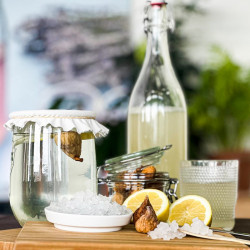
The Orisae - My Scoby homemade kombucha kit contains 8 items:
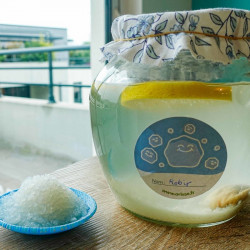
- A 1 L glass jar with a swing-top closure
- 2 glass bottles with swing-top closures, 0.5 L
- A reusable organic cotton tea bag
- An organic cotton protective cloth to cover your kombucha
- A 50 g pack of selected black tea for kombucha - up to 10 L of drink
- A 35 g pack of Oasis flavouring (made from orange peel, turmeric, acerola and hibiscus flower)
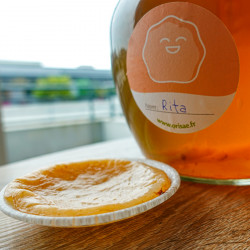
- A kombucha mother (SCOBY) of 10 cm and 50 g + 100 ml of starter liquid
- Access to the complete guide to making your kombucha a success (available here)
All the equipment is made in France.
The flavourings are made only from dried plants; you can change them to vary the flavours of your kombuchas.
🍶 How do you make your own kombucha at home with this kit?
With this kombucha kit, making your kombucha comes down to three steps. It really is within reach of a complete beginner - along with kefir, it is even the easiest fermentation to get right the first time.
- Prepare the sweetened tea. Brew the organic black tea from the kit in the cotton bag, then dissolve the sugar (allow 60 to 80 g per litre - it is not supplied). Leave to cool to room temperature: hot liquid would damage the SCOBY.
- Start the first fermentation. Pour the cooled tea into the 1 L jar, add the kombucha mother and its 100 ml of starter liquid. Cover with the organic cotton cloth, away from direct light, between 20 and 25 °C. Allow 7 to 12 days depending on the temperature of your kitchen and the taste you are after: the longer the fermentation, the less sweet the drink and the more tangy it becomes.
- Bottle it (second fermentation). Transfer into the 2 swing-top bottles with the Oasis flavouring. Close and leave for 2 to 4 days at room temperature: this is when the bubbles appear. Then into the refrigerator, which pauses the fermentation.
You can also see the process in the video below:
Very fun and easy to understand, you will never fail your kombuchas again.
To go further, our detailed preparation guide:
Homemade kombucha: the complete guide to making your first fermentation a success
🍶 Why choose a kombucha kit rather than buying the parts separately?
In practical terms, three reasons come up among our customers.
Simplicity. Buying separately a live SCOBY, a suitable jar, an unflavoured tea compatible with fermentation, bottles that hold pressure and a breathable cloth means five orders from five different suppliers - and as many chances to get it wrong. The kombucha kit settles the matter in one go.
The compatibility of the items with each other. This is the point people underestimate. A tea flavoured with essential oils can hinder the culture. A jar with an airtight seal is not suited to the first fermentation, which needs air. A recycled bottle does not always hold the pressure of the second fermentation. In this kombucha kit, each item has been chosen to work with the others.
Cost. A turnkey kit costs less than the sum of its components bought individually. And once you have the kit, the only recurring expense is tea and sugar - a few cents per litre. The SCOBY reproduces itself.
This kombucha starter kit is particularly suitable for beginners. If you are still hesitating between the two main drink fermentations, our complete kefir or kombucha guide will help you decide.
🍶 What our customers say
These reviews are about Biovie and our fermentation range in general - to date, no published review relates specifically to this kombucha kit. Here they are as they are, unedited.
"I regularly place orders there, among other things sea water, fresh coconuts, seaweed, honey, wooden utensils, and more recently the filter bottle and the kit to get started making plant-based yoghurts. In short, I love the products they offer, as well as their approach, the care they put into the provenance, quality and ethics of the products."
Maiwenn O. - Google review, 5/5
"When it comes to food, quality must come first and I have become demanding about the "sourcing" of my food. I get my sprouted seeds, my Quinton® water, my seaweed there and I will soon be tackling the subject of lacto-fermentation."
Jonathan Tabutin - Google review, 5/5
"I have been ordering from Biovie for years, my fresh seaweed to make my seaweed tartare, nori sheets for my sushi, marine plasma, my ferments for yoghurt and plant-based cheeses, and lots of other delicious products. I have always been delighted with the quality of the products and the service."
Florence Demay - Google review, 5/5
🍶 What a kombucha contains
The composition of a kombucha varies a great deal depending on the tea used, the fermentation time and the temperature. It generally contains the following constituents:
- Organic acids, mainly acetic acid, gluconic acid and lactic acid, produced by the microbial consortium during fermentation. These are what give kombucha its characteristic tangy profile.
- Polyphenols from the tea (catechins, theaflavins), whose levels change over the course of fermentation.
- Live yeasts and acetic and lactic bacteria, provided by the SCOBY. The exact composition of this consortium varies from one culture to another.
- A small amount of carbon dioxide, which is the source of the natural effervescence.
- Residual sugar, in varying amounts depending on the fermentation time.
In the SCOBY, yeasts and bacteria work in symbiosis: the former transform the sugar, the latter convert the products of this transformation into organic acids. The variability in composition of artisanal kombuchas is significant: we describe here what the drink contains, not what it would do to the body.
🍶 Precautions for use
- Alcohol. Fermentation naturally produces a small amount of alcohol, generally in the region of 0.2 to 0.5% vol in an artisanal kombucha. In France, a drink is classified as alcohol-free below 1.2% vol (article L3321-1 of the Public Health Code). A very long or very warm fermentation can raise this level: it is better to respect the stated durations.
- Pregnancy and breastfeeding. Because of this presence of alcohol and the unpasteurised nature of the drink, drinking kombucha is not recommended during pregnancy and breastfeeding. If in doubt, ask your doctor or midwife for advice.
- Children. For the same reasons, kombucha is not suitable for young children.
- Vulnerable people. If you are immunocompromised, on long-term medical treatment, or if you follow a particular diet, talk to a healthcare professional before adding an unpasteurised fermented drink to your daily routine.
- Preparation hygiene. This is the most important point for home fermentation. Clean utensils, washed hands, no reactive metal utensils in prolonged contact with the culture, and visual monitoring: dry, fuzzy mould (green, black or blue) on the surface means you must throw away the preparation and start again with a new mother. A mother in good condition is beige, supple, sometimes stringy - that is normal.
And to be clear: kombucha is a fermented food, not a treatment. It is part of a varied and balanced diet and is no substitute for any medical care.
🍶 Find various articles about kombucha on our blog:
Where to buy a kombucha mother?How to make and feed a kombucha mother?
What are the differences between kombucha and kefir?
Kefir or kombucha: the complete guide to choosing the ideal fermented drink
Homemade kombucha: the complete guide to making your first fermentation a success
Home fermentation: where to start?
Home fermentation: where to start when you are a beginner?
ORISAE - My Scoby
Axel and Cléo founded Orisae in 2020. This couple of designers wanted to put more meaning into their lives and so devoted their time to doing everything possible so that everyone can discover and adopt the most economical, most ecological and above all most delicious method: home fermentation.
Here is a video and interview we had the pleasure of filming with Cléo, co-founder of Orisae:
Increasingly aware of the impact of food on living things, our health and our environment, they started from nothing and launched a crowdfunding campaign that almost tripled its target. Supported by hundreds of people in their project, the kits for kefir and for kombucha then came into being, accompanied by a real exchange platform so that everyone can share their home fermentation adventure. Their goal? To make fermentation accessible, simple, fun and above all convivial!
Their workshop is located in Strasbourg and everything is made on site. You could even say they are ferment breeders!
Why Biovie distributes this fermentation kit
Biovie has specialised in living food since 2007. In almost twenty years, we have seen a lot of fermentation kits come and go - and we have turned down a lot of them too. Three criteria tipped the balance for this kombucha kit.
1. Strains that are genuinely alive on arrival. A kombucha mother cannot be stored like a packet of tea. At Orisae, the SCOBYs are cultivated continuously in the workshop and shipped with their starter liquid. That is what makes the difference between a first fermentation that gets going in three days and a culture that stays inert.
2. French manufacturing and organic raw materials. The glass, the cotton, the tea, the flavourings: everything is organic and made or assembled in France, in a workshop we know and whose behind-the-scenes we have filmed. For a drink you are going to prepare every week for years, that matters.
3. Real support after purchase. This is the point that kits sold in supermarkets or on marketplaces do not have. The online guide, the community, the answers to questions like "my mother has sunk to the bottom of the jar, is that serious?" (no, it is not serious). Frankly, that is what makes a kit end up used rather than forgotten in a cupboard.
Best before: 20/01/2027
Kombucha kit technical sheet
Contents : 1 glass jar with a swing-top closure, 1 L · 2 glass bottles with swing-top closures, 0.5 L (made in France) · 1 reusable organic cotton tea bag · 1 organic cotton protective cloth · 50 g of organic black tea, selected for kombucha · 35 g of Oasis flavouring · 1 organic kombucha mother (SCOBY) of 10 cm and 50 g + 100 ml of starter liquid · 1 access to the complete guide to making your kombucha a success (available at this link).
Flavouring ingredients : Oasis = Orange*, turmeric*, acerola*, hibiscus flower*.
* ingredients from organic farming
Origin : Orisae - My Scoby workshop, Strasbourg (France).
Best before : 3 years
Storage : all the items keep at room temperature. The kombucha mother keeps in the fridge.
What is not supplied in the kit
The kombucha kit contains all the equipment and the ferments. Two basic ingredients remain your responsibility, simply because they are already in every kitchen:
- Sugar - allow 60 to 80 g per litre of preparation. A blond or white cane sugar works very well; whole sugars are harder to manage for a beginner. Useful reminder: this sugar feeds the culture, it is not there to sweeten the final drink.
- Water - preferably unchlorinated. If your tap water is heavily chlorinated, let it stand overnight in the open air or use filtered water. Chlorine hinders the work of the microorganisms.

Frequently asked questions about the kombucha kit
How many litres of kombucha can you make with this kit?
The 50 g of organic black tea supplied allows you to prepare up to 10 L of kombucha. The 1 L jar corresponds to one batch, i.e. around ten batches with the tea in the kit. After that, only the tea and sugar need to be bought again: the kombucha mother keeps working and reproduces with each cycle.
How long does a kombucha mother last?
A well-maintained kombucha mother lasts for years - ours has been going for well over five years. With each fermentation, it produces a new layer on the surface, which you can separate to start a second jar or give to a friend. You simply need to feed it regularly (sweetened tea) and keep it in the refrigerator in a little kombucha if you take a break.
Does homemade kombucha contain alcohol?
Yes, in very small amounts. Fermentation naturally produces alcohol, generally between 0.2 and 0.5% vol in an artisanal kombucha fermented over 7 to 12 days. In France, a drink is considered alcohol-free below 1.2% vol (article L3321-1 of the Public Health Code), a threshold that homemade kombucha does not normally exceed - except with a very long fermentation or one carried out at a high temperature.
Is there any sugar left in kombucha after fermentation?
Yes. The sugar added at the start serves as food for the yeasts and bacteria in the SCOBY, which consume most of it - but a residual fraction always remains in the final drink. The longer the fermentation, the smaller this fraction and the more tangy the taste becomes. You decide where to set the cursor by tasting from day 7.
Is it fine to drink kombucha every day?
Kombucha is a fermented drink that can be part of a varied and balanced diet, like kefir or lacto-fermented vegetables. In practice, most people who drink it regularly have around one 150 to 200 ml glass per day. If you are starting out, begin with small quantities to give your body time to get used to it, and adjust according to how you feel. It is neither a treatment nor a food supplement: it is a drink.
When should you not drink kombucha?
Kombucha is not recommended during pregnancy and breastfeeding, nor for young children, because of the low alcohol content and the unpasteurised nature of the drink. If you are immunocompromised, on long-term medical treatment or if you need to limit your acid intake, ask a healthcare professional for advice. Finally, a preparation showing dry, fuzzy mould on the surface must never be consumed.
What is the difference between kombucha and kefir?
Kombucha is a sweetened tea fermented by a SCOBY - a disc of bacteria and yeasts. Water kefir, on the other hand, ferments sweetened water with translucent grains, and milk kefir ferments milk. The cultures, durations and tastes are different: kombucha is more tangy and more "tea-like", water kefir lighter and quicker (around 48 h). We go into all this in detail in our article What are the differences between kombucha and kefir?
Disclaimer: the information presented on this page is provided for information purposes only and does not constitute medical advice. Kombucha is a fermented food, not a treatment; it is part of a varied and balanced diet and a healthy lifestyle, and is no substitute for any medical care. Consult a healthcare professional before making any change to your diet.
Updated: August 2026. Page validated by Éric Viard, founder of Biovie and ISTOM, co-author of Algues au quotidien (Gallimard, 2024) - Best cookbook in the world, Gourmand Cookbook Awards 2025, and Best cookbook in France, Académie Nationale de Cuisine 2025.
The documents that back up what we write about this product. Every document is dated; we remove those that are no longer valid.
Biovie organic certificate
Valid until 31/03/2027Orisae organic certificate
Valid until 31/03/2027Wondering… ?
Everything you need to know before ordering.
Be the first to ask a question about this product!
Question about the product
Ask a question