


Organic Kombucha Mother
Kombucha mother, to use to start your kombucha adventure at home (50g)
Certified organic
New: Orisae becomes My Scoby! The kombucha doesn't change, only the brand.
No queries yet, leave the first!
Price:
€15.90
Product availability:
In stock
Tax included


Organic Kombucha Mother images


Organic kombucha mother (=SCOBY) - 50 g + starter liquid
A kombucha mother - or SCOBY - is a living disc of bacteria and yeasts that transforms a sweetened tea into a lightly sparkling fermented drink, in 5 to 7 days at room temperature. The one we offer weighs 50 g, arrives with 100 ml of starter liquid, and starts a 0.8 L batch according to Orisae's reference recipe. It is raised and checked in Strasbourg by Orisae, a French workshop whose founders and premises we know.
In practical terms: you open the pouch, pour the mother and its starter into your cooled sweetened tea, cover with a cloth, and wait. That is all. No laboratory equipment, no mysterious knack. That is why fermentation is coming back into kitchens - it is one of the rare culinary techniques that works for you while you sleep.
Stop worrying about how, with what, and where to find what you need to make kombucha!
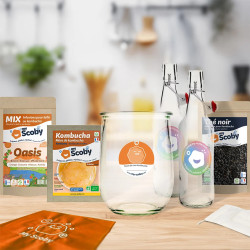
Find the complete kit with the kombucha mother + the equipment here and receive everything in one go to start your production at home. In addition to the organic raw materials and quality equipment, you have access to a very detailed guide as well as a community of people who, like you, are growing their kombucha day after day.
The new star of drinks with friends, kombucha is a fermented tea drink, flavoured with fruit, flowers or plain, lightly sparkling and alcohol-free. Its taste is tangy, very refreshing and unsweetened. At last a festive drink that is neither very sweet nor alcoholic!
Do you know the term SCOBY? It is in fact an English acronym for the kombucha mother: Symbiotic Culture Of Bacteria and Yeast.
🍶 How do you make your kombucha?
Here we follow Orisae's official protocol, the Strasbourg workshop that raises this mother - the very one they developed after several years of fine-tuning and thousands of customer feedbacks. No improvisation on our part: it is their reference recipe.
The equipment:
- 1 jar of at least 1 L, no metal-
- 1 or 2 swing-top bottles (lemonade or beer type), designed to withstand pressure
- 1 reusable filter or a tea ball
- 1 protective cloth + 1 string or elastic band
- 1 jug for decanting
The ingredients, for one batch:
- 0.8 L of water, ideally filtered or left to stand
- 5 g of organic black tea
- 50 g of organic caster sugar - this is the fuel for the microorganisms, not the seasoning for your drink
- 1 kombucha mother of 50 g + 100 ml of starter liquid (the one from the pouch, then the one from your previous batch)
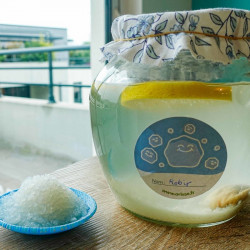
F1 - the first fermentation. Brew the 5 g of black tea in the 0.8 L of boiling water for 10 minutes, using the filter. Remove the tea, add the 50 g of sugar and stir until completely dissolved. Cover with the cloth, then leave to cool to room temperature - this is the step beginners burn, literally: a tea that is still warm damages the mother. Then place the mother in the preparation (its position does not matter at all), add the 100 ml of starter, cover with the cloth firmly attached, and leave to ferment for 5 to 7 days at room temperature, in a dry place, out of direct sunlight, and away from plants, fruit and vegetables.
Taste from time to time, with a teaspoon, to adjust to your palate. Too sweet? Wait. Too vinegary? You let it go a day too long - it is not lost, it will make an excellent kombucha vinegar for dressings. The cursor is yours: everyone at their own pace and to their own taste.
Harvesting. Gently remove the mother, pour the drink into bottles, and keep 100 ml to start the next batch. A thin film has formed on the surface? That is the birth of a daughter.
F2 - the second fermentation, the one for the aromas. It is in the bottle, and only in the bottle, that you add flavour - never during the first fermentation. Fruit, flowers, ginger, hibiscus: over to you. Close tightly, leave for 24 to 48 h in the shade and at room temperature (allow 48 h if your room is below 24 °C), then place in the fridge. When opening, hold the mechanism and open gently: kombucha can be quite effervescent. The drink then keeps for 1 month in the fridge.
⚠️ And if your first two or three batches are not perfect, that is normal - fermentation is a practice that gets adjusted with use, not a formula you apply. Persevere.
.🍶 Below are links to complete preparation guides:
How to make kombucha: quick and easy recipe
Homemade kombucha: the complete guide to making your first fermentation a success
Before handling the kombucha mother, it is crucial to wash your hands carefully to avoid contaminating it and to make sure you use very clean utensils and containers. Use hot water and soap to make sure your hands are properly clean. For the equipment, Orisae recommends washing with very hot water and white vinegar, on a clean, clear work surface.
The process begins with preparing a solution of black or green tea, sugar and the kombucha mother. This mixture is then left to ferment for several days, which allows the bacteria and yeasts (from the mother) to feed on the sugar and develop the unique flavour of kombucha, its organic acids and its compounds from the tea.
Most of the initial sugar is consumed during fermentation: only a small fraction remains in the final drink, and this fraction decreases as the fermentation goes on.
And the SCOBY splits in two. With each fermentation, a new disc forms on the surface. After a few cycles you will have several - enough to give some to people around you. Frankly, that is what we like most about this product: you buy a mother once, and you can give them away for years.
🍶 You can also see the process in the video below:
Very fun and easy to understand, you will never fail your kombuchas again.
Kombucha belongs to a family of fermented foods - lacto-fermented vegetables, kefir, miso, sourdough bread - that are worth keeping going in the kitchen. Here, factually, is what it contains.
– What a kombucha really contains
Fermentation produces organic acids: acetic acid, lactic acid and gluconic acid. These are what give kombucha its characteristic tangy profile, and what lower its pH - hence its good natural keeping qualities. The drink also retains the compounds of the original tea, in particular its polyphenols, and harbours the live bacteria and yeasts from the mother.
– A fermented drink, in the line of living foods
Fermented foods have accompanied the human diet for millennia, on every continent. Kombucha is a drinkable, refreshing version of them, easy to fit into everyday life. It is this regularity that counts, far more than the quantity : a glass from time to time as part of a varied and balanced diet is better than three weeks of enthusiasm followed by six months of neglect.
– A low-sugar alternative to sodas
This is the most concrete argument, and the most verifiable. Kombucha replaces a soda without the soda's sugar, while keeping the fizz, the acidity and the pleasure of a glass with friends. You can flavour it with fruit, flowers, ginger, hibiscus flower - or drink it plain. A simple way to change a habit without giving anything up.
In summary: kombucha is a pleasant, low-sugar fermented drink, with organic acids and compounds from the tea, which naturally finds its place as part of a varied and balanced diet and a healthy lifestyle. That is already a lot.
🍶 Find various articles about kombucha on our blog:
Where to buy a kombucha mother?How to make and feed a kombucha mother?
What are the differences between kombucha and kefir?
Kefir or kombucha: the complete guide to choosing the ideal fermented drink
Homemade kombucha: the complete guide to making your first fermentation a success
Home fermentation: where to start?
Home fermentation: where to start when you are a beginner?
ORISAE - My Scoby
Axel and Cléo founded Orisae in 2020. This couple of designers wanted to put more meaning into their lives and so devoted their time to doing everything possible so that everyone can discover and adopt the simplest, most economical, most ecological and above all most delicious method: home fermentation.
Here is a video and interview we had the pleasure of filming with Cléo, co-founder of Orisae:Increasingly aware of the impact of food on living things and our environment, they started from nothing and launched a crowdfunding campaign that almost tripled its target. Supported by hundreds of people in their project, the kits for kefir and for kombucha then came into being, accompanied by a real exchange platform so that everyone can share their home fermentation adventure. Their goal? To make fermentation accessible, simple, fun and above all convivial!
Their workshop is located in Strasbourg and everything is made on site. You could even say they are ferment breeders! And that is exactly why we chose them: a kombucha mother is not a commodity you keep in stock, it is a living organism whose vigour depends on how it was fed before reaching you. A French workshop, on a human scale, checked by an independent laboratory - that is the guarantee that mattered to us.
Best before: 22/09/2027
- Pouch with kombucha mother (10cm and 50g) + starter liquid (100ml)
Ingredients : preparation for kombucha (unrefined beet sugar*, cider vinegar*, black tea*).
*From organic farming.
Kombucha mother raised and checked in an independent laboratory in Strasbourg.
50 g is enough to start a 0.8 L batch, according to the Orisae reference recipe.
The product at a glance
- Weight of the mother : 50 g (around 10 cm in diameter)
- Starter liquid : 100 ml, supplied in the pouch
- Achievable volume : 0.8 L per batch according to the Orisae protocol (jar of 1 L minimum), renewable indefinitely
- F1 duration : 5 to 7 days at room temperature · F2 : 24 to 48 h in the bottle
- Origin : Orisae workshop, Strasbourg (France)
- Certification : ingredients from organic farming
Find the complete kit with the kombucha mother + the equipment here.
Best before : 12 months
Storage : keep in the fridge before use. You can then keep it in the 1st kombucha fermentation at room temperature. The whole scoby must be submerged so that it does not dry out.
To pause it, Orisae offers two methods:
1. At room temperature - their recommendation, up to 12 months. In a glass container, never metal, completely submerge the mother in starter (the liquid from your last drink; failing that, brew 5 g of tea in 1 L of water with 50 g of sugar, and leave to cool). Cover with a breathable cloth held by an elastic band, then place somewhere dry, out of direct light. You can, without obligation, feed it every month: remove a little old liquid, add a glass of fresh, completely cooled sweetened tea.
2. In the refrigerator. The cold inhibits the activity of the ferment, which goes dormant - handy for stopping production without maintenance. In that case, close the jar tightly, to prevent the liquid from drying out and the scoby from absorbing fridge odours. Warning: a prolonged stay in the cold, beyond a few months, can put the scoby to sleep for good, or even destroy it.
What you must never do: freeze or dehydrate it. Freezing breaks the cell structures and the bacteria do not survive; a direct heat source (oven, sun) kills the microorganisms on the spot.
Your most frequently asked questions
How many litres of kombucha can I make with this mother?
The Orisae protocol provides for 0.8 L per batch, in a jar of 1 L minimum - and as many batches as you like. The mother is not consumed: it rebuilds itself and splits in two with each fermentation. So a single purchase is enough, barring accidents.
My kombucha mother has brown filaments hanging from it: is that normal?
Yes, absolutely. These brownish filaments are active yeasts, a sign that the culture is working. What you need to watch out for is dry, powdery, green or black mould sitting on the surface - that kind means you must throw away the preparation and start again with a new mother.
Does kombucha contain alcohol?
The yeasts produce a little ethanol during fermentation, which the bacteria then transform into organic acids. Homemade kombucha retains traces of it, far below a beer. As with any fermented product, medical advice is recommended in the case of pregnancy, breastfeeding or ongoing treatment.
Can I go on holiday and put my SCOBY on pause?
Yes - the kombucha mother is tough. The method favoured by the Orisae team: the mother fully submerged in its starter, in a glass jar covered with a breathable cloth, somewhere dry and out of the light. Up to 12 months. The liquid will acidify over the months to become a kombucha vinegar - do not throw it away, it can be used in cooking like a cider vinegar, and some of it will make you a formidable starter. The refrigerator, with the jar closed tightly, is the other option, but not beyond a few months.
How do I restart a mother after a long pause?
If it is coming out of the fridge, open the jar and let it return to room temperature for a few hours before handling it. Then prepare a fresh sweetened tea, let it cool completely, place the mother in a clean jar and add a good dose of acidic starter. The first batch after a long pause is often slower - that is normal, the strain is waking up. Taste, and extend by 24 h if you like it more tangy.
How much kombucha should you drink?
Start small - a 100 to 150 ml glass per day - then adjust according to how you feel, as part of a varied and balanced diet and a healthy lifestyle. Everyone at their own pace: there is no reason to force it.
Updated: August 2026. Page written and validated by Éric Viard, founder of Biovie since 2007 and ISTOM, co-author of Algues au quotidien (Gallimard, 2024) - Best cookbook in the world, Gourmand Cookbook Awards 2025, and Best cookbook in France, Académie Nationale de Cuisine 2025.
Disclaimer: the information presented on this page is provided for information purposes only and does not constitute medical advice. Consult a qualified healthcare professional before making any change to your diet or supplementation. As part of a varied and balanced diet and a healthy lifestyle.
The documents that back up what we write about this product. Every document is dated; we remove those that are no longer valid.
Biovie organic certificate
Valid until 31/03/2027Orisae organic certificate
Valid until 31/03/2027Wondering… ?
Everything you need to know before ordering.
Be the first to ask a question about this product!
Question about the product
Ask a question