









Milk kefir and fruit kefir (or water kefir) are two different fermented drinks, made from a symbiotic culture of bacteria and yeasts. Both have their place in a living food diet, but they are not alike, neither in their base nor in their contraindications. I will walk you through both, with their real limits, and with what you need to rescue your culture if it sulks.
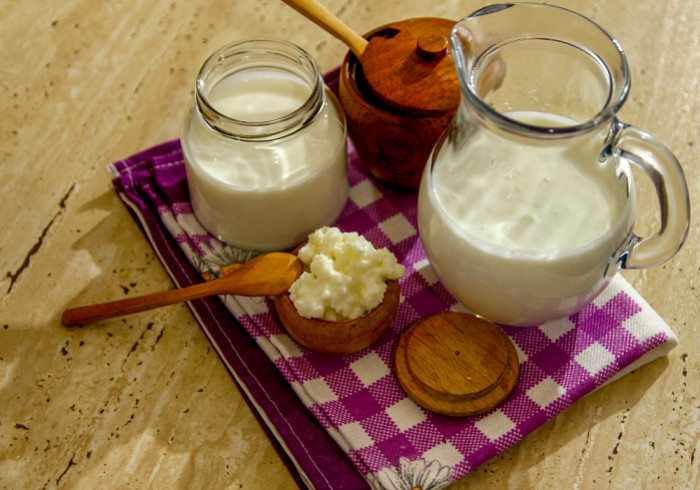
Can you drink kefir every day?
Share this article

Complete organic fruit kefir pack
€33.25 In stock
Where does kefir come from, and what is it really?
The word "kefir" is thought to come from the Turkish keyif, which evokes good spirits. This drink originates from the Caucasus mountains, where its culture goes back several centuries. Milk kefir grains were traditionally passed down from generation to generation there, in skin pouches where milk fermented naturally alongside herds of sheep and goats.
In concrete terms, a kefir grain is neither a seed nor a mushroom: it is a gelatinous mass formed by a symbiotic culture of bacteria and yeasts, sometimes called by the acronym SCOBY (as with kombucha). This community lives in symbiosis: the yeasts produce alcohol and carbon dioxide from sugar, the lactic bacteria produce lactic acid, and together they protect each other from unwanted micro-organisms. Fruit kefir works on the same symbiotic principle, but with different grains, adapted to a sugary environment rather than a milky one.
The result of this 24 to 48 hour fermentation is a lightly tangy, sometimes gently sparkling drink, containing live micro-organisms as long as it is not pasteurised. It is precisely this richness in live micro-organisms that explains the renewed interest in kefir in recent years, carried by the wider enthusiasm for fermented foods.
Milk kefir or fruit kefir: what are the differences?
The confusion is common, so let's clear it up right away: milk kefir is a dairy drink, made by fermenting kefir grains in milk (animal or plant-based). Fruit kefir, on the other hand, starts from sugared water with dried fruit and citrus added, and is an entirely vegan drink, with no lactose and no milk proteins.
Unlike fruit kefir, milk kefir therefore contains lactose and milk proteins, which makes it unsuitable for a vegan diet and may not suit people who are intolerant. In our shop, we also offer vegan lactic ferments with which you can make a plant-based milk kefir, using almond, soy or coconut milk for example.
| Criterion | Milk kefir | Fruit kefir |
|---|---|---|
| Base | Milk (animal, or plant-based with suitable ferments) | Sugared water, dried fruit and citrus |
| Lactose | Greatly reduced by fermentation | None (non-dairy drink) |
| Calcium | Yes, provided by the milk | No, unless calcium-rich foods are added |
| Calories (100 ml, approximately) | 40 to 65 kcal depending on the milk used | 20 to 30 kcal |
| Fermentation time | 24 to 48 h at room temperature | 24 to 48 h at room temperature |
| Taste | Thick, tangy, close to a drinking yoghurt | Light, sparkling, fruity |
| Who it suits | Tolerates dairy, looks for creaminess | Vegan, lactose-free, looks for lightness |
Calories are indicative: they vary with the milk used (or the amount of residual sugar for fruit kefir) and the fermentation time. The longer it is, the more sugar the culture consumes.
Whether it is milk kefir or fruit kefir, both can be enjoyed at different times of the day. A few good quality kefir grains are all you need to start your own culture at home. Discover our homemade kefir recipe, or our variation with coconut water kefir.
How much kefir should you drink a day?
So as not to shock your gut, it is recommended to start with a small amount if you are not used to it yet: half a glass to one glass a day is enough for your body to get used to it. Once your body is used to it, you can gradually increase up to 1 litre a day, in one go or spread throughout the day.
Drinking more than this can cause temporary digestive discomfort, faster transit and bloating, in sensitive people.
What is the best time to drink kefir?
Kefir can be drunk at different times of the day. I advise you to start the day with a glass as soon as you wake up: that is when I most happily drink it, fresh and lightly tangy. It can also go with a meal, or be taken between meals.
Homemade kefir or shop-bought kefir?
Both have their merits, depending on your available time and your habits.
Homemade kefir is economical and leaves you in charge of everything: the type of milk or water, the amount of sugar, the fermentation time, the flavourings of the second fermentation. You feed your own culture, which multiplies and lasts indefinitely as long as it is well looked after, so one batch of grains can accompany a family for years. The flip side: hygiene must be impeccable, and you have to accept a bit of regularity in the rinsing.
Shop-bought kefir, available in the chilled aisle of organic shops or some supermarkets, is convenient and consistent. The point to watch: many commercial versions are pasteurised after fermentation to stabilise the product and extend its shelf life, which destroys the live micro-organisms that make the drink worthwhile. Before buying, turn the bottle over and check for the words "unpasteurised" or "live cultures", as well as a short list of ingredients.
If you want truly living kefir every day, the surest way is still to make it at home from quality kefir grains. All you need is a healthy culture to start, and the initial investment is quickly repaid compared with the price of bottles in shops.
One last practical tip: once strained, kefir keeps for 3 to 5 days in the refrigerator in a closed container. Fermentation continues slowly even when cold, so the longer you keep it, the tangier it becomes. That is normal, and harmless as long as the smell stays pleasant. Remember to always keep a little liquid from your last batch to start the next one, it speeds up the recovery of your grains.
Kefir: precautions and contraindications
Kefir is a living drink. Like any active fermented food, it calls for a few precautions:
- Intolerance or allergy to milk proteins: prefer a fruit kefir, or a plant-based milk kefir prepared with suitable ferments.
- Pregnant and breastfeeding women: ask for medical advice before drinking it regularly, as for any unpasteurised fermented product.
- Immunocompromised people: an unpasteurised kefir contains live micro-organisms, which calls for caution when the body's defences are weakened.
- Chronic inflammatory bowel diseases: ask your doctor for advice before drinking it.
- Trace of alcohol: kefir contains less than 1% alcohol, naturally produced by fermentation.
- Beginners: always start small (half a glass) and increase gradually to give your microbiota time to adapt.
If in doubt, or if you are following medical treatment, ask your doctor for advice. Always.
The full range Drinks
Biovie drinks are caffeine-free and alcohol-free: Tikawa lupin coffee (Mild, Classic, Intense), golden milk with turmeric, fermented birch sap, and fruit kefir and kombucha kits to make yourself. Lupin coffee recreates the taste and ritual of coffee without caffeine or acidity, for anyone who wants to cut back on caffeine without giving up the coffee ritual. To gently quit coffee, start with Tikawa Classic; for a seasonal drink, choose fermented birch sap, natural or with blackcurrant., 11 products
Discover the full range


You will find our kefir grains, alongside our other living cultures, in our Fermentation category.
Troubleshooting: what to do if your kefir is not doing well?
Whether you grow milk kefir or fruit kefir, fermentation sometimes does not go as planned. Here are the most common problems, and how to fix them, with your kefir grains as the starting point.
My kefir does not fizz
For fruit kefir in particular, lack of fizz is the most common concern. The most frequent causes: a fermentation that is too short (the carbon dioxide produced by the yeasts needs time to build up, allow 48 to 72 h for a second fermentation in an airtight bottle), a badly closed jar that lets the gas escape, or not enough sugar: the yeasts need sugar to produce gas, never reduce the usual dose on the pretext of making the drink lighter. A room temperature that is too cool (below 18°C) also clearly slows the whole fermentation, gas included.
My grains no longer multiply
Healthy kefir grains double in volume roughly every one to two weeks. If they stagnate, there are several things to check in order: first the quality of the water (see below), the freshness of the sugar or milk used, a temperature that is too low and slows the whole metabolism of the culture, or simply grains that are still young and need several cycles to settle into their new environment. An occasional pause in growth is nothing to worry about; stagnation that lasts several weeks deserves a change in one of the parameters above.
How do you recognise healthy kefir grains?
Healthy grains are firm, white to translucent in colour for water kefir, or cream-white and slightly lumpy for milk kefir, never slimy, discoloured or foul-smelling. A distinctly rotten smell, a pinkish or orange colour, or a sticky, stringy look are signs that it is better to throw the batch away than to try to save it: never put suspect grains back into an otherwise healthy culture.
Why avoid any contact with metal?
Kefir grains are sensitive to oxidation from prolonged contact with certain metals, which can weaken the culture over time. As a precaution, use a strainer, a spoon and containers made of food-grade plastic, glass or wood: never metal, including for rinsing or stirring the grains day to day.
Why let tap water stand for 24 h?
The chlorine in tap water, added to disinfect drinking water, upsets the balance of the bacteria and yeasts in your grains. The simplest solution: let the water stand 24 hours at room temperature, in an open container, while the chlorine evaporates naturally, before preparing your fruit kefir. Filtered water or spring water also work very well, with no waiting needed.
Kefir FAQ
Can you drink kefir every day?
Yes, for a healthy person, daily consumption of up to one litre is perfectly reasonable once the body is used to it. Start with half a glass and increase gradually.
What is the difference between milk kefir and fruit kefir?
Milk kefir is a fermented dairy drink, containing lactose and milk proteins. Fruit kefir (or water kefir) is a vegan drink made from sugared water and fruit, with no lactose and no animal proteins.
Does kefir contain alcohol?
A trace, less than 1%, naturally produced by fermentation, comparable to a very ripe fruit juice.
Can you drink kefir when pregnant?
Ask your doctor or midwife beforehand, as for any unpasteurised fermented product.
Why do my kefir grains not fizz?
Most often: fermentation too short, badly closed jar, lack of sugar or a temperature that is too cool. See our troubleshooting section above.
Does kefir help you lose weight?
No drink makes you lose weight on its own. Kefir can be part of a varied and balanced diet, but it is not a slimming product.
Going further
Recipes with this product
Updated: November 2026. Article written and validated by Éric Viard, founder of Biovie since 2007 and ISTOM engineer, co-author of "Algues au quotidien" (Gallimard, 2024), Best Cookbook in the World, Gourmand Cookbook Awards 2025, and Best Cookbook in France, Académie Nationale de Cuisine 2025.
Disclaimer: the information presented in this article is provided for information purposes only and does not constitute medical advice. Consult a qualified health professional before making any change to your diet or supplementation. As part of a varied and balanced diet and a healthy lifestyle.
Share this article