Water kefir: the homemade recipe, the grains and what science says
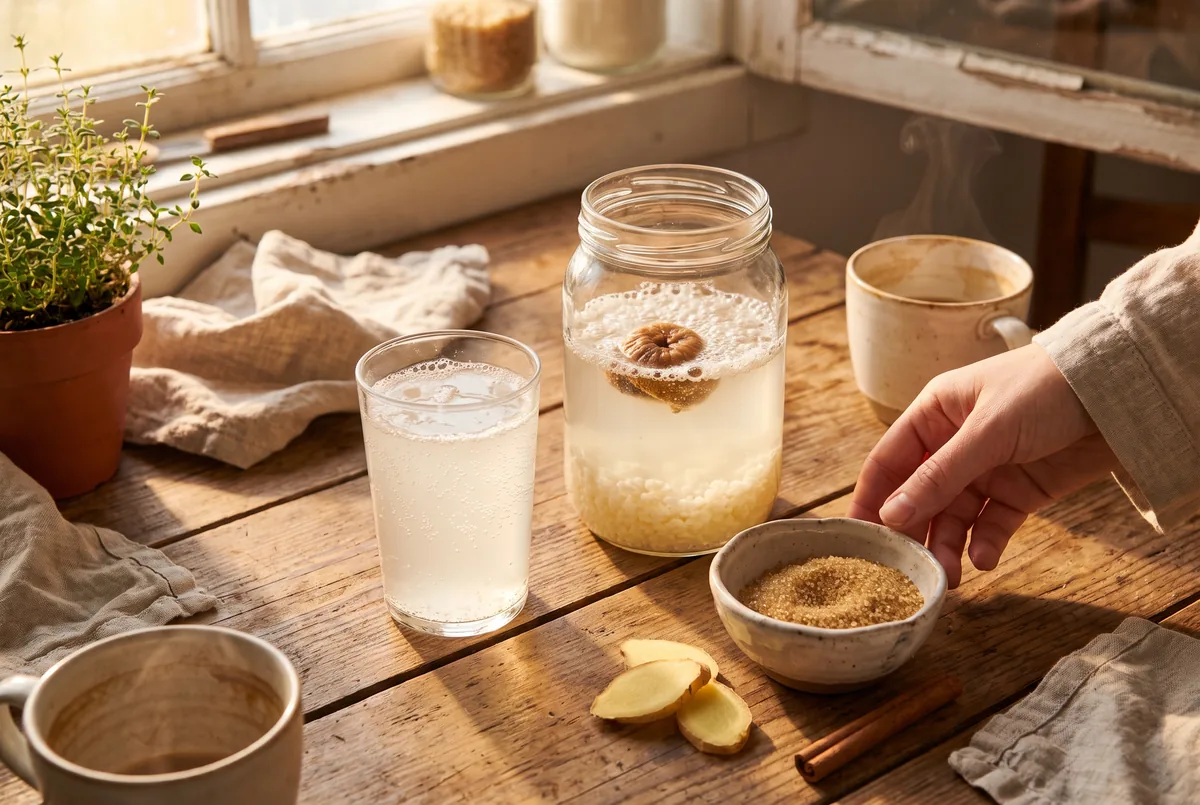
Water kefir is the sparkling drink that comes to life in a jar where a dried fig floats: sugar water and dried fruit, fermented for 24 to 48 hours by kefir grains (colonies of bacteria and yeasts) before it goes into the bottle. The figures below come from published studies, read through my eyes as the founder of Biovie.
Put two recipes side by side and doubt sets in right away: 60 g of sugar for one litre of water on one side, 35 g for 1.2 litres on the other. Whom to believe? Both, believe it or not. It all depends on the grains (fresh or dehydrated, that is not at all the same story), on the fermentation time and on the taste you are after. I have been immersed in living food since the early 2000s, and at Biovie we sell these grains: all the more reason to tell you, figures in hand, what is really in the glass.
What is water kefir?
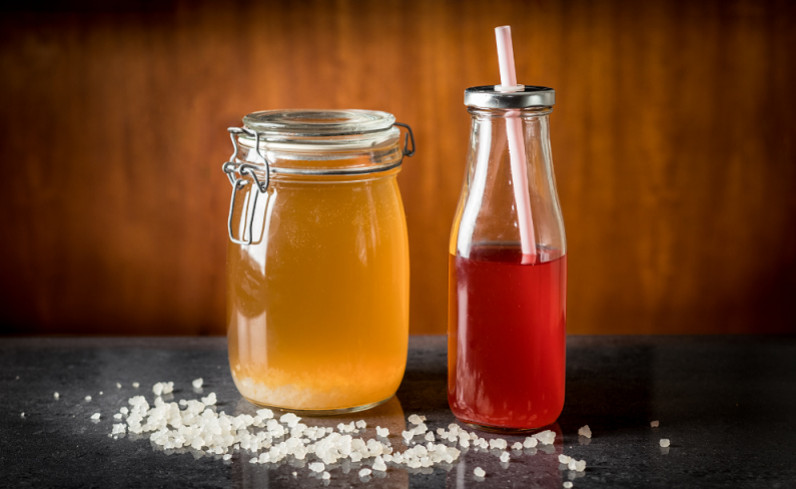
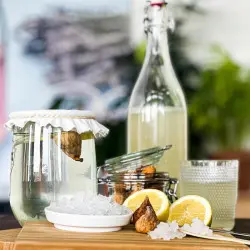
From the outside, nothing spectacular: a few translucent grains at the bottom of a jar, a piece of dried fruit drifting around, small bubbles rising. Water kefir is a sparkling, slightly acidic drink made by fermenting sugar water and dried fruit with kefir grains. These grains are a colony of lactic bacteria, yeasts and acetic bacteria, housed in a matrix of polysaccharides (Lynch et al., 2021).
What the grains contain
Picture a small city. The lactic bacteria build its walls (that jelly which gives the grain its hold), the yeasts supply usable nitrogen, and the population changes with the origin of the grain and the life you give it (Lynch et al., 2021). In the trial by Laureys and De Vuyst (2014), most of the microorganisms lived on the grains themselves: several Lactobacillus, Bifidobacterium, and the yeasts Saccharomyces cerevisiae and Dekkera bruxellensis. Quite the crowd. Giving a few grains to a friend means moving the whole city, residents included.
Water kefir, fruit kefir, tibicos: one single ferment
Water kefir, tibicos, fruit kefir: same grains, several names depending on the region and habits. Nothing to do with milk kefir grains, though: these grains contain no lactose and no milk proteins, and one does not replace the other. As for kombucha, it is another family altogether, since it ferments a sweetened tea: to compare kefir and kombucha, see the dedicated article.
How to make water kefir, step by step
Ingredients and quantities: why recipes do not say the same thing
Two widely read French recipes, a lab trial and this blog's recipe, set side by side, so you can see why every kefir water recipe looks different:
Recipe
Grains
Liquid
Sugar and fruit
Online recipe no. 1
20 g
1 l of water
60 g of sugar
Online recipe no. 2
35 g
1.2 l of water
35 g of sugar
Lab trial at 21 °C (Laureys and De Vuyst, 2014)
15 g
65 ml of water + 20 ml of extract from 5 g of dried figs
6 g of unrefined cane sugar (about 70 g/l)
Biovie recipe (fresh grains)
50 to 100 g
1 l of spring or filtered water
100 g of cane sugar, 1 dried fig, 2 slices of lemon
More sugar and a longer fermentation give a more acidic, fizzier and more alcoholic drink (Laureys and De Vuyst, 2014). And fresh grains, full of water, are not dosed like dehydrated ones: for the latter, their own instructions rule. Each of these recipes simply aims at a different glass. None of them is wrong, they just are not talking about the same drink.
First fermentation
On to the jar, because that is where everything happens.
In a clean one-litre jar, dissolve the sugar in the water.
Add the fig, the lemon, then the grains.
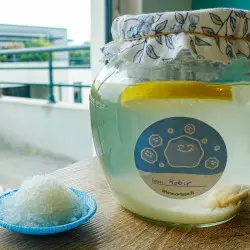
Cover with a cloth held by a rubber band, to let the gas out and keep the fruit flies away, and leave at room temperature, away from light.
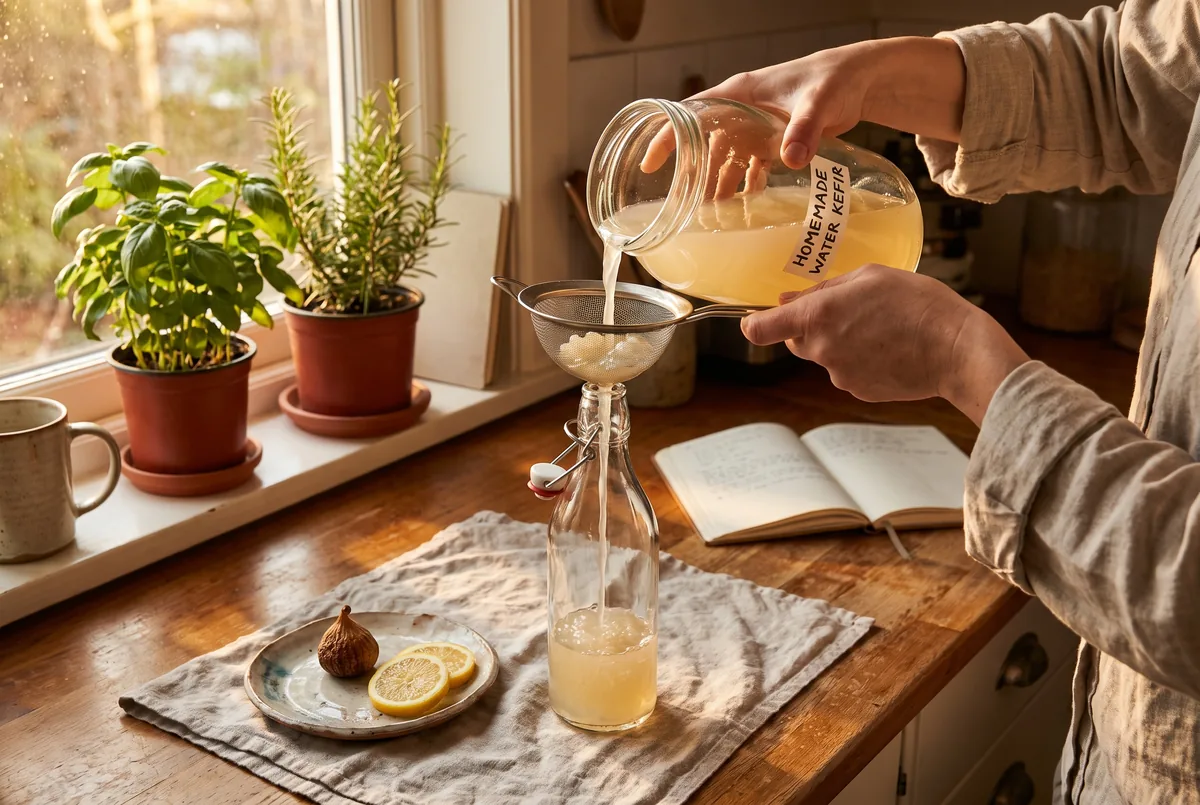
After 24 to 48 hours, strain through a fine sieve and keep the grains for the next batch.
Choose untreated dried fruit without sulphites (they can hinder fermentation, a pity to sabotage the party from the start), and an unrefined cane sugar; if your grains turn brown with a whole sugar, no panic, that is normal. Honey, on the other hand, disrupts fermentation.
Meanwhile, in the jar, things are busy: yeasts and bacteria turn the sugar into gas and acids, with a little alcohol along the way. In the lab, sucrose drops to 1.2 g per litre as early as 24 hours and the pH goes from 4.26 to 3.45 in 72 hours, most of the acids and alcohol being produced during those three days (Laureys and De Vuyst, 2014). Out of roughly 70 g of table sugar per litre at the start, barely more than a gram is left in its original form after one day. It has not vanished for all that, it has changed form, more on that below. On the palate, the final acidity is reminiscent of a citrus juice.
The simplest cue is visual: when the fig floats, it is ready.
Second fermentation in the bottle
Pour the strained liquid into a swing-top bottle, designed for fizzy drinks, and leave it at room temperature for roughly the same time as the first fermentation before putting it in the cold. A few raspberries, a slice of ginger, a cinnamon stick or a citrus zest will flavour it, but beware, the fruit adds its sugar, and therefore gas. Always open the bottle gently, over the sink, because an overloaded bottle can erupt like a geyser.
Personally, this is a drink I like to serve at home instead of sodas: the same bubbles, the same gesture of popping the bottle open, but a liquid you made yourself, from jar to glass.
Waking up, multiplying and storing your water kefir grains
Dehydrated grains: the waking-up phase
Dehydrated grains are dormant, a bit like a seed waiting for rain, and the first fermentations serve to reactivate them: no worries if they fizz little at first. Follow the instructions for the dehydrated water kefir grains; when they swell and the jar starts bubbling again, the city is back on its feet.
Can you make water kefir grains?
No: you do not make kefir grains, they multiply. That is actually the most delightful thing about them. The lactic bacteria produce the matrix that makes them grow, mostly during the first 24 hours of a fermentation (Laureys and De Vuyst, 2014; Lynch et al., 2021). Well fed, your grains grow from batch to batch, and the surplus gets given away. For a break, they wait patiently in the refrigerator in sugar water renewed about every two weeks.
Storing dry ingredients: figs, sugar, an opened bag of grains
That leaves the cupboard, the one we always forget. Dried figs, whole sugar and an opened bag of grains fear humidity, and dried fruit attracts moths. At our place, this kind of stock ends up vacuum-sealed in glass jars, like our activated almonds, which we prepare in big batches for several months. The BocUp kit takes care of it with a bell and a small manual pump, with no electricity and no plastic bag, on the jars you already have if they have "shoulders" and a 65 or 84 mm lid, nothing else to buy. Vacuum keeps dry foods safe from humidity and moths, but it replaces neither the fridge nor the freezer, and it does not sterilise.
Sugar, calories, alcohol: what is left in the glass
A sugar-water drink that contains alcohol? Yes, a little, better to know it. The sugar you pour in does not stay as it is: it becomes gas, acids, alcohol and grain material.
After 72 hours, the trial by Laureys and De Vuyst (2014) measured 20.3 g of ethanol per litre, or about 2.6% vol. Alongside the alcohol, there were 4.9 g/l of lactic acid, 2.3 g/l of glycerol, 1.0 g/l of acetic acid, 0.8 g/l of mannitol and 3.1 g/l of remaining carbohydrates. As for alcohol, three days of fermentation bring it closer to a small light beer than to a lemonade. Mind the scope, all the same: this is a lab vessel, with about 70 g of sugar per litre, left for 72 hours at 21 °C, not your kitchen jar.
Strained after 24 or 48 hours, a homemade drink keeps more sugar and less alcohol. And calories? No official value exists for homemade kefir, not even a Ciqual entry. I will not make one up to look good.
On the market, an analytical study of 31 water kefirs from Vancouver finds an average under 1% vol., but 19% of the products above it, against 53% of the 107 kombuchas compared (Situm, 2020). In other words, roughly one bottle of kefir in five, against more than one in two for kombucha. Finished products on one side, a prolonged trial on the other: the gap is no surprise.
As for why it makes you gain weight, it all comes down to two variables: the sugar that remains and the volume drunk. The further the fermentation goes, the less sugar is left (Laureys and De Vuyst, 2014). As part of a varied and balanced diet and a healthy lifestyle, a glass finds its place among your drinks; I have also devoted an article to drinking kefir every day.
Water kefir and its benefits: what science really says
Online you find lists of "5 benefits according to science", neatly lined up, reassuring. I sincerely wish it were that simple, we sell grains! But when you go and read the studies themselves, the landscape is more nuanced, and I prefer to show it to you as it is.
According to the ISAPP expert consensus, a fermented food is not automatically a probiotic (Marco et al., 2021). A probiotic means identified strains with a demonstrated effect; a fermented food is more like a village fair, full of life, but without a verified guest list. The review by Lynch et al. (2021) also describes the benefits of this kefir as "presumed". The word is weighed.
Still, a trial conducted at Lund University, in Sweden, followed 40 healthy adults drinking 200 ml of homemade water kefir a day for 14 days (de Mel et al., 2026). Firmicutes dropped by 6.5%, Bacteroidetes rose by 21.6% and Actinobacteria by 14.8%, with no change in alpha diversity (the variety of species). The downside is noted in black and white: mild, passing flatulence in 32% of participants, bloating in 24%, so nearly one person in three, and one in four.
Only one caveat, but it matters: without a control group, you are just comparing before and after, and the authors themselves write that causality cannot be established.It is a research lead, not a health claim validated by EFSA. A longer controlled trial will tell what these changes mean. I can't wait to read it.
As part of a varied and balanced diet and a healthy lifestyle, it remains a fermented drink that contains live lactic bacteria and yeasts; to place it, see the guide to fermented foods. To try it simply, the complete water kefir kit brings together a jar, swing-top bottles, a sieve, organic dried figs and fresh grains.
Fruit kefir grains and kombucha mothers, all organic and unpasteurised, are produced in Strasbourg by Orisae, a young company founded in 2020 by Axel and Cléo. Biovie's complete kits include everything needed to start a first fermentation without buying anything elsewhere. For a first try, fruit kefir produces a fizzy result in 24 to 48 hours, a short time frame that lets you quickly see whether the practice suits you; kombucha takes 7 to 14 days but in return offers more aromatic complexity., 4
products
Four points before the first jar, nothing complicated:
Alcohol. A homemade drink can exceed 1% vol., more if the fermentation goes on (Laureys and De Vuyst, 2014; Situm, 2020). The authors of the Canadian study recommend caution for pregnant women, children and people who avoid alcohol.
A clean jar: if there is mould on the surface, throw everything away.
Bottles designed for gas, because an unsuitable bottle can burst, kept cool and opened gently.
Your belly, finally, since flatulence and bloating were reported in the Swedish trial: start with small quantities, everyone at their own pace.
On hygiene, I speak from experience, and not the most glorious: a lacto-fermentation I started at home with vegetables that were already spoiled ended up as a "stink bomb", the rot won the race. Tested for you, then. With kefir, same logic: healthy grains and clean ingredients, and the good bacteria take the lead. As part of a varied and balanced diet and a healthy lifestyle, a small glass is enough to get acquainted.
To begin, a jar and a fig are enough. The rest, the grains take care of, at their pace and at yours. Keep an eye on the surface, and if questions come up along the way, write to me!
Frequently asked questions
What is water kefir and how do you make it?
Water kefir is a sparkling, slightly acidic drink made by fermenting sugar water and a dried fig with kefir grains, colonies of bacteria and yeasts. You let the jar rest for 24 to 48 hours, strain while keeping the grains, then you can refine the drink in a closed bottle.
Which fruit should you use for water kefir?
A dried fruit for the first fermentation, the dried fig being the most used, including in the reference lab trial. Choose it untreated and without sulphites. Fresh fruit, red berries, ginger or a citrus zest are rather used to flavour the drink during the second fermentation, in a closed bottle.
Is water kefir high in calories, and why is it said to make you gain weight?
It all depends on the sugar that remains in the glass and on the quantity drunk. In a lab trial, only 3.1 g of carbohydrates per litre were left after 72 hours of fermentation, but a homemade drink strained earlier keeps more. There is no official calorie value for homemade water kefir.
How long can you keep water kefir in a bottle?
Up to two weeks in the refrigerator in a well-closed bottle, that is the benchmark we give, and about three days once the bottle is opened. In the cold, fermentation slows down without stopping completely: the taste becomes more acidic and the pressure rises, hence the point of opening gently, over the sink.
Is water kefir good in case of diarrhoea?
Water kefir is not a remedy, and it does not replace medical advice in case of diarrhoea. A fermented food is not automatically a probiotic, according to the ISAPP expert consensus, and the only recent human trial noted passing flatulence and bloating in some of the drinkers.
How do you make water kefir grains, and where can you find them?
You do not make them: kefir grains multiply on their own, because their bacteria produce the polysaccharide matrix that makes them grow, mostly during the first 24 hours of fermentation. To start, you get them from someone who has a surplus, or as dehydrated grains, to be woken up following their instructions.
The information presented in this article is provided for informational purposes only and does not constitute medical advice. Please consult a healthcare professional before making any change to your diet or supplementation.