


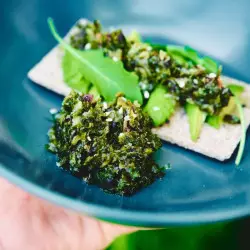

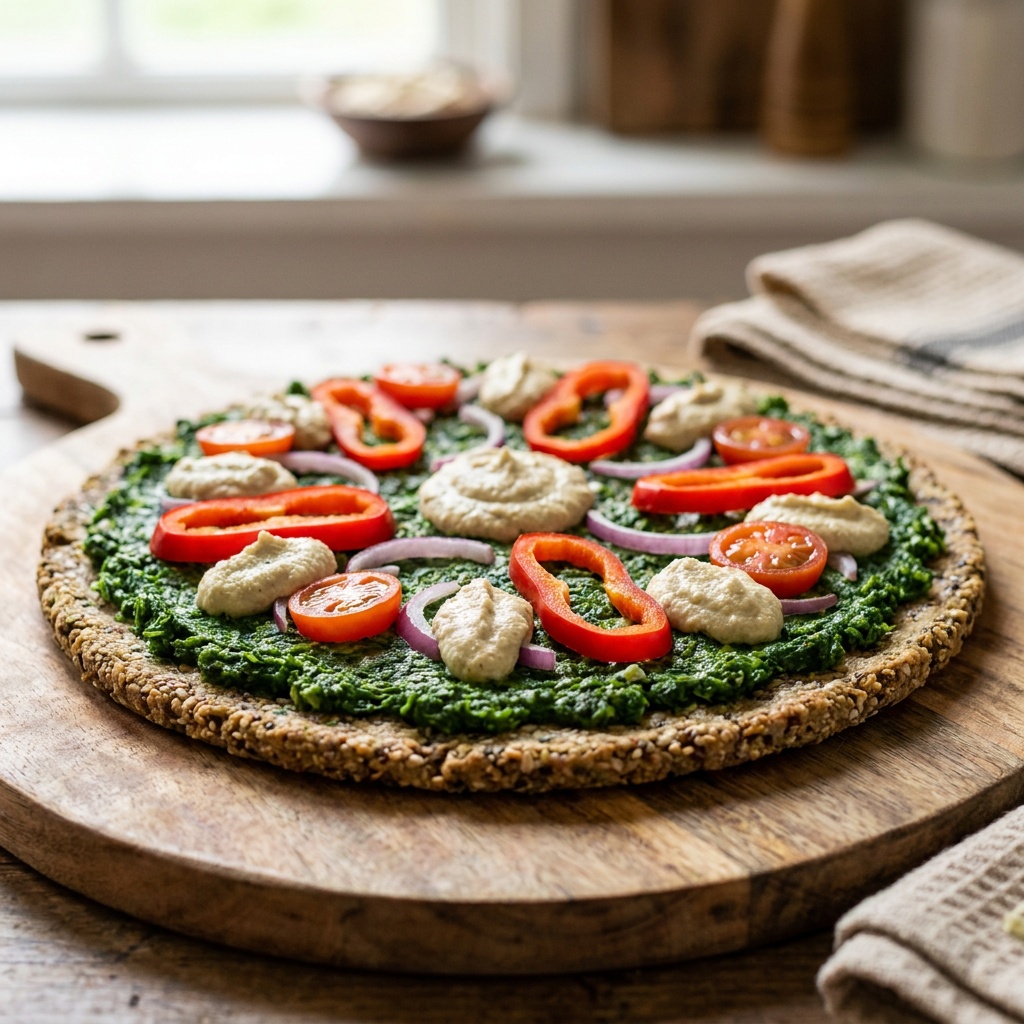
Most raw pizza crusts lean heavily on nuts for structure; this one does without them entirely. Built on soaked chia, sweet potato, leafy greens and fresh herbs, it dehydrates into a chewy, satisfying base with none of the usual heaviness. It is finished with a chunky marinara, a layer of fresh spinach, and mushrooms and onions marinated until they take on an almost sautéed, caramelised character in the dehydrator. What stands out is the way each layer is treated separately before assembly: the marinara drains in a colander so it will not soak the base, the spinach is pressed through a nut milk bag until it becomes a dry pulp, the mushrooms marinate for hours before going into the gentle warmth. This is patient work rather than technical work, and it is worth doing for an occasion. Start the crust and the marinade the day before: on the day itself, only the assembly and one last spell in the dehydrator remain to serve the pizza at the right temperature. Be generous with the mushroom marinade - it is what brings the flavour closest to a cooked pizza.
Gourmet raw pizza with a nut-free crust

Share this article
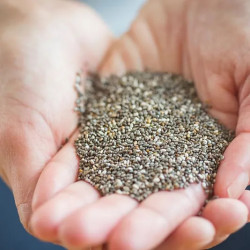
Organic and fair trade Chia seeds
€6.50 Last items in stock
Ingredients
Nut-free pizza crust
- 6 tablespoons chia seeds
- 1 sweet potato
- 1 handful fresh oregano
- 1 handful fresh basil
- 2 to 3 cups spinach
- 1 garlic clove, chopped
- 1 teaspoon sea salt and ground pepper
- Any other seasoning, to taste
- Hemp seeds (optional)
Chunky marinara
- 500 g cherry tomatoes
- 3 to 4 sundried tomato halves, soaked
- 1 garlic clove, chopped
- 1 handful fresh oregano
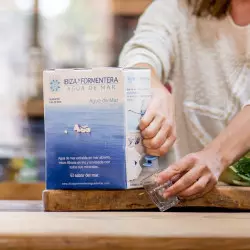
- Sea salt and pepper, to taste (the equivalent of 1 tablespoon - 15 ml - of seawater)
- 2 tablespoons olive oil
Spinach layer
- 2 to 3 cups fresh spinach
Marinated mushrooms and onions
- 2 cups sliced mushrooms, any variety
- 1/2 onion, thinly sliced
- 1 garlic clove, chopped
- Juice of 1/2 lemon
- 2 tablespoons olive oil
Preparation
Crust
- Combine the chia seeds with water in a jar (about 350 ml), shake well and refrigerate for at least an hour, up to overnight - shake occasionally so all the seeds swell evenly.
- When you are ready to begin, chop the sweet potato and process it in a food processor until it is almost a pulp.
- Add the oregano, basil, spinach and seasoning, then process until fully incorporated.
- Finally add the soaked chia and process again until a dough forms - it will be pudding-like rather than firm.
- Spread the mixture into a circle on a dehydrator sheet covering the full tray, and dehydrate at 40-46 °C. Let it dry for several hours before flipping it onto a mesh tray and peeling away the sheet - this can take up to 8 hours, until the top is dry to the touch. (The edges may curl as they dry; they will flatten back out once flipped.) Continue dehydrating until it reaches the texture you like.
Marinara
- Process all the marinara ingredients together until saucy but still a little chunky.
- Pour into a colander set over a bowl and let the excess liquid drain off while you prepare the other layers.
Spinach layer
- Pulse the spinach in a food processor until finely chopped, then squeeze it through a nut milk bag to remove excess liquid, leaving a dry pulp.
Marinated mushrooms and onions
- Whisk together the lemon juice, garlic and olive oil in a bowl.
- Pour over the sliced mushrooms and onion and let marinate for several hours, up to overnight.
- About 3 to 5 hours before serving, transfer to the dehydrator - the gentle warmth softens the vegetables and gives them a sautéed feel.
Assembly
- Remove the finished crust from the dehydrator.
- Spread the drained marinara evenly over the top.
- Add an even layer of the spinach pulp.
- Top with the marinated mushrooms and onions, spread evenly.
- Garnish with fresh herbs and sliced tomatoes, if you like.
- Return to the dehydrator for 10 to 15 minutes to warm through, then slice and serve.
Tip
Do not skip draining the marinara or pressing the spinach: those two gestures decide whether the crust stays firm under the topping or softens within minutes. A raw pizza that collapses has almost always been assembled with layers that were too wet, rarely with a poorly dehydrated crust.
The full range Sprouted seeds
46 products
Discover the full range
FAQ: your questions about raw pizza with a nut-free crust
How do you make a gluten-free pizza crust?
In raw cooking the question does not even arise: there is no flour and no rising, so no gluten at all. What replaces the gluten network is a gelling agent - here soaked chia - paired with a dense plant matter such as sweet potato, which brings the body. Dehydration does the rest of the work by evaporating water until the crust holds on its own. The principle adapts to other bases: courgette, carrot, cauliflower, with ground flaxseed in place of chia.
How can I store raw pizza dough?
Once dehydrated, the crust keeps for several days in an airtight container at room temperature, provided it is thoroughly dry - the slightest residual moisture will make it mould. If it is still pliable, keep it in the fridge instead, and for no more than two or three days. Raw undehydrated dough, on the other hand, does not keep: it goes on oxidising and loses its hold. Make it and spread it straight away.
Which gluten-free flour should you use for pizza dough?
If you stay in raw cooking, the closest thing to a flour is sprouted then dried buckwheat, ground to a powder: it gives body and a cereal flavour without ever being cooked. Ground flaxseed and dehydrated nut pulp play the same role. In conventional baking, rice, buckwheat and chestnut flours are used as a blend, with psyllium to make up for the absence of gluten. In this particular recipe no flour is involved at all: the structure comes from chia and sweet potato.
How do you make a gluten-free dough rise?
In raw cooking a dough does not rise and does not need to: its hold comes from drying, not from gas. In conventional gluten-free baking, rising does happen but stays more modest, because there is no elastic network to hold the bubbles; you support it with psyllium or gum, a wetter dough and a longer resting time. Do not look for the same volume as with wheat flour - you would be disappointed.
Share this article