Organic and fair trade Chia Seeds
Organic Chia Seeds
Fair harvest and processing in Bolivia
400g or 200g pouch
No queries yet, leave the first!
Price:
€6.50
Product availability:
In stock
Tax included


Organic and fair trade Chia Seeds images


Organic chia seeds, small producers' supply chain
🌱 Organic chia seeds come from Salvia hispanica, a small sage native to Central America, grown today mainly in Mexico, Argentina, Bolivia, Colombia and Peru. In practical terms, it is a small oval seed - white or black depending on the variety, the colour having no bearing on nutritional qualities - belonging to the Lamiaceae family, the same as common sage or rosemary. Its botanical name "Salvia hispanica" was given to it in the 18th century by the Swedish botanist Karl Linnaeus. Frankly, what has always struck me about this plant is its robustness: an annual plant, it tolerates drought very well, grows to over 50 cm and produces pretty little mauve flowers spaced along upright stems.
The Maya, then the Aztecs, grew chia as one of their staple foods, on a par with maize and wheat. Here is an anecdote that says it all: Chia means "strength" in Mayan!
🌱 Chia seeds have a particularity: their outer layer, made up of soluble fibre, turns into a gel on contact with water. The seeds then form a mucilage - a viscous liquid that coats each seed.
🌱 How do you eat chia seeds?
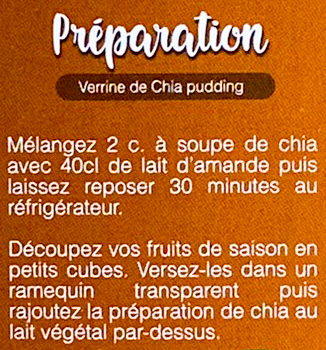
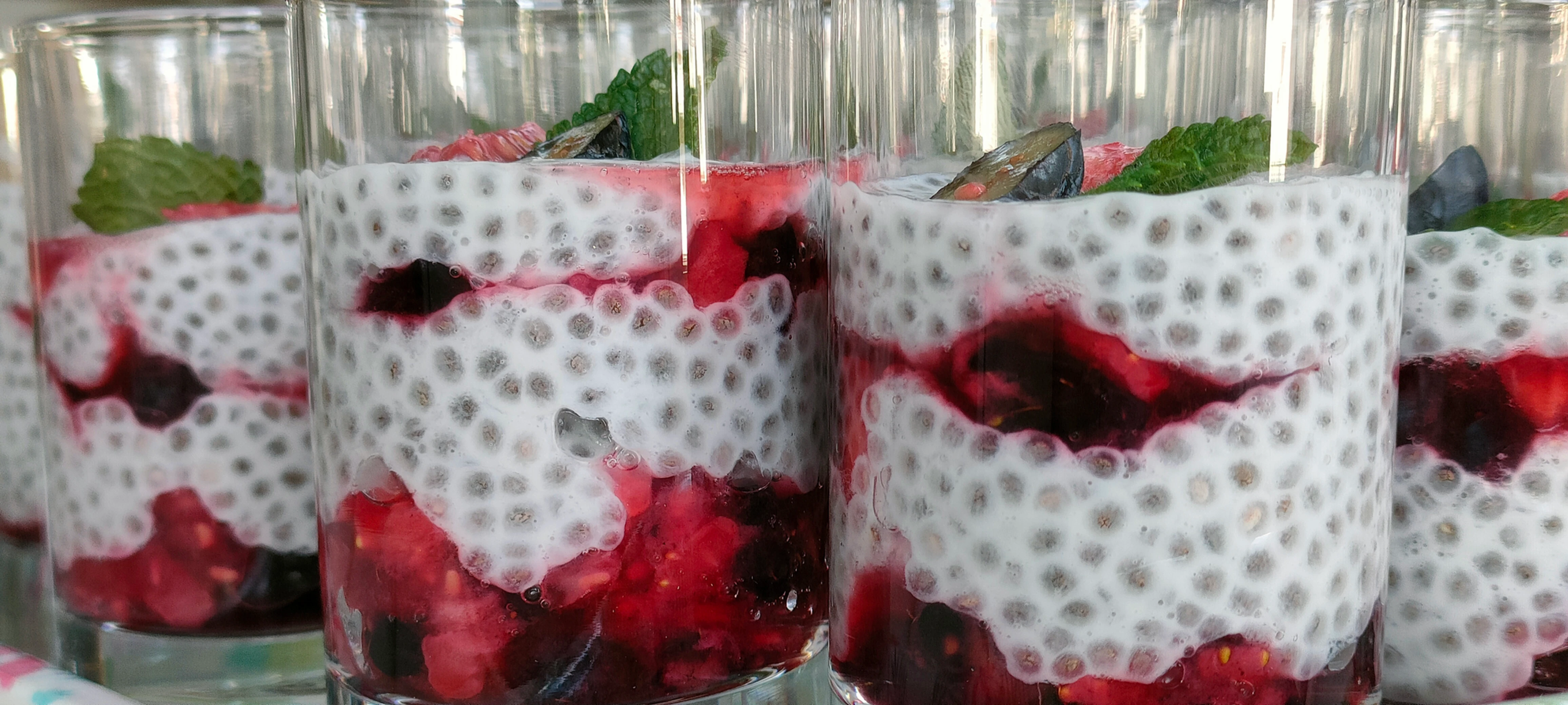
To eat them as chia pudding, you will find tips on our blog on how to make a plant milk, as well as a strawberry chia pudding recipe !
🟩 Find our chia seed recipes:
With Aurélie, we have tested chia in just about everything that came through the kitchen - from morning pudding to raw biscuits. Here are our favourites, all without cooking:
Coconut chia pudding, to prepare the day before
Raw chocolate and chia seed pudding
Orange and ginger chia verrines with pistachios and goji
Green smoothie with peach, spinach and chia seeds
Chia pudding smoothie to go
Raw lemon-chia scones with coconut butter icing
Raw crunchy bars: chia, squash, dates and cranberries
Raw chocolate-cherry chia biscuits with rose raspberry jam
 |
 |
🌱 Where do our chia seeds come from?
The chia seeds we offer in our shop come from Bolivia, more precisely from the Copaïbo forest area - a region declared a nature reserve since 2011. Our supplier Natural'Andes has developed an entire agroforestry supply chain there, a practice that combines crops and forest cover. Thanks to this supply chain, the inhabitants now make a sustainable living from growing chia while preserving their ecosystem. For my part, what moves me in this project is the philosophy behind it: not simply organic, not simply fair trade, but a true alliance between an ancestral crop, a terroir and small producers. That is exactly what we have sought to promote at Biovie since 2007.
Find more information on this subject in this video:
🌱 Chia seeds are high in omega-3 fatty acids, in the form of alpha-linolenic acid or ALA (15 to 17 g per 100 g), and contain omega-6 in the form of linoleic acid or LA (5 to 8 g per 100 g).
Gluten-free, they contain per 100 g (values from the table in the Practical info tab): calcium 631 mg (79% of the NRV), phosphorus 860 mg (123%), magnesium 335 mg (89%), iron 7.7 mg (55%), zinc 4.6 mg (46%), copper 0.92 mg (92%), manganese 2.72 mg (136%), vitamin B1 0.62 mg (56%), vitamin B3 8.83 mg (55%) and vitamin B9 49 µg (24.5%), as well as 0.04 g of salt. Calcium is needed for the maintenance of normal bones*, and phosphorus contributes to normal energy-yielding metabolism*.They contain 19.5 g of protein per 100 g, including all the essential amino acids.
Chia contains 34.4 g of fibre per 100 g, mostly soluble. It also contains insoluble fibre.
*Calcium is needed for the maintenance of normal bones. Phosphorus contributes to normal energy-yielding metabolism. The beneficial effect is obtained with a varied and balanced diet and a healthy lifestyle.
And then a point that is often forgotten: the omega-3 in chia is ALA, the "basic" plant form, which the body converts into EPA and DHA with a limited yield. To complement both, I refer you to our article Dulse and EPA omega-3: why this Breton seaweed is an advantageous replacement for fish.
NATURAL ANDES
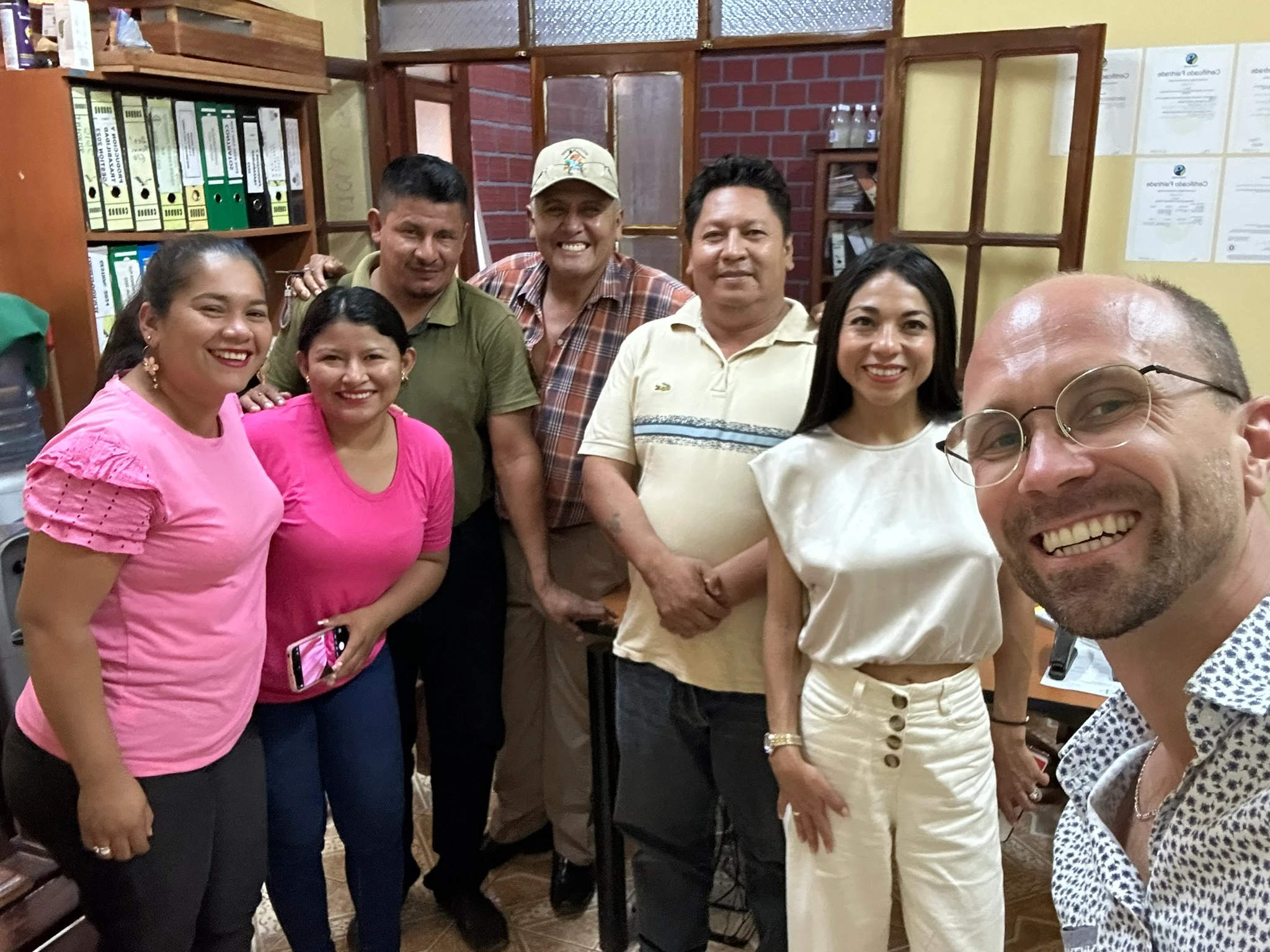
It is a project that first arose from Maxime Chiquet's encounter with the people of Bolivia, with whom he lived for more than 5 years. During his travels, he was able to meet small producers who still work in an artisanal way and with respect for traditions. Their story moved him, and more particularly, seeing that they are no longer valued, to the benefit of production that is becoming industrialised.
Then from meeting Jhomaira Vera, his wife, with whom he decided to set up Natural Andes with the aim of promoting Life, the Earth and People. Their commitment is based on preserving the values of People respectful of their land, the Pachamama (Mother Earth). Authentic Bolivian culture is respectful of the Earth, but industrialisation threatens the nobility of sustainable ancestral practices, which preserve the future and economic security of producers.
Their purpose: authenticity. Their action: 100% endemic organic products sourced from supply chains that leave a positive impact on their production terroir.
Beyond organic and fair trade, their commitment to producers is established at 3 levels:
- Sustainability of production activities.
- Economic security for the local population.
- More even distribution of wealth.
The search for the Authentic Terroir: preserving People and their Land.
On the Natural Andes website you can find an article about the logistics of their supply chain as well as the Calendar of their harvests in Bolivia.
Best before: 31/01/2029
- Ingredients : 100% Chia seeds (Salvia Hispana), from organic farming
- Packaging: 400 g or 200 g formats, packed in a protective atmosphere, in a recyclable cardboard container made in Bolivia
- Storage : In a cool, dry place, preferably in an airtight jar.
- Best before: 31/12/2026
- Recommended daily intake : 15 g per day.
Average nutrition declaration per 100 g
| Nutrition declaration | per 100 g (% RI*) |
| Energy | 1880 kJ / 454 kcal (22.4%) |
| Fat | 30.7 g (43%) |
| of which saturates | 3.3 g (16.5%) |
| Carbohydrate | 7.7 g (2.9%) |
| of which sugars | 2.3 g (2.6%) |
| Dietary fibre | 34.4 g |
| Protein | 19.5 g (39%) |
| Salt | 0.04 g (0.7%) |
*RI = Reference Intake for a typical adult (8,400 kJ / 2,000 kcal), in accordance with article 32 of Regulation (EU) No 1169/2011.
Vitamins and minerals per 100 g
| Vitamins & minerals | per 100 g (% NRV*) |
| Thiamine (B1) | 0.62 mg (56.4%) |
| Niacin (B3) | 8.83 mg (55%) |
| Folic acid (B9) | 49 µg (24.5%) |
| Calcium | 631 mg (79%) |
| Potassium | 407 mg (20%) |
| Phosphorus | 860 mg (123%) |
| Magnesium | 335 mg (89%) |
| Iron | 7.7 mg (55%) |
| Zinc | 4.6 mg (46%) |
| Copper | 0.92 mg (92%) |
| Manganese | 2.72 mg (136%) |
*NRV = Nutrient Reference Values in accordance with Regulation (EU) No 1169/2011.
Frequently asked questions about chia seeds
Do chia seeds have to be soaked?
It is not compulsory, but it is clearly preferable. Chia seeds absorb up to 14 times their weight in water: soaked for 10 minutes in water, a plant milk or a juice, they form a gel with a more pleasant texture. Sprinkled dry over a dish, they are perfectly edible - just remember to drink a glass of water with them.
How many chia seeds should you eat per day?
We recommend 15 g per day, i.e. about one heaped tablespoon (a level tablespoon weighs around 10 g). In practical terms, that is the amount in a morning chia pudding. Nothing obliges you to take them all at once: some in the smoothie, the rest sprinkled over a salad, that works too. As part of a varied and balanced diet, of course.
White or black chia seeds: what is the difference?
None in nutritional terms. The colour simply depends on the variety of Salvia hispanica: both have the same neutral taste, the same gelling power and the same composition. Choose according to the look of your preparations, not according to nutritional value.
How should chia seeds and chia gel be stored?
The dry seeds keep in a cool, dry place, in an airtight jar, until the best-before date shown on the packaging. They do not go rancid like flax seeds - so you can choose the 400 g format without worry. Chia gel keeps for a few days in the refrigerator in a closed jar: handy for preparing several breakfasts at once.
Do chia seeds contain gluten?
No. Chia seeds are naturally gluten-free. Our product is made up of 100% organic chia seeds, with no other ingredient.
Can chia seeds replace an egg in baking?
Yes, and it is one of our favourite uses in plant-based cooking: one tablespoon of chia seeds (around 10 g) mixed with three tablespoons of water, left to stand for about ten minutes, gives a "chia egg" that binds biscuit doughs, bars and scones. You will find several recipes using this principle in the How to use tab.
Where do Biovie chia seeds come from?
From Bolivia, from the Copaïbo forest area, a nature reserve since 2011. They are grown in agroforestry by small producers brought together within the Natural'Andes supply chain, certified organic and packed on site, in Bolivia, in a recyclable cardboard container.
Updated: September 2026. Product page validated by Éric Viard, founder of Biovie and ISTOM, co-author of Algues au quotidien (Gallimard, 2024) - Best cookbook in the world, Gourmand Cookbook Awards 2025, and Best cookbook in France, Académie Nationale de Cuisine 2025.
Disclaimer: the information presented on this product page is provided for information purposes only and does not constitute medical advice. Consult a qualified healthcare professional before making any change to your diet or supplementation, particularly in the case of ongoing medical treatment, pregnancy or breastfeeding. As part of a varied and balanced diet and a healthy lifestyle.
The documents that back up what we write about this product. Every document is dated; we remove those that are no longer valid.
Biovie organic certificate
Valid until 31/03/2027Natural Andes organic certificate
Valid until 31/03/2027Wondering… ?
Everything you need to know before ordering.
Be the first to ask a question about this product!
Question about the product
Ask a question