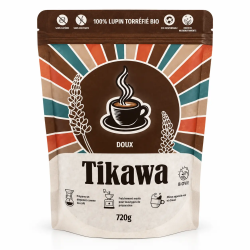
Organic Lupin Coffee - TIKAWA Intense
Alternative to coffee, 100% roasted lupin seeds
Certified organic
Intense taste, 720g
No queries yet, leave the first!
Price:
€13.90
Product availability:
In stock
Tax included


Organic Lupin Coffee - TIKAWA Intense images


Alternative coffee made from organic lupin (INTENSE)
Dominant roasted aromas with a fine note of chocolate! Ideal for milk-based drinks! Prepare and enjoy it like classic coffee!
Coffee, and coffee beans in particular, is one of the most deeply rooted habits in the daily lives of the French and, at the same time, the hardest to change. Whether you want to stop drinking coffee or simply cut down your daily consumption, this little habit is hard to shake, so unique is the sensory experience: the smell of hot coffee, that typical taste at the end of a meal, the strength of the drink when you wake up... And until now, no alternative could combine all these elements.
We had long been looking for this alternative: a real coffee taste, without caffeine.
☕ An ancient infusion, not so new after all
Tikawa is the rediscovery of an ancient infusion made from lupin seeds (a seed from the legume family) that has been part of human history for at least 4000 years! Mentions of this lupin infusion appear on papyri from ancient Egypt. And, closer to home, Italy and Germany know this alternative well as the one whose taste is closest to coffee. It was about time it arrived in France!
☕ A drink with no caffeine and no acidity
Tikawa, this excellent alternative with a delicious taste, is naturally caffeine-free and acidity-free, produced under organic farming in Germany, and is the closest drink to coffee you can taste. Unlike coffee, which has a strong ecological and societal impact (comes from far away, questionable working conditions, polluted soils...), lupin is grown locally and has an incredible ecological footprint.
What's more, it is the first alternative coffee that can be prepared like classic coffee, whatever the method used (machine, moka pot, filter...). But be careful: even though it is prepared like classic coffee, it behaves physically differently. So you will need to learn the art of preparing a good Tikawa! To prepare Tikawa Intense, we recommend using a manual espresso machine!
☕ Who is Tikawa for?
People looking for a more sustainable way of living, or simply anyone who enjoys a good cup of coffee. It is suitable even for children, pregnant or breastfeeding women. Tikawa is for all of you!
Naturally FREE from caffeine, gluten, soya and lactose.
Please note: as with soya and peanuts (cousins of lupin), a very small number of people are unable to process certain protein strains contained in lupin. So avoid it if you have a legume allergy.
The lupin seeds are roasted = this product is NOT RAW (without roasting it is impossible to recreate the taste of coffee).
☕ An alternative that adapts to all your cravings
With 2 sugars or plain. With plant milk or without milk. Hot or cold. In a cup or in baking. You decide!
We have even created a recipe ebook for you to add Tikawa to your everyday meals! > Click here to download it <
We offer 3 varieties: Classic, Mild and Intense
☕ Short user guide
Preparing lupin coffee is very similar to preparing classic coffee. Whether with a stovetop coffee maker, a filter or a French press, you can easily get the maximum aroma and taste from your daily coffee.
The grind: first of all, the grind is coarser and heavier than classic coffee. So, to prepare a Tikawa, you need to use less ground coffee by volume than for classic coffee.
It swells! Lupin coffee swells much more than classic coffee, because lupin seeds have a higher protein content than coffee beans. This mainly affects preparation in an espresso machine and a moka pot. Using too much ground coffee will stop the water from flowing through.
If you use an automatic coffee machine, you will absolutely need to readjust the settings (more water, less ground coffee). Otherwise, you risk blocking the machine...
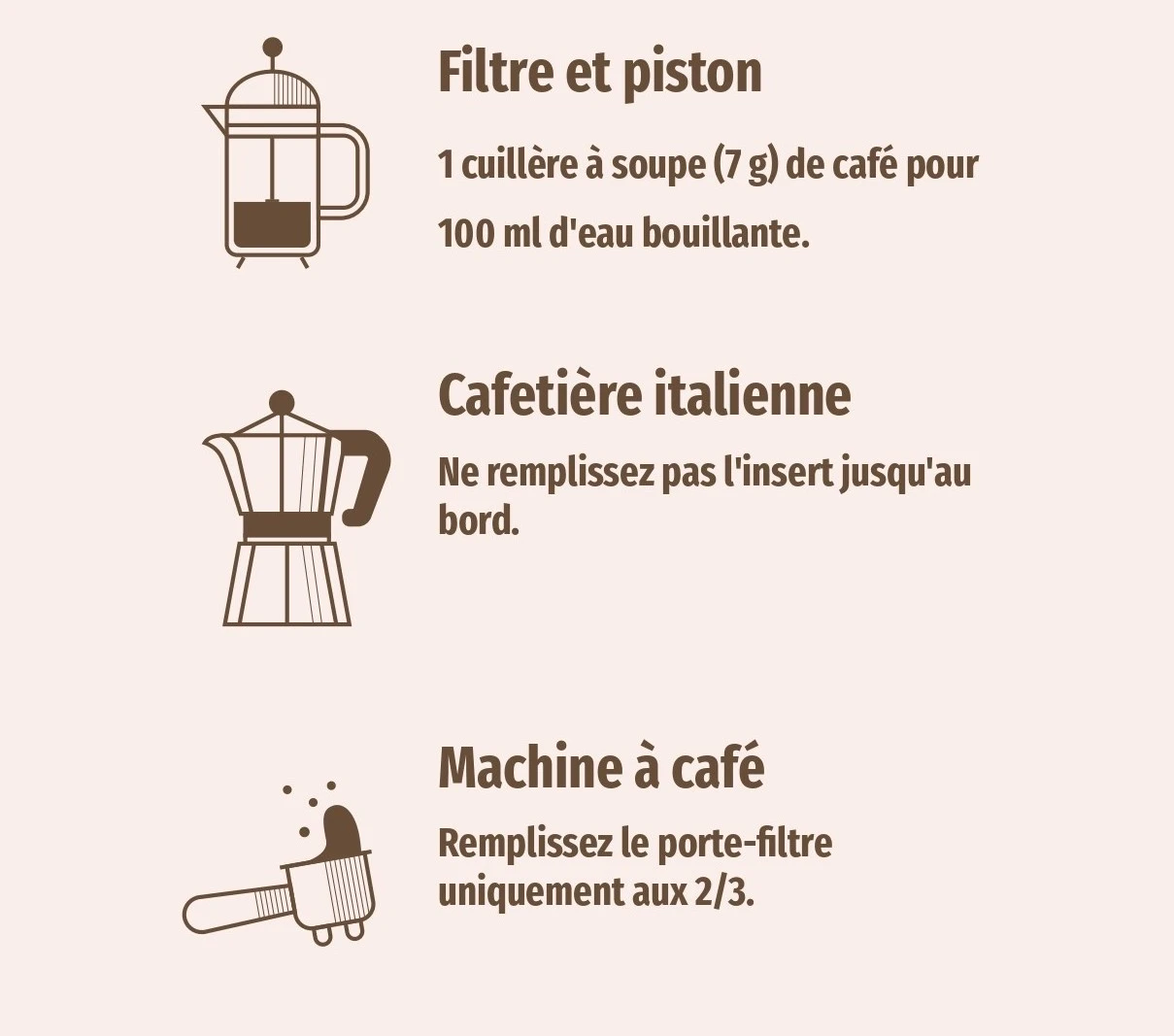
Filter and French press : use 20% less powder than for traditional coffee. This preparation method is perfect for Tikawa Mild !
Moka pot : use about 50-65% of the usual amount of ground coffee (by volume).Manual espresso machine : use about 50-65% of the usual amount of ground coffee (by volume). That corresponds to 5-6g for a single and 10-12g for a double shot or a coffee. That said, every machine is different and if you want to use this method, you will need to find the perfect amount for your machine. You can use a tamper to level the surface of the grounds and apply light pressure, but don't compact it too much or the water won't flow through properly. Aim for an extraction time of about 15 to 25 seconds. We rather recommend Tikawa Classic or Intense for this method.
Lupins are flowers in rich, varied colours native to the Mediterranean rim. They are grown for their ability to enrich the soil and for their seeds.
It is a local, sustainable alternative to soya. Growing it requires neither pesticides nor fertilisers, and for a long time it was reserved for animal feed.
It is gradually coming back onto our plates, and lends itself particularly well to roasting.
Lupin seeds are roasted at a lower temperature (depending on the roast, between 180 and 200°C) and for a longer period than coffee beans. This process is gentler and reduces the formation of residual matter and polymers produced during roasting.
Traditional coffee is an acidic product: naturally present in green coffee beans, the acidity increases during roasting. Lupin coffee, on the other hand, is naturally free from acidity and caffeine.
Good for the planet too! For a daily coffee drinker, per year:
- 75% less CO2 when making Tikawa VS classic coffee
- 13,000 L of water used (=1 shower of 3 min /day) VS 126,000 L of water for coffee (=2 baths /day)
- 0 L of polluted water with lupin: no fertilisers or pesticides needed to grow it
- 78% less land area used (19m² versus 88m² for coffee)
Coffee has a heavy ecological footprint; it should not be a mass-market product in a world aware of its impact on living things.
☕ Also see our blog articles:Coffee or lupin?
Loffee, a recent Biovie partnership!
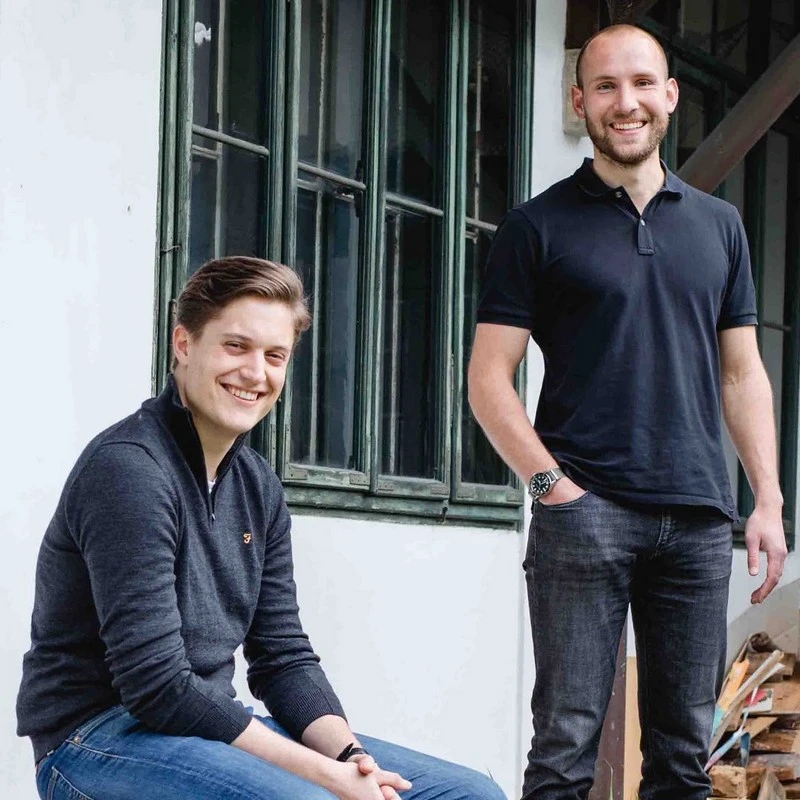
Tikawa is the work of a partnership between Biovie and the German company Loffee, run by Simon and Jan, who both come from the coffee industry. Their know-how, acquired throughout their careers refining the finest raw coffees, is now put to use developing and producing their organic lupin-based products.
Indeed, through their many years of experience, they have learned and mastered the art of roasting and know that complex aromas need time to develop fully. Their lupins are roasted with as much care as the finest traditional coffees. Their expertise and the various technical equipment at their disposal convinced us to work with them and to offer you their products.
.webp) |
 |
The lupins come from Bavarian organic farming. They are grown, harvested and processed practically on their doorstep. The entire process of harvesting and making lupin coffee is transparent. It is also worth noting that their whole team is properly paid and that nobody has to work in inhumane conditions, which unfortunately is not always the case in the conventional coffee industry.
For roasting, Loffee uses exclusively sweet blue lupins, a variety whose protein content is above average and which contains very little bitterness. That is why their lupin coffee is so pleasantly sweet and has so much body!
The lupin seeds are roasted in two small drum roasters for nearly 30 minutes at a maximum of 180°C. Everything is also done to ensure no acrylamide forms. Thanks to this long roasting, the seeds develop complex aromas and a fine toasted note.
Best before: 24/02/2027
- Ingredients : 100% pure roasted lupin, from organic farming.
No additives and no chemicals. No caffeine and no caffeic acid.
Intense flavour
- Origin : Grown, drum-roasted and packaged in Germany.
Distributed by Biovie
- Packaging : 100% recyclable bag, 720 g
- Storage : at room temperature, in a cool, dry place, away from light. Reseal the bag well or place in an airtight container to limit the loss of aromas and extend the shelf life.
- Best before: 7/10/2026
Average nutritional values per 100 ml of prepared drink
- Energy: 3 kJ / 1 kcal (< 1% of RI*)
- Fat: < 0.1 g (< 1% of RI*)
- of which saturated fatty acids: < 0.1 g (< 1% of RI*)
- Carbohydrates: < 0.1 g (< 1% of RI*)
- of which sugars: < 0.1 g (< 1% of RI*)
- Protein: 0.2 g (< 1% of RI*)
- Salt: < 0.03 g (< 1% of RI*)
*Reference intakes (RI) for a typical adult: 8,400 kJ/2,000 kcal, according to Regulation (EU) No 1169/2011.
❓ Frequently asked questions about Tikawa Intense
Does Tikawa lupin coffee contain caffeine?
No. Tikawa Intense is naturally and completely free of caffeine, like the whole Tikawa range. Lupin seeds contain no caffeine or caffeic acid.
What is the difference between the three Tikawa varieties?
Biovie offers three roasts: Classic, Mild and Intense. Mild lends itself well to filter and French press methods. Classic and Intense are rather recommended for the manual espresso machine; Intense stands out with more pronounced roasted aromas and a fine note of chocolate.
How to prepare Tikawa Intense with an espresso machine?
Use about 50 to 65% of the usual amount of ground coffee, i.e. 5-6 g for a single and 10-12 g for a double shot or a coffee. Aim for an extraction time of 15 to 25 seconds, without compacting the grounds too much so the water flows through properly. As every machine is different, you will need to adjust the ideal amount for yours.
Is Tikawa Intense suitable for children and pregnant or breastfeeding women?
Being naturally free from caffeine, gluten, soya and lactose, Tikawa can be enjoyed by the whole family, as part of a varied and balanced diet. If in doubt, particularly during pregnancy or breastfeeding, it is advisable to talk to a health professional.
Can lupin cause allergies?
Like soya and peanuts, to which it is related, lupin contains proteins to which a very small number of people may be sensitive. Lupin is in fact listed as a major allergen by EU Regulation 1169/2011 (EFSA). If you have a legume allergy (peanuts, soya, broad beans, peas, lentils), it is better to avoid Tikawa or to talk to a health professional first.
Where does the lupin used to make Tikawa come from?
The lupins are grown under Bavarian organic farming, then harvested and roasted on site by Loffee, our German partner. The seeds are roasted in small drum roasters for nearly 30 minutes, at a maximum of 180°C, which develops complex aromas while avoiding the formation of acrylamide.
How to store Tikawa Intense?
Keep the bag at room temperature, in a cool, dry place, away from light. Reseal it well after each use or transfer the lupin coffee to an airtight container, to preserve its aromas for as long as possible.
Updated: September 2026. Product sheet written and validated by Éric Viard, founder of Biovie since 2007 and ISTOM, co-author of Algues au quotidien (Gallimard, 2024) - Best cookbook in the world, Gourmand Cookbook Awards 2025, and Best cookbook in France, Académie Nationale de Cuisine 2025.
Disclaimer: the information presented in this product sheet is provided for information purposes only and does not constitute medical advice. Consult a health professional before making any changes to your diet, particularly in the case of pregnancy, breastfeeding or medical treatment.
Wondering… ?
Everything you need to know before ordering.
Be the first to ask a question about this product!
Question about the product
Ask a question