


People throw out olive oil once it smells rancid. The problem is that by then, it has already lost most of what you bought it for - and often paid a premium for. Three factors drive this loss, in a precise order: light, heat, then oxygen. None of the three is visible. That is exactly what makes them so effective.
To put this in context: olive oil belongs in the guide to vegetable oils rich in omega-3 that we keep updated every year - and how you store it deserves the same level of attention as choosing it in the first place.
What Your Olive Oil Loses Before You Notice It
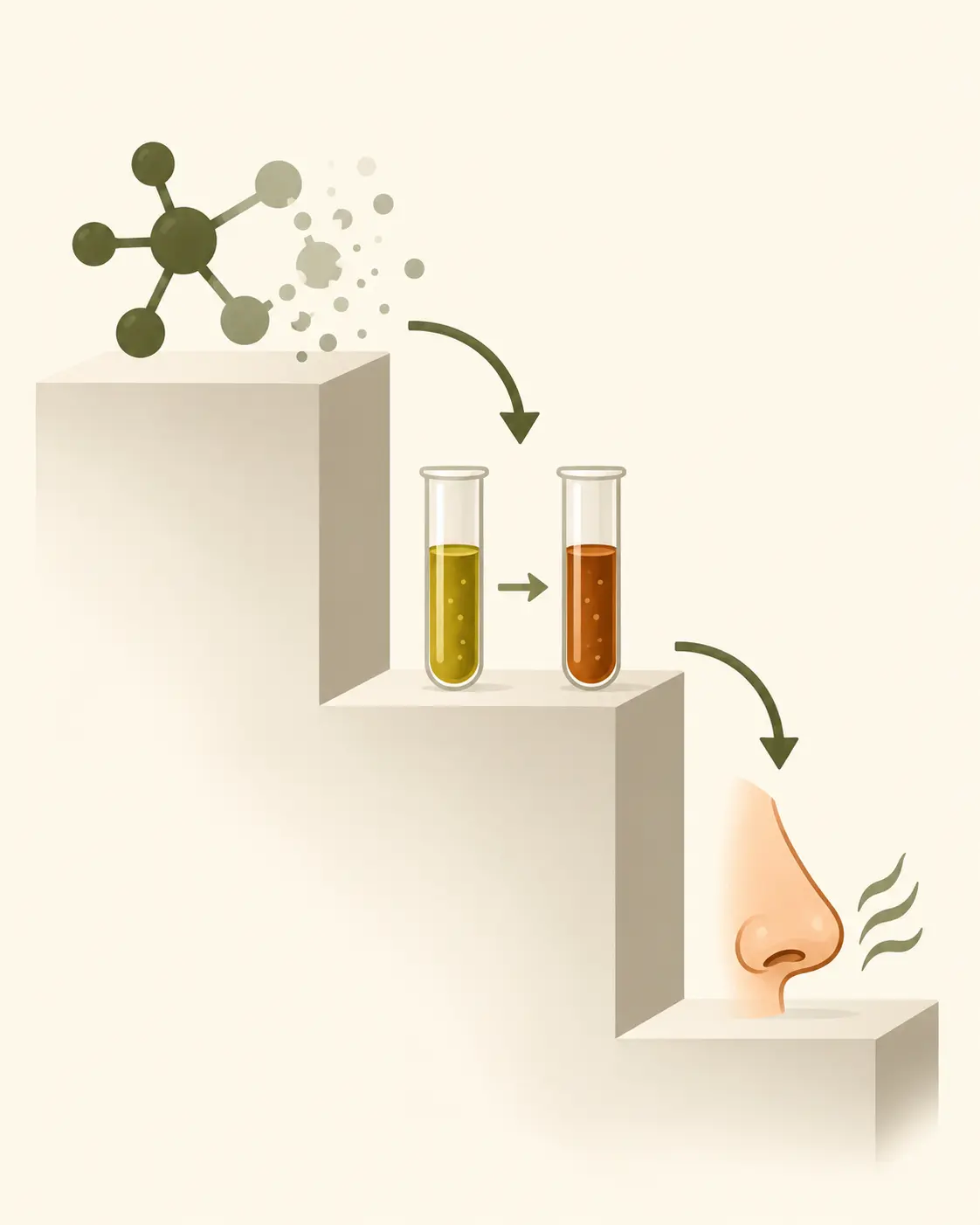
Here is what fools almost everyone: we watch the taste, while degradation actually starts well before it ever shows up there. There are three levels. First, the polyphenols collapse. Then the regulatory indices - the ones that officially define an oil as "extra virgin" - degrade in turn. Rancid taste is the last to arrive, often months after the essential has already been lost.
A study on a polyphenol-rich Coratina (Crupi et al., Antioxidants, 2025, University of Bari) measured up to 70% of polyphenols lost in just 18 months at room temperature - while free acidity had barely moved and the peroxide value remained under the legal limit. In practical terms, this means an oil can pass every official compliance check and still have already lost most of what made it valuable. The regulation does not measure what you actually came looking for.
Why Polyphenols Are the First to Go
Polyphenols act as an antioxidant shield: they oxidize in place of the oil's fatty acids. In other words, as long as they remain, they are the ones absorbing the damage - not the rest of the oil. A close correlation has been observed between polyphenol content and Rancimat induction time (the standard laboratory test that measures an oil's resistance to oxidation). And not all polyphenols behave the same way: oleacein, which is chemically more reactive, oxidizes faster than oleocanthal - not unlike a natural antioxidant studied by science elsewhere in the plant world: every molecule has its own kinetics.
One detail worth noting: this behavior describes what happens inside the bottle, not an effect on your body. This is about storage chemistry, not a health benefit.
12, 18 or 24 Months? Why the Numbers Don't Agree
If you have ever searched for "how long does olive oil last," you have run into answers that contradict each other - 12 to 18 months according to some, 12 to 24 according to others, with an ideal storage temperature sometimes given as 13-18°C, sometimes as 18-20°C. No one is exactly wrong, but no one gives the missing piece of context either: this duration depends on the starting polyphenol content, the type of filtration, and the container. There is no single figure that holds true for every oil.
Light: The First Enemy, and the International Olive Council Says So
The International Olive Council (IOC), the world's reference body on olive oil, is direct on this point: to preserve an oil's quality, it must be protected from heat, air, humidity and, above all, light. This is not an incidental order of priority - light is factor number one.
The mechanism is called photo-oxidation. The chlorophylls present in the oil act as photosensitizers: they capture light and accelerate the very oxidation they are theoretically supposed to help color. A study published in Foods (Ianni et al., 2025) compared storage in light and in darkness over 24 months: by just 3 months of exposure, the peroxide value was already climbing compared to the sample kept in the dark. Over the full period, oleacein lost around 75% and oleocanthal around 60%.
Translated into a daily habit: every minute spent on a sunny windowsill counts. That said, there is no need to overdramatize - the gap builds up over weeks, not in a single afternoon. What holds true at 24 months does not mean light "destroys everything" instantly.
A detail almost no one mentions: since November 2022, European regulation 2022/2104 has required olive oil labels to state that the product must be stored away from light. This is not a marketing tip from any particular brand - it is a legal requirement. And yet, almost no consumer-facing content ever points this out.
Clear Glass, Dark Glass, Cardboard, Metal: What Actually Protects It
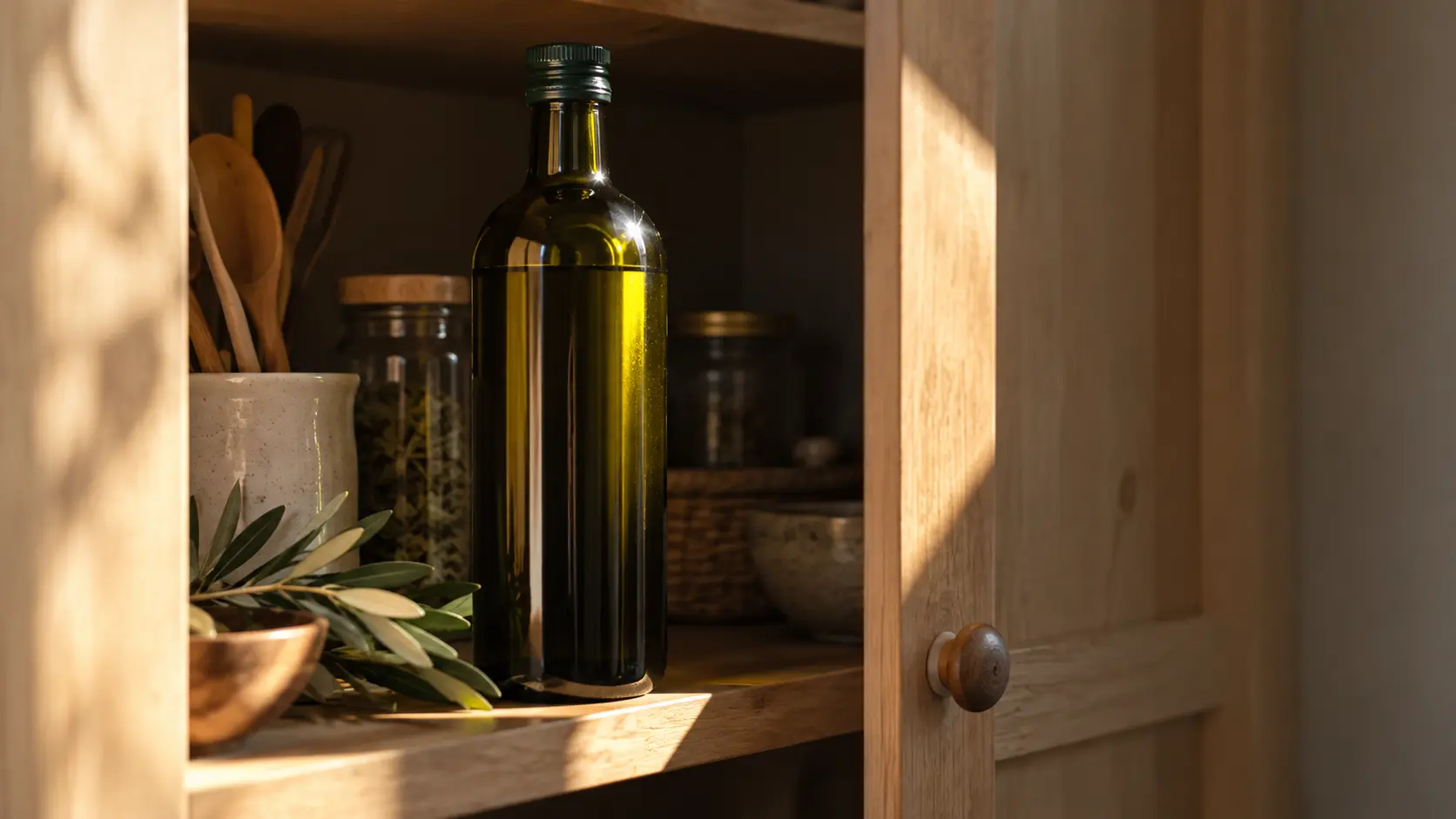
Not all containers offer the same protection from light. Clear glass lets everything through. Dark tinted glass filters part of the spectrum. Metal blocks light completely - as does the cardboard of a Bag in Box container, which is fully opaque and lets no light through at all.
If you tried three weeks with a genuinely opaque container instead of a clear glass bottle left out on the counter, the difference in the peppery kick toward the end of the bottle would become noticeable quickly.
If relying on your own vigilance alone feels a bit fragile, trying an oil that already comes in a container that is opaque by design - rather than a bottle you have to keep tucking away - makes a real difference over several months.
Heat: The Silent Accelerator
On that same Coratina studied by Crupi and colleagues, the drop in polyphenols starts as early as 6 months of storage. Room temperature significantly influences the K270 index (p = 0.0004 - a statistically solid result, not a vague trend), and the K232 index remained around 7% lower when the oil was kept at 4°C rather than at room temperature after 18 months.
But here is the counterintuitive point that no one mentions: the richer an oil is in polyphenols to start with, the more it loses in absolute terms. On the richest oil in the panel (860 mg/kg, 2020 vintage), the loss reached around 70% at room temperature - compared with around 40% for less rich vintages stored under the same conditions. In other words: paying more for a polyphenol-rich oil and leaving it next to the stovetop means losing proportionally more than your neighbor who bought a more ordinary oil.
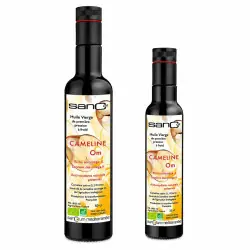
This is certainly not a reason to give up on a rich oil - it is a reason to pay attention to where it lives in your kitchen. It is, in fact, the same principle that governs how to preserve the nutrients in food: heat is rarely the friend of whatever you are trying to preserve. And if you want an example of an oil that is even more sensitive to this factor, camelina oil, which is far more sensitive to oxidation, illustrates just how much this kind of vigilance varies from one oil to another.
The Refrigerator Myth
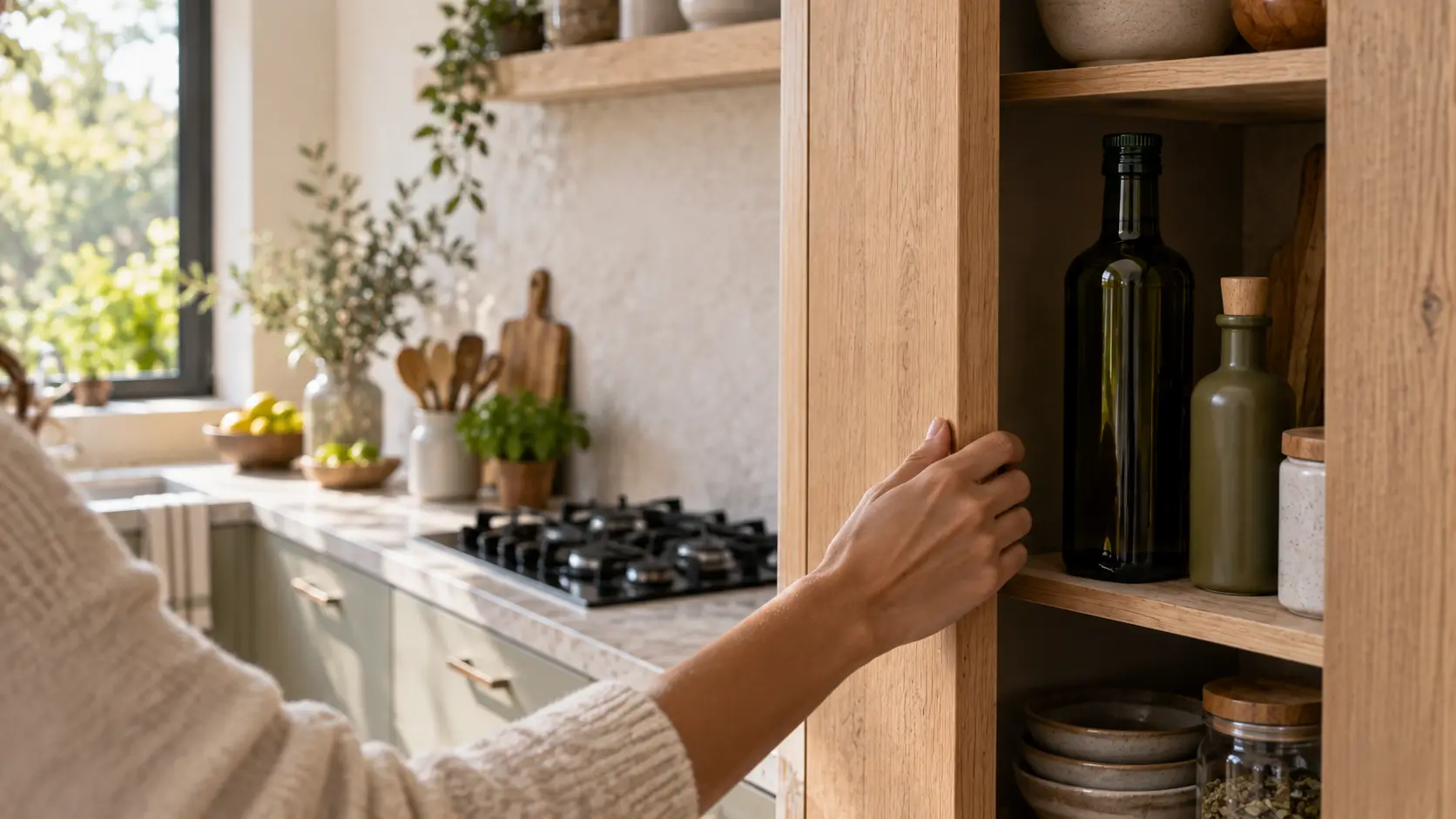
Many people think they are doing the right thing by putting their oil in the fridge. In reality, cold makes the oil solidify - it turns cloudy, sometimes almost solid - and causes condensation when you open it again, which is not ideal either. The IOC does not recommend this practice for household use. Solidifying is not the same as spoiling: an oil that turns liquid again at room temperature has not lost anything in particular because of the cold - unlike, for example, the benefits of flaxseed oil, which genuinely does benefit from being kept cool. But for olive oil, that is not the right answer. The right answer, simpler than it looks: a cool, stable place, away from direct heat. No fridge required.
Oxygen: The Problem of the Half-Empty Bottle
This is the least understood of the three factors, probably because it acts gradually, with every pour. Every time you pour oil, air takes its place in the container. This "headspace" grows week after week - and nobody thinks about it.
The IOC standard (T.15/NC No. 3, November 2024 revision) actually requires that the contents of a container fill at least 90% of its capacity. The industry therefore knows that headspace is a problem - it is written in black and white in the standard. A study on Coratina in metal cans (Macciola & De Leonardis, OCL, 2022) confirms this indirectly: the authors themselves acknowledge that the non-inerted gas space in their cans likely accelerated the degradation of the K232 and K270 indices over the six years of monitoring.
A study dedicated to Bag in Box packaging (De Leonardis et al., 2021) tested this format at 100% and 50% fill levels, with repeated draw-offs simulating real use - pouring, and pouring again, over and over. The result: this packaging maintains a potential shelf life of up to 24 months. The principle is simple to understand: the inner pouch retracts as oil is drawn off, without ever letting an air pocket reform. It is the exact opposite of a classic bottle.
If reopening a half-full bottle every couple of days bothers you as much as it damages the oil, packaging designed to never let air in is worth a look.