It's 7 p.m., the day has been long, and you want a warm cup that isn't yet another tea and isn't coffee at this hour - nothing stimulating. So you type "golden milk recipe". And there it is: a saucepan, ten minutes, a turmeric paste to make the night before and keep in the fridge. A project, basically. Not a drink.
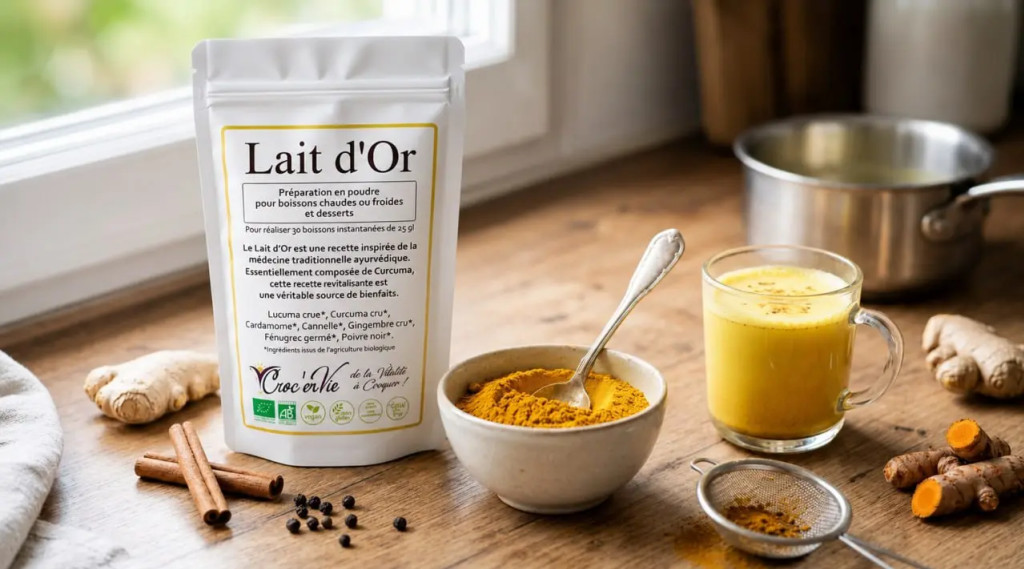
So let's be direct. Golden milk takes 30 seconds: 200 ml of warm plant milk (homemade or store-bought), one level teaspoon of spice blend, one pass with a milk frother or a mini barista whisk. That's all. No pan to watch, no paste to simmer, nothing to strain.
The rest of this article is everything around that golden milk recipe: where this turmeric latte comes from, what each spice brings to the cup, why there's pepper in it (the real reason, not the one the blogs give), which cinnamon to pick if you drink it often - and who it isn't for.
What golden milk actually is
Golden milk is a hot drink made of milk and spices, dominated by turmeric, which gives it its orange colour. It draws on haldi doodh, made for generations in Indian homes, often in the evening. In the West you'll also see it called turmeric latte, turmeric milk or golden latte: same names, same drink.
What you need to grasp - and it changes everything about how you approach it - is that haldi doodh was never a pharmacy remedy. It's a home-kitchen preparation. People make it because it tastes good, because it's warm, because it's part of the evening. Like hot chocolate here, with a different aromatic palette.
The name "golden latte" turned up much later, in the 2010s, when Australian and then European cafés put it on the menu next to the matcha latte and the chai. The word latte did the rest: it slotted the drink into a family everyone already knew.
Honestly, I find that shift a happy one. It pulled turmeric out of the supplement aisle and put it back where it has always belonged: in a kitchen, in a pan, in a cup.
The six golden milk ingredients and what each one brings to the cup
Golden milk isn't "turmeric in milk". It's a chord. A bit like a guitar chord: take away one string and it rings hollow, even if the other notes are right.
Here are the six spices in the blend, and the precise job each one does.
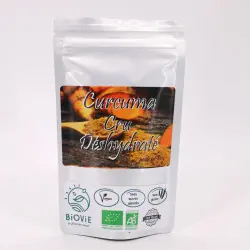
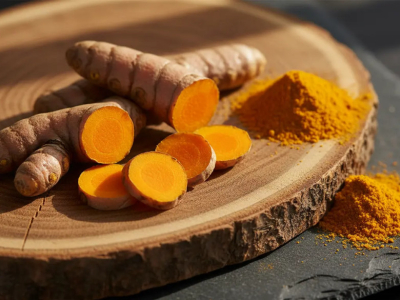
Turmeric - the colour and the earthy bitterness
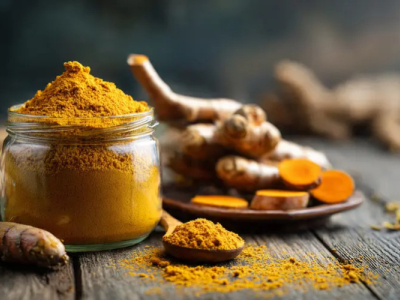
This is the base and the pigment. The dried rhizome contains roughly 1 to 5 % curcuminoids (BfR, opinion no. 040/2021), and that tiny fraction is enough to turn a whole mug solar orange. Concretely: when you watch the powder bloom in the milk, you're watching a few hundredths of the spoonful you just poured go to work. The rest is flavour - an earthy bitterness, slightly peppery, that needs rounding out.
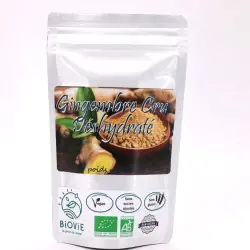
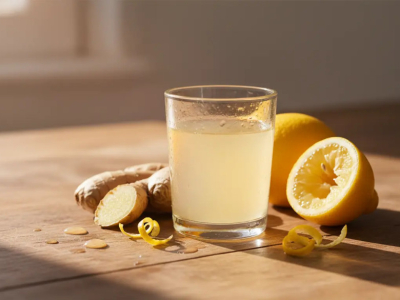
Ginger is the length on the palate. That warmth that climbs two seconds after the sip and stays. It gives relief to a blend that would otherwise be very soft.
Cinnamon - the woody sweetness
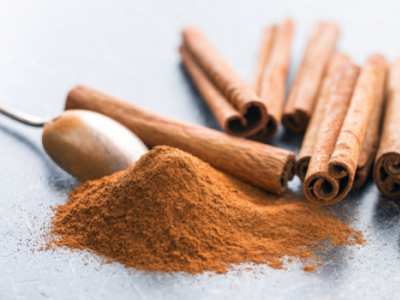
It rounds off the bitterness of the turmeric. It's the binder of the blend, the one that stops turmeric standing out on its own. And not all cinnamons are equal - we'll come back to that further down, because it's probably the most useful piece of information in this article if you drink golden milk regularly. In the meantime, here's everything worth knowing about cinnamon.
Cardamom - the citrus lift
The spice that keeps the blend from turning heavy. A lemony note, slightly camphorous. Without it, a golden milk tends to sag on the palate.
Fenugreek - the maple syrup note
Here's the gem. You know that caramel, nutty note, honestly close to maple syrup? It comes from a single molecule: sotolon (LactMed, NIH, revised March 2026). It's the same compound that gives fenugreek its unmistakable smell. A chemist's detail, but a detail that explains why a well-built golden milk has that sweet undertone when nothing sweet has been added.
Two precautions worth knowing, which I detail further down: fenugreek is not advised during pregnancy and breastfeeding, and under 18. Good news: the recipe works perfectly well without it.
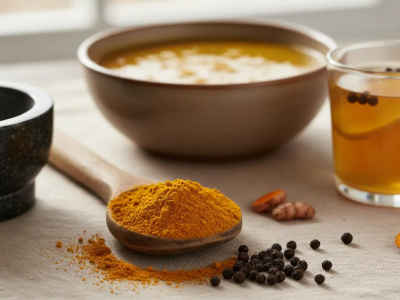
Black pepper - the sharp edge
And the pepper. That's the next section, because that's where most articles go off the rails.
The 30-second golden milk recipe
That's it. That's the whole thing.
Ingredients for one cup:
200 ml plant milk (hemp, tiger nut, coconut or almond)
1 level teaspoon of golden milk blend, about 3 g
Optional: ½ teaspoon of agave syrup or honey
How to make golden milk, in 3 moves:
Heat the milk to 60-70 °C - hot, not boiling.
Pour in the teaspoon of blend.
Whisk for 15 seconds with a milk frother.
About that 60-70 °C: the right temperature is the one where you can hold the cup in both hands without letting go, and drink without scalding your lips. The moment it starts to shiver, you've gone too far. This isn't a whim - curcumin is fat-soluble and poorly stable in water at neutral pH (Bertoncini-Silva et al., Antioxidants, 2024). Hence the milk, a little fat, and gentle heat rather than boiling water. A question of preparation, not of virtue.
Iced version: same dose, cold milk, whisk a little longer, pour over ice cubes.
And the three things you don't do: no pan to watch, no paste made the night before, no whole spices to fish out through a sieve.
A word on the blend itself: alongside the six spices, it also contains a little lucuma, a South American fruit dried into powder, with a soft caramel taste. That's what explains why you usually need no added sweetener at all.
"So far I've only tasted the dehydrated barley grass juice, and it tastes really good :)" - Alice, French customer review (5/5)
If you'd rather try the gesture tonight than "one day", this is the blend I use at home, dosed for one cup - six spices plus the lucuma, organic and raw.
Why there's black pepper in golden milk (and a little fat)
In Indian kitchens, turmeric and pepper have always travelled together. It isn't an invention of some health blog from 2015.
What the science says, precisely: a landmark pharmacokinetic study (Shoba et al., Planta Medica, 1998) measured markedly higher blood absorption of curcumin in the presence of piperine, the pungent molecule in pepper.
And now the nuance - because it matters more than the figure.
The doses in that study were 2 g of pure curcumin. That's the equivalent of roughly 40 to 200 g of turmeric powder, depending on the rhizome's content. Concretely: somewhere between half a glass and two full glasses of turmeric powder, in one go. Your teaspoon holds 3 g, and only part of that is turmeric. We're not in the same world.
And the recent work stays cautious. An independent 2025 crossover trial (Kroon et al., iScience, 9 healthy volunteers) measured unconjugated plasma curcumin often below 2 nM, and concluded that piperine supplementation "offered no advantage".
So let's say it plainly: we put pepper in golden milk because that's the tradition, and because it tastes good. What science measured about absorption is real, but at doses that have nothing to do with an evening cup. While everyone announces "+2,000 %", I'd rather tell you what the number actually means.
Same logic for the fat. A slightly rich plant milk and gentle heat: that's cooking technique - curcumin is fat-soluble, it disperses better in a fatty matrix. It's a story about texture and finish, not a promise.
Ceylon or cassia cinnamon: the one that changes everything in your golden milk
If you drink golden milk every day, this section is the most useful one in the article. It's also the one none of the articles I've read bothers with.
There are two big cinnamon families on the market. Cassia (often sold simply as "cinnamon") contains on average around 3,000 mg of coumarin per kilo, with measurements up to 10,000 mg/kg. Ceylon cinnamon (Cinnamomum verum) contains very little (BfR, coumarin FAQ).
The BfR and EFSA use a tolerable daily intake of 0.1 mg of coumarin per kilo of body weight. Translated into a kitchen: for a 60 kg adult, around 2 g of cassia cinnamon a day is enough to reach it. For a 15 kg child, around 0.5 g. In other words, we're talking about amounts a daily habit can drift towards without you noticing - not a theoretical excess.
The practical conclusion fits in one sentence: for regular drinking, choose Ceylon cinnamon.
How do you spot it? A Ceylon stick is thin, pale, beige-gold, rolled into multiple flaky layers - a bit like a cigar. A cassia stick is thick, dark red-brown, made of a single tightly curled bark, hard under the fingers.
This isn't a connoisseur's quibble. It's simply information nobody hands you in the spice aisle. And not knowing is a choice.
30 seconds or the traditional turmeric paste: the honest comparison
I've done both for years. Here's what actually changes.
The traditional method, in detail:
measure out 4 to 5 spices separately;
bring to the boil with water;
cook 8 to 10 minutes, stirring;
transfer to a jar;
refrigerate (it keeps up to a month);
then, every evening, reheat with the milk;
and strain, if you used whole spices.
Real total, the first time: 15 to 20 minutes. Plus the washing up.
The express golden milk recipe: heat the milk, one teaspoon, whisk. Total: 30 seconds. And an identical dose in every cup, which is no small thing when you know that online recipes range from ½ to 3 teaspoons of turmeric depending on the site.
Now let's be fair: the paste brings things. A rounder, more enveloping texture. A homemade quality that gives real satisfaction. And the value of a batch made ahead when several of you are drinking it. If you like to cook, make it at least once: you'll understand your blend better afterwards.
But the real argument is elsewhere, and it's behavioural. A paste gets made once, then forgotten at the back of the fridge behind the pickles. A spoonful in a mug gets made every evening. The difference between the two methods isn't 18 minutes. It's frequency.
If the idea is to make this an end-of-day habit rather than a Sunday experiment, the powder format is the one that survives.
"I mostly order seaweed, but also spices, marine plasma and small accessories. […] always impressed by how fast the delivery is." - Julie F., French customer review (5/5)
Which plant milk should you pick for your golden milk recipe?
It's the question you ask the first time, and it's the one that decides the texture.
A small personal aside: my mother is Dutch and my father was a baker. I was raised on bread and milk. When I went plant-based in the early 90s, finding a base that held up in a hot drink was far from obvious. Today we're spoilt for choice, so we may as well choose knowingly.
Hemp - light vegetal note, fine texture. It takes 2 minutes in a blender from hulled seeds.
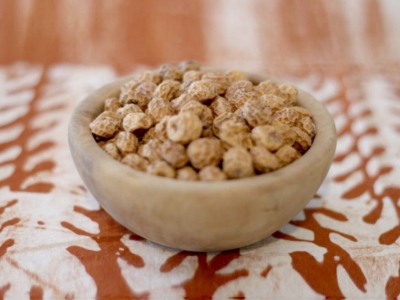
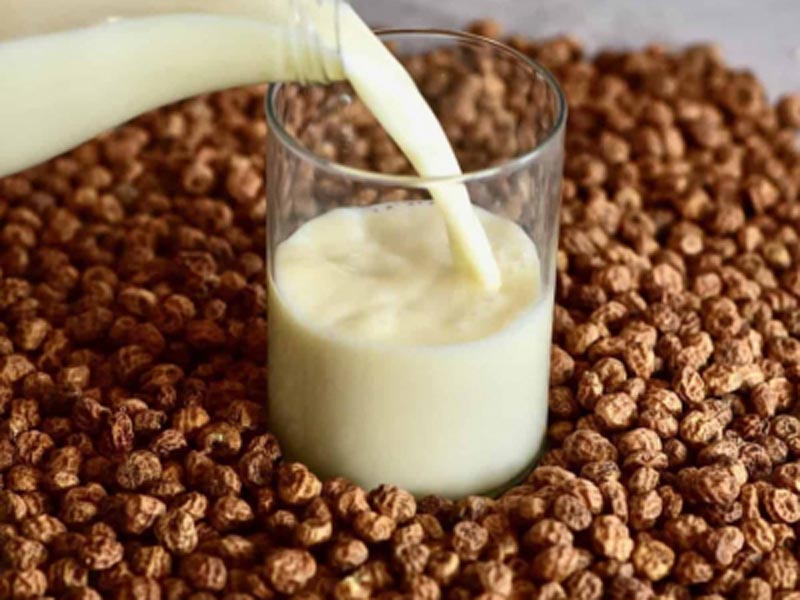
Tiger nut - the softest and most naturally sweet of the four. It's the most successful match with turmeric, no hesitation: its roundness goes exactly where the bitterness of turmeric leaves a hollow.
Coconut - the fattiest, the most unctuous. If you want a thick foam that lasts to the bottom of the cup, that's the one.
Almond - the most neutral. It steps back and leaves all the room to the spices.
None of them is "the right one". Try two, and you'll know.
Two how-tos if you want to make them yourself: make your own tiger nut milk and how to make your own plant milk at home.
"[…] with the tiger nut milk I'm particularly fond of" - Elodie, French customer review (5/5)
If you want to test the tiger nut version for two or three weeks and see whether that's the one that keeps you, the tiger nuts are in the shop - you'll make your milk in two minutes in a blender.
The variations: iced, evening version, more indulgent
The iced version. In July, nobody wants a steaming cup. Same dose, cold milk, shaker or vigorous whisk, and pour over ice cubes. The foam holds for less time, but the taste is cleaner, sharper. Some people prefer this iced turmeric latte.
The evening version, without ginger. If you find ginger a bit too bright at the end of the day, simply cut back the dose of blend and top up with a pinch of Ceylon cinnamon on its own. It's a question of comfort on the palate, nothing more.
The indulgent version. Full-fat coconut milk, a touch of vanilla. At that point we're not really in ritual territory any more, we're in dessert. Owned.
The fenugreek-free version, for the precautionary cases detailed just below: simply make your golden milk without it. The recipe works perfectly.
This is the question none of the articles I've read handles seriously. It deserves better than a line at the bottom of the page.
The bile ducts. Turmeric is not recommended in cases of bile duct obstruction, cholangitis, liver disease or gallstones. That's not my opinion: it's the European EMA/HMPC monograph on Curcuma longa. If that's you, sit this drink out.
Pregnancy and breastfeeding. In the absence of sufficient data, medicinal use of turmeric is not recommended (EMA/HMPC). Fenugreek is explicitly not advised during pregnancy and breastfeeding, nor under 18 (EMA/HMPC, Fenugreek seed). Hence the fenugreek-free variation mentioned above.
Ongoing medication. If you're on medication, ask your doctor or your pharmacist. That's ANSES's wording, and it's the right one: it presumes nothing.
And above all: supplements ≠ spice. ANSES recorded 120 cases of adverse effects linked to turmeric food supplements between January 2009 and August 2021, of which 67 sufficiently documented and 15 cases of hepatitis (Vigil'Anses no. 17, June 2022). Those reports concern concentrated extracts, not the culinary spice. Here's the order of magnitude: the rhizome contains 1 to 5 % curcuminoids, whereas the E100 additive requires a minimum of 90 % (BfR, opinion no. 040/2021). Between your teaspoon and a capsule of standardised extract there's the same gap as between a glass of grape juice and a glass of marc brandy.
Frequency. One cup a day is common practice. For curcumin (E100), EFSA uses an acceptable daily intake of 3 mg per kilo of body weight and notes that estimated intakes in children aged 1 to 10 exceed that ADI in some European countries (EFSA, 2010). Nothing alarming, but reason enough for children to drink turmeric milk occasionally rather than daily, and in a smaller cup.
Your questions about golden milk
Can you drink golden milk at night?
Yes, and it's the traditional use: haldi doodh is an end-of-day drink in Indian homes. It's a quiet moment before bed, in the same way as a herbal tea. It contains no caffeine.
Which plant milk should you choose?
Hemp, tiger nut, coconut or almond. Tiger nut gives the softest match with turmeric, coconut the thickest foam, almond the most neutral finish. The dedicated section above details each option.
Does golden milk contain caffeine?
No, none at all. That's what sets it apart from a chai latte (black tea) or a matcha latte (green tea): you can drink it at 9 p.m. without a second thought.
How long does golden milk powder keep?
Store it away from light, heat and moisture, with the jar properly closed after each use. The best-before date is on the packaging and on the product page.
Can you drink it every day?
For a healthy adult, yes: one cup a day is common practice. For children, better to keep it occasional (see the EFSA acceptable daily intake above). And if one of the situations listed in the precautions section applies to you, get medical advice.
Do you really need black pepper?
No. We put it in because it's the Indian tradition and because it brings a sharp edge that balances the blend. The scientific data on absorption exists, but at doses unrelated to a single cup - the dedicated section explains why.
Can you make golden milk with water?
Technically yes. But curcumin is fat-soluble: without any fat, the powder disperses less well, the texture is thinner and the result duller. That's a cooking argument, not a health one. A slightly fatty plant milk makes a real difference.
Is golden milk suitable during pregnancy?
Caution. Medicinal use of turmeric is not recommended during pregnancy and breastfeeding, and fenugreek is explicitly not advised (EMA/HMPC). Make a fenugreek-free version and ask a healthcare professional.
To finish
There you go. One spoonful, warm milk, fifteen seconds of whisking. The rest - the Ceylon cinnamon, the pepper we own as a tradition rather than a promise, the tiger nut milk you try every other evening - is what turns a golden milk recipe into a habit.
No dogma. Everyone at their own pace, and everyone their own cup.
Updated: August 2026. Article written and reviewed by Éric Viard, founder of Biovie and ISTOM engineer, 33 years of plant-based and living-food practice, co-author of "Algues au quotidien" (Gallimard, 2024) - World's Best Cookbook, Gourmand World Cookbook Awards 2025, and Best French Cookbook, Académie Nationale de Cuisine 2025.
This article is culinary and cultural. It is not medical advice. If you are on medication, pregnant, breastfeeding or have a bile duct problem, ask a healthcare professional. As part of a varied, balanced diet and a healthy lifestyle.