








Welcome to the world of freeze-dried fruits! Yes, eating freeze-dried fruits is an excellent choice, and if you are looking for a convenient way to get your daily dose of vitamins, minerals, trace elements, phytonutrients, and valuable enzymes, freeze-dried fruits are a real solution. The reason lies in a technical detail that changes everything: the drying is done cold, without cooking. As a result, the retention of minerals is almost total, and among all drying methods, freeze-drying is the one that best preserves fragile vitamins like vitamin C (comparative study on kiwi, 2026). For my part, I have been working with living food at Biovie since 2007, and frankly, few foods combine practicality and nutritional density as well. The freeze-dried fruits check both boxes.
Let's see together, here, the benefits of freeze-dried fruits, the interest of the freeze-drying process, its limitations, how to use them daily, what distinguishes them from dehydrated fruits, and how long they last. To learn more about each variety, you can also consult our guide to the ten varieties, further down in this article.
What is a freeze-dried fruit ?
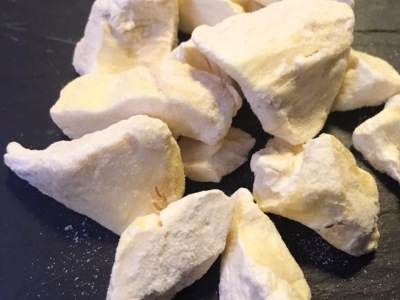
A freeze-dried fruit is a fruit from which water has been removed at cold temperatures, under vacuum, without ever heating it. Specifically, the fruit is frozen at around -40°C, and then the ice it contains transitions directly from a solid state to a gaseous state, without returning to a liquid state. This physical phenomenon is called sublimation (it's exactly what happens when frost disappears from a windshield in cold and dry weather). The fruit then retains its shape, color, and most of its nutrients, with a crunchy and airy texture.
In brief:
- a cold process, without cooking or thermal drying ;
- the water is removed under vacuum by sublimation ;
- according to the compounds, 90 to 97% of the nutrients are preserved ;
- a crunchy texture and a concentrated taste ;
- a single transformation, and at Biovie: without added sugar or additives.
Here is the definition. It is, moreover, the same process that space agencies use to feed astronauts - which is to say, it has proven effective in terms of preservation.
What are the benefits of freeze-dried fruits ?
The main benefit of freeze-dried fruits is that they provide a convenient and nutritious way to get your daily vitamins, phytonutrients, enzymes, and minerals in a form that is easy to store and that particularly appeals to children, athletes, and travelers. Bananas, durians, pineapples, jackfruits, and mangoes provide vitamins A, C, and E, as well as minerals like iron, zinc, and magnesium. Vitamin C helps reduce fatigue and supports the normal functioning of the immune system, as part of a varied and balanced diet and a healthy lifestyle.
And then there is a point that is often forgotten: These fruits were picked at optimal ripeness in their country of origin. before being freeze-dried on site, unlike exotic fruits picked green that then ripen in a cargo. The maturity at the time of picking can be tasted in the flavor and is important for nutritional richness.
Since the cold does not degrade enzymes (which are usually destroyed by the heat of traditional drying methods), freeze-dried fruits fully align with the concept of living food. They are also naturally fat-free, which makes it a light and convenient snack, provided you keep in mind that the fruit's sugars are concentrated (I'll come back to this later).
A word about antioxidants, because it's striking. Açaí, for example: a study published in the Journal of Agricultural and Food Chemistry measured on the freeze-dried berry one of the highest antioxidant capacities ever recorded among the tested fruits (Schauss et al., 2006). If the subject interests you, I discuss it in more detail in our dedicated article on freeze-dried açaí.
On the children's side, it's undoubtedly the use I prefer. The freeze-dried strawberries, with their bright red color, naturally sweet and crunchy, make an excellent replacement for industrial candies. Aurélie and I regretted not discovering them earlier, back when our children were at home. That's the whole point of our article on strawberries as a healthy alternative to candy for children. And for thrill-seekers, there is freeze-dried durian - our best seller, the famous "king of fruits" from Asia.
Share this article
What are the benefits of freeze-drying ?
Beyond the contents of the plate, the process itself has advantages. Freeze-drying removes water from the fruit, under vacuum and without any heat., which helps preserve the color, flavor, natural texture, and maximum nutritional values. This is indeed confirmed by the scientific literature: a reference review published in the journal Foods (Bhatta et al., 2020) notes that the low temperature of the process allows for maximum retention of nutrients and bioactive compounds, whereas hot drying methods destroy some of them.
The numbers speak for themselves. In a study comparing five drying methods for kiwi (2026), freeze-drying offers the best retention of vitamins and carotenoids: the fresh fruit contained 5.57 mg/g of vitamin C, and freeze-drying preserved the most (3.13 mg/g), far ahead of natural drying (1.06 mg/g) or hot air drying (1.21 mg/g). In other words, with the same fruit, the drying method makes a significant difference. To understand the differences between the processes in depth, see our comparison. Freeze-drying or dehydration: a comparison.
Disadvantages and limitations of freeze-drying
Let's be honest, because not everything is perfect. The first drawback is the cost: freeze-drying requires four to ten times more energy than hot air drying (Bhatta et al., 2020), and it is more expensive than other drying methods like dehydration. This inevitably affects the final price. Then, the freeze-dried fruit surprises: it has a crunchy texture, which may surprise at first, quite different from the softness of a fresh fruit. Some love it, while others need some time to adapt. Finally, it must be kept away from moisture, as it absorbs it very quickly.
Freeze-dried fruits: is there a danger ?
No, there is no particular danger in eating freeze-dried fruits. The only real point of caution is the sugar. By removing the water, the volume of the fruit is significantly reduced, which naturally concentrates its sugars into a small bite. This doesn't mean you should avoid them, just that a reasonable portion is sufficient, especially if you are monitoring your blood sugar levels. Second point: depending on the brand, some freeze-dried fruits are coated with sugar or additives. Read the label. At Biovie, it's a single cold transformation, with no added sugar. And for young children, as with any dry food, just make sure they chew well before swallowing.
How to consume freeze-dried fruits ?
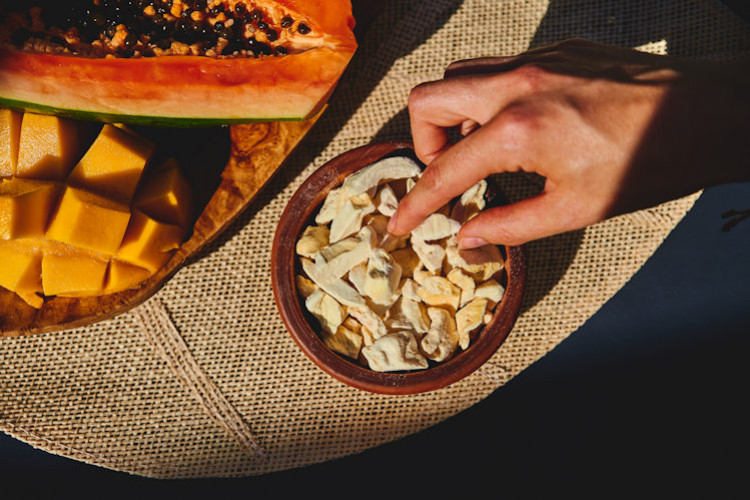
The simplest way is to eat them as they are, as a snack or for a treat. But they deserve better than that. We can incorporate into smoothies, gluten-free cereals, plant-based yogurts, or breakfast fruit salads. As their taste is intensely concentrated, a small amount is enough to flavor an entire recipe. Freeze-dried red fruits (strawberry, raspberry, blueberry) make a superb topping on a bowl of porridge or a plant-based ice cream. Freeze-dried fruits can also be rehydrated for a few minutes in a bit of water, or used as a topping on a dessert.
At Biovie, you will find, for example, our freeze-dried Monthong durian - our best-seller for years - or our whole freeze-dried strawberries, derived from a single cold transformation, without added sugar.
Little home tip: when ground into powder using a blender, freeze-dried fruits naturally color and flavor pastries without artificial coloring or flavoring. That's the benefit of freeze-dried fruit powder. And if you're wondering how to make freeze-dried fruits yourself: honestly, it's very difficult to do at home without a professional freeze-dryer (the equipment is expensive and the cycle takes many hours). For everyday use, starting with already freeze-dried fruits is by far the simplest option.
Dehydrated or freeze-dried fruits: what's the difference ?
Both remove water from the fruit, but not in the same way, and the result is completely different.
- Dehydration dries the fruit using heat, typically between 40 and 70 °C. It is an ancient, economical method, but the heat degrades some of the heat-sensitive vitamins. The fruit comes out softer and darker.
- Freeze-drying, on the other hand, dries the fruit at sub-zero temperatures and under vacuum. No heat, therefore much better preservation of color, flavor, and nutrients. The fruit remains light and crunchy.
The gap is measured. A study on jujube compared the processes: compared to freeze-drying taken as a reference, sun or oven drying results in a loss of 90 to 93% of vitamin C and 96 to 99% of proanthocyanidins (antioxidants). Cold really changes the game. To delve into the subject method by method, head to our comparison. Freeze-drying or dehydration.
What is the shelf life of freeze-dried fruits ?
It varies depending on the fruits and the storage method, but Freeze-dried fruits can be stored without concern for many months, or even several years, as long as they are kept in a cool and dry place., especially protected from moisture. In practice, often count on 18 months to 2 years for a well-packaged product.
The secret is airtightness. A scientific review on the stability of vitamin C (Giannakourou and Taoukis, 2021) also reminds us that heat and oxygen are the two main enemies of nutrients, and that storage conditions are as important as the manufacturing process itself. Concrete conclusion: store your fruits in an airtight container, close it well after opening, and avoid heat and light. Otherwise, they become rubbery in texture and lose quality. If you're more broadly interested in fruit preservation, we've also written about how to store your fruits and vegetables over time.
The full range Freeze Dried Fruits
Enjoy the flavor and nutrients of exotic fruits, harvested at maturity in Vietnam and preserved while respecting the nutritional qualities of the fruit., 11 products
-20%
Freeze-dried durians - 200g
€12.24 €15.30

Freeze-dried bananas - 200g
€14.90

Freeze-dried mangoes - 200g
€15.30
The 10 Biovie freeze-dried fruits: complete guide by variety
At Biovie, we have selected 10 exceptional fruits, all harvested at full ripeness in their country of origin before being freeze-dried on site. This freshness at the source makes all the difference. To learn more about tropical fruits and their origins, feel free to explore our dedicated guide.
Durian Monthong (Thailand): the exclusive king of fruits
Here is our best-seller, and that is no accident. Durian is nicknamed "the king of fruits" in South-East Asia, and the Monthong variety from Thailand is considered the noblest.
Its taste? Imagine a smooth custard with notes of vanilla and almond, with a touch of caramelised onion. I know, that can sound strange put like that, but it is an absolutely unique explosion of flavours.
Nutritional profile:
- Exceptionally rich in potassium (more than a banana!)
- Source of magnesium and copper
- Good fibre content
- Moderate glycaemic index despite its sweet taste
Biovie's freeze-dried durian is a European exclusive. You will not find it anywhere else in this form, sourced from the Chanthaburi province, renowned for producing the best durians in the world.
Discover durian, king of fruits
For smoothie lovers, try our durian smoothie recipe – a surprising and delicious combination!
Nam Dok Mai mango: the fibre-free premium variety
Nam Dok Mai mango is an exceptional Thai variety, practically impossible to find fresh in Europe. Its distinguishing feature? Flesh with absolutely no fibre, incredibly sweet.
If you have tasted the mangoes sold in supermarkets (often picked green and artificially ripened), you are about to discover a completely different fruit. The gap is comparable to that between a garden tomato picked at full ripeness and a supermarket tomato.
Nutritional benefits:
- Very high in vitamin C
- Excellent source of beta-carotene (provitamin A)
- Powerful antioxidants that contribute to skin and eye health
To find out more about this extraordinary fruit, I invite you to discover the health benefits of mango.
Taste the premium Nam Dok Mai mango
Jackfruit: the plant-based alternative with a unique taste
Jackfruit is the largest fruit in the world. It can weigh up to 35 kg! Its taste evokes a mix of banana, mango and pineapple, with subtle floral notes.
In Asia, it has been used for centuries in both savoury and sweet dishes. The freeze-dried version offers an absolutely addictive crunchy texture.
Nutritional strengths:
- Source of vitamin C
- Contains lignans, isoflavones and saponins with antioxidant properties
- Contributes to the normal function of the immune system
If this fruit intrigues you, discover the 7 benefits of jackfruit in our dedicated article.
Pineapple: bromelain preserved
Pineapple is probably the best-known tropical fruit, but the freeze-dried version reveals an unsuspected dimension of flavour. The taste is 10 times more concentrated than the fresh fruit!
The major advantage of freeze-drying for pineapple: it preserves bromelain, this precious digestive enzyme that is destroyed by heat. Canned pineapples, cooked at high temperature, barely contain any left.
Nutritional strengths:
- Excellent source of vitamin C
- Rich in bromelain (contributes to normal digestion)
- Source of manganese
Discover pineapple, rich in bromelain
Gros Michel banana: the rediscovered historic variety
Gros Michel banana is a bit of nostalgia in a bite. This variety was THE reference banana until the 1950s, before being wiped out by a fungus and replaced by the Cavendish we know today.
Its taste? Much more intense, sweeter, with notes of vanilla that the Cavendish does not have. This is the banana that inspired the artificial banana flavour found in sweets – not the Cavendish!
Nutritional profile:
- Excellent source of potassium
- Rich in vitamin B6
- Good fibre content
- Quick source of energy for athletes
Rediscover the taste of real banana
Lychee (Vietnam): the vitamin-packed pearl
This small fruit with translucent flesh comes from our ISO 22000, HACCP and IFS certified Vietnamese suppliers. Lychee is one of the fruits richest in vitamin C – far more than an orange, weight for weight!
Its taste evokes rose and muscat grape, with an incomparable freshness. In freeze-dried form, this delicate flavour concentrates to offer a tasting experience close to a natural sweet, but with no added sugar.
Nutritional strengths:
- Exceptionally rich in vitamin C
- Source of antioxidant polyphenols
- Contributes to the normal function of the immune system
- Good copper content
Discover ultra vitamin-rich lychee
Longan (Vietnam): the dragon's eye with honey notes
A close cousin of lychee, longan is nicknamed "dragon's eye" in Asia because of its appearance once peeled. Its taste is muskier, with honey notes and an aromatic finesse that wins over the most demanding palates.
Slightly less sweet than lychee, longan offers a different subtlety of flavour. Frankly, it is a fruit rarely discovered in Europe and one that truly deserves attention.
Nutritional strengths:
- Rich in vitamin C
- Source of riboflavin (vitamin B2)
- Contains potassium
- Antioxidant properties
Taste longan with its floral notes
Whole strawberries: the intensity of French flavour
Freeze-dried strawberries are truly a rediscovery of the fruit. The process concentrates the flavours so much that a single freeze-dried strawberry matches the intensity of a handful of fresh strawberries.
What I particularly like about our whole strawberries is their versatility: eaten straight as a crunchy snack, blended into powder to naturally colour your pastries, or rehydrated in your yoghurts and smoothies.
Nutritional strengths:
- Very high in vitamin C
- Source of manganese
- Contains antioxidants (anthocyanins)
- Low in calories
Fall for whole freeze-dried strawberries
Coconut: tropical crunch
Freeze-dried coconut offers a texture and experience completely different from traditional dried coconut. The crunch is lighter, airier, and the fresh coconut flavour is remarkably preserved.
It is a must for anyone who enjoys tropical flavours. In the kitchen, it fits perfectly into granolas, energy balls or simply as a topping on your smoothie bowls.
Nutritional strengths:
- Source of fibre
- Contains medium-chain triglycerides (MCTs)
- Rich in manganese
- Source of copper and selenium
Purple dragon fruit (pitaya): the spectacular antioxidant
Purple dragon fruit – or purple pitaya – is arguably the most photogenic in our range. Its intense magenta colour comes from betalains, pigments with powerful antioxidant properties.
Its taste is subtle, lightly sweet with notes of kiwi and pear. The freeze-dried version reveals a crunchy texture and a colour that stays vivid – perfect for impressing your guests!
Nutritional strengths:
- Exceptionally rich in betalains (antioxidants)
- Source of vitamin C
- Contains iron
- Good fibre content
Aurélie and I often use pitaya powder to naturally colour our smoothie bowls. The result is spectacular and 100% natural.
How to choose your freeze-dried fruits according to your needs?
With 10 varieties, it is easy to feel lost. Here is my selection guide based on your goals.
For energy and sport: durian, banana, pineapple
Looking for a natural energy boost? These three freeze-dried fruits are your allies:
- Durian: the all-round champion for potassium and complex carbohydrates
- Gros Michel banana: quick energy, ideal before or after exercise
- Pineapple: bromelain helps recovery after physical exercise
Aurélie and I always bring a bag of freeze-dried banana on hikes. Ultra-light, zero waste (we eat it all!), and an immediate energy boost.
For immunity and vitamins: lychee, mango, pineapple
Need to stock up on vitamin C? Rely on this winning trio:
- Lychee: one of the fruits richest in vitamin C
- Mango: vitamin C + beta-carotene for a double action
- Pineapple: vitamin C + bromelain for optimal synergy
A daily intake of these fruits contributes to the normal function of the immune system, especially during periods of fatigue.
For children: a healthy alternative to sweets
This is perhaps the use I am proudest of. Our freeze-dried fruits have become the "sweet" of choice for many children – and their parents!
Start with:
- Mango: mild, sweet taste, melt-in-the-mouth texture
- Banana: a familiar flavour in an improved version
- Pineapple: the crunch that children love
For the more adventurous:
- Lychee: like a natural floral sweet
- Jackfruit: fun texture and complex taste
For discovery: which fruit to start with?
If you have never tasted freeze-dried fruits, I recommend starting with a fruit you already know in its fresh form. Mango or pineapple are perfect for beginners.
Once won over by the technique (and you will be!), venture towards durian or jackfruit for genuinely new flavours.
FAQ: Freeze-Dried Fruits
Is it good to eat freeze-dried fruits ?
Yes. Freeze-dried fruits retain the vast majority of nutrients from fresh fruit thanks to a cold drying process that does not degrade heat-sensitive compounds. They provide vitamins, minerals, and antioxidants in a convenient and lightweight form, as part of a varied and balanced diet. The only point of caution: their sugars are concentrated, so they should be consumed in reasonable portions.
What is the difference between dehydrated and freeze-dried fruits ?
Dehydrated fruits are dried using heat (40 to 70 °C), which degrades some of the vitamins and results in a soft fruit. Freeze-dried fruits are dried cold, under vacuum, through sublimation: they better retain color, taste, and nutrients, and remain crunchy. For jujube, hot drying can result in a loss of up to 90-93% of vitamin C compared to freeze-drying.
Do freeze-dried fruits cause weight gain? What is their glycemic index ?
Freeze-dried fruits contain only the sugars naturally present in the fruit, but these are concentrated because the water has been removed. Therefore, a small handful is enough, and it's better to pay attention to portions, especially if monitoring blood sugar levels. They do not contain added fats and, at Biovie, no added sugar.
Are freeze-dried fruits dangerous ?
No, there is no particular danger. The main guideline is to monitor the portion size due to concentrated sugars and to check the label: some brands add sugar or additives. Favor fruits that have undergone a single cold processing, without any additions. For young children, ensure proper chewing.
How long do freeze-dried fruits last ?
From long months to several years, often 18 months to 2 years for a well-packaged product, provided they are kept in an airtight container, in a cool, dry place, away from light and moisture. Moisture is their main enemy: if not properly sealed, they soften.
How to consume freeze-dried fruits ?
As is for a snack, or added to smoothies, plant-based yogurts, mueslis, porridges, and fruit salads. When ground into powder, they naturally flavor and color pastries. Since their taste is concentrated, a small amount is enough to enhance a recipe.
In conclusion, if you are looking for
-
a practical alternative for an easy-to-carry snack, with optimal nutritional content, not damaged by heat ;
-
a natural candy for your children ;
-
an original ingredient to enhance your recipes or smoothies ;
-
a food for your travels, treks, camping... etc. ;
So freeze-dried fruits are an ideal choice: light, tasty, and easy to store. To try them is to adopt them !
References
- Bhatta, S., Stevanovic Janezic, T., & Ratti, C. (2020). Freeze-Drying of Plant-Based Foods. Foods, 9(1), 87. (revue)
- Alibas, I., & Ipek, S. S. (2026). Effects of major drying methods on the stability and retention of vitamin C, B group vitamins, fat-soluble vitamins, and carotenoids in kiwifruits. Journal of Food Composition and Analysis, 150, 108880. (etude comparative)
- Preservation of Phenols, Antioxidant Activity, and Cyclic Adenosine Monophosphate in Jujube (Ziziphus jujuba Mill.) Fruits with Different Drying Methods. (comparative study)
- Giannakourou, M. C., & Taoukis, P. S. (2021). Effect of Alternative Preservation Steps and Storage on Vitamin C Stability in Fruit and Vegetable Products: Critical Review and Kinetic Modeling Approaches. . Foods, 10(11), 2630. (review)
Warning: The information presented in this article is provided for informational purposes only and does not constitute medical advice. Consult a qualified healthcare professional before making any changes to your diet or supplementation. As part of a varied and balanced diet and a healthy lifestyle.
Update: June 2026. Article approved by Éric Viard, founder of Biovie and engineer ISTOM, co-author of " Seaweed in everyday life "(Gallimard, 2024) - " Best cookbook in the world, Gourmand Cookbook Awards 2025, and Best cookbook in France, National Academy of Cuisine 2025.