
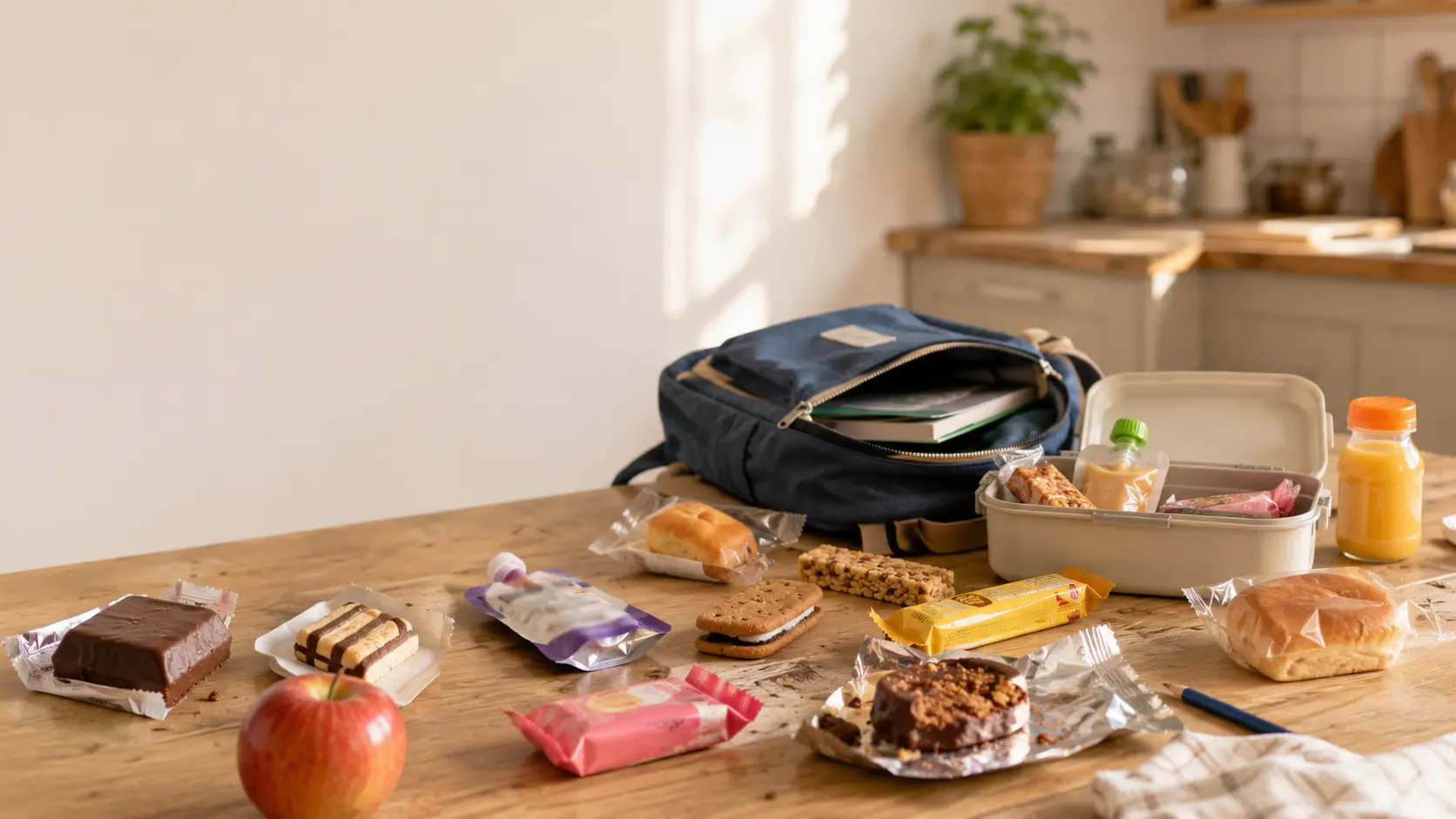

91.3% of packaged snacks for kids are ultra-processed: that's the finding of the investigation carried out by 60 Millions de Consommateurs, a French consumer magazine, together with the Yuka app in June 2026, covering 82 products from 35 brands. A genuinely healthy back-to-school snack, on the other hand, requires neither a big budget nor any particular baking talent — just knowing where to look.
Out of every ten snack packs that go into the cart at back-to-school time, nine belong in a factory more than in a kitchen. Frankly, this number stopped me in my tracks when I first came across it, and I'm not usually the type to get alarmed easily about these things.
The Number That Should Worry You (a Little, Not Too Much)
Let's take this calmly. The consumer association examined 82 kids' snacks — cookies, cereal bars, brioche, and milk bread rolls — from 35 brands, with Yuka as its technical partner. The verdict: 91.3% of these products are ultra-processed, meaning they contain what the investigation calls markers of ultra-processing: additives, processed sugars, artificial flavors, glucose-fructose syrups.
This isn't an isolated statistic. Ultra-processed foods already account for 46% of French children's daily energy intake, compared with 36% for their parents. Kids, in other words, eat proportionally even more ultra-processed food than adults do. This isn't a question of parental carelessness — it's a question of what's actually available on the shelf. The ultra-processed product is the norm there, not the exception.
For American readers, this isn't just a French phenomenon. According to the U.S. Centers for Disease Control and Prevention's National Center for Health Statistics, youth ages 1–18 got 61.9% of their daily calories from ultra-processed foods between August 2021 and August 2023 — compared with 53.0% for adults — with 6- to 11-year-olds topping the list at 64.8%. Sweet bakery products and savory snacks ranked among the top five sources, right alongside sandwiches and pizza. The exact numbers differ from the French investigation, but the pattern holds on both sides of the Atlantic: kids eat proportionally more ultra-processed food than their parents do, and snacks are a major reason why.
In detail, the worst offenders are, unsurprisingly, on the chocolate side: Kinder Délice, Kinder Country, and LU's Lulu chocolate snack tray all exceed 43 g of sugar per 100 g. Sophie Coisne, the magazine's deputy editor-in-chief, gives a telling example: with four Lulu chocolate trays, a 4-year-old already reaches their recommended daily sugar intake. LU's Napolitain, for its part, packs in 24 ingredients including 14 ultra-processing markers, plus potassium sorbate (E202), a preservative now under scrutiny for a possible increased risk of cancer and type 2 diabetes.
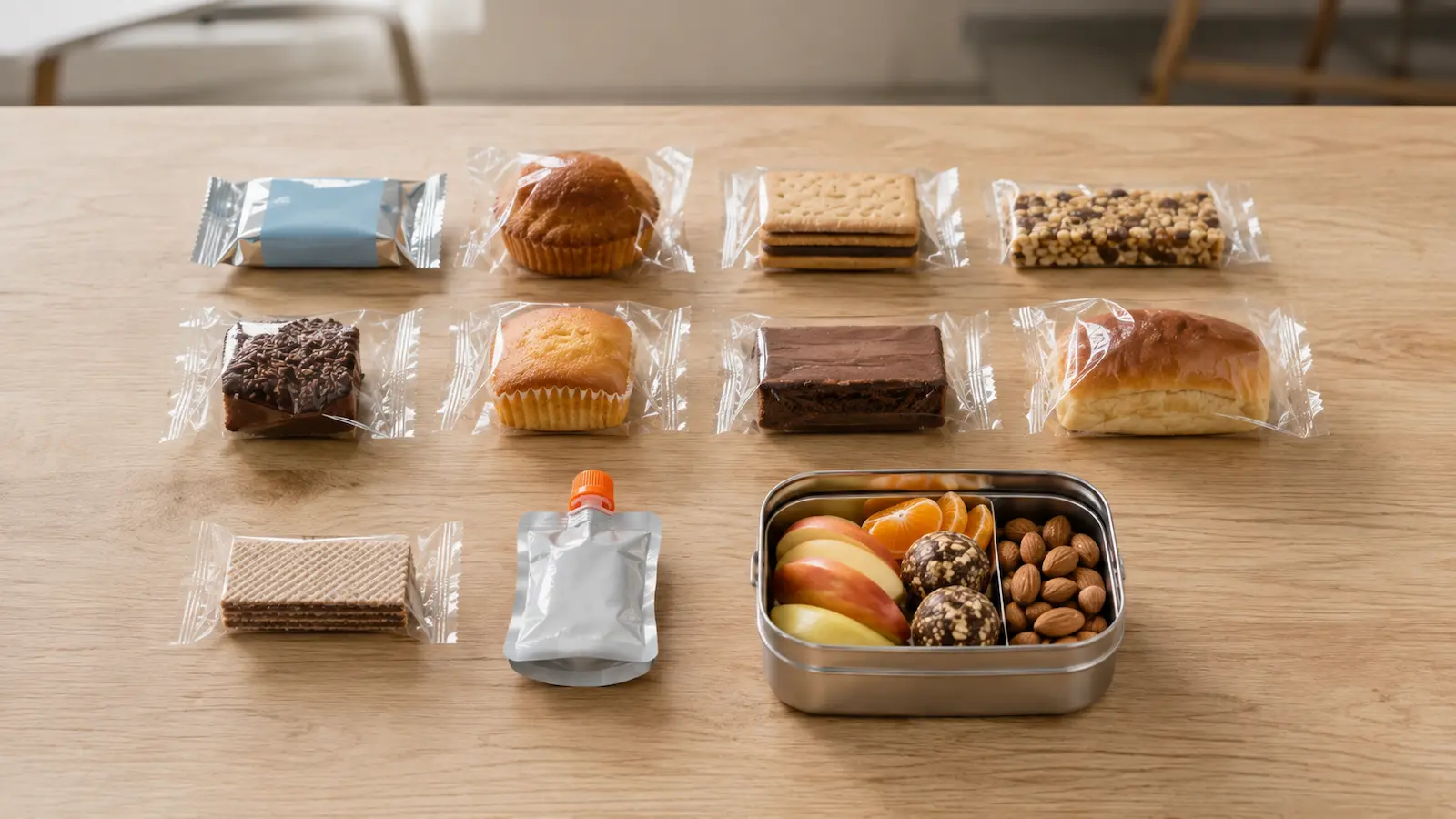
On the other hand, two categories save a bit of the industrial shelf's honor: plain dry biscuits (one product in two isn't ultra-processed, like La Mère Poulard's all-butter Sablé, with its five-ingredient list) and, above all, plain milk bread rolls, which the investigation crowns the "winners of the snack aisle" — two ultra-processing markers on average, and four times less sugar than a chocolate biscuit of equal weight.
That's the picture. Now, why does this actually matter, beyond the sugar content?
Why Ultra-Processing Is a Problem — and It's Not (Just) About Sugar
This is where a lot of parents aim at the wrong target. We check the sugar count on the label, assume a "reduced-sugar" or "no added sugar" product must be healthier, and miss the real issue: the degree of processing.
The Nova classification, now the reference standard in nutritional epidemiology, sorts foods into four groups by their degree of processing. Group 4 — "ultra-processed foods" — covers products made largely from ingredients used only in industrial food manufacturing: modified starches, isolated proteins, hydrogenated oils, combined with colorings, emulsifiers, flavorings, and other additives you simply wouldn't find in a home kitchen. ANSES, France's national food safety agency, relies on this same classification, while acknowledging that no fully consensual definition exists yet.
What the research shows is that the degree of processing matters independently of sugar or fat content. The large French NutriNet-Santé cohort, which has followed more than 100,000 people since 2009, allowed a team of researchers (Fiolet et al., published in the BMJ in 2018) to establish that a 10% increase in the share of ultra-processed foods in the diet is associated with roughly a 10% higher risk of cancer overall, and 12% for breast cancer specifically. This is an observational study, not proof of direct causation — it should be said plainly — but its consistency with other research on cardiovascular disease makes it a signal that's hard to ignore any longer.
In practice, here's what this changes about how you read a label: stop looking only at the sugar count. Flip the pack over and count the ingredients you'd never find in your own pantry — glucose-fructose syrup at the top of the list, maltodextrin, isolated chicory fiber, unspecified flavorings. A short ingredient list is still often the best indicator.
Healthy Snacks for Kids, in Practice: Three Ways to Get There
Enough diagnosis — let's get practical. In my experience as an ISTOM engineer and a practitioner of living, plant-based food for more than thirty years — and in the experience of the many parents who come to us at Biovie — there are three realistic ways to have a healthy snack for the school year, and they aren't mutually exclusive.
The first is homemade. It's the most economical and the most controllable option, but it takes a minimum of organization (more on that below, with a recipe that takes five minutes, no more).
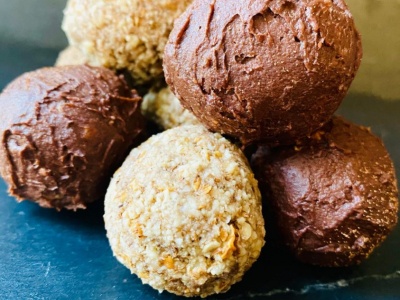
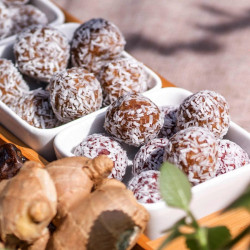
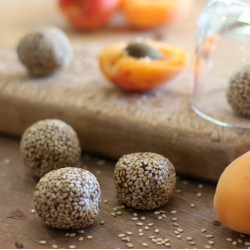
The second is to rely on genuine small-batch makers when homemade isn't possible that particular week. At Biovie, we've worked for several years with Up'N Mind, a small family business based in the Alpes-Maritimes region of France that makes raw, organic, vegan, and gluten-free energy balls. Their story is actually rather touching: it grew out of a real need to find a healthy, suitable diet for their own child. We carry them in three flavors — raspberry, ginger and almond, or apricot-acerola — in bags of 20 pieces made from dates, almonds, and cashews, with no added sugar beyond what's naturally present in the dried fruit. This is exactly the kind of product that should make up nine snacks out of ten on store shelves, and almost never does: few ingredients, all of them identifiable, nothing you couldn't reproduce at home given a bit more time.

What's the Real Budget Over a School Term?
This is the question I get asked most often, and rightly so: does "healthy" automatically mean "expensive"? Not necessarily, if you compare things properly.
A bag of 20 Up'N Mind energy balls costs €16.90, or roughly €0.85 per piece — for a portable, ready-anytime snack with a short, fully identifiable ingredient list. By comparison, a homemade energy ball, batch-prepped on a Sunday with dates, almonds, and a little coconut, comes out to under €0.50 per piece in organic ingredients.
Over a school term — call it about a dozen weeks — the real gap has less to do with the per-unit price than with frequency: a homemade snack once or twice a week, filled out with small-batch energy balls on days when time is short, rarely costs more than a steady habit of premium packaged snacks, while avoiding the buildup of additives. The real budget to plan for isn't the ingredients — it's Sunday evening's time. And unlike money, that can be scheduled.
The Recipe: 5-Minute No-Bake Homemade Energy Balls
No special equipment needed, and no high-end blender required. Here's the base recipe I make most often at home:
- 200 g pitted medjool dates
- 100 g almonds or cashews

- 2 tablespoons tiger nut milk or homemade hemp milk (as a binder, optional depending on texture)
€4.10
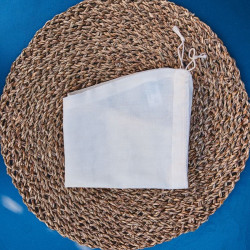
Nut milk bag
- A pinch of salt, a little shredded coconut for coating
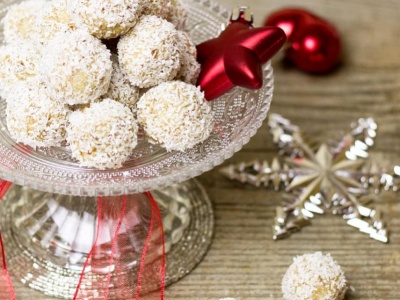
Blend everything until you get a smooth, cohesive dough. Shape into balls with your palms, roll them in the shredded coconut, and refrigerate for thirty minutes before serving. They keep for a good week in an airtight container — plenty to cover snacks through to the following weekend.
For a bit of variety, we've shared on the blog a version made with hemp oil, designed more for a calm afternoon, and a more indulgent coconut-lemon version, for a change from chocolate without losing any of the enjoyment.
One caution: this recipe contains tree nuts (almonds, cashews). If you have allergies, simply substitute with blended sunflower seeds.
The Sunday Night Routine: Fifteen Minutes That Last All Week
Beyond snacks specifically, I can't help sharing something that's been part of my life since I was 16: one of the tips I recommend most often for increasing the share of homemade food — and one that keeps coming up in the feedback we get — is to schedule your first batch of sprouted seeds for Sunday evening. You start your sprouter at the same time you're preparing dinner, and a week's worth of fresh sprouts is waiting for you (start another batch on Wednesday), without having to think about it every day.
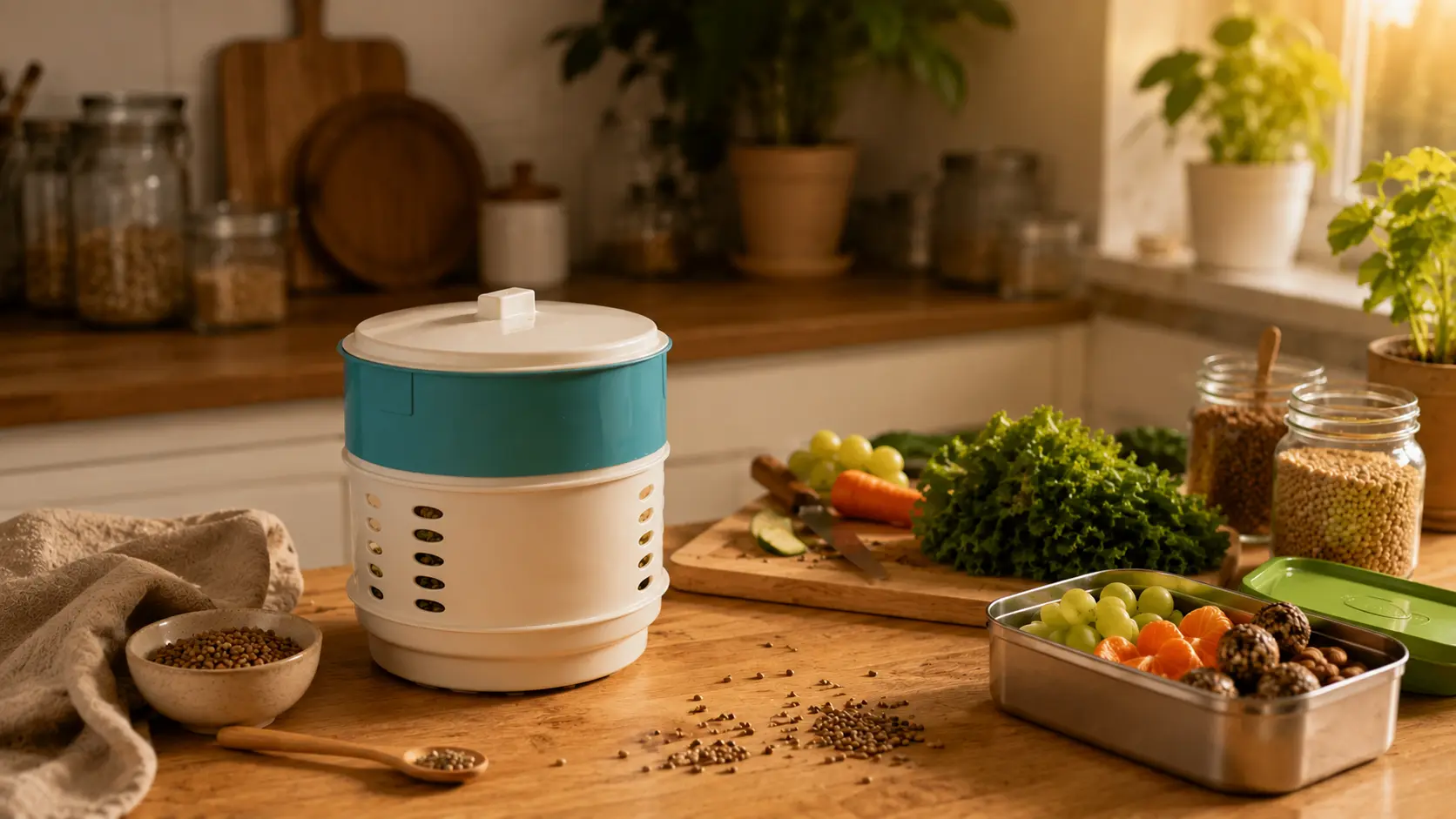
We offer more than 34 organic sprouting seed blends, including varieties especially suited to kids thanks to their mild flavor — sprouted leek seeds, a mild variety for children in particular, which takes about ten days to sprout and fits well into a weekly cycle. For this type of longer-cycle seed, a self-contained, multi-compartment sprouter is noticeably more practical than a classic tiered sprouter: you avoid repeated rinsing and can run several varieties in parallel.
€139.00
NEW SOIL SPROUTER!
Easygreen Sol autonomous sprouter

This one habit, on its own, won't turn an industrial snack into a gourmet meal. But added up over an entire school term, it changes the overall texture of your kids' diet — without them really noticing, which is probably the best way for it to actually stick.
FAQ — Your Questions About Healthy Snacks for Kids
What is the healthiest snack for a child?
According to the 60 Millions de Consommateurs × Yuka investigation, plain milk bread rolls come out on top among packaged options, with an average of just two ultra-processing markers. But homemade — fresh fruit, a homemade energy ball, a slice of bread with sprouted seeds — remains the safest bet, because you control every ingredient.
How do you make a healthy snack quickly, without spending hours on it?
Batch-prep a round of energy balls on Sunday evening (five minutes, no baking) for the whole week, and round it out with fresh fruit. It's the simplest combination to keep up over time.
What snack should you reach for at 4 p.m., when the afternoon slump hits?
A mix that combines slow-digesting carbohydrates (dates, dried fruit) with a bit of good-quality fat (almonds, cashews) avoids the energy spike followed by a crash, unlike a very sugary, low-fiber product.
Can a healthy snack also work for an adult who's watching their weight?
Yes, as long as you adjust the portions: one or two energy balls are plenty as a snack, without the fast sugar spike of very sweet packaged cookies.
What snack recipe won't make you gain weight?
No single food "makes you gain weight" on its own — it's excess and repetition that matter. As part of a varied and balanced diet, a homemade date-and-almond energy ball, eaten at a rate of two or three a day, remains a reasonable snack in terms of calorie density, especially compared with an industrial chocolate bar.
What is the lowest-calorie snack for a child?
Fresh fruit remains the lightest option. For something more substantial, a small handful of sprouted seeds on a slice of whole-grain bread provides micronutrients without excess calories.
In Brief
91.3% of the packaged snacks analyzed in June 2026 are ultra-processed, and kids already eat proportionally more of them than adults do — a pattern confirmed on the U.S. side too, where CDC data show youth getting nearly 62% of their daily calories from ultra-processed foods. The good news is that a healthy back-to-school snack requires neither a big budget nor any special talent: a Sunday-evening sprouting routine, a few small-batch energy balls in the pantry for busy days, and a five-minute homemade recipe are enough to shift the trend, without overhauling the rest of your family's diet.
References
- 60 Millions de Consommateurs & Yuka (2026). "Children's snacks investigation — special June–July 2026 issue." 82 products, 35 brands. French investigation, reported via Bourse Inside and ConsoGlobe, June 2026.
- Williams, A.M., Couch, C.A., Emmerich, S.D., & Ogburn, D.F. (2025). "Ultra-processed Food Consumption in Youth and Adults: United States, August 2021–August 2023". NCHS Data Brief No. 536. U.S. Centers for Disease Control and Prevention, National Center for Health Statistics.
- Fiolet, T., et al. (2018). "Consumption of ultra-processed foods and cancer risk: results from NutriNet-Santé prospective cohort". BMJ, 360, k322.
- ANSES (2022). "Opinion on ultra-processed foods". Referral No. 2022-SA-0155.
Last updated: August 2026. Article written and reviewed by Éric Viard, founder of Biovie since 2007 and ISTOM engineer, co-author of "Algues au quotidien" (Gallimard, 2024) — World's Best Cookbook, Gourmand Cookbook Awards 2025, and Best French Cookbook, Académie Nationale de Cuisine 2025.
The information presented in this article is provided for informational purposes only and does not constitute medical advice. Consult a healthcare professional before making any changes to your diet or supplementation. As part of a varied and balanced diet and a healthy lifestyle.