


Organic red Mizuna seeds to grow as microgreens
Organic red Mizuna seeds to grow as microgreens
Available in 15g or 250g
No queries yet, leave the first!
Price:
€2.19
Product availability:
In stock
Tax included

Organic red Mizuna seeds to grow as microgreens images

Organic red Mizuna seeds to grow as microgreens
Red mizuna (Brassica rapa var. nipposinica) is the colourful sister of traditional Japanese green mizuna. Like it, it belongs to the Brassicaceae family (the Crucifers) and to the species Brassica rapa, the same as turnip, pak choi or Chinese cabbage. The name 水菜 (mi-zuna) literally means "water vegetable" in Japanese, referring to its origin in the wetlands of the Kyoto region. The red version, more recent than the green, is now particularly prized by chefs and microgreen enthusiasts for its double asset: dramatic colour and assertive flavour.
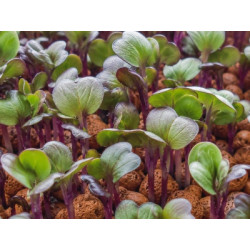
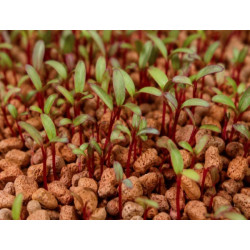
🌱 What sets it apart is its dual character. Visually, the leaves are finely cut, purple-green, with red veins that stand out elegantly. The colour is most intense on the underside of the leaves and the young stems - dramatic effect guaranteed. In terms of taste, the flavour is spicier and more pronounced than green mizuna, in the rocket register. It is the mizuna you choose when you are looking for character, zing, contrast. For those who like a bit of a kick.
In practice, it goes wonderfully with raw Japanese salads such as sunomono with a spicy touch (cucumber, daikon, raw young ginger), fresh seaweed salads (wakame, dulse, crumbled nori) where it is back on home ground, raw Asian-style bowls (cucumber, avocado, seaweed, black sesame), raw "plant-based ponzu" style sauces (tamari, lime or yuzu, fresh ginger), spicy raw maki (nori, avocado, ginger, microgreens), vegetable tartares with sesame and sweet chilli, avocado toasts for a peppery, colourful touch, or green smoothies where the heat gives a pleasant wake-up call. A few fresh shoots just before serving, and the dish instantly takes on a spicy and visually spectacular dimension.
Harvest at : 5 to 7 cm tall
Cycle : 6 to 10 days (quick harvest!)
Quantity per tray : 8 to 9 g of seeds
🌱 How to grow your red mizuna microgreens at home?
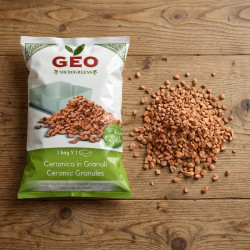
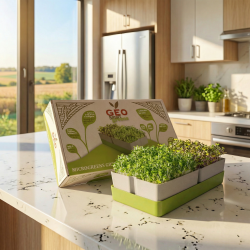
Microgreens are grown on a light, well-draining substrate, and not by mist watering like classic sprouted seeds. For an optimal, repeatable result, we recommend our GEO Smart Greens sprouter from Geo Bavicchi combined with GEO ceramic granules (100% natural, reusable substrate).
🌱 The principle is simple:
- Pour the ceramic granules into the perforated growing tray.
- Spread 8 to 9 g of red mizuna seeds evenly over the surface, without pressing them in. Good news: no soaking needed for Brassicaceae seeds, which are small and germinate easily.
- On the first day, spray generously with water to hydrate the seeds well.
- Place the tray in a bright spot, out of direct sunlight.
- Then pour water into the lower tray: thanks to bottom watering, the substrate absorbs moisture by capillary action, without drowning the shoots or encouraging mould.
- Keep an eye on surface moisture (an extra spray if the air is dry).
- Harvest with scissors as soon as your shoots reach 5 to 7 cm. It's ready - and it's quick: just 6 to 10 days.
🌱 The advantages of the ceramic granule substrate: a porous structure that holds just the right amount of water, very little water used, a clean environment, no potting soil messing up the kitchen, and above all 100% natural and reusable from one crop to the next.
🌱 Discover our 8 varieties of microgreens
We offer a complete range of organic seeds to grow as microgreens, carefully selected from Geo Bavicchi. From aromatic flavours to spicy ones, via mild and earthy flavours, here is the complete list of varieties available in our Biovie catalogue:
| Variety | Shoot colour | Dominant flavour |
|---|---|---|
| Dill (Dill) |
Light green, thin stems | Aniseed, fresh |
| Red chard (Ruby Red Chard) |
Purple stems, green cotyledons | Mild, slightly earthy |
| Chioggia chard | Pale pink striped stems, green cotyledons | Mild, subtle |
| Bull's Blood red beetroot | Burgundy red, intense purple | Earthy, mild, sweet |
| Purple kohlrabi | Purple stems, green cotyledons | Mild, like raw cabbage |
| Green mizuna | Light green, serrated | Slightly spicy, mustardy |
| Red mizuna | Red-green serrated | Spicier, like rocket |
| Tatsoi | Glossy dark green, spoon-shaped | Mild, like spinach |
All our varieties are organic, guaranteed with a germination rate above 95%, and selected from Geo Bavicchi in Perugia, Umbria.
🌱 Below is a behind-the-scenes video at our supplier Geo Bavicchi:
🌱 And the interview we had the pleasure of filming with Dario Bavicchi, who embodies the third generation of this Italian family business founded in 1896:
🌱 What do red mizuna microgreens contain?
Frankly, what struck me when I looked into this variety is that it combines two signatures: the sulphur compounds characteristic of the Brassicaceae (the large Crucifer family), and the anthocyanin pigments that give it its purple colour. It is a bit as if it brought together in a single small shoot the characteristics of cabbage and those of red cabbage.
The diversity of varieties available - dill, chard, beetroot, kohlrabi, mizuna, tatsoi… - offers varied flavours and nutritional profiles, perfect for enriching a living-food diet every day.
- Presence of glucosinolates. Red mizuna microgreens contain glucosinolates, sulphur compounds characteristic of the Brassicaceae family. These are the compounds that give red mizuna its spicy, mustardy flavour typical of crucifers, here more pronounced than in green mizuna.
- Presence of anthocyanins. The purple colour of the veins and stems comes from anthocyanins, plant pigments also found in red cabbage, aubergine, black grapes and blueberries. Not to be confused with the betalains responsible for the red of beetroot - chemically, they are two different families of pigments.
- Presence of chlorophylls and carotenoids. Like all young green shoots, red mizuna microgreens contain plant pigments - chlorophylls, carotenoids - characteristic of fresh, living foods.
There you have it. To my mind, the decisive argument is the idea that a spoonful of freshly cut shoots reaches your plate with no processing, no cooking, no transport. You harvest, you cut, you eat. That is the very definition of living food. And with red mizuna, you add to that the spicy character and purple colour that wake up a dish effortlessly.
Please note: like all Brassicaceae (cabbages, broccoli, radish, turnip…), mizuna contains compounds called "goitrogens" which, when eaten raw in very large quantities, can interfere with iodine absorption. For consumption at the microgreen stage (a few shoots per dish), no particular restriction is documented. People with thyroid disorders can simply moderate very regular consumption of raw crucifers.
🌱 To go further on growing young shoots at home, see our blog articles:
Best before: 30/04/2029
- Packaging : available in a doypack of 15 g (about 1 crop) or 200 g (economy size, about 22 to 25 crops)
- Best before : 3 years after the production date
- Origin : seeds selected and packaged in Italy by Geo Bavicchi (Perugia, Umbria), a family business specialising in sprouting seeds since 1896, certified organic. Mizuna is a traditional Japanese variety originating from the Kyoto region.
- Botanical variety : Brassica rapa var. nipposinica, selection with purple pigmentation (Brassicaceae family)
- Guaranteed germination rate : above 95% (each batch tested before sale)
- Storage : away from light, in a cool, dry place
🌱 Packaging quality that matches the quality of the seeds: all our bags are made from materials certified for food contact, moisture-resistant, and show the best-before date, the weight and the production batch number - for complete traceability. The instructions are printed in five languages: Italian, English, French, German and Spanish.
🌱 Frequently asked questions about red mizuna microgreens
What is the difference between red mizuna and green mizuna?
Both varieties belong to the same botanical species (Brassica rapa var. nipposinica), but they differ in colour and intensity of flavour. Green mizuna has uniform soft green foliage and a mild, balanced flavour, in the "mild mustard" register. Red mizuna has purple-tinted leaves - thanks to anthocyanins, the pigments also found in red cabbage and blueberries - and a spicier, more pronounced flavour, in the rocket register. Visually, one is zen and soothing, the other more dramatic. In terms of growing, the process is identical: 6 to 10 days, 8 to 9 g of seeds per tray, no soaking.
Why are the leaves purple?
The purple colour of the leaves and veins comes from anthocyanins, plant pigments also found in red cabbage, aubergine, black grapes and blueberries. Not to be confused with the betalains responsible for the red of beetroot - chemically, they are two different families of pigments, even if the visual effect may look similar. In red mizuna, the colour is most intense on the underside of the leaves and the young stems, and deepens with good light exposure.
What exactly is mizuna?
Mizuna is a traditional Japanese vegetable plant (Brassica rapa var. nipposinica) grown for centuries in the Kyoto region. Its name 水菜 literally means "water vegetable" in Japanese. Botanically, it belongs to the large Brassicaceae family (the Crucifers), like mustard, radish, cabbage or turnip - and more precisely to the species Brassica rapa, the same as turnip, pak choi and Chinese cabbage. The red version we offer here is a modern selection that pushes visual and taste expressiveness even further.
What is the difference between sprouted seeds and red mizuna microgreens?
Sprouted seeds are harvested very early (2 to 5 days), at the rootlet stage, and are grown in a jar or sprouter with daily rinsing. Microgreens go further: they are harvested at the cotyledon stage (the first embryonic leaves), between 6 and 10 days for red mizuna, and only the aerial part, cut with scissors, is eaten. They are grown on a light substrate - in our case, 100% natural ceramic granules. And with red mizuna as microgreens, you get as a bonus that vivid purple hue and spicy flavour that the sprouted seed does not reveal.
How many red mizuna seeds for one tray?
Allow about 8 to 9 g of seeds for a standard tray of the GEO Smart Greenssprouter. The 15 g bag therefore gives you 1 crop, and the 200 g size about 22 to 25 crops - enough to have fresh red mizuna microgreens continuously for more than five months.
How long does it take to harvest red mizuna microgreens?
In practice, allow 6 to 10 days between sowing and harvest. It is one of the quickest harvests in our selection - the Brassicaceae (mizuna, kohlrabi, radish, broccoli, mustard) generally have a shorter cycle than the Amaranthaceae (chards and beetroots), which need 10 to 14 days. Harvest when the shoots reach 5 to 7 cm. If you want fresh spicy microgreens quickly, red mizuna is an excellent variety to go for.
Do red mizuna seeds need soaking before sowing?
No, it isn't necessary. Unlike chard or beetroot seeds (which are hard seed clusters requiring several hours of soaking), mizuna seeds are small, smooth and germinate quickly without any special preparation. Pour them straight onto the substrate, spray generously on the first day, and off you go.
Can red mizuna seeds be grown in an Easygreen Light or Sol sprouter?
For microgreens, it isn't ideal. Easygreen sprouters are perfect for classic sprouted seeds (alfalfa, broccoli, lentils, fenugreek...) grown by misting or siphon effect, without substrate. Microgreens, on the other hand, need to be grown on a substrate with bottom watering. That is precisely the function of the GEO Smart Greenssprouter, designed for this process.
Is the ceramic granule substrate really reusable?
Yes, it is one of its big assets. After harvest, you remove the roots, rinse the granules in clean water, and you can start a new crop. The porous structure of the ceramic keeps its absorption capacity over the cycles - up to 5 reuses recommended by Bavicchi. It is frankly more eco-friendly than a single-use peat or coir type substrate.
How do I store my red mizuna microgreens after harvest?
Ideally, cut them just before serving - that way you get all their freshness, vivid colour and crunch. If you need to store them, put them in the fridge in an airtight box between two sheets of kitchen paper. They keep 3 to 4 days, but their flavour and colour are at their best in the first 24 hours.
How do I add red mizuna microgreens to my everyday dishes?
A few concrete ideas we use at home with Aurélie: in a raw Japanese sunomono-style salad with daikon or raw ginger; in a fresh seaweed salad such as rehydrated wakame or dulse - mizuna is back on home ground there; in a raw Asian-style bowl (cucumber, avocado, seaweed, black sesame, lime); in a raw "plant-based ponzu" style sauce (tamari, yuzu or lime juice, fresh ginger); on an avocado toast sprinkled with gomasio (on sourdough bread or seed crackers); in a raw maki (nori roll filled with avocado, fresh ginger, microgreens); on a vegetable tartare with sesame and sweet chilli; as a garnish on a homemade black sesame hummus; or as a topping on a green smoothie for the spicy touch that wakes it up. Always add at the end of preparation, raw, to preserve the aromas and the brightness of the purple colour.
🌱 Notes for your first crops:
- Red mizuna likes light but hates scorching direct sun. A well-lit kitchen does the job perfectly. Good to know: the purple hue intensifies with good light exposure - a shoot grown in the shade will be paler than one grown in indirect light.
- Moisture must be constant but never excessive. That is the whole point of the bottom watering of the GEO Smart Greens sprouter: the substrate absorbs just what it needs.
- No need to pre-soak the seeds, a practical asset of this variety.
- The spicy flavour of red mizuna becomes more assertive with light - a well-lit shoot will have a more pronounced taste than one grown in the shade.
- If you see mould appearing (rare with this system), it is usually a sign of too much water or not enough ventilation. Adjust and it picks up again.
Disclaimer: the information presented in this product sheet is provided for information purposes only and does not constitute medical advice. Consult a qualified health professional before making any changes to your diet or supplementation. As part of a varied and balanced diet and a healthy lifestyle.
Updated: May 2026. Article validated by Éric Viard, founder of Biovie and ISTOMengineer, co-author of "Algues au quotidien" (Gallimard, 2024) - Best cookbook in the world, Gourmand Cookbook Awards 2025, and Best cookbook in France, Académie Nationale de Cuisine 2025.
The documents that back up what we write about this product. Every document is dated; we remove those that are no longer valid.
Biovie organic certificate
Valid until 31/03/2027Bavicchi organic certificate
Valid until 02/12/2028Wondering… ?
Everything you need to know before ordering.
Be the first to ask a question about this product!
Question about the product
Ask a question