


Organic dill seeds to grow as microgreens
Organic Dill Seeds to Grow as Microgreens
Available in 15g or 150g
No queries yet, leave the first!
Price:
€6.01
Product availability:
Last items in stock
Tax included


Organic dill seeds to grow as microgreens images


Organic Dill seeds to grow as microgreens
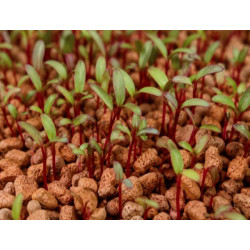
Dill (Anethum graveolens) is an aromatic herb of the Apiaceae family, native to the Mediterranean basin and grown since Antiquity. As microgreens, it is a different story from the dried dill in your cupboard: the young shoot is harvested at the cotyledon stage, where the plant concentrates its aromas.
🌱 Its flavour is delicate, slightly aniseed and fresh, with that green edge reminiscent of fennel. In practice, it goes wonderfully with thinly sliced raw cucumber, mashed avocado, fresh seaweed salads (wakame, dulse, samphire), raw soups made with courgette or cucumber, cold-pressed green juices, raw sauces made with plant yoghurt and lemon, or finely chopped vegetable tartares. A few fresh shoots just before serving, and the dish takes on another dimension.
Harvest at : 5 to 7 cm tall
Cycle : 10 to 14 days
Amount per tray : 8 to 9 g of seeds
🌱 How to grow your dill microgreens at home?
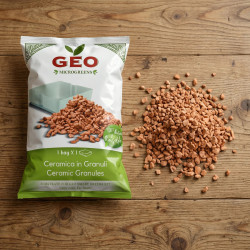
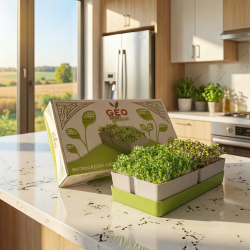
Microgreens are grown on a light, well-draining substrate, and not by mist watering like classic sprouted seeds. For an optimal and repeatable result, we recommend our GEO Smart Greens sprouter from Geo Bavicchi combined with the GEO ceramic granules (100% natural and reusable substrate).
🌱 The principle is simple:
- Pour the ceramic granules into the perforated growing tray.
- Spread 8 to 9 g of dill seeds evenly over the surface, without pressing them in.
- On the first day, spray generously with water to hydrate the seeds well.
- Place the tray in a bright spot, out of direct sunlight.
- Then pour the water into the lower tray: thanks to bottom watering, the substrate absorbs moisture by capillary action, without drowning the shoots or encouraging mould.
- Keep an eye on surface moisture (use a spray bottle as a top-up if the air is dry).
- Harvest with scissors as soon as your shoots reach 5 to 7 cm. It's ready.
🌱 The advantages of the ceramic granule substrate: a porous structure that holds just the right amount of water, very little water used, a clean environment, no potting soil messing up the kitchen, and above all 100% natural and reusable from one crop to the next.
🌱 Discover our 8 varieties of microgreens
We offer a complete range of organic seeds to grow as microgreens, carefully selected from Geo Bavicchi. From aromatic flavours to peppery flavours by way of mild and earthy flavours, here is the complete list of varieties available in our Biovie catalogue:
| Variety | Shoot colour | Dominant flavour |
|---|---|---|
| Dill (Dill) |
Light green, thin stems | Aniseed, fresh |
| Red chard (Ruby Red Chard) |
Purple stems, green cotyledons | Mild, slightly earthy |
| Chioggia chard | Pale pink striped stems, green cotyledons | Mild, subtle |
| Bull's Blood red beetroot | Burgundy red, intense purple | Earthy, mild, sweet |
| Purple kohlrabi | Purple stems, green cotyledons | Mild, raw cabbage-like |
| Green mizuna | Light green, serrated | Slightly peppery, mustardy |
| Red mizuna | Red-green, serrated | More peppery, rocket-like |
| Tatsoi | Glossy dark green, spoon-shaped | Mild, spinach-like |
All our varieties are organic, guaranteed with a germination rate above 95%, and selected from Geo Bavicchi in Perugia, Umbria.
🌱 Below is a behind-the-scenes video from our supplier Geo Bavicchi:
🌱 And the interview we had the pleasure of filming with Dario Bavicchi, who embodies the third generation of this Italian family company founded in 1896:
🌱 What do dill microgreens contain?
Frankly, what surprised me the first time I dug into the subject was the gap between the mature plant and the young shoot. Dill microgreens are harvested at the cotyledon stage, that is, when the seed has just released its reserves, and are eaten raw, perfectly suited to living food.
The diversity of available varieties - dill, radish, broccoli, rocket, mustard, basil, sunflower… - offers varied flavours, perfect for everyday living food.
- Presence of carotenoids and chlorophylls. Like all young green shoots, dill microgreens contain plant pigments - chlorophylls, carotenoids - characteristic of fresh, living foods.
There you have it. In my eyes, the decisive argument is not some particular "superpower"; it is rather the idea that a spoonful of freshly cut shoots ends up on your plate with no processing, no cooking, no transport. You harvest, you cut, you eat. That is the very definition of living food.
Please note: eating dill in very large quantities is traditionally not recommended during pregnancy. For use as a condiment (a few shoots per dish), no particular restriction is documented.
🌱 To go further on growing young shoots at home, read our blog articles:
Best before: 30/04/2029
- Packaging : available in a doypack of 15 g (about 1 crop) or 150 g (economy size, around 16 to 18 crops)
- Best before : 3 years after the production date
- Origin : Italy - Geo Bavicchi supply chain (Perugia, Umbria), a family company specialising in sprouting seeds since 1896, certified organic
- Botanical variety : Anethum graveolens L. (Apiaceae family)
- Guaranteed germination rate : above 95% (every batch tested before sale)
- Storage : away from light, in a dry, cool place
🌱 Packaging quality to match the quality of the seeds: all our bags are made from materials certified for food contact, moisture-resistant, and show the best-before date, the weight and the production batch number - for complete traceability. The instructions are printed in five languages: Italian, English, French, German and Spanish.
🌱 Frequently asked questions about dill microgreens
What is the difference between sprouted seeds and dill microgreens?
Sprouted seeds are harvested very early (2 to 5 days), at the rootlet stage, and are grown in a jar or a sprouter with daily rinsing. Microgreens go further: they are harvested at the cotyledon stage (the first embryonic leaves), between 10 and 14 days for dill, and only the aerial part, cut with scissors, is eaten. They are grown on a light substrate - in our case, 100% natural ceramic granules.
How many dill seeds for one tray?
Allow around 8 to 9 g of seeds for a standard tray of the GEO Smart Greenssprouter. The 15 g bag therefore gives you 1 crop, and the 150 g size around 16 to 18 crops - enough to have fresh dill microgreens continuously for several months.
How long does it take to harvest dill microgreens?
In practice, allow 10 to 14 days between sowing and harvest. Dill is a little slower than rocket or radish (which are harvested in 6 to 8 days), but the wait is worth it for that so characteristic aniseed flavour. Harvest when the shoots reach 5 to 7 cm.
Can you grow dill seeds in an Easygreen Light or Sol sprouter?
For microgreens, it is not ideal. Easygreen sprouters are perfect for classic sprouted seeds (alfalfa, broccoli, lentils, fenugreek...) which are grown by misting or siphon effect, without substrate. Microgreens, on the other hand, need to be grown on a substrate with bottom watering. That is precisely the function of the GEO Smart Greenssprouter, designed for this process.
Is the ceramic granule substrate really reusable?
Yes, that is one of its big assets. After harvesting, you remove the roots, rinse the granules in clean water, and you can start a new crop. The porous structure of the ceramic keeps its water-absorbing capacity over the cycles. It is frankly more eco-friendly than a single-use peat or coir type substrate.
How do I store my dill microgreens after harvesting?
Ideally, cut them just before serving - that way you get all their freshness. If you need to store them, put them in the fridge in an airtight box between two sheets of kitchen paper. They keep for 3 to 4 days, but their flavour is at its best in the first 24 hours.
How do I work dill microgreens into my everyday dishes?
A few concrete ideas we use at home with Aurélie: on avocado toast or seed crackers, in a raw cucumber salad with lemon plant yoghurt, to finish a raw courgette or cucumber soup, on a finely chopped vegetable tartare, in a fresh seaweed salad such as rehydrated wakame or dulse, as a garnish for a home-made seaweed hummus, or simply in a cold-pressed green juice for a burst of aromatic freshness. Always add at the end of preparation, raw, to preserve the aromas.
🌱 Notes for your first crops:
- Dill likes light but hates scorching direct sun. A well-lit kitchen does the job perfectly.
- Moisture must be constant but never excessive. That is the whole point of the bottom watering of the GEO Smart Greens sprouter: the substrate absorbs just what it needs.
- If you see mould appearing (rare with this system), it is generally a sign of too much water or not enough ventilation. Adjust and off it goes again.
Disclaimer: the information presented on this page is provided for information purposes only and does not constitute medical advice. Consult a qualified health professional before making any change to your diet or supplementation. As part of a varied and balanced diet and a healthy lifestyle.
Updated: May 2026. Article approved by Éric Viard, founder of Biovie and ISTOM, co-author of "Algues au quotidien" (Gallimard, 2024) - Best Cookbook in the World, Gourmand Cookbook Awards 2025, and Best Cookbook in France, Académie Nationale de Cuisine 2025.
The documents that back up what we write about this product. Every document is dated; we remove those that are no longer valid.
Biovie organic certificate
Valid until 31/03/2027Bavicchi organic certificate
Valid until 02/12/2028Wondering… ?
Everything you need to know before ordering.
Be the first to ask a question about this product!
Question about the product
Ask a question