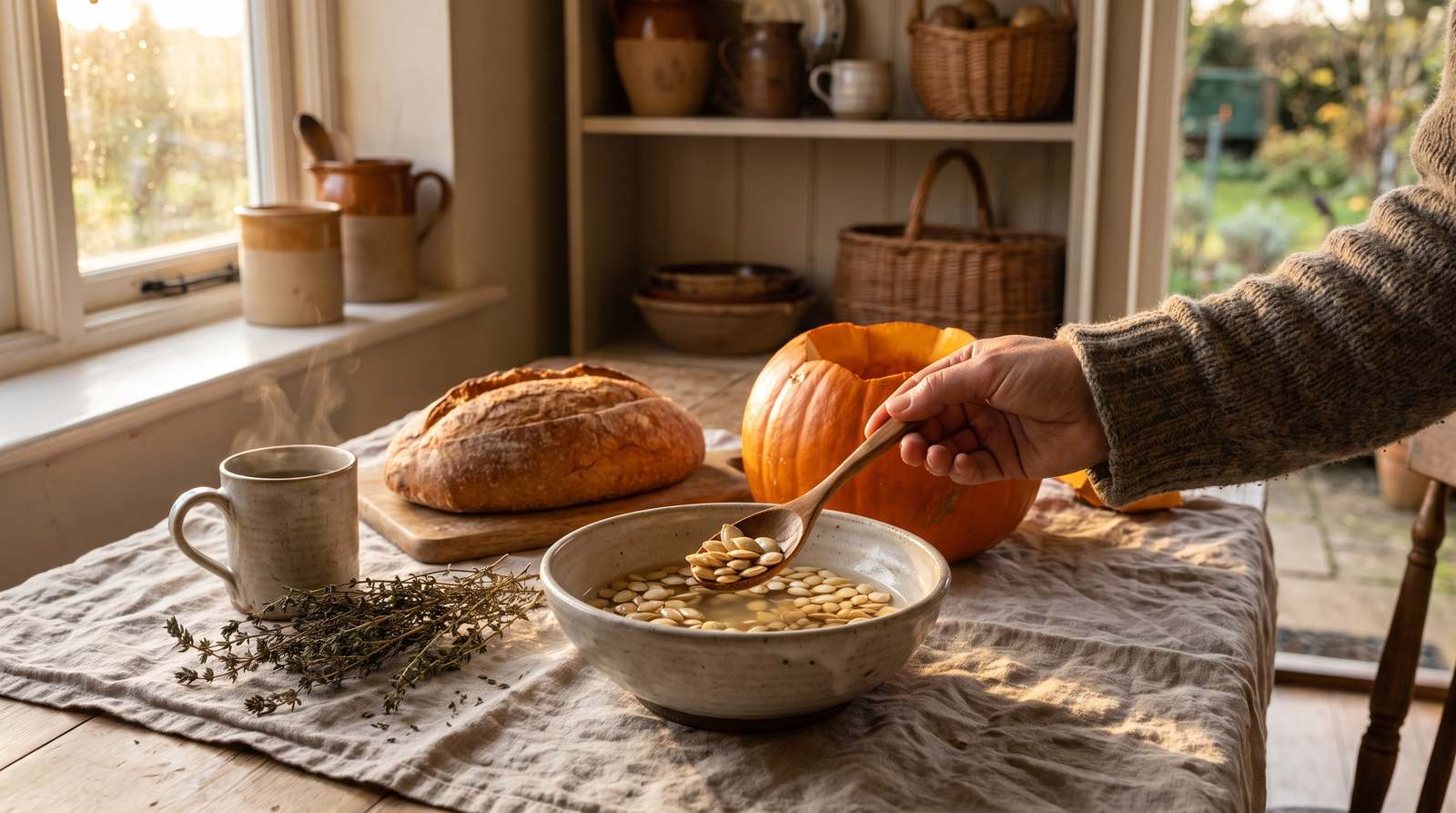
At the end of October the Halloween pumpkin gets hollowed out and its seeds go straight in the bin: so what to do with pumpkin seeds after carving? Rinse them, dry them at low temperature and keep them dry in a jar, or sprout them with strict hygiene, provided they come from an edible squash with non-bitter flesh. The pointers below draw on ANSES, EFSA, the French Ministry of Agriculture and the USDA composition tables.
The gesture is almost automatic. You scoop with a spoon, fill a bowl with stringy pulp and slimy seeds, then it all heads to the compost (often with a small pang, because you can tell there was something good in there).
I am an ISTOM engineer by training, vegan since 1992, and I have been practicing living food since the early 2000s. To me a seed remains a living being waiting for its moment to become a whole plant, and I am always amazed by that program of life. So here is my answer to the question "what to do with pumpkin seeds", from the pumpkin to the jar, with this year's safety update.
Which pumpkins and squashes have edible seeds?
Before rinsing anything, look at where your squash comes from. Ornamental gourds and decorative squashes are all toxic and must not be eaten, seeds included, ANSES points out.
In the vegetable garden, hybridization can make the flesh bitter, and the substances responsible, cucurbitacins, survive cooking. The check is simple: taste a small piece of raw flesh. If it is bitter, spit it out and throw away the whole squash, seeds included.
Poison control centers recorded 353 people with symptoms from 2012 to 2016: none was in life-threatening danger, and 4% had symptoms of moderate severity. In practice, it remains rare, but common enough to justify a quick tasting before you hollow anything out. The bitter squash came from the family vegetable garden in 54% of cases, and from a shop in 46%. Who would have thought the garden would come ahead of the supermarket?
Pumpkin, red kuri squash, butternut or any pumpkin from the food aisle: yes. Squash from the decoration aisle: never. And if you are wondering what to do with butternut squash seeds, the answer is the same as for pumpkin or red kuri seeds.
What to do with pumpkin seeds: the 5 steps to make them edible
Here is what to do with fresh pumpkin seeds, step by step.
- Scoop the seeds out with a spoon, strands included.
- Drop everything into a bowl of water and separate the seeds from the pulp by hand.
- Rinse them in a colander.
- Pat them dry in a clean tea towel, rubbing gently until they no longer stick to your fingers.
- Dry them at low temperature, then keep them dry in a closed jar, ideally vacuum-sealed.
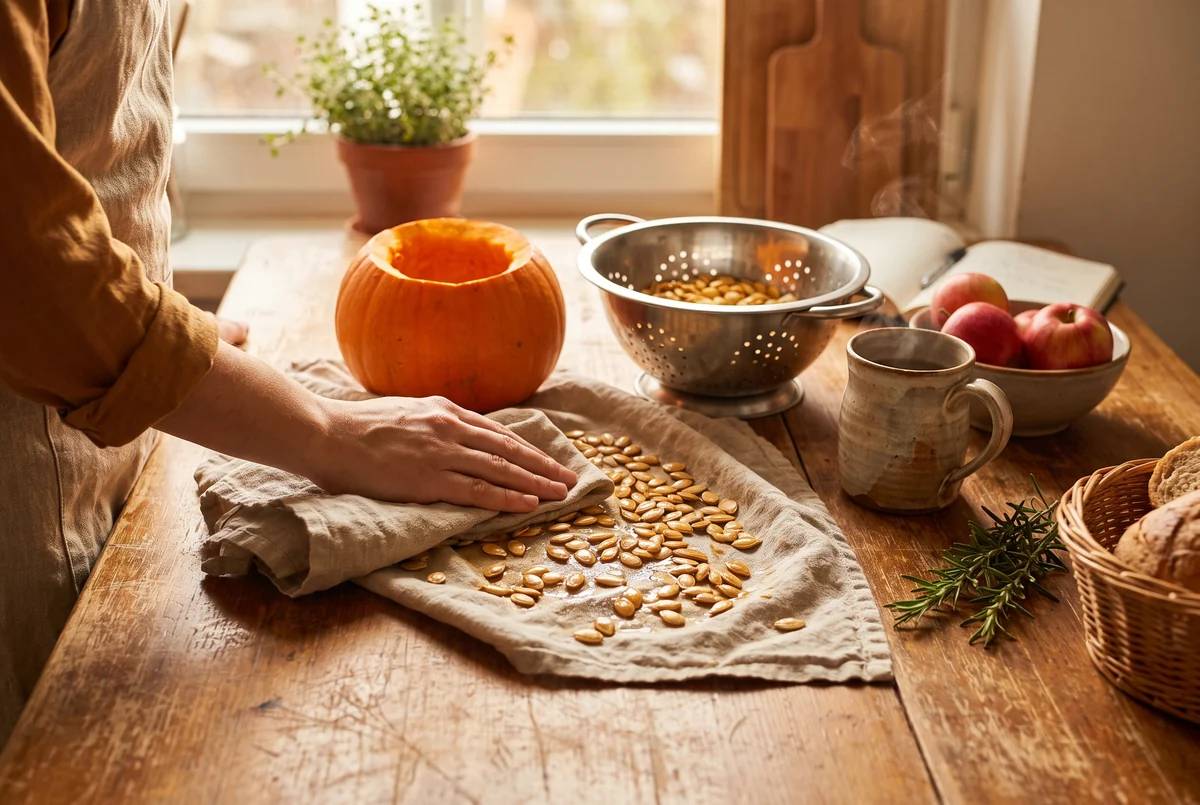
Why go through water? Because the seeds float and the pulp sinks: stir by hand and the sorting almost does itself. Making pumpkin seeds edible starts with this sorting, because pulp left stuck to them holds moisture.
Patting them dry is no detail either. Every drop removed with the towel is less moisture for mold.
Honestly, no reliable source sets a time or a temperature for home use, so I would rather give you signs: a properly dry seed sounds dry when it drops into a bowl, and its shell turns brittle under your fingernail. As long as it bends, it is not ready. Once they are dry, you still have to decide what to do with pumpkin seeds: keep them in a jar or sprout them.
Dry at low temperature rather than roast
Drying means removing water; roasting means cooking. The image I like is laundry: drying is hanging it on the line, and roasting is ironing it until it scorches.
Dried at low temperature in the sun, in a dehydrator or in an oven set to its lowest setting with the door slightly open (below 50 °C), the seeds stay whole, keep their hazelnut-like taste and can still sprout. Roasted, they will no longer sprout. So if you are wondering what to do with raw pumpkin seeds: dry them gently and they remain raw.
That leaves the exact temperature, and how to dry pumpkin seeds properly. Cooking sites contradict each other, from 50 to 180 °C, without citing any source. In reality, they are not aiming for the same result: at 180 °C you roast for snacking, at the lowest setting you dry to store or sprout.
The useful benchmark comes from composition tables: a dried pumpkin seed kernel contains only 5.23 g of water per 100 g (USDA FoodData Central). In other words, the seed should snap cleanly under the tooth, not bend.
That is, by the way, the principle of activated buckwheat seeds: soaked, then dried at low temperature, they stay raw. And if you like preserving the season's harvest for winter, these seeds belong next to the summer jars.
Whole seed or shelled kernel: what you are really eating
From one site to the next, fiber or protein contents vary by a factor of two. Nobody is really wrong. The shell changes everything: the figures do not describe the same food depending on whether you weigh the whole seed or the shelled kernel.
| Per 100 g | Dried kernel (shelled) | Whole roasted seed, unsalted (with shell) |
|---|---|---|
| Energy | 559 kcal | 446 kcal |
| Protein | 30.2 g | 18.6 g |
| Fat | 49.0 g | 19.4 g |
| Fiber | 6.0 g | 18.4 g |
| Iron | 8.82 mg | 3.31 mg |
| Magnesium | 592 mg | 262 mg |
| Zinc | 7.81 mg | 10.3 mg |
The shell is very fibrous: 18.4 g of fiber per 100 g of whole roasted seed, against 6.0 g for the dried kernel (USDA FoodData Central). By taking up room in the 100 g, it mechanically dilutes the protein and the fat. It is a bit like weighing walnuts with or without their shells: the content does not change, but the scale tells a different story. These are American data from 2019, on two different products: keep orders of magnitude in mind rather than values to the nearest milligram.
On the practical side, the classic pumpkin seed is eaten with its shell, crunchy and fibrous, or shelled by hand (a real exercise in patience, I warn you). Some squashes, known as "hull-less", give seeds directly without a hard shell. As part of a varied and balanced diet and a healthy lifestyle, these seeds are simply added to a salad or a soup, off the heat.
How to store dried pumpkin seeds?
A pumpkin seed kernel contains 49.0 g of fat per 100 g (USDA FoodData Central). In plain terms, nearly half its weight is fat, which fears heat, light and air, like a bottle of oil forgotten in the sun.
To store pumpkin seeds, one rule: an airtight jar in a cool, dark cupboard. One still-damp seed in a closed jar, and the whole jar may go moldy. Close the lid only when the seeds are perfectly dry.
The closed jar protects against moisture, not against the air it contains. Yet oxygen is exactly what turns this fat rancid. The simplest solution is vacuum sealing, and you do not need a machine for that: with the BocUp kit, you remove the air from your reused jars in a few seconds, with a bell and a small manual pump. The empty jam jar lying around in your cupboard will do, as long as it has "shoulders", that bulge under the lid, and a 65 or 84 mm lid. No electricity, no plastic bag, and you can reopen and re-seal the jar after each handful you take. Vacuum-sealed seeds are also safe from pantry moths, which matters when you keep your harvest for several months.
A vacuum does not rescue a poorly dried seed, though: it does not sterilize and does not replace a cool cupboard. For the rest of the kitchen, I have detailed the benefits of vacuum sealing at home in a dedicated article.
If in doubt, trust your senses, which tell you far more than a date scribbled on the jar lid. A rancid smell or a trace of mold: throw it out. A bitter taste too, no discussion.
Properly stored, the seed stays alive and then joins all the seeds you can sprout.
2026 salmonellosis: seeds from your pumpkin or a store-bought batch, what changes
On 4 September 2026, the French Ministry of Agriculture announced 81 clustered cases of salmonellosis linked to a single strain of Salmonella Enteritidis, isolated between 3 May and 12 August 2026, in connection with pumpkin seeds from a processor in Lot-et-Garonne. The origin of the contamination had not yet been confirmed at that date. Across the whole of France, that is very, very few; for a single origin, however, it is enough to trigger a recall.
A Rappel Conso notice for unbranded pumpkin seeds had been published as early as 28 August 2026 (sales from 1 October 2025 to 28 August 2026). Official instruction: stop eating these seeds and take them back to the point of sale. Symptoms generally appear 6 to 72 hours after consumption. If you have symptoms, see your doctor and mention this consumption; with no symptoms within 7 days, no consultation is needed.
The seeds from your own pumpkin are not covered by this recall.
The reflex is simple. A bag you bought can be checked on Rappel Conso. Low-temperature drying does not disinfect: according to the recall notice, only cooking right through to +65 °C destroys the bacterium. So you never sprout seeds from a recalled batch.
How do you sprout pumpkin seeds, and what are the limits?
A dry seed is a plant on hold, with all its reserves packed in a suitcase. It is just common sense: watch nature. Only a raw seed, never roasted and dried gently, can sprout. Sprouting to eat, over a few days, remains a different thing from sowing in the vegetable garden.
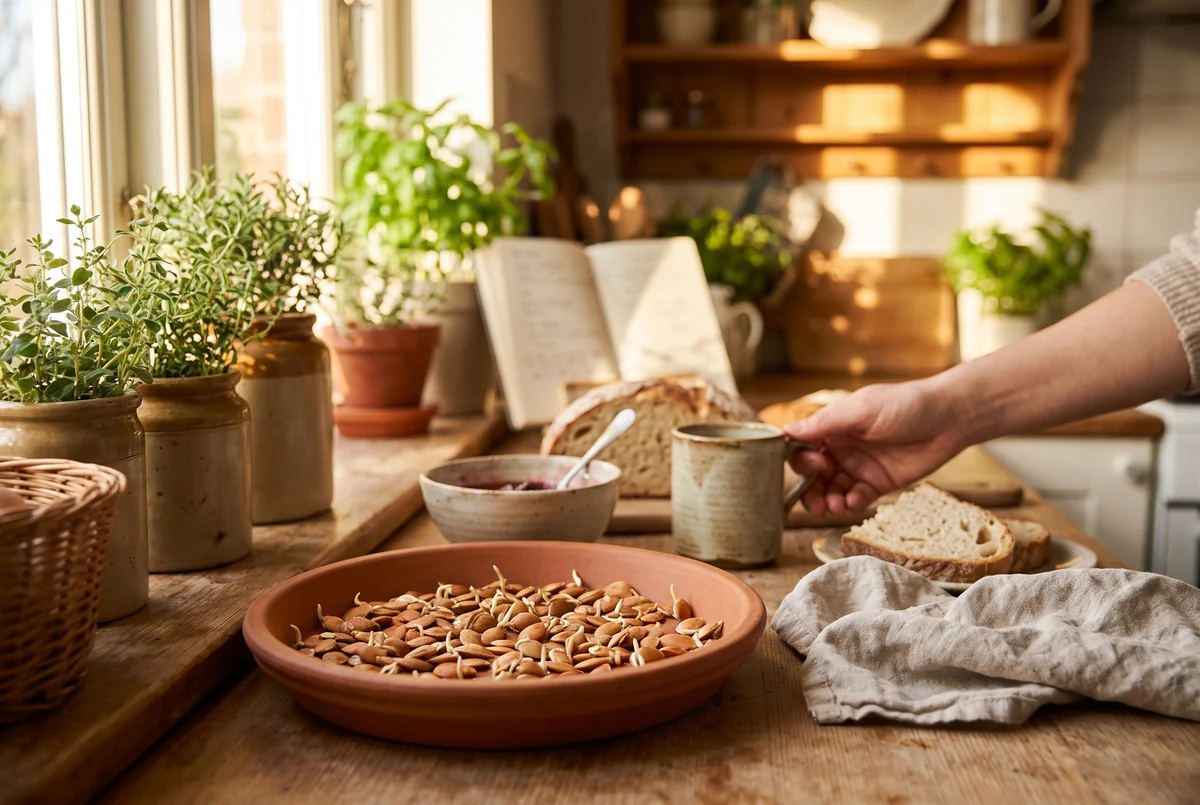
In the laboratory, pumpkin seeds sprouted in about two and a half days, in an enriched solution at a controlled temperature (Liang et al., 2022). Nothing domestic: at home, the time depends mostly on the temperature of your kitchen.
Sprouting also changes the composition of the seed. A Nigerian study on pumpkin seed flour (Cucurbita pepo) reports phytate contents of 35.56 to 14.56 mg per 100 g depending on whether the seeds were raw or processed (sand-roasted or sprouted), its authors concluding that these traditional processes improve nutritional quality (Elechi and Sule, 2023). In other words, the content is divided by more than two between the extremes, even though the abstract does not give the value for each process.
That leaves hygiene, which really calls for rigor. EFSA identifies contaminated dry seed as the most likely initial source of outbreaks linked to sprouted seeds, with the moisture and warmth of sprouting then allowing bacteria to multiply (EFSA, 2011). In some outbreaks, 4 salmonellae per kilo of seeds were enough: a pinch of sourdough starter, and the whole dough rises in the warmth.
Hence a few simple rules: seeds from a healthy squash, frequent rinsing, a clean sprouter and quick consumption. If you are starting out, a 10-minute sprouting routine will give you the right moves, and this guide will help you choose a suitable sprouter. To go further, the book Cuisiner les graines germées is full of ideas.
One last limit, and not the least. ANSES advises against re-sowing seeds from the previous harvest, because of the hybridization risk that gives bitter squashes. And never seeds from decorative squashes, neither on the plate nor in the sprouter.
And if the urge to sprout hits you before the next pumpkin, the oilseed closest to this experiment remains unhulled organic sunflower seeds for sprouting. There you go, a nice way to get your hand in, at your own pace, as part of a varied and balanced diet and a healthy lifestyle. On 31 October, you will finally know what to do with pumpkin seeds, bowl and all.