What Is Lion's Mane? Taste, Powder and How to Use It
What is lion's mane? An all-white edible mushroom, Hericium erinaceus, called crinière de lion or hydne hérisson in French, covered in long spines that hang down like a beard, and sold in Europe mostly dried, as a powder or as an extract. At Biovie, we built this page on five public sources, from Cornell University to the European Commission.
Type "lions mane" into a search engine and you land on a pile of product pages and lists of benefits. About the mushroom itself, almost nothing. Quite something, because it all starts with a big white ball bristling with soft spines, hanging from a trunk, which people in Asia have been eating for a long time (Friedman, 2015).
My training as an ISTOM engineer, in agronomy, left me with a reflex: before seeing a product in a bag, I look at a food as something that grows somewhere. Here, on wood. So when someone asks "what is lion's mane?", I answer in order: the mushroom as it grows first, what we do with it in the kitchen next.
What is lion's mane?
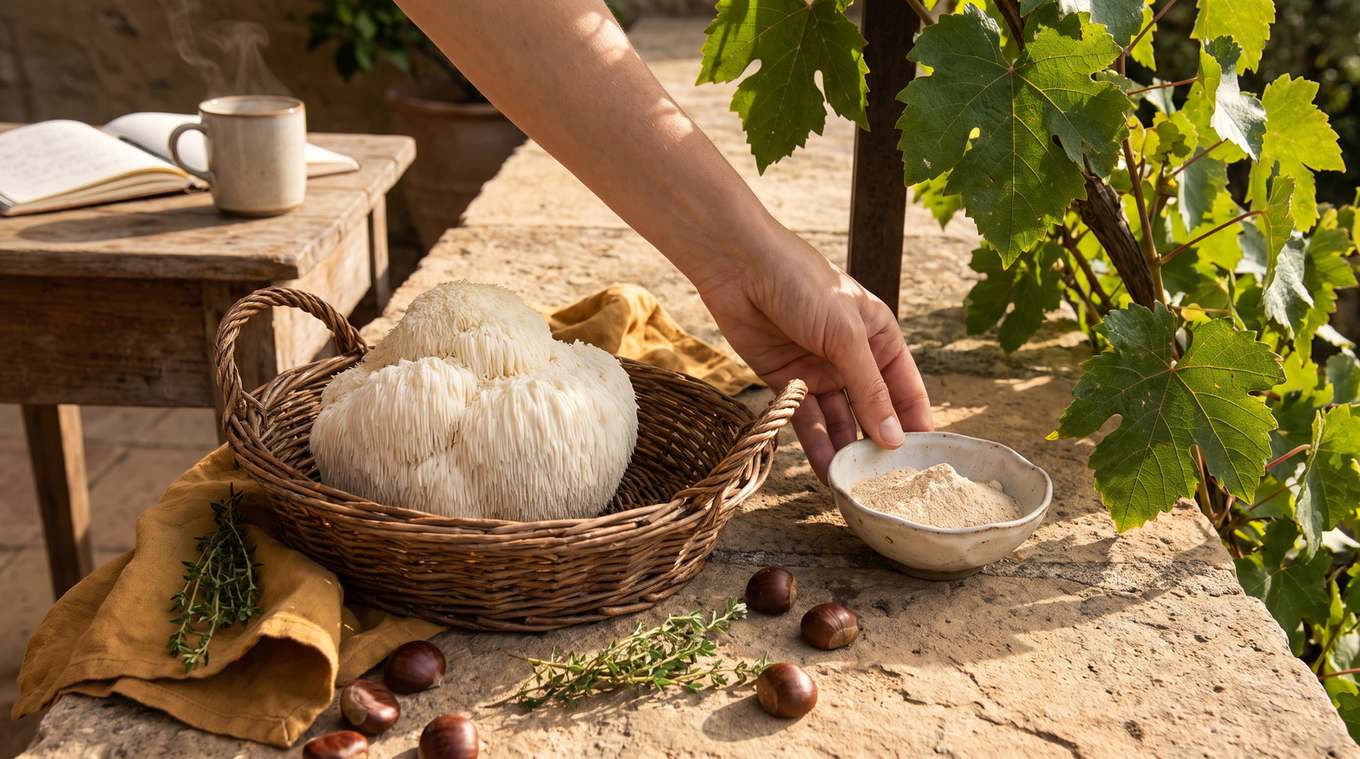
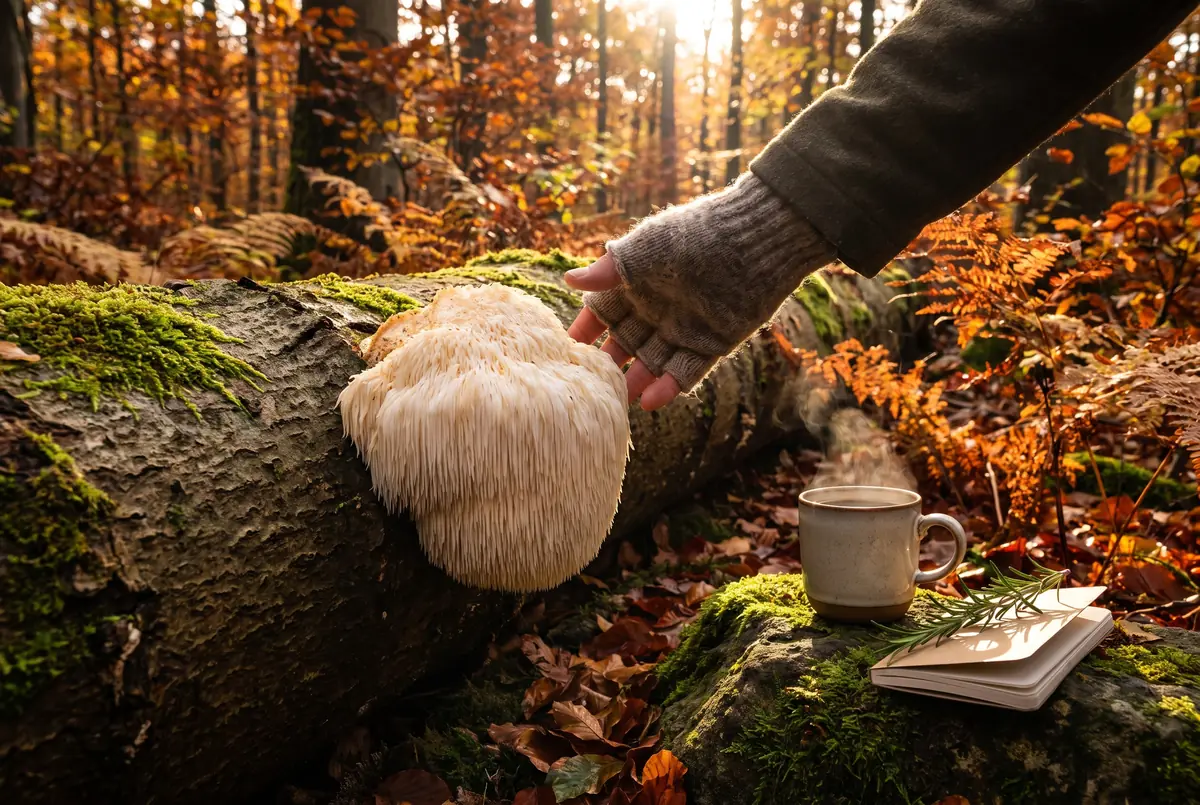
Lion's mane is an edible mushroom, Hericium erinaceus, known in French as crinière de lion or hydne hérisson. You recognise it by its hanging white spines, packed together like the bristles of a brush. In Asia it is eaten fresh; here in Europe, it is mostly sold dried, as a powder or as an extract.
Several names for the same mushroom
In Japan it is yamabushitake; in Spain, melena de león; in Germany, Igelstachelbart (try saying that in one breath). The safest reference remains the Latin name, the one used by the major journal article on the classification of the species (Thongbai et al., 2015).
What it looks like and how it grows
The lion's mane mushroom is lignicolous, in other words it grows on wood. At Cornell University, forest cultivation trials used drilled logs, inoculated with sawdust colonised by the mushroom, then stacked in a "totem" (Shackford, Cornell Chronicle, 2012). Each log yielded about two pounds of mushrooms, or nearly 0.9 kg, several times a year for 3 to 5 years. Think of your basket: one single log fills it several times every year, without ever needing to be replaced. Not bad for a piece of wood. Commercial production, for its part, takes place indoors, on sawdust.
Fruiting body and mycelium: two different parts
This time, think of an apple tree. The mycelium is the tree: a network of very fine filaments, invisible, running through the wood. The fruiting body is the apple, the one you pick and bite into.
The two do not contain the same things, by the way. Friedman's review lists about 70 so-called bioactive compounds in the species, with hericenones in the fruiting body and erinacines in the mycelium (Friedman, 2015). I quote these names the way you read an identity card, without drawing any promise from them. A mushroom remains a food, to be eaten as part of a varied and balanced diet and a healthy lifestyle.
Answering "what is lion's mane?" starts with knowing which part you are eating. Look at the mushroom before you read the label: everything else follows from that.
What does lion's mane taste like?
Fresh, lion's mane surprises with its texture more than its aroma. A Cornell University article speaks of a "seafood-like texture", of meaty flesh that absorbs flavours, and notes in passing that very few of the New York chefs surveyed knew this mushroom (Shackford, 2012). New York chefs, not amateurs! If New York was barely discovering it in 2012, should we really be surprised that people still ask, in France, what it looks like?
As for aromas, a Hungarian team went and looked more closely: it analysed the volatile compounds of 4 mushrooms in the laboratory, and identified from 61 to 100 per species (Csóka et al., 2017). Lion's mane stands out for esters and long-chain fatty acids, with an aroma less pronounced than that of spices. An aroma is a choir of dozens of voices: in this one, none sings very loud. Of course, the study measures molecules, it does not put a tasting panel to work, and I am not going to make it say more than it says. But in the kitchen, the message comes through: this is far from the button mushroom that takes over the whole pan.
And as a powder? The lion's mane taste stays mild and discreet, and it blends into a hot drink or a sauce without taking up all the room.
Whole mushroom powder or 10:1 extract: what is the difference?
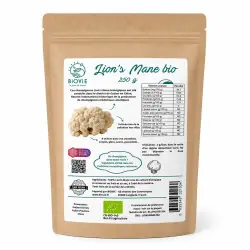
Watch out, two products hide under the same name. The lion's mane powder we offer is the whole fruiting body, dried then ground. The mushroom, the whole mushroom: its taste is still there, and it is used in the kitchen like a spice.
And what is lion's mane extract? The water-soluble 10:1 lion's mane extract is another story: it takes about 10 kg of dried mushroom to obtain 1 kg of extract. Imagine a pot of broth that you let reduce, then reduce again, until only a tenth is left at the bottom. The matter is still there, in much less volume. A small amount is therefore enough, and the price per gram is logically higher. It dissolves in hot water.
On some labels, you will read "30:1, equivalent to X mg". It sounds impressive. In reality, this mention describes a calculation method, not a quality. What matters is the part used (fruiting body or mycelium), the ratio and the solvent, water most of the time. And when a formulation stays opaque on these points, it is sadly the ingredient that ends up carrying the bad reputation, when it has nothing to do with it.
European law, and this is rare enough to be worth pointing out, makes exactly the same distinction. A "novel food", that is, a food not consumed to a significant degree in the Union before May 1997, must be authorised before it is placed on the market. The European Commission classes dehydrated mycelium powder of Hericium erinaceus as a novel food (29 October 2019), and the powdered extract of the fruiting body as "not novel" (entries of 28 February 2025 and 10 September 2026). In other words, for Brussels, the part you pick already belongs to European food history (European Commission). The mycelium, for its part, must first go through the authorisation stage.
The simplest way is to start from something you already do. A hot drink in the morning, a soup in the evening: the powder slips in with no equipment or recipe, and without upsetting your habits.
In a hot drink
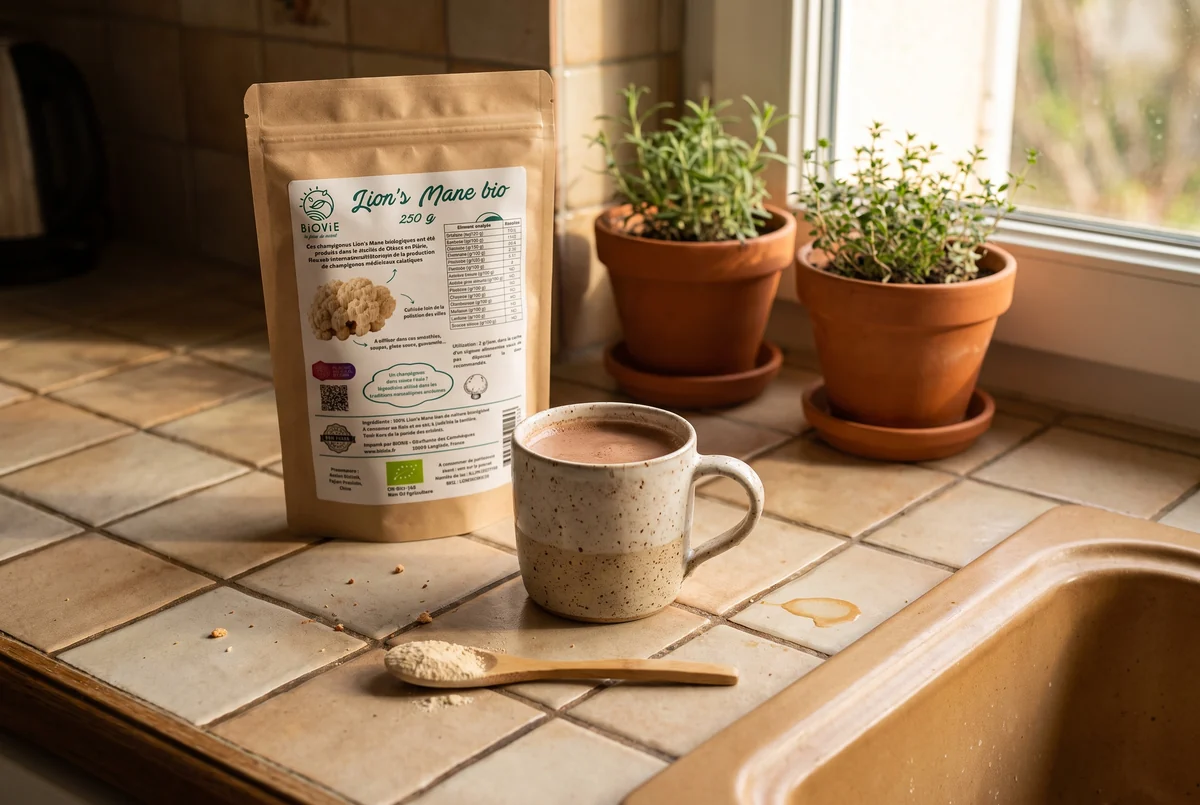
First stir the powder into a splash of hot water (not boiling, above all), otherwise beware of lumps, then top up with a store-bought plant-based drink or a homemade tiger nut milk. It goes well with cocoa and mild spices.
At home, with Aurélie, we sometimes get back at 6:50 pm. We blend dried and fresh mushrooms, almond purée, avocado, a clove of garlic and lukewarm water, and at 7:05 pm we are eating a living soup. Nothing like the pasteurised carton soup, cooked and cooked again. It is typically the kind of dish where a mushroom powder naturally finds its place. It adds to the meal, it replaces nothing, as part of a varied and balanced diet and a healthy lifestyle.
The 10:1 extract: a small amount in hot water
If you are looking for a drink without a strong taste, the 10:1 lion's mane extract dissolves straight into hot water. A small amount is enough.
Storing the powder well once opened
A dry powder dislikes humidity and light. I remember a bulk spirulina counter in an organic shop: the part exposed to light had turned blue-green. Hence our rule, valid for all powders: keep them away from light.
As soon as the pouch is open, at Biovie we recommend vacuum sealing with the BocUp kit: a bell and a small hand pump, no electricity or plastic bag, used on the glass jars you already have, provided they have "shoulders" and a 65 or 84 mm lid. According to the manufacturer, dry foods stay protected there from humidity and moths. Then store the jar in a cupboard. Vacuum does not replace the fridge or the freezer, and it does not sterilise.
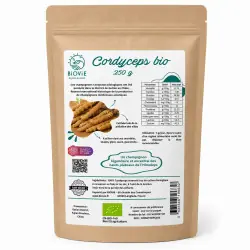
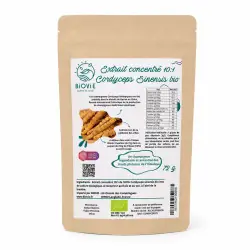
Two mushrooms make up this range: Cordyceps (Ophiocordyceps sinensis), offered as a food supplement in powder form, and Lion's Mane (Hericium erinaceus, crinière de lion), an edible mushroom in powder form to add to your drinks and preparations. Each is available as a plain powder or as a 10:1 concentrated extract, from certified organic cultivation. The composition, doses and precautions for use are given on each product page., 6
products
Fresh, lion's mane remains rare in France. If you are lucky enough to find some from a grower, cook lion's mane like a mushroom, pan-fried or roasted. It is always eaten cooked. Dried in pieces, it rehydrates in a broth.
In Asia, it has been eaten for a long time, whereas in the West, and notably in the United States, it remains much less common, as Friedman's review points out (2015). I find that a shame, for a mushroom that grows on wood and asks for nothing more than to be cultivated. Let us hope that in a few years, we will come across it as often in our markets as the other cultivated mushrooms.
Precautions and what Biovie does not promise
People allergic to mushrooms should avoid lion's mane. If you are pregnant, breastfeeding or undergoing treatment, ask a health professional for advice before eating it.
There are so many promises made around this mushroom that I prefer to write it in black and white. Biovie presents a food here, and promises you no effect whatsoever. A mushroom deserves to be judged on what it really is, its texture, its taste, its place on the plate, rather than on what we would like it to say.
If you are discovering it, start with a little powder in your morning drink, and see at your own pace whether it finds its place in your kitchen, as part of a varied and balanced diet and a healthy lifestyle. And if you ever come across a fresh lion's mane at a market, write to me: I would be curious to know how you cooked it!
Frequently asked questions
How do you cook lion's mane?
Fresh, lion's mane is cooked like any mushroom, pan-fried or roasted, and it is always eaten cooked. As a powder, it goes in at the end of preparation, into a soup, a sauce, a purée or a hot drink, like a spice. Dried in pieces, it rehydrates in a broth.
What does lion's mane taste like?
Lion's mane has a mild taste and a discreet aroma. Fresh, its meaty flesh is reminiscent of seafood, according to a Cornell University article. A Hungarian analysis of its aromas mainly finds esters and long-chain fatty acids, with an aroma less pronounced than that of spices.
Where does lion's mane grow?
Lion's mane grows on wood: it is a lignicolous mushroom. It can be grown on inoculated logs stacked in a totem, which produce several times a year for 3 to 5 years according to Cornell University trials. Commercial production takes place indoors, on sawdust.
When should you take lion's mane powder?
No particular time is required for lion's mane powder: it is a matter of habit. The simplest way is to pair it with a routine already in place, like the hot drink at breakfast or the soup in the evening. For quantities, Biovie devotes a whole article to extract and powder doses.
How much does lion's mane cost per kilo?
The price of lion's mane is compared per gram and by form. The 10:1 extract costs more per gram than the powder, because it takes about 10 kg of dried mushroom to make 1 kg of extract. At Biovie, the organic extract is €45.95 for 72 g, and a small amount is enough.
Who should avoid lion's mane?
People allergic to mushrooms should avoid lion's mane. If you are pregnant, breastfeeding or undergoing treatment, ask a health professional for advice before eating it. Like any food, it fits as part of a varied and balanced diet and a healthy lifestyle.
The information presented in this article is provided for informational purposes only and does not constitute medical advice. Consult a health professional before making any change to your diet or supplementation.