How to Reduce Food Waste at Home: What If You Grew Some of Your Vegetables in Your Kitchen?
Seasonal vegetables are up 17% in a year at Rungis, so you may as well know how to reduce food waste at home: plan, check your cupboards, buy fragile fresh food in small amounts, store it well, cook the leftovers, and grow some of that fresh food yourself, since part of it is lost before it even reaches you. The figures below come from ADEME, the FAO and UNEP, and I have decoded them with the perspective of working in organic food for more than thirty years.
Lettuce, artichoke, bell pepper and tomato are among the vegetables that climbed the most this summer, according to the price survey by Que Choisir (2026), which compares August 2026 with August 2025 at the Rungis market. Fruit, for its part, rose only 2%. In practice, the lettuce forgotten at the back of the drawer costs you noticeably more than it did a year ago. Across all fruit and vegetables, whatever the origin, Rungis records only a 1% increase: a different scope, not to be confused with the other figures.
People talk a lot about leftovers and use-by dates. Much less about what gets lost before it reaches your home. About ten years at Bio Bourgogne, helping farms with their conversion to organic, taught me to see a lettuce as the last link in a long chain.
How to reduce food waste at home: the 6 steps that help
Here is how to reduce food waste at home, in six steps:
plan your meals and your shopping;
check the fridge and the cupboard before you buy;
buy fragile fresh food in small quantities;
store food well, cold and in closed containers, even under vacuum;
cook the leftovers;
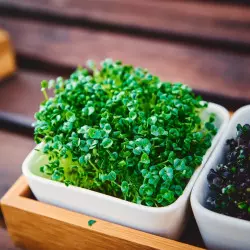
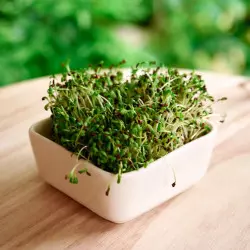
grow a share of the most fragile fresh food yourself, such as young shoots or sprouted seeds.
You probably know the first five already. Honestly, they work, and anyone can adopt them at their own pace, one at a time, without turning the kitchen upside down.The sixth one is more of a surprise.
It means growing at home a small part of what you usually buy in a tub, precisely the most fragile fresh food, the kind that spoils fastest in the fridge and has often already suffered losses before reaching the shelf.
30, 79 or 150 kg per person: how much do we really waste?
Three figures are going around. Before looking at how to reduce food waste around the world, it helps to know what each one measures, because they do not share the same scope or the same reference year. In reality, none of the three is wrong.
Worldwide, UNEP's Food Waste Index Report 2024 counts 1.05 billion tonnes of food wasted in 2022, inedible parts included, or 132 kg per inhabitant per year, all sectors combined. Households account for 60% of it, the rest being split between food service (28%) and retail (12%). Applied to the 132 kg, that 60% gives about 79 kg per person per year at home: this is our own calculation, not a figure published as such. Seventy-nine kilos is roughly the weight of an adult, thrown away every year from the kitchen.
The report also estimates that almost a fifth of the food available to consumers is wasted, and that this waste weighs 8 to 10% of global greenhouse gas emissions. Relative to your own shopping, that is about one bag out of five.
In France, ADEME (2016) puts losses and waste at 10 million tonnes a year across the whole food chain, for a theoretical commercial value of 16 billion euros (calculated at the selling price, without accounting for what is recovered afterwards). The Ministry of Agriculture (2019) speaks of about 150 kg per person per year, from field to plate. For households alone, food waste per person in France is estimated at 30 kg a year by the National Waste Management Plan (2019), including 7 kg of products still in their packaging, at a cost of 160 euros per person per year. Seven kilos thrown away without even being opened: that is the figure that speaks to me most.
Figure
Scope
Year
Source
132 kg per inhabitant per year
World, all sectors, inedible parts included
2022 data
UNEP
79 kg per person per year
World, households only (60% of 132 kg, our calculation)
2022 data
UNEP, Biovie calculation
150 kg per person per year
France, whole chain, from field to plate
Page published in 2019
Ministry of Agriculture
30 kg per person per year
France, households only, including 7 kg still packaged
Plan published in 2019
Ministry of Ecological Transition
Hidden losses: what gets lost before it reaches you
According to ADEME (2016), production accounts for 32% of French losses and waste, processing 21%, distribution 14% and consumption 33%. Two thirds of losses therefore happen before the household plate: out of three kilos lost, two are lost before your kitchen. The carbon impact of all these losses reaches 15.3 million tonnes of CO2 equivalent, about 3% of national emissions.
In other words, lorries drive and cold rooms run for food that nobody will eat.
Worldwide, the FAO (2019) estimates that about 14% of food is lost between harvest and retail: these are the food losses before sale. Roughly one item in seven disappears before it has even seen a shelf.
Why fragile fresh food is the most exposed
According to the FAO, fruit and vegetables are lost more than cereals and pulses at most stages; the critical points are harvesting, storage, handling, packaging and transport.
Follow a lettuce. It is picked, cooled, packed, loaded onto a lorry, unloaded, put on the shelf, bought, then stored in your vegetable drawer, where it waits some more. At every handover, a leaf gets crushed or a crate stays too long in the heat. A bag of lentils, on the other hand, takes the trip without a murmur.
Who thinks about that whole journey when throwing away a wilted lettuce? I am not blaming the producers or the hauliers: this logistics is precisely what lets us find fresh vegetables all year round. I often say that ignorance is a choice: these losses are invisible from the kitchen, so you might as well know about them.
What rising prices change
With seasonal vegetables up 17% and herbs up 4% over a year (Que Choisir, 2026), every leaf you throw away costs more than in 2025. And a bunch of coriander turning black at the back of the fridge is money going the same way.
The maths: a store-bought tub or shoots grown on your worktop
The calculation is simple. The real price of a fresh product depends on the share actually eaten: it is the price paid divided by the share consumed. Take a simple hypothesis: if a quarter of a tub of young shoots ends up in the bin, you only eat three quarters of it, and each portion you eat costs you a third more than the label said.
The leaf you throw away, you pay for anyway: it hides in the price of the ones you eat. That is the cost of food waste seen from your kitchen.
Let us compare, step by step, a store-bought tub with shoots grown on your worktop.
Step
Store-bought tub
Shoots grown at home
Transport
From the production area to the warehouse, then to the shop
None: they grow where you eat them
Storage before purchase
Cold room, then shelf
None
Storage in the fridge
A few days, and an opened tub spoils quickly
Very short: you cut just before the meal
Quantity harvested
A batch imposed by the packaging
On demand, according to the meal
Likely loss
Leaves that go soft before being eaten
Low if you sow small and often
Let's be honest: shoots do not replace your everyday vegetables. They mostly replace the most fragile fresh food, bagged salads and fine herbs, the kind that copes worst with waiting.
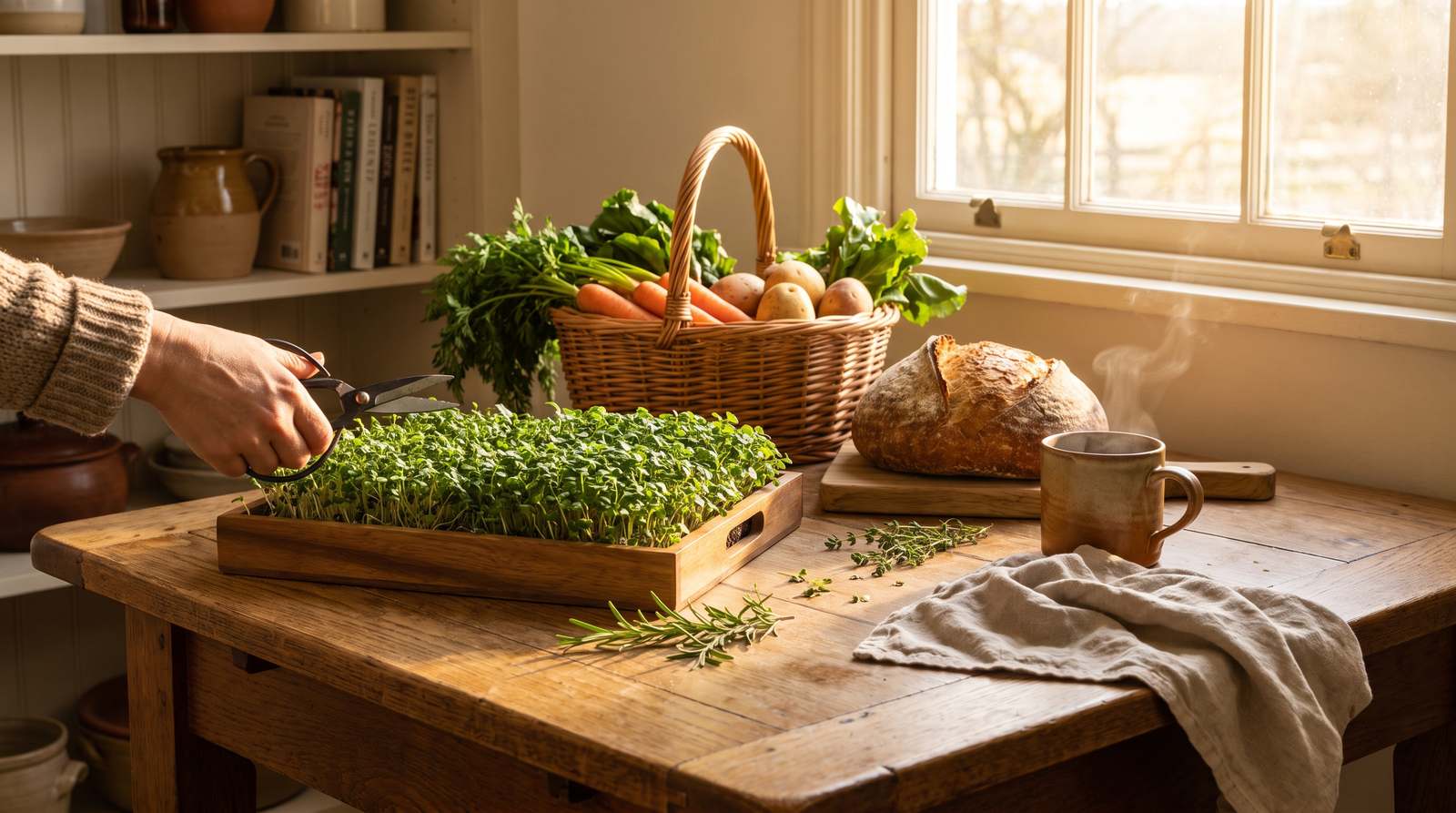
At this scale, growing your own vegetables at home without a garden fits on a windowsill. Some varieties even get an article of their own, like tatsoi young shoots. Fresh shoots, harvested the same day, naturally find their place as part of a varied and balanced diet and a healthy lifestyle.
How to sprout seeds at home without creating more waste or taking a hygiene risk? The answer starts before the first rinse.
Choosing seeds meant for sprouting
It all starts with the seed. In its 2011 scientific opinion, issued after that year's European outbreak, EFSA identifies contaminated dry seed as the most likely initial source of outbreaks linked to sprouted seeds. The warmth and moisture of sprouting allow the bacteria present to multiply, and no disinfection step is guaranteed to eliminate contamination of the seed.
In the United States, the FDA (2022) lists 52 outbreaks and more than 2,700 illnesses linked to raw or lightly cooked sprouted seeds between 1996 and 2020, and recommends seeds produced under specific good agricultural practices. That figure simply reminds us that the seed matters as much as the technique.
The right reflex is to use only seeds sold for sprouting or for young shoots, never treated garden seeds. To choose your varieties, here is which seeds to sprout, sorted by category.
Rinsing and cleanliness
Take a very clean jar or tray. Rinse regularly, then drain thoroughly, so that water never stagnates at the bottom. With seeds meant for sprouting and regular rinsing, you limit the risks. Vulnerable people (pregnant women, young children, older people, immunocompromised people) should first ask their doctor before eating raw sprouted seeds.
Sow small and often
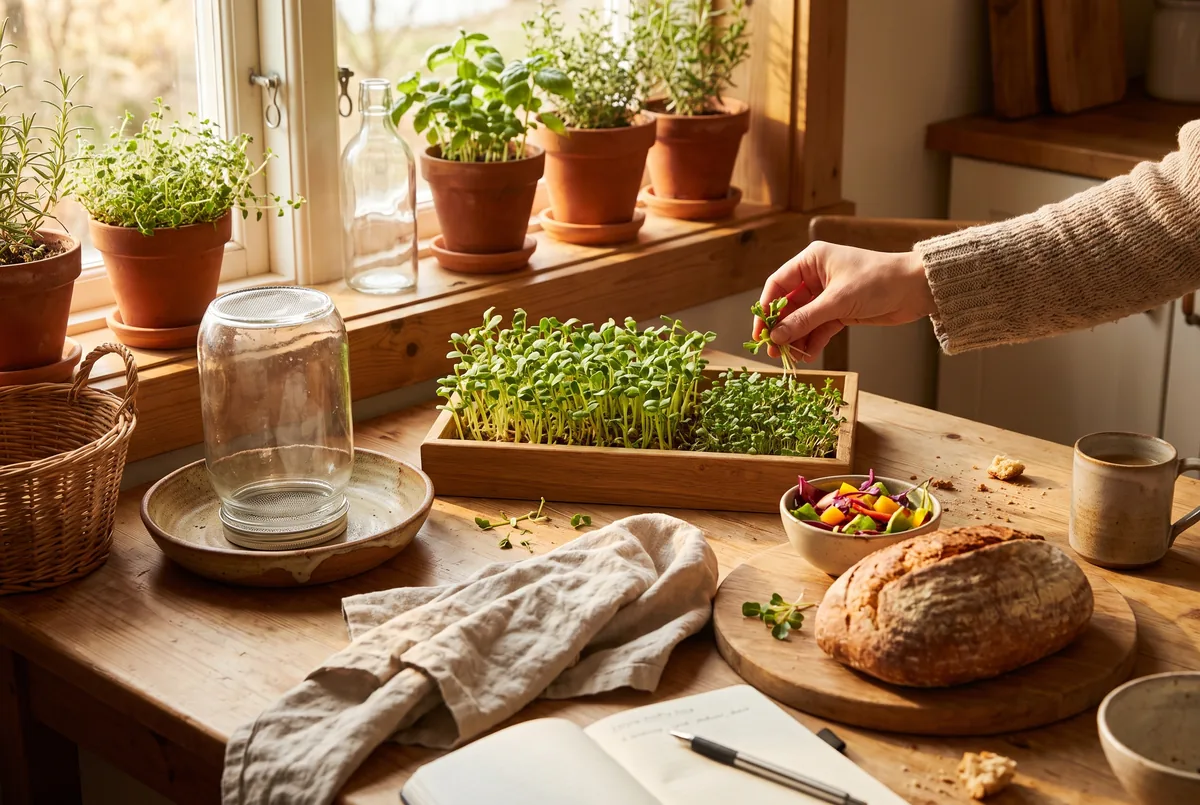
Sow small quantities, a few days apart, so that you harvest at the pace of your meals instead of ending up with a whole jar to finish in a hurry. This is where most of the anti-waste effect is won.
To begin with, there is no equipment to buy: an empty jam jar does the job very well. The effort is short but daily, and a 10-minute sprouting routine lets you fit it into your days.
What to do with the soaking water?
The soaking water from seeds is not for drinking: the conditions of sprouting favour the multiplication of bacteria (EFSA, 2011). It can, however, be used to water your houseplants or your window box.
Storing the harvest
Harvest on demand, just before the meal. What has been cut keeps in the cold and should be eaten quickly. Better to cut than to stock: as long as they stay on their tray, the shoots are not waiting at the bottom of the vegetable drawer. Added raw to a slice of bread or a salad, they round out your meals as part of a varied and balanced diet and a healthy lifestyle.
Making bought produce last: vacuum sealing in your own jars
Not everything grows on a tray. For the vegetables you bring home from the market, the fourth step, storing well, can go much further than a closed box in the fridge: vacuum sealing. By removing the air, and therefore the oxygen, from the container, you slow down the oxidation and drying out that make a lettuce wilt or a bunch of herbs turn black. You are attacking the waste in the vegetable drawer at its root.
For a long time, vacuum sealing at home meant an electric machine, single-use plastic bags and one more appliance on the worktop. The BocUp kit turns the problem around: a bell sits on the lid of a glass jar, and a small manual pump removes the air in a few seconds. No need to buy new containers: the jam, tomato sauce or gherkin jars piling up in your cupboards will do, as long as they have "shoulders", that bulge just under the lid. The bells fit lids of 65 and 84 mm in diameter, the most common on the market. No electricity, no bag to throw away: it is reuse in the literal sense, and the only thing to buy is the BocUp itself.
According to its manufacturer, fresh produce keeps up to five times longer under vacuum, and a vegetable soup lasts 8 to 10 days in the refrigerator instead of two. Vegetables are where the difference shows most: washed lettuce, fresh herbs, raw vegetables cut in advance for the week keep their crunch and flavour much longer. You can then cook in one go or buy a little more at the market, without throwing away on Thursday what you brought home on Saturday. Dry foods benefit too, protected from humidity and moths, starting with your seeds for sprouting.
Two rules to keep in mind: vacuum does not replace the refrigerator or the freezer, and it does not sterilise. The jars stay cold, are washed in hot soapy water after each use, and what you put in them must be clean and in good condition. To go further, I have detailed the benefits of vacuum sealing at home in a dedicated article.
What this step changes, and its limits
Of course, a few trays of shoots will not settle the question at the scale of a country. Growing in the kitchen touches a small part of the plate, but precisely the most fragile part, and for that part you remove the transport and storage that come before the purchase. This step adds to the other five without replacing them, and vacuum sealing in jars extends the life of everything else.
We add rather than take away. If you were wondering how to reduce food waste at home without upending everything, the simplest way is to start with the most fragile food, at your own pace. The same logic applies to other delicate foods: you can, for example, learn to store fresh seaweed without waste. And to widen the palette, organic red chard seeds can also be grown as young shoots, to add to your meals as part of a varied and balanced diet and a healthy lifestyle.
There you go, that is my hope: that in a few years a tray of shoots on the windowsill will be as ordinary as a pot of basil, and that we will talk about losses before the shop as much as about Sunday's leftovers.
By planning meals and shopping, checking the fridge and cupboard before buying, taking fragile fresh food in small quantities, storing it cold in closed containers and cooking the leftovers. A sixth step completes the others: grow a share of the most fragile fresh food yourself, such as young shoots.
How can I keep fresh vegetables longer?
Cold, in a closed container, and ideally under vacuum: removing the air slows wilting. A BocUp bell and a manual pump let you vacuum seal the glass jars you already own, with no machine or plastic bag. Vacuum does not replace the refrigerator and does not sterilise: the jars stay cold and are washed after each use.
How much food is wasted every year?
About 1.05 billion tonnes worldwide in 2022, according to UNEP, inedible parts included. In France, ADEME counts 10 million tonnes lost or wasted per year across the whole food chain, and the Ministry of Ecological Transition puts household waste at 30 kg per person per year, including 7 kg still in their packaging.
What are the main causes of food waste?
The causes are spread across the whole food chain: in France, ADEME attributes 32% of losses to production, 21% to processing, 14% to distribution and 33% to consumption. According to the FAO, the critical points are harvesting, storage, handling, packaging and transport.
Which foods are wasted the most?
Fruit and vegetables are among the most exposed: according to the FAO, they are lost more than cereals and pulses at most stages, from harvest to transport. Fragile and perishable, they cope badly with storage and handling, which is why it makes sense to buy them in small quantities or to grow some of them.
Which seeds can I grow in the kitchen?
Only seeds sold for sprouting or for young shoots, never garden seeds, which may be treated. EFSA points out that contaminated dry seed is the most likely initial source of outbreaks linked to sprouted seeds. To find out which seeds to sprout, a complete list by category is available on the blog.
Is an anti-waste app enough?
No, not on its own. An anti-waste app helps rescue unsold goods from shops, which is useful, but it does not act on the losses that happen before sale, at harvest or during transport. It therefore complements the steps at home and growing a share of your fresh food, without replacing them.
The information in this article is provided for information purposes only and does not constitute medical advice. Consult a healthcare professional before changing your diet or taking any supplement.