


Plenty of pouches say “up to 70% protein”. So how much protein is in spirulina, really? Is spirulina a good source of protein? By concentration, yes: 57.5 g per 100 g of dried powder, according to the USDA database. But at 5 g a day, it provides about 2.9 g, or 5% of the needs of a 70 kg adult: enough to complement legumes, which remain the foundation. At Biovie, we built this page on public composition tables and on the EFSA scientific opinion.
That “up to 70%” is everywhere on labels, and it deserves a very simple question: 70% of what, and for how much in your bowl? Because a percentage isn't something you eat. What counts is the grams that reach your plate, and then the ones your body actually absorbs, which is not quite the same thing.
Vegan since 1992 and an ISTOM engineer, I founded Biovie in 2007, and I will always prefer science to slogans.
So let's do the math, simply: first the percentage converted into grams per serving, then the quality of those proteins. For the benefits and the precautions, everything is gathered in our complete guide to spirulina.
How much protein is in spirulina?
Dried spirulina contains 57.5 g of protein per 100 g, according to the USDA FoodData Central database. These proteins provide about 79% of its calories. That's huge, and it's also the whole paradox of this little blue-green alga: one of the most protein-dense foods there is, yet you eat it by the pinch.
For the rest, 100 g of dried powder contains 23.9 g of carbohydrates, 7.72 g of fat and 4.68 g of water, for a total of 290 kcal. You can redo the 79% on the back of an envelope: protein counts for 4 kcal per gram, so 57.5 × 4 = 230 kcal out of 290. In other words, out of every ten calories the powder gives you, nearly eight come from its protein.
For a food to be called “high in protein”, at least 20% of its energy must come from protein. The threshold drops to 12% for “source of protein”, as the Institut national de la consommation points out. At 79%, dried spirulina clears that bar by a very, very wide margin.
And the 55%, 60% or 70% you come across on other sites, then? Nobody is necessarily lying. The content varies from one batch to another and from one analysis to another. Spirulina is a living organism, not a lab powder calibrated to the gram. So here I stick with the public reference value, the USDA's, and for a given product, it's the batch label that counts, not the roundest number you find online.
That leaves fresh spirulina. It contains a lot of water, so much less protein per 100 g than the powder, even though on a dry-matter basis its profile is the same. I'd rather not give you a figure for fresh spirulina, for lack of a verified value. Here again, check the label.
Spirulina and plant protein: what a serving really gives you
A high concentration doesn't make a large quantity. Nobody eats 100 g of spirulina in a day, or they're hiding it well. You stir a spoonful into a glass, add a pinch to a dish, and it's on those few grams that its real place among your plant proteins is decided.
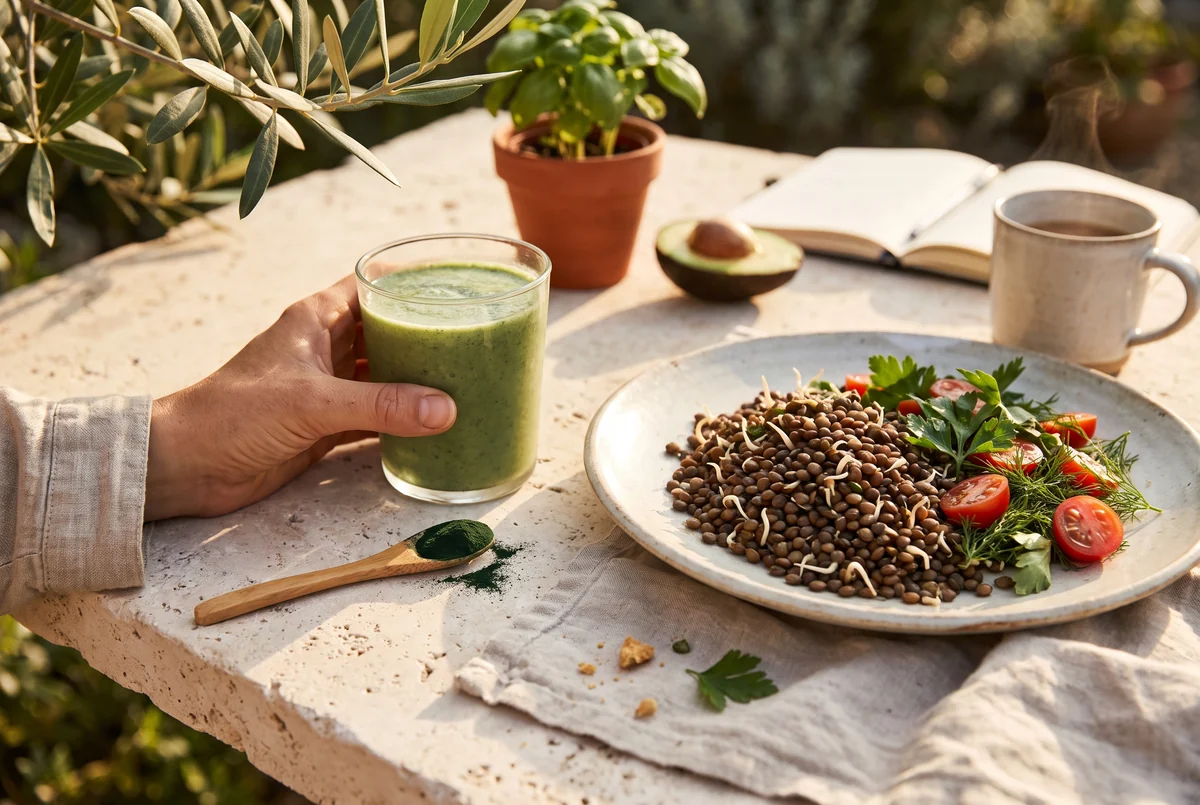
Let's put all this side by side with lentils and an adult's daily need: the table speaks for itself.
| Food and amount | Protein | Source |
|---|---|---|
| Dried spirulina, 5 g | 2.9 g | Calculated from the USDA database |
| Dried spirulina, 10 g | 5.75 g | Calculated from the USDA database |
| Raw lentils, 100 g | 24.6 g | USDA, raw lentils |
| Lentils boiled in water, 100 g | 9.0 g | USDA, cooked lentils |
| Reference need, 70 kg adult | 58 g per day | Calculated from the EFSA value |
Where does that reference need come from? From EFSA, which sets 0.83 g of protein per kilo of body weight per day for an adult (the average requirement, for its part, is 0.66 g/kg). That gives 0.83 × 70 = 58 g for a 70 kg person, a value designed for a mixed diet that combines animal and plant proteins. The math is quick. 5 g of spirulina covers about 5% of that need. To reach 58 g with spirulina alone, you'd need about twenty servings like that one, enough to turn your smoothies seriously green!
Lentils, for their part, show the effect of water nicely: 24.6 g of protein per 100 g raw, 9.0 g once cooked and swollen with water. Even so, a small 100 g plate of cooked lentils provides three times more protein than 5 g of spirulina. Lentils aren't very glamorous, but they're the ones holding the house up. For quantities, legumes do the bulk of the work, as part of a varied and balanced diet and a healthy lifestyle.
If the question of absorption is nagging you, I've gathered the common myths about plant proteins in a separate article.
How good is spirulina's protein?
Counting grams isn't enough. A protein is also judged by its amino acids and by the share your body really absorbs, and studies know how to measure that.
All nine essential amino acids are there
A “complete” protein is a food that contains all nine essential amino acids, the ones the body can't make and has to find on the plate. Spirulina contains all of them. For 100 g of dried spirulina, the USDA database gives, for example, 3.02 g of lysine, 1.15 g of methionine and 1.08 g of histidine.
Still, “complete” says nothing about the amount of each one, or about what gets absorbed. Picture a building site where a wall goes up with nine kinds of bricks, all indispensable. If one runs short, the wall stops there, even with whole pallets of the other eight: that's the limiting amino acid. And then some of the bricks fall off the truck on the way, and only the ones that reach the site count (that's digestibility).
The PDCAAS, the index used to score proteins, combines precisely both. You start from the least well covered amino acid, then correct for digestibility.
Digestibility: what the studies measure
To find out, researchers had a rather clever idea: label spirulina with nitrogen 15 and trace its proteins in rats (Tessier et al., 2021). They found about 86% digestibility for nitrogen (measured in feces) and about 83% for amino acids (measured at the end of the small intestine), with histidine as the most limiting amino acid, lysine to a lesser extent, and a PDCAAS of 0.84. Out of 100 g of spirulina protein swallowed, these rats therefore absorbed about 83 to 86 g. I give you the authors' conclusion as it stands, even if it is less flattering than what you read on pouches: a rather balanced profile, and a relatively low digestibility.
In humans, spirulina even served as the reference protein to develop a dual-tracer measurement method (Devi et al., 2018): the mean digestibility of its indispensable amino acids reaches 85.2%. In animals as in humans, the measurements land in the same order of magnitude. That's a little below the best-digested proteins. It's the only reservation worth keeping, and it's an honest one.
You aren't what you eat, but what you absorb: I've been convinced of that for a long time, and these digestibility figures are its most down-to-earth translation. It's the bricks that reach the site that build the wall.
What a trial in humans shows
A randomized double-blind trial compared three drinks each providing 25 g of protein (mycoprotein, spirulina or chlorella), in 36 healthy young adults, 18 men and 18 women, after a single-leg resistance exercise session (van der Heijden et al., 2023). “Double-blind” means that neither the participants nor the researchers knew who was drinking what. With spirulina, amino acids rose in the blood the fastest and the highest. Muscle protein synthesis increased comparably in the three groups.
The trial remains small, run over a few hours in young adults. Above all, 25 g of protein is about 43 g of dried spirulina in a single go, nearly half of a 100 g pouch. Admit it, that's not your breakfast glass! This trial sheds light on the quality of these proteins; it says nothing about everyday use.
Where does spirulina fit on a plant-based plate?
In a plant-based diet, proteins complement each other over the day. Legumes, grains and nuts and seeds form the base, and their amino acids answer each other from one meal to the next, like teams taking turns on the same building site. Spirulina comes in as a supplement to these basic plant proteins, with a few grams that contain all the essential amino acids. It also provides iron, 28.5 mg per 100 g of dried powder according to the USDA, or about 1.4 mg in a 5 g serving.
On one point, however, I'd rather be very clear, because the opposite idea dies hard. Spirulina does not cover vitamin B12 needs. The USDA database credits it with 0.00 µg of B12, and an in vitro analysis of commercial products showed that 83% of the B12-type compounds isolated from them were pseudovitamin B12, inactive in humans (Watanabe et al., 1999). For B12 and the rest, I took stock in the essential nutrients for a vegan diet, and those who want to compare with a macroalga will read the article on nori and its protein.
As part of a varied and balanced diet and a healthy lifestyle, a few grams of spirulina a day simply add to what you already eat. Nothing to remove, nothing to upend. Everyone at their own pace.
At Biovie, we offer it as organic spirulina powder, the dried form that all the figures in this article are about.