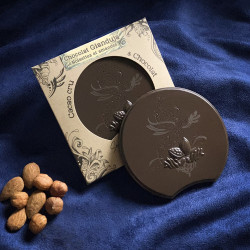
Chestnut & cocoa nibs bar, raw organic cocoa - Songes et Cacao - 50 g
The vegan equivalent of milk chocolate: raw, unroasted cocoa, AOP chestnut flour from Ardèche, and crunchy cocoa nibs.
50 g bar, handmade by Songes et Cacao.
No queries yet, leave the first!
Price:
€5.90
Tax included
- New
- Out-of-Stock


Chestnut & cocoa nibs bar, raw organic cocoa - Songes et Cacao - 50 g images


Chestnut & Cocoa Nib Tablet, Organic Raw Cocoa
The Chestnut Tablet from Songes et Cacao is the vegan equivalent of milk chocolate. The AOP chestnut flour from Ardèche, sourced from the Ferme du Châtaignier in Lamastre, provides a round and slightly sweet softness, while the cocoa nibs add crunch and a lovely freshness.
🍫 Why this tablet?
Finding the softness of milk chocolate without milk is often the challenge for those transitioning to a plant-based diet. Yann found the answer in his Ardèche terroir: the chestnut, whose flour gives the cocoa a soft texture and a nutty flavor.
It's the ideal tablet for children, for those who find dark chocolate too bitter, and for anyone who loves autumn flavors.
🍫 How to enjoy it?
Enjoy it as is for a snack, or at the end of a meal. The cocoa nibs reveal their crunch under the teeth, contrasting with the softness of the chestnut.
It pairs very well with a hot drink, oat or almond plant milk, or a few pieces of pear.
Store it in a cool, dry place, between 15 and 18 °C, away from light. After taking it out of the refrigerator, let it sit for a few minutes at room temperature to release all its aromas.
🍫 Focus on the ingredients:
- Raw cocoa (43%): unroasted beans, ground for 24 hours under a stone mill.
- Chestnut flour (27%): AOP from Ardèche, from the Ferme du Châtaignier in Lamastre. It provides the softness and roundness reminiscent of milk chocolate.
- Cocoa nibs (10%): raw cocoa bean pieces, for crunch and a fresh, slightly tangy note.
- Coconut sugar and beet sugar: for measured sweetness.
> Discover our full selection of raw cocoa.
Chestnut and raw cocoa: a milk-free sweetness
Without roasting, cocoa retains a much higher proportion of its polyphenols and flavonoids. The nibs, which are simply crushed cocoa beans, are the rawest form. To learn more, discover the benefits and virtues of raw cocoa.
The chestnut is a fruit rich in complex carbohydrates and fibers, traditionally nicknamed "the bread tree" in the Cévennes and Ardèche. Here, it replaces the milk powder found in classic chocolates.
It remains a treat: to be savored square by square, as part of a varied and balanced diet.
SONGES ET CACAO
Songes et Cacao is the workshop of Yann Maritaud, a chocolatier based in Drôme, in Crest, after several years in Lamastre in Ardèche. Yann is one of the very few French chocolatiers who make their chocolate from bean to bar: this is the "bean-to-bar" approach. Only 2 to 3% of chocolatiers in France work this way.
At his workshop, everything that can be done by hand is done by hand. The beans are sorted one by one, crushed, and separated from their shells, then ground for 24 hours under a stone mill to obtain the cocoa paste. Each tablet is then molded by hand and wrapped by hand. No step is outsourced to an industrial company.
Most importantly, the beans are not roasted. While classic chocolate roasts its beans between 150 and 180 °C, Yann works with them raw, preserving the most delicate aromas of each origin, much like a grape variety for wine.
His tablets are certified Organic Agriculture and Nature & Progrès. The beans come from small cooperatives in South America, the chestnut flour from the Ferme du Châtaignier in Lamastre, and the sugar is a mix of coconut flower sugar and French beet sugar. The tablet's packaging is compostable, and the workshop's waste is used as mulch by a neighboring plant producer.
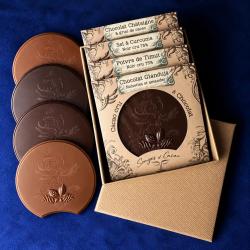
We discovered Yann's work while searching for a raw cocoa workshop, and we immediately recognized the same level of commitment as at Biovie. After a family tasting, the choice of these four tablets was clear.
Packaging: 50 g tablet, compostable bag.
Ingredients: Raw cocoa* 43%, chestnut flour* 27%, coconut sugar*, beet sugar*, cocoa nibs* 10%.
*Ingredients from organic farming.
Unroasted cocoa, vegan, dairy-free. Artisan bean-to-bar production.
Certification: Organic Agriculture, certified by Certipaq (FR-BIO-09). Also certified Nature & Progrès.
Allergens: possible traces of nuts and gluten.
Storage method: in a cool, dry place, between 15 and 18 °C, away from heat, light, and humidity.
Manufacturer: Songes et Cacao, Yann Maritaud, artisan chocolatier, 11 rue de l'Hôtel de Ville, 26400 Crest.
Nutritional values:
| Nutritional values | per 100 g |
|---|---|
| Energy | 583 kcal - 2433 kJ |
| Fat of which saturated fatty acids |
42 g 25 g |
| Carbohydrates of which sugars |
49 g 30 g |
| Dietary fiber | 3.2 g |
| Protein | 4.1 g |
| Salt | 0.03 g |
Frequently Asked Questions about the Chestnut Tablet:
Why is it called a milk chocolate equivalent?
The chestnut flour provides a softness and roundness reminiscent of milk chocolate, without any dairy products. With 43% cocoa, the tablet is much less bitter than dark chocolate.
What is cocoa nibs?
Nibs are crushed cocoa bean pieces. Here, they are raw: they provide crunch and a fresh, slightly tangy note, typical of unroasted beans.
Is the Chestnut Tablet gluten-free?
Chestnut does not contain gluten, but the tablet is made on the same machines as the 1001 Nuits tablet from the workshop, which contains oat flour. Oats are naturally gluten-free, but they can be contaminated during cultivation or processing near wheat fields. As a precaution, the Chestnut Tablet is labeled "possible traces of gluten" (as well as nuts) and is not suitable for a strictly gluten-free diet.
Why does my tablet have white marks?
This is blooming: after a heat shock (during transport, for example), the cocoa butter rises to the surface and forms a white film. It's purely aesthetic, the tablet remains perfectly edible and its taste is intact. To avoid it, store it in a cool, dry place, between 15 and 18 °C, away from light.
Why do we talk about "raw cocoa" instead of "raw chocolate"?
The term "raw chocolate" is not recognized by French regulations. Therefore, we refer to it as a raw cocoa tablet: the beans are not roasted, unlike classic chocolate whose beans are roasted between 150 and 180 °C. This preserves the delicate aromas of the bean.
Update: September 2026. Sheet validated by Éric Viard, founder of Biovie and engineer ISTOM, co-author of Algues au quotidien (Gallimard, 2024) - Best Cookbook in the World, Gourmand Cookbook Awards 2025, and Best Cookbook in France, National Culinary Academy 2025.
Disclaimer: The information presented on this sheet is provided for informational purposes only and does not constitute medical advice. Consult a qualified health professional before making any changes to your diet. As part of a varied and balanced diet and a healthy lifestyle.
Wondering… ?
Everything you need to know before ordering.
Be the first to ask a question about this product!
Question about the product
Ask a question
These products may