Why Am I So Bloated After Eating? Digestive Enzymes Put to the Test of the Studies
An hour after a plate of lentils or a coffee with milk, your belly tightens and your belt pinches: why am I so bloated after eating? First, look for the cause, because the enzymes tested in humans only target specific foods: alpha-galactosidase for legumes, lactase for lactose. At Biovie, I built this page from four trials and official opinions with figures.
Why am I so bloated after eating? What happens in your belly
Before asking "why am I so bloated after eating?", let's put the right words on what you feel. Bloating is a sensation of pressure that nobody sees from the outside. Distension, on the other hand, is visible: the belly really swells, and the button of your trousers remembers it. The two often travel together.
If this happens to you, you are far from alone. A Rome Foundation survey (Ballou et al., 2023) questioned 51,425 adults in 26 countries. Nearly 18% of them report bloating at least once a week, from 11% in East Asia to 20% in Latin America. Count it around a table of ten guests: almost two people know this tight belly every week, and carefully avoid mentioning it over dessert.
The most frequent causes are not mysterious:
air swallowed by eating fast or with fizzy drinks;
a meal that is too large;
poorly digested sugars that reach the colon, where bacteria ferment them and produce gas;
constipation;
a sensitive gut, which reacts more strongly than others.
Among all these causes, only one opens the door to enzymes: poorly digested sugars. Swallowed air, the festive meal, constipation: there, an enzyme simply has nothing to cut.
I look at a seed with the eyes of an ISTOM engineer: a well-packed stock of reserves for the future plant. I have been sprouting seeds since my teens, long before founding Biovie in 2007. Now, part of those reserves are precisely sugars that our gut cannot cut.
Fermenting sugars: legumes and lactose
Why am I getting so bloated after eating, while my neighbour at the table digests everything? The answer sometimes lies on the plate. Legumes contain oligosaccharides, mainly raffinose and stachyose: short chains of sugars that the human gut cannot cut, for lack of the right enzyme. They reach the colon intact, where bacteria make a meal of them (and we get the gas).
The gas after a plate of legumes is therefore more a matter of chemistry than of a "fragile" stomach. It is not you who is badly built, it is a chemical bond that found no taker.
Lactose follows the same path when lactase, the enzyme that cuts it in the small intestine, runs short: it heads for the colon and ferments in turn. That is the whole link between lactose intolerance and bloating. We are not what we eat, but what we absorb: a sugar that reaches the colon intact has not been absorbed, it has simply changed dinner guests.
What exactly is a digestive enzyme?
The principle fits in one image. A digestive enzyme is a pair of molecular scissors, highly specialised, almost fussy. Each enzyme only cuts one type of bond, like scissors that could only cut a single fabric.
Lactase cuts lactose, proteases cut proteins, and your body makes a good share of these scissors itself, all along the digestive tract: saliva, stomach, pancreas, small intestine.
When the right scissors are missing, the food carries on its way in one piece. With digestive enzymes for difficult digestion, the whole question is therefore which scissors are missing, and for which food.
Let's say it upfront: if you wonder why am I so bloated after eating, digestive enzymes have results in two specific cases. With alpha-galactosidase, participants reported fewer symptoms after a meal of legumes, and the enzyme lactase contributes to the breakdown of lactose in people who digest it poorly. For blends, the evidence is thinner.
Enzyme
What it breaks down
Situation tested
Level of evidence and source
Alpha-galactosidase
Raffinose and stachyose from legumes
Bean meal in healthy volunteers; galacto-oligosaccharides in irritable bowel
The first randomized trial (Di Stefano et al., 2007) is tiny: 8 healthy volunteers facing 420 g of cooked beans, double-blind against placebo. Chance decided who received the enzyme, and neither the participants nor the researchers knew. At 1,200 GalU (the unit that measures the enzyme's activity), exhaled hydrogen, a sign of fermentation, and flatulence decreased; at 300 and 1,200 GalU, the overall symptom score went down. Those 420 g make a big soup plate, well filled.
Eight people is not many. So the second trial matters: Tuck et al. (2018) followed 31 people with irritable bowel, each trying the enzyme and the placebo in turn, double-blind, so that everyone becomes their own control. In the 21 people sensitive to galacto-oligosaccharides, bloating fell to 6.5 mm with 300 GalU, against 20.5 mm without the enzyme (p = 0.017).
Millimetres to measure a belly? On this visual analogue scale, each person draws a mark on a line running from "no bloating" to "the worst possible", and the distance is measured in millimetres. The mark therefore slides clearly towards "nothing at all". As for p = 0.017, it means that such a gap would have fewer than 2 chances in 100 of appearing by chance if the enzyme did nothing.
The effect only exists at the time of a meal rich in these sugars: alpha-galactosidase works on today's plate, nothing else.
Lactase: when milk sits badly
For lactase there is no small trial to dissect: the reference is a scientific opinion from the European Food Safety Authority (EFSA, 2009). The enzyme lactase contributes to the breakdown of lactose in people who digest it poorly. It only concerns them, and it is taken with the meal that contains lactose, the morning coffee with milk for example, as part of a varied and balanced diet and a healthy lifestyle.
Multi-enzyme complexes: thinner evidence
Complexes that combine several enzymes have a thinner file, and I would rather tell you so. A placebo-controlled trial (Majeed et al., 2018) followed 40 adults with functional dyspepsia (a painful digestion with no lesion found) for 60 days, a good two months: symptom scores improved significantly more than with the placebo. The study remains small, and its authors are linked to the manufacturer of the tested product. No accusation intended: an encouraging starting point that calls for more research.
Pancreatic enzymes: a medical matter
Last case, a separate one. When the pancreas no longer produces enough enzymes, as in cystic fibrosis or pancreatic insufficiency, animal-derived pancreatic enzymes are an established treatment, on prescription (Ianiro et al., 2016). Plant-based or microbial enzymes are considered promising there, still under study.
For everyday comfort, if you would like to try an enzyme supplement at the meals that weigh on you, we offer Enzymes Assimil at Biovie, as part of a varied and balanced diet and a healthy lifestyle. As for searches like "best digestive enzymes reviews", my own opinion is simple: look at which enzymes the product contains, and whether they match your meals.
On your plate: what to do about bloating after meals?
Bloating after meals, what to do first? Chew, put the fork down between bites, serve smaller portions, keep fizzy drinks for another time: nothing spectacular, which is exactly why it gets forgotten. The first step is a low one: tonight, put your fork down between every bite, without buying anything. The habit of eating fast is stubborn, so allow a few days.
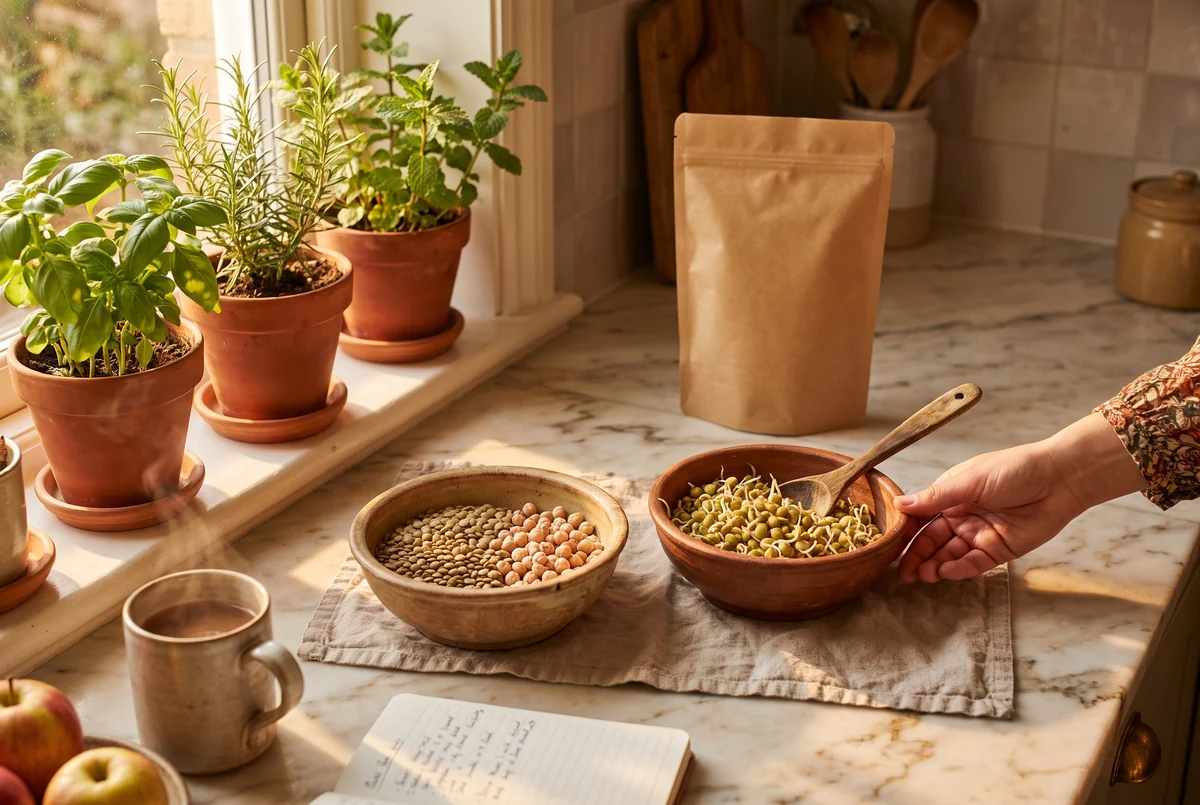
For legumes, we know soaking and gradual introduction. Sprouting goes further, because it goes after the sugars themselves: as it wakes up, the seed draws on its reserves to launch its shoot. With a sprouted seed, we hand our carpenter workers planks that are already sawn instead of tree trunks, and part of the digestive work is done outside, in the sprouter.
In sweet lupin, a laboratory study (Kaczmarska et al., 2017) measured a 98% drop in total oligosaccharides after uncontrolled germination (6 mg/g remained) and a 44% drop after controlled germination (86 mg/g). The figure is impressive, and I am always a little wary of impressive figures. In the first case, almost none of these sugars were left; in the second, a little more than half. The gap depends on the germination conditions and the species, and the measurement concerns the food, not people eating it: it cannot be extended to all seeds, nor used to infer an effect on the belly.
At our place, a sprouter runs all the time and sprouted seeds are eaten by the bowlful, while top chefs place them on the plate with tweezers. It is not a model, just our way of doing things. A few sprouted lentils in a salad are enough to start, everyone at their own pace, as part of a varied and balanced diet and a healthy lifestyle. We add rather than remove.
To deflate your belly in the moment, a short walk and a loosened belt remain the simplest gestures; you will find more ideas in 10 ways to a calmer belly. On the enzymes of raw plants, the page eating raw and enzymes takes stock, without promises. To go further, Justine Lamboley's book, "Santé intestinale", extends the reflection.
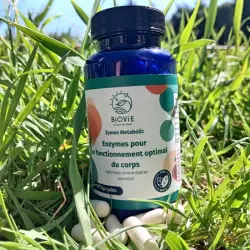
Biovie offers two enzyme-based food supplements, exclusive to the shop and notified to the French authorities: Enzymes Assimil, a blend of digestive enzymes (protease, amylase, lipase, lactase, cellulase) in capsules, and Enzymes Metabolic, which combines enzymes with plant and mushroom extracts. Both are taken at 3 capsules per day, around mealtimes. The detailed composition, the quantities per daily dose and the precautions for use are given on each product page., 2
products
A swollen belly after a festive meal is the lot of many of us. A belly that changes its behaviour, however, deserves a closer look. The American Gastroenterological Association update (Moshiree et al., 2023), an expert review, describes a measured approach:
imaging or endoscopy only in case of alarm signs, recent worsening or an abnormal clinical examination;
a blood test to rule out celiac disease;
an elimination diet or a breath test to detect a deficiency in a sugar-digesting enzyme;
a low-FODMAP diet, preferably with a dietitian.
Unintentional weight loss, blood in the stool, vomiting, new or worsening symptoms, permanent bloating: these signs call for medical advice. The breath test, for its part, measures exhaled hydrogen, a trace of sugar fermentation.
An enzyme must never delay medical advice when these signs are present. I prefer to put it in black and white.
The rest of the time, a belly swollen after eating is mostly a story of sugars and bacteria. Knowing what to do when you wonder why am I so bloated after eating often starts with a fork put down, or with a plate of sprouted lentils. Everyone at their own pace, and if you have found your own trick, write to me!
Frequently asked questions
Why am I always so bloated after eating?
Most often because of swallowed air, a meal that is too large, poorly digested sugars that ferment in the colon, or a sensitive gut. You are far from alone: nearly 18% of adults, surveyed in 26 countries, report bloating at least once a week.
How do I deflate my belly after a meal?
In the moment, walk a little, avoid lying down right after eating and loosen whatever feels tight. These are the simplest gestures. In the longer term, identify the foods involved, for example legumes or milk, to adapt portions or preparation.
How can I get rid of bloating quickly?
A little warmth on the belly and a gentle movement, like a short walk, are the most accessible gestures. An enzyme does not catch up with a meal that has already passed: it acts on the foods it meets during the meal, hence the point of taking it when you eat, not afterwards.
What is the best natural remedy for bloating?
There is no universal best remedy for bloating, because everything depends on the cause. If it is legumes, sprouting can reduce their fermentable sugars: in sweet lupin, a laboratory study measured up to 98% fewer oligosaccharides. Eating slowly and chewing well remain simple options.
Are digestive enzymes useful when gas comes from certain foods?
Yes, for two families of foods. With legumes, participants who took alpha-galactosidase reported fewer symptoms in two placebo-controlled trials. With milk, the enzyme lactase contributes to the breakdown of lactose in people who digest it poorly. In both cases, the enzyme is taken with the meal concerned.
When should I see a doctor about bloating?
See a doctor in case of unintentional weight loss, blood in the stool, vomiting, new or worsening symptoms, or permanent bloating. These alarm signs justify examinations, according to the American Gastroenterological Association update (2023). An enzyme must never delay that advice.
The information presented in this article is provided for information purposes only and does not constitute medical advice. Consult a healthcare professional before making any change to your diet or supplementation.