


What supplements do vegans need? Only one is essential, vitamin B12; vitamin D, iodine and omega-3 EPA/DHA depend on your situation, while calcium, zinc and iron are first watched on the plate, then through a blood test. At Biovie, we built this sorting on EFSA reference values and two recent systematic reviews.
Type the question into a search engine and look at the first nine results. Five are shops or product lists, prices alongside, where B12, vitamin D, omega-3, iron, iodine and zinc parade at the same level, like boxes on the same shelf. Everything would be worth the same, then? Enough to make you think you have to fill an entire basket to earn the right to eat plants.
I've been vegan since 1992, and I remember the starting point very well. Around age 20, I met someone who had eaten plant-based since birth, and I had this very clear feeling that I'd been lied to, I who had always been told that animal products were needed to be in good health. Since then there have been my engineering studies at ISTOM, Biovie founded in 2007, and over time, I ended up forgetting the basic questions. So when I meet someone who is just starting out, I sit down and listen: those are the most valuable questions to understand.
“Do I need to supplement everything?” is one of them. The answer comes in three levels, sources included, and with no supplement to sell you. Eating plants is not a condition to be managed with handfuls of pills: apart from B12, the plate does most of the work, and the sea, with its seaweed and its water, is happy to lend a hand.
What supplements do vegans need? One essential, three to assess, three to watch
Vegan deficiencies, what supplements do vegans need to take? The sorting comes down to three levels: vitamin B12 is essential for everyone, while vitamin D, iodine and omega-3 EPA/DHA depend on the sun, your salt and your situation. Calcium, zinc and iron, for their part, are played out on the plate first.
| Nutrient | Level | Adult reference value | Where the balance is played |
|---|---|---|---|
| Vitamin B12 | Essential | 4 µg/day (EFSA, 2015) | Supplement or fortified foods |
| Vitamin D | Depends on sun and season | 15 µg/day without skin synthesis (EFSA, 2016) | Sun, possibly a supplement in winter |
| Iodine | Depends on your habits | 150 µg/day (EFSA, 2014) | Iodized salt, seaweed in moderation |
| Omega-3 EPA/DHA | Depends on your situation | No numerical reference value used here | Walnuts, flax, flaxseed oil, algae oil |
| Calcium, zinc, iron | The plate first | No numerical reference value used here (750 mg/day calcium threshold mentioned below) | Soaked legumes, seeds, nut butters, sea spaghetti for iron |
| Minerals and trace elements | The plate, and the sea in small amounts | No single reference value: one per mineral | Seaweed, marine plasma in a small dose |
To picture this sorting, think of a car's dashboard. One warning light stays on permanently: the B12 one. You end up not noticing it, it's there, that's all. Three others come on depending on the season, the road and the passengers (vitamin D, iodine, omega-3). And the last three only blink if the basic maintenance, meaning the plate, has been neglected.
This ranking doesn't make plant-based eating a fragile lifestyle. Oh really, meat-eaters wouldn't have deficiencies, them? A systematic review of 141 studies (Neufingerl and Eilander, 2021) reminds us that they have their shortfalls too, in fiber, ALA, folate or vitamins D and E. It's just that nobody asks them the question. Each their own dashboard.
Vitamin B12: the one supplement that's non-negotiable
If I had to keep just one answer to “what supplements do vegans need”, it would be B12. No debate, no “it depends”. In the current state of research, vitamin B12 is the only nutrient on this list for which the plant-based plate cannot do the job alone, however carefully planned.
Why isn't a plant-based plate enough?
B12 is made neither by plants nor by our body: bacteria produce it. A plate of vegetables, grains and legumes, however beautiful, therefore can't be a reliable source.
And spirulina, you'll say? It's often presented as a source of B12, and that's where you have to look at the molecule up close. Watanabe's team reviewed the available food analyses: most edible cyanobacteria, spirulina included, mainly contain a pseudovitamin B12, inactive in mammals (Watanabe et al., 2013).
This pseudo-B12 is a key cut the wrong way: it looks right, it goes into the lock, but the door doesn't open. You are not what you eat but what you absorb, and a B12 the body can't use doesn't count.
The alga isn't to blame: it all comes down to the shape of the molecule. Spirulina keeps all its interest for the rest of its composition, which our complete guide to spirulina details, just not for B12. The same team also surveyed the plants that contain B12, and dried nori comes out as the most suitable plant source identified (Watanabe et al., 2014). Suitable, not sufficient: nothing proves it covers your needs, so it doesn't replace the supplement. For those who want to dig deeper, here is what we know about the B12 in nori.
How much: 2.4 µg or 4 µg?
A systematic review of 48 studies (12 cohorts and 36 cross-sectional studies) puts the B12 intakes observed in vegans between 0.24 and 0.49 µg per day, against a recommendation of 2.4 µg (Bakaloudi et al., 2021). In other words, the measured intakes are five to ten times lower than the recommendation. That's not a small gap you close with a bit of attention, it's another order of magnitude.
EFSA, for its part, sets 4 µg per day for an adult, an “adequate intake” based on blood markers and on intakes observed in Europe (EFSA, 2015). Four millionths of a gram. A speck of dust, and yet it's the European reference.
Why two figures? The 2.4 µg is the American value used by the review, the 4 µg the European value, and the two committees didn't follow the same method. Either way, from one continent to the other, the practical conclusion doesn't change: with a few tenths of a microgram a day, the numbers don't add up.
And the dose of a vitamin B12 supplement for vegans? There, I won't give you a figure. None of the sources used here sets a supplement dose: the product label and your healthcare professional are the right people to ask.
What the DGE says (2024)
The German Nutrition Society (DGE) updated its position in 2024: in adults, a well-planned vegan diet can be favorable to health, provided vitamin B12 is supplemented (Klug et al., DGE, 2024). Coming from a learned society, the sentence has the merit of being clear, and I admit it pleases me. Vitamin B12 contributes to the normal functioning of the nervous system, as part of a varied and balanced diet and a healthy lifestyle.
Vitamin D and iodine: to assess according to your situation
As for what vitamin supplements vegans need beyond B12, there's no single rule here, and that's rather good news. The need depends on very concrete things: the latitude where you live, the month of the year, the salt in your salt shaker.
Vitamin D
EFSA sets the reference value at 15 µg per day for adults, with a blood target of 50 nmol/L of 25(OH)D, the form measured in a blood test (EFSA, 2016). This value assumes minimal skin synthesis, in other words skin that barely sees the sun. When your skin gets enough sun, the dietary need goes down, and it can even disappear.
It all comes down to the calendar, then. In winter, in France, the sun often isn't enough anymore, and the Neufingerl and Eilander review finds a lower vitamin D status in plant-based eaters. That leaves the classic objection: isn't D3 necessarily of animal origin? No, it also exists in a plant-based version, made from lichen. Vitamin D contributes to the maintenance of normal bones.
Iodine
For iodine, the EFSA reference value is 150 µg per day for adults (EFSA, 2014), barely more than a tenth of a milligram. In the review of 141 studies, vegans are the ones with the lowest iodine intakes and status. Iodine contributes to the normal function of the thyroid, as part of a varied and balanced diet and a healthy lifestyle.
The simplest step is already in your kitchen: replace non-iodized salt with iodized salt, without using more of it. No need to look further. Seaweed also provides iodine, but its content varies a lot from one species to another and too much isn't desirable either: enjoy it in measured amounts, raw, rehydrated or as flakes on the plate.
Well, I won't hide that I love seaweed, I co-wrote an entire book about it, Algues au quotidien. It's precisely because I know it well that I recommend it with moderation when it comes to iodine. Loving it doesn't mean serving it by the ladle.
Long-chain omega-3: the real question of EPA and DHA
Behind the word “omega-3” hides a whole family, and it would be wrong to lump it all together. In plants (walnuts, flaxseeds, hemp), you mostly find ALA, a short-chain omega-3. EPA and DHA, on the other hand, are long-chain omega-3s that we associate with fish, whereas originally it's microalgae that produce them.
Fish is just an intermediary.
It plays a bit the role of the wholesaler who resells what he bought from the producer. Being an importer myself, I know that trade well, and I know you can also go straight to the source.
A review of 141 studies finds lower EPA and DHA intakes in plant-based eaters (Neufingerl and Eilander, 2021). What remains is how much ALA your body converts into EPA and DHA, and there, you read everything and its opposite. I have no verified figure to give you on this conversion, and I'd rather tell you so than make one up.
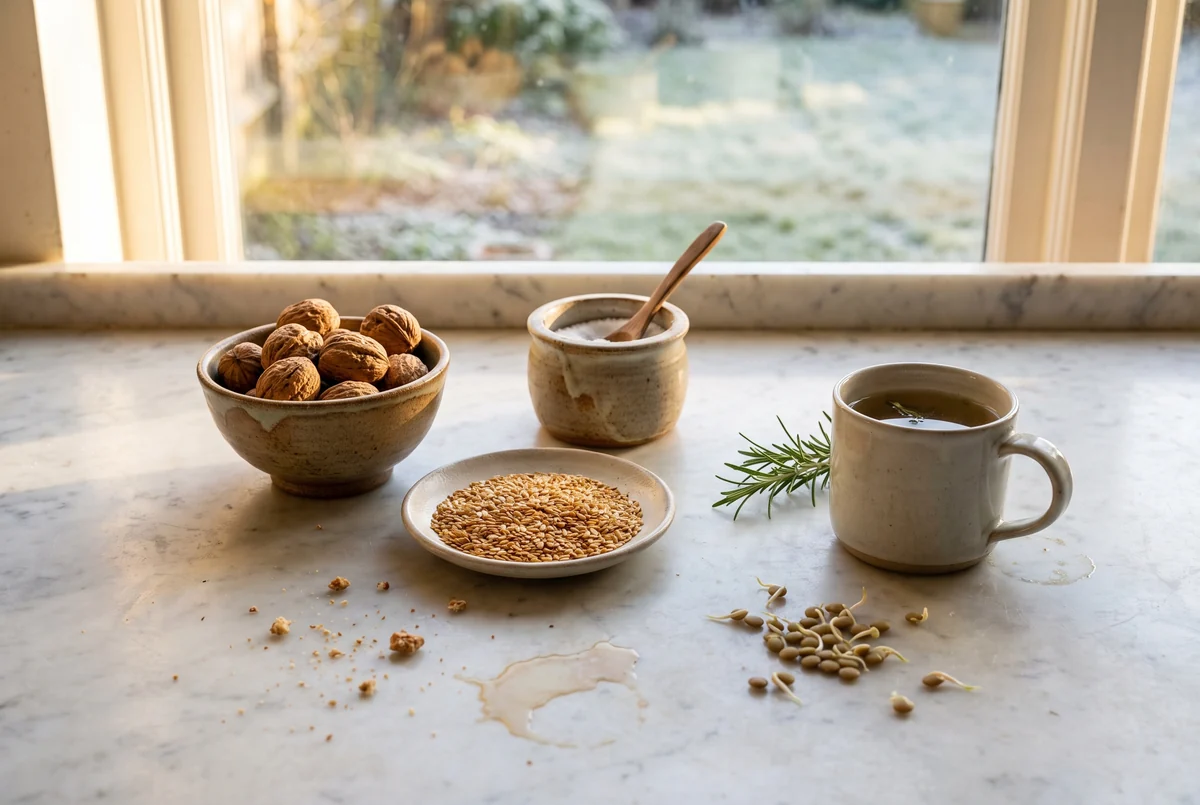
In practice, walnuts, flaxseeds and a spoonful of flaxseed oil each day provide ALA. Flaxseed oil is poured on the plate, never in the pan: raw, kept cool and away from light, as we explain in our article on flaxseed oil. For EPA and DHA, an algae oil providing DHA is something to discuss depending on your situation, notably during pregnancy or for children, with a healthcare professional. It's the omega-3 from algae, without going through fish.
Calcium, zinc, iron: the plate first, the blood test after
This is the chapter where we have to face the numbers, and they're not all comfortable. I'm convinced that plants don't make you deficient; it still has to be planned with a bit of care, like any plate you want to hold up.
Calcium and bones
According to the review of 48 studies by Bakaloudi and colleagues, most vegans have calcium intakes below 750 mg per day, less than three quarters of a gram. The Neufingerl and Eilander review also notes a lower bone mineral density in vegans.
And then there's EPIC-Oxford, a prospective cohort that followed 57,898 participants, including 1,982 vegans, for 17.6 years on average (Tong et al., 2020). Compared with meat-eaters, veganism is associated there with a 1.43 times higher risk of total fracture, and a 2.31 times higher risk of hip fracture. Put like that, it's abstract. In a room of 1,000 people followed for ten years, that represents 14.9 more hip fractures: about fifteen people.
I won't brush this result aside just because it doesn't suit me. So of course, this study has to be read for what it is: an observational study, which shows an association and not a cause. The gap is wider without adjustment for body mass index, and taking calcium and protein into account narrows it slightly without erasing it. I see it as a good reason to look after your calcium, and no reason to give up plants. Calcium is needed for the maintenance of normal bones, as part of a varied and balanced diet and a healthy lifestyle.
Zinc and iron
On the zinc side, intakes are lower in vegans (Bakaloudi et al., 2021), and iron and zinc status is lower in plant-based eaters (Neufingerl and Eilander, 2021). The plate has plenty to offer, though: soaked legumes, nut butters, and the seeds you can sprout, which slip in everywhere, from salad to sandwich.
Iron and vitamin C: sea spaghetti
For plant-based iron, one detail matters, and it plays out in the kitchen: vitamin C contributes to increasing iron absorption. You're told everywhere to add an orange or a lemon next to the dish. Me, I prefer the seaweed that does both at once: sea spaghetti contains both iron and vitamin C, in the same food. It's a Breton brown alga, and our article on sea spaghetti reports measurements of 28.5 to 120.5 mg of vitamin C and about 59 mg of iron per 100 g of dehydrated seaweed (analyses by CEVA and BIOCEAN, quoted in that article).
Let's keep a cool head: you eat a few grams at a time, not 100 g, and these figures vary with the harvest season and the drying. Sea spaghetti is therefore not an iron supplement: it's an ingredient that makes the plate smarter. A few flakes on soaked lentils or in a salad of soaked chickpeas, and the pairing happens without thinking. Like all seaweed, it contains iodine: use it in moderation, and ask your doctor for advice in case of a thyroid disorder. It's just kitchen common sense.
Iron, for its part, is only supplemented after a ferritin test, prescribed by your doctor. Not before, and not “just in case”. For the rest, here is the complete table of plant sources, nutrient by nutrient.
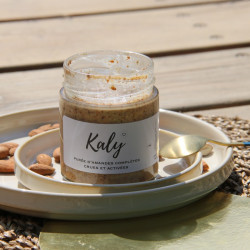
Among nut butters, organic whole almond purée, raw and activated, easily finds its place in a salad dressing or a raw soup. An everyday ingredient to vary the sources on your plate, with no promise of covering your calcium needs on its own.