

You don't need to decode 200 E-numbers to eat well. The simplest answer to ultra processed foods is a rule you already know deep down: choose food that doesn't need a label. A handful of sprouts, a jar of lacto-fermented vegetables, microgreens growing on your kitchen counter — zero dyes, zero preservatives, zero "cosmetic" additives, by design. That's exactly what we've championed at Biovie since 2007, and the science that landed in 2026 just put a huge spotlight on it.
So let's look at it calmly.
New 2026 studies raised the stakes
On May 21, 2026, France's Inserm and INRAE released three studies in a row, all drawn from the NutriNet-Santé cohort — more than 100,000 people tracked since 2009. Mathilde Touvier's team looked, at unprecedented scale, at what people actually eat: not vague categories, but the exact brands and products, additive by additive.
Here's what stood out, and it's striking.
For type 2 diabetes, the highest consumers of food coloring additives showed a 38% higher risk than the lowest consumers (published in Diabetes Care). For cancer, a second study found an association with a 14% higher overall risk, and 21% for breast cancer (European Journal of Epidemiology). A third, this time on preservatives, linked the highest intakes to a 24% higher risk of high blood pressure (European Heart Journal).
So what does that mean at your kitchen table? Not that one brightly colored yogurt will make you sick tomorrow — these are statistical associations across large populations, not proof of cause and effect for any individual, and the researchers say so themselves. What it means is simpler: the easiest, most immediate lever you actually control is to cut the share of ultra-processed food on your plate. Not out of fear. Out of common sense.
And honestly, that's where I find the news reassuring. Because the "way out" isn't deprivation. It's a return to living food. As I always say: add one new healthy food, and the ones that aren't healthy will quietly find their own way out over time.
What counts as ultra-processed?
Good question — and the answer is clearer than people think. We use the NOVA classification, which sorts food into four groups by degree of processing.
- Group 1: unprocessed or minimally processed foods — an apple, dry lentils, seeds, fresh fish.
- Group 2: culinary ingredients — oil, salt, vinegar.
- Group 3: simple processed foods — sourdough bread, canned vegetables, cheese.
- Group 4: ultra-processed foods.
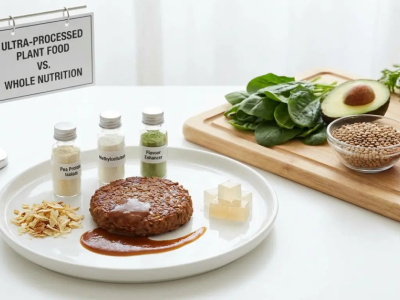
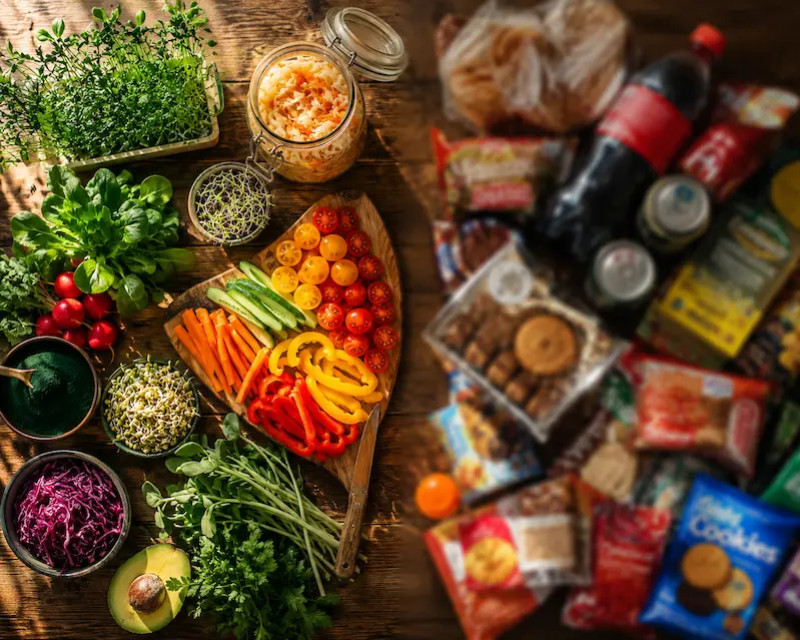
How do you spot them without a chemistry degree? A field trick from my years as an agronomist: flip the package over and read the list. If you find five or more ingredients, and especially things you'd never keep in your own kitchen — high-fructose corn syrup, protein isolates, emulsifiers, E1xx dyes, E2xx preservatives — you're holding an ultra-processed food. Those "cosmetic" additives are the clearest marker: they're there for color, texture and shelf life. Not to nourish you.
A handy reference the 2026 studies reiterate: on labels, dyes run from E100 to E199, preservatives from E200 to E299, antioxidants from E300 to E399. You don't have to memorize them. Just notice when they show up.
And remember — processing food isn't bad in itself. Fermenting, sprouting, gently cooking are all transformations, and some of the best there are. The problem isn't processing. It's industrial ultra-processing.
The "no-label" rule
Here's the mental switch that changes everything, and it's become a kind of compass for us: the best food is often the one with no label.
A handful of sprouts has no ingredient list. Microgreens you snip at the base have no printed expiry date. A jar of lacto-fermented cabbage you started yourself contains only cabbage, salt and time. Sea spaghetti flakes, too: just the seaweed, dried. Zero dyes, zero preservatives, zero additives. Not because they were "removed" — but because they never had any reason to be there.
That's living food. And that's exactly why it answers the additive worry almost by accident: you're not fighting an ingredient list, you simply make it disappear.
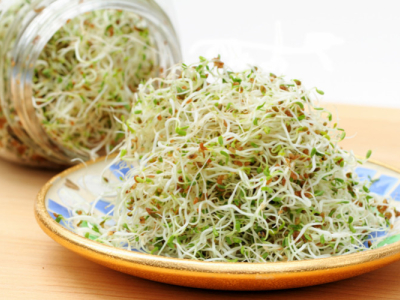
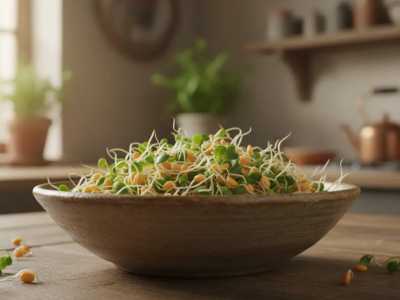
Sprouting seeds are the most accessible entry point. Alfalfa, radish, broccoli, lentil, fenugreek — you start from the raw seed, add water and a little light, and within days you've got fresh, crunchy, living food. For my part, it's the first thing I suggest to anyone who wants out of ultra-processed eating without upending their life: start with sprouts.
Grow food at home: move number one
If I had to keep just one action, this would be it. Not a diet. Not an endless shopping list. Just grow a little of your own food. And frankly, it's easier than assembling flat-pack furniture.
Sprouting: 2 minutes a day
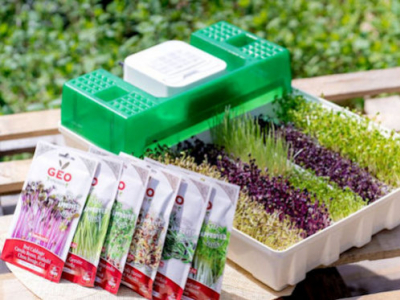
People overstate the difficulty. Here's the everyday truth: you put your seeds in a sprouter, rinse morning and evening — two minutes total, about as long as your tea takes to steep — and nature does the rest. No soil, no garden, no green thumb. A corner of the counter is enough.
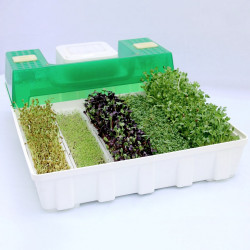
With an EasyGreen sprouter, rinsing even becomes automatic, removing the one small chore that's left. For the first week, change nothing else about your diet: just add a spoonful of sprouts to what you already eat. That's it. Density comes naturally later, once the habit sticks. What people tell me most often isn't some dramatic transformation — it's the simple pleasure of watching something grow at home, and the quiet pride of producing fresh food with no label at all. One customer, Catherine, puts it well in her review: "seeds to sprout, a very rich diet" (French customer review). That's exactly it.
€269.00
Out-of-Stock
Easygreen Light automatic sprouter
Lacto-fermentation: a jar, salt, time
The other move is fermentation. And again, this is something humanity has done for millennia, long before laboratories.
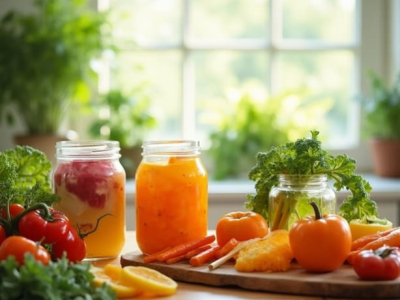
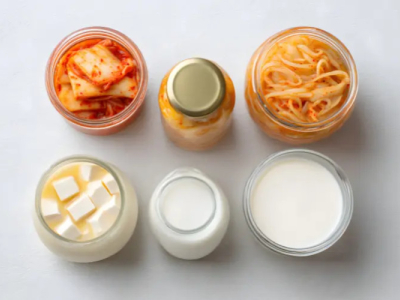
Shredded cabbage, salt, a glass jar, pack it down, wait one to two weeks at room temperature. You get living lacto-fermented vegetables, rich in good bacteria, that keep for months — without a single synthetic preservative. Salt and microorganisms do the job industry hands off to additives. To get going, here's where to start with home fermentation.
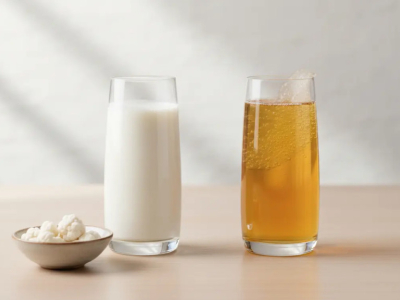
You can also try kefir or kombucha, those fizzy, living fermented drinks (we compare the two in this complete kefir-or-kombucha guide). And if a recipe calls for milk, skip the industrial oat milk: hemp or tiger-nut milk, homemade or plain, do the job perfectly and stay true to the "no-label" logic.
What many people describe after adopting these fermented foods is lighter digestion and the pleasure of a living, tangy taste no standardized product can copy. Nothing medical about it — just a real food coming back into everyday life.
"Natural" colors aren't automatically safe
Let's be honest, because it matters and it adds nuance. You might assume a naturally derived dye is automatically harmless. The 2026 studies caution against that shortcut.
Among the dyes associated with higher type 2 diabetes risk you'll find, for example, carotenoids (E160), plain caramel (E150a), and even curcumin (E100) — additives often seen as "natural." In reality, what matters isn't the "natural" marketing label, but the dose, the isolated form, and the fact that these molecules rarely travel alone: they ride inside products that are themselves ultra-processed and often very sweet.
Let me be clear: this isn't about demonizing the turmeric in your kitchen, which is a whole, precious spice. It's about understanding that an isolated additive, dosed to color an industrial product, has little to do with the original food. One more reason to come back to the whole, the raw, the living — rather than hunting for the "good" additive.
FAQ — Ultra processed foods
What are ultra-processed foods?
They're the Group 4 foods in the NOVA classification: sodas, industrial cookies, ready meals, sugary breakfast cereals, reconstituted deli meats, salty snacks, some "health" bars. You recognize them by a long ingredient list (often five or more) featuring cosmetic additives absent from home kitchens: dyes, emulsifiers, flavor enhancers, sweeteners.
How do I spot an ultra-processed food quickly?
Flip the package over. If you read ingredients you don't own at home, and lots of E-numbers, that's a clear signal. By contrast, a food with no ingredient list — a seed, a vegetable, a microgreen — is by definition not ultra-processed.
Are ultra-processed foods bad for you?
Large observational studies, like Inserm's on the NutriNet-Santé cohort, find associations between high intake and increased risk of certain conditions. These are statistical associations, not proof of cause and effect for an individual. The public-health consensus is clear: it's wise to limit these products and favor unprocessed or minimally processed foods.
What can I replace ultra-processed foods with, simply?
With raw, living foods that are easy to add in: sprouts, microgreens, lacto-fermented vegetables, seasonal fruit and vegetables, legumes. The idea isn't to change everything at once, but to gradually raise the share of living food.
Do I really need to cook for hours to avoid ultra-processed food?
No. Sprouting seeds takes two minutes a day. Starting a jar of lacto-fermentation, ten minutes once every two weeks. These are short moves that add to your routine instead of replacing it.
Are "natural" colors safe?
Not automatically. Several naturally derived dyes (caramels, carotenoids, curcumin as an additive) are among those associated with higher risk in recent studies. An additive's "natural" origin doesn't guarantee its safety at the dose and in the isolated form used by industry.
Take back control, without the guilt
Let's end here, because it's the most important part. The goal was never perfection. Nobody eats "perfectly," and feeling guilty in a supermarket aisle has never made anyone healthier.
What I'm offering is much gentler: add living food. A little more each week. A handful of sprouts here, a fermentation jar there, microgreens on the windowsill. As living food takes up more room on your plate, ultra-processed food loses ground — without you having to wage war on anything. It's addition, not subtraction.
And maybe that's the real answer to the 2026 studies: not fear, but action. If you want to test for three weeks what it changes to grow part of your own food, the "Essentials" discovery pack gathers the easiest seeds to sprout so you can start without going wrong. At your own pace. This way.
Eric Viard — founder of Biovie, agricultural engineer (ISTOM) and co-winner of the 2025 Gourmand World Cookbook Award. He has been helping people return to living food since 2007.
This article is for information only and is not medical advice. The studies cited report statistical associations, not cause-and-effect relationships. For any health concern, talk to a professional.