


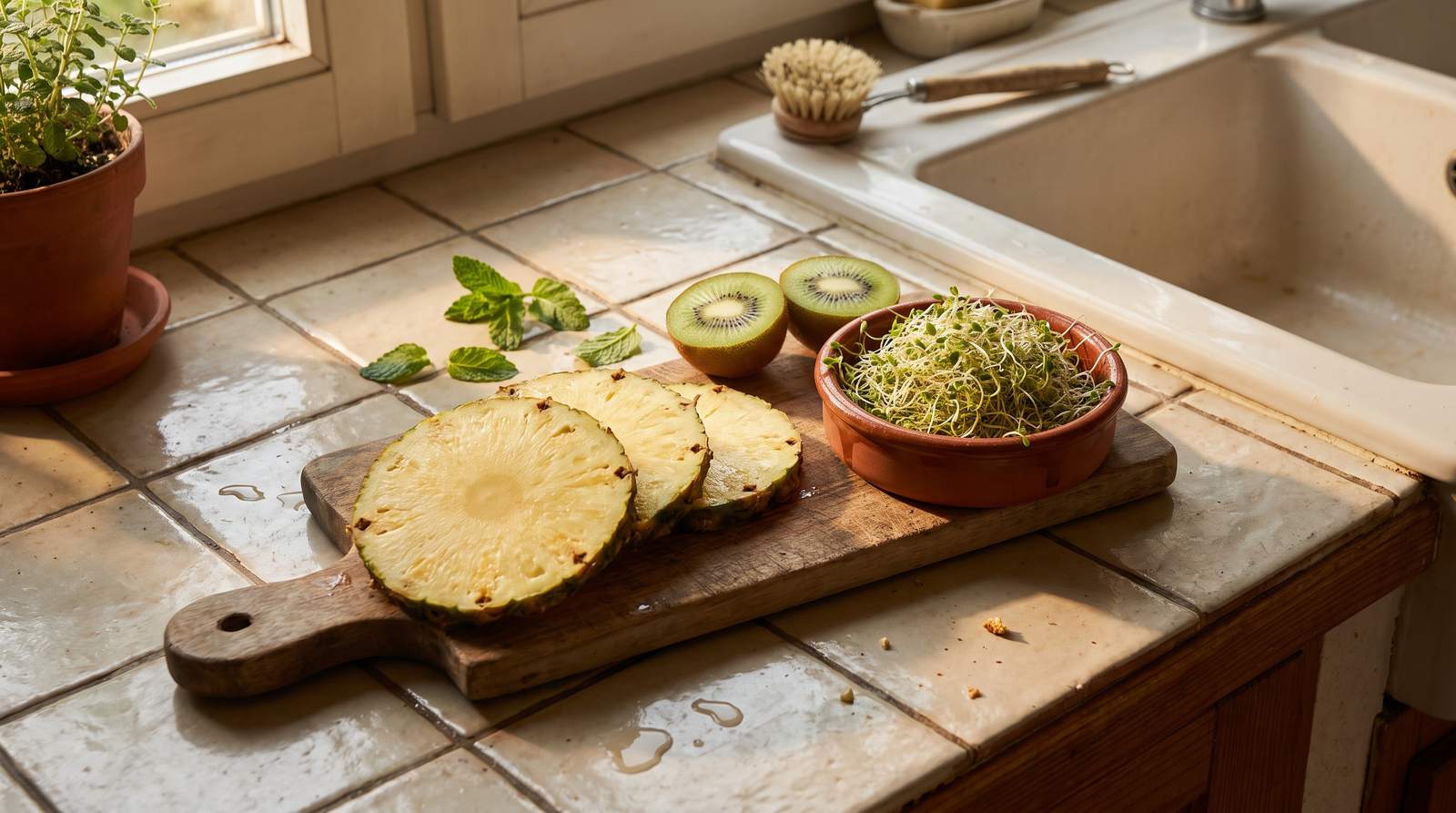
A green kiwi, a raw broccoli floret, a slice of pineapple: on the question of raw food enzymes and digestion, the answer is yes, they do contain enzymes, but your body makes the ones that digest your meal itself, and most food enzymes are digested like any other protein. A few still act, and their real value plays out in the food itself. As the founder of Biovie, vegan since 1992 and a living-food practitioner since the early 2000s, I rely here on eight sources, cited one by one.
Raw Food Enzymes and Digestion: Yes, but Not the Way You Think
Yes, raw foods contain enzymes. But your body makes the ones that digest your meal itself, from the saliva to the small intestine (NIDDK). A large share of food enzymes is digested like any protein; a few, such as bromelain or actinidin, still act. Their main value plays out in the food itself.
There is a sentence I have heard a hundred times since the early 2000s, in one form or another, and that I repeated myself in my early days with all the fervour of the convert: “every raw food contains the enzymes needed to digest itself”. It sounds nice, it is simple, it sticks. But it mixes truth and fiction.
The truth: a kiwi or a raw broccoli does hold active enzymes, nobody disputes that. The fiction, or at least the never-demonstrated: that they digest your meal in place of your own. So, do raw foods contain digestive enzymes, and does eating raw bring you any? Yes, and on this trio of raw food enzymes and digestion, the whole point is to know where they really work.
Three Families of Enzymes Not to Confuse
An enzyme is a protein that speeds up one precise reaction, always the same one. There are three families, which get mixed up in just about every conversation on the subject.
The ones your body makes
I picture digestion as a workshop of carpenters in blue overalls, each at their own bench with their own tool. The saliva attacks starch, the stomach adds its acid and its enzymes, the pancreas cuts up carbohydrates, fats and proteins, then the small intestine finishes the job, helped by bacteria for certain carbohydrates (NIDDK). And it all starts with chewing.
The ones in foods
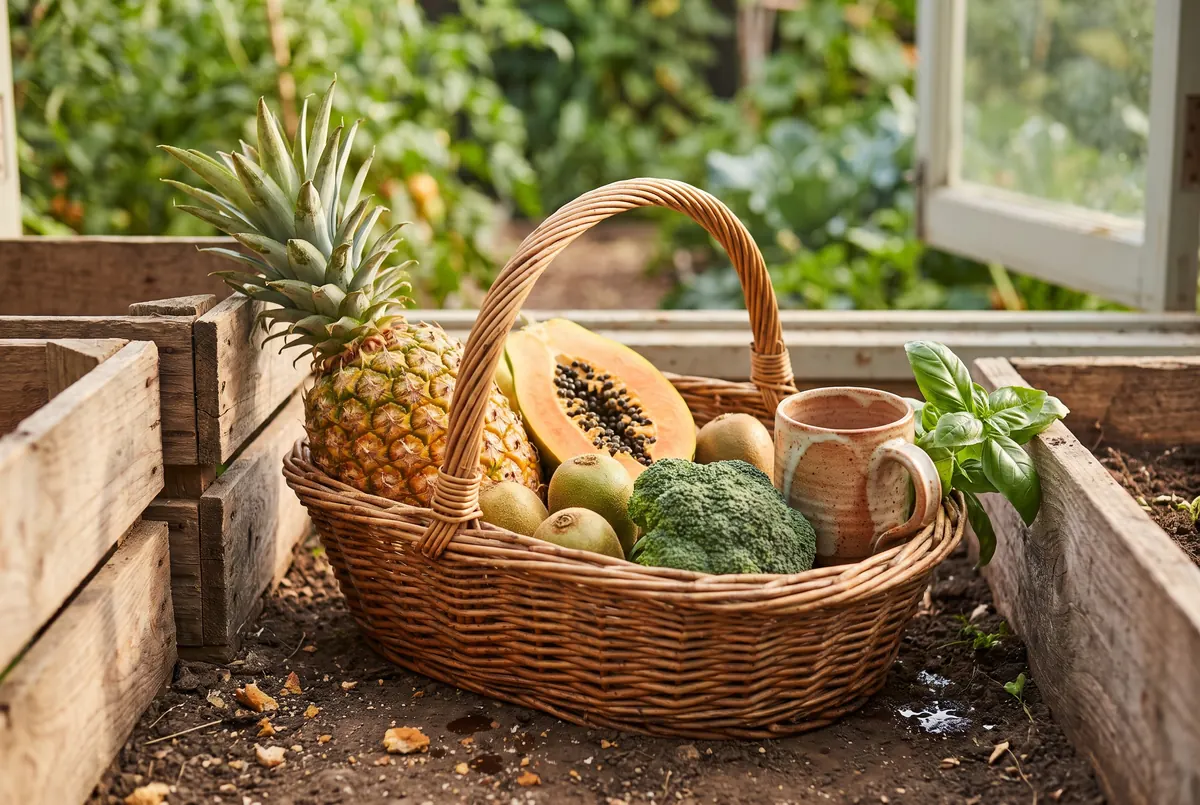
Pineapple has its bromelain, papaya its papain, green kiwi its actinidin, broccoli its myrosinase, and sprouting seeds activate their amylases and phytases (Nkhata et al., 2018). None of this lot was put there to do us a favour. These enzymes first serve the plant itself.
The ones in supplements
Here we change gear. The aim is to make up for a diagnosed shortfall, such as pancreatic insufficiency or a lactase deficiency. According to a non-systematic review (Ianiro et al., 2016), enzymes of animal origin then remain the reference treatment, while plant or microbial enzymes are a promising lead. I went into what digestive enzymes are for in a dedicated article.
What Happens to Food Enzymes in Your Stomach?
An enzyme is still a protein, and your stomach does not sort the “useful” proteins from the others: its acidity unfolds it, then pepsin cuts it up like the rest of the meal. The lab model of Kaur et al. (2010) works, by the way, with pepsin at pH 1.9, a very acidic environment, close to lemon juice. Most of the enzymes in your salad therefore end up like its other proteins. It is less romantic, but that is how it is.
Two nuances, though.
The first comes from pineapple. In 19 healthy men who took 3 g a day of purified bromelain (extracted from the pineapple stem), a small fraction passed into the blood intact, and partly active (Castell et al., 1997): up to 5,000 pg/ml at 48 hours, about 10.8 µg between 3 and 51 hours, and a half-life of 6 to 9 hours (the time it takes for half of it to disappear from the blood). Put like that, the figure is impressive. Except that a picogram is a thousandth of a billionth of a gram: a drop in a bathtub. And 3 g of purified bromelain has nothing to do with a slice of pineapple; the study does not measure digestion, either.
The second comes from kiwi. In the lab, green kiwi extract increased the digestion of certain proteins, not all of them: on milk casein, +37% for alpha-casein, +33% for beta and +48% for kappa (Kaur et al., 2010). A third to almost half more cutting up is not nothing. But this is test-tube work, and nothing allows us to conclude as much for your stomach.
I often say it: we are not what we eat, but what we assimilate. And nutrient assimilation starts with chewing, the first step of digestion (NIDDK).
Does Cooking Destroy Enzymes in Food? The Broccoli Example
For some of them, yes, and broccoli is the textbook case. Its myrosinase is sensitive to heat: in the lab, its inactivation was measured between 30 and 60 °C (Ludikhuyze et al., 1999). To give you an idea, you would not leave your hand in water at 60 °C for long. So in a pot of boiling water, the matter is settled quickly.
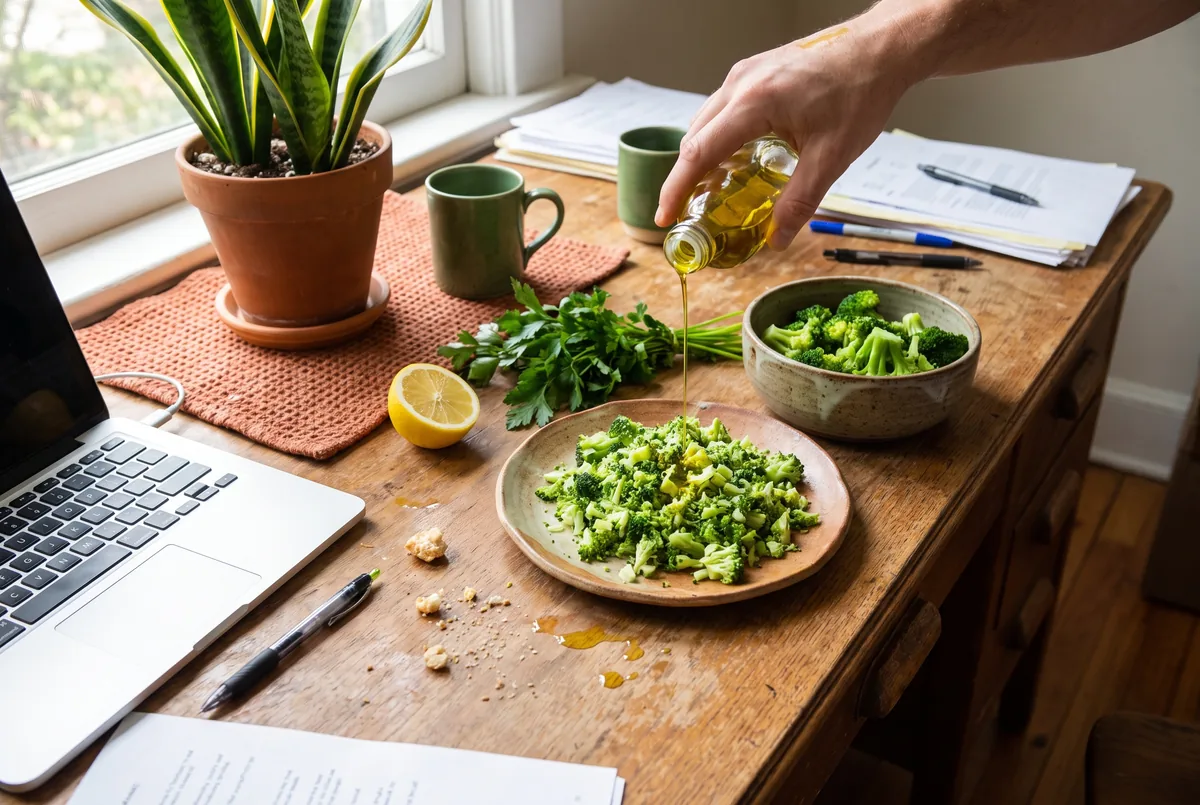
What remained was to see what that changes on the plate. A randomised crossover trial in 8 men compared 200 g of crushed broccoli, raw or cooked, each man eating both versions (Vermeulen et al., 2008). Eight people is a small sample, I will not tell you otherwise. Yet the gap is clear: 37% of the available sulforaphane with raw broccoli, versus 3.4% cooked, and a blood peak at 1.6 hours versus 6 hours.
Raw or cooked broccoli: for the same plate, the cooked version makes about ten times less available. It is a real argument for raw, and it is measured. But look closely at where the action happens. Here, the raw food’s enzyme makes sulforaphane inside the crushed food; the digestion of the meal remains your body’s business.
| Food | Enzyme | What it does | What was measured |
|---|---|---|---|
| Pineapple | Bromelain | Cuts up proteins | Partial passage into the blood, in humans (Castell et al., 1997) |
| Green kiwi | Actinidin | Cuts up certain proteins | +33 to +48% casein digestion, in vitro (Kaur et al., 2010) |
| Broccoli | Myrosinase | Produces sulforaphane | 37% available raw versus 3.4% cooked, in humans (Vermeulen et al., 2008) |
| Sprouted seeds | Amylases, phytases | Break down the seed’s starch and phytates | Activation described by a review (Nkhata et al., 2018) |
Papain from papaya is not in it, for lack of a figure in the sources I kept: I would rather have one line less than one invented line. On another front, I wrote about eating raw and enzymes in relation to oxalates.
Sprouted Seeds and Ferments: Enzymes That Work Before the Plate
I was already sprouting seeds as a teenager, at my parents’ place, long before Biovie. A dry seed is a dormant reserve, neatly locked away; give it water, and a real little factory starts up. During sprouting and fermentation, the seed’s own enzymes (alpha-amylase, pullulanase, phytase) switch on and break down part of the antinutritional factors, such as the phytates that hold back certain minerals (Nkhata et al., 2018). It all plays out before the plate.
Go back to our workshop of carpenters and imagine they are handed planks already sawn rather than tree trunks: the bulk of the work was done outside, in the sprouter or in the jar. Between raw food enzymes and digestion, this is where food enzymes show their value best.
To see them at work at home, browse the list of fermented foods.
Eating Raw: A Real Benefit, Not an Absolute Rule
I will be honest with you. At the start, I spent a year and a half at 100% raw, in a religious way, extremist even, and I did my share of proselytising along the way. I came back from it to something more sustainable, with a little cooked food. It was a personal experience, not a model.
A cross-sectional study of 198 strict raw foodists in Germany (about 95% raw, mostly fruit) reminds us of it in its own way (Garcia et al., 2008): normal vitamin A in 82%, favourable beta-carotene in 63%. So far, nothing to complain about. But low lycopene in 77%, roughly three people out of four. Fat intake predicted the carotenoid level, with no proof of cause and effect (a cross-sectional study takes a snapshot at one moment, it does not demonstrate).
Lycopene is the red pigment of the tomato, and it is released better when the tomato is cooked with a little fat. The simmering tomato sauce had a few arguments in its favour, then. Raw has a real benefit, without winning on every front.
My suggestion is to alternate raw and cooked, to add rather than remove, each at their own pace, as part of a varied and balanced diet and a healthy lifestyle. No all or nothing. A first step? A raw starter at the beginning of a meal, well chewed.
To go step by step, there is Justine Lamboley’s 21-day raw food programme, and to sort fact from fiction, the misconceptions about living food.
What About Enzyme Supplements?
Enzyme supplements have an established use when a shortfall is diagnosed, and they do not replace the enzymes your body makes (Ianiro et al., 2016). In a person without a deficiency, the sources gathered here show no particular benefit. I prefer to say that plainly before telling you about what we offer.
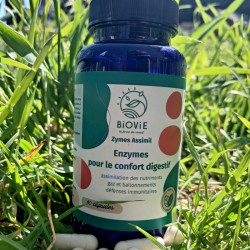
At Biovie, we offer Enzymes Assimil, a complex of plant-origin enzymes obtained by fermentation: amylase, protease, glucoamylase, bromelain, lactase, lipase, papain, pectinase, cellulase, invertase, alpha-galactosidase and peptidase. You will find two old acquaintances in it, the bromelain of pineapple and the papain of papaya. These are plant digestive enzymes, which I describe here for their composition, with no promise about your digestion. The product page says to take them at the start of a meal.