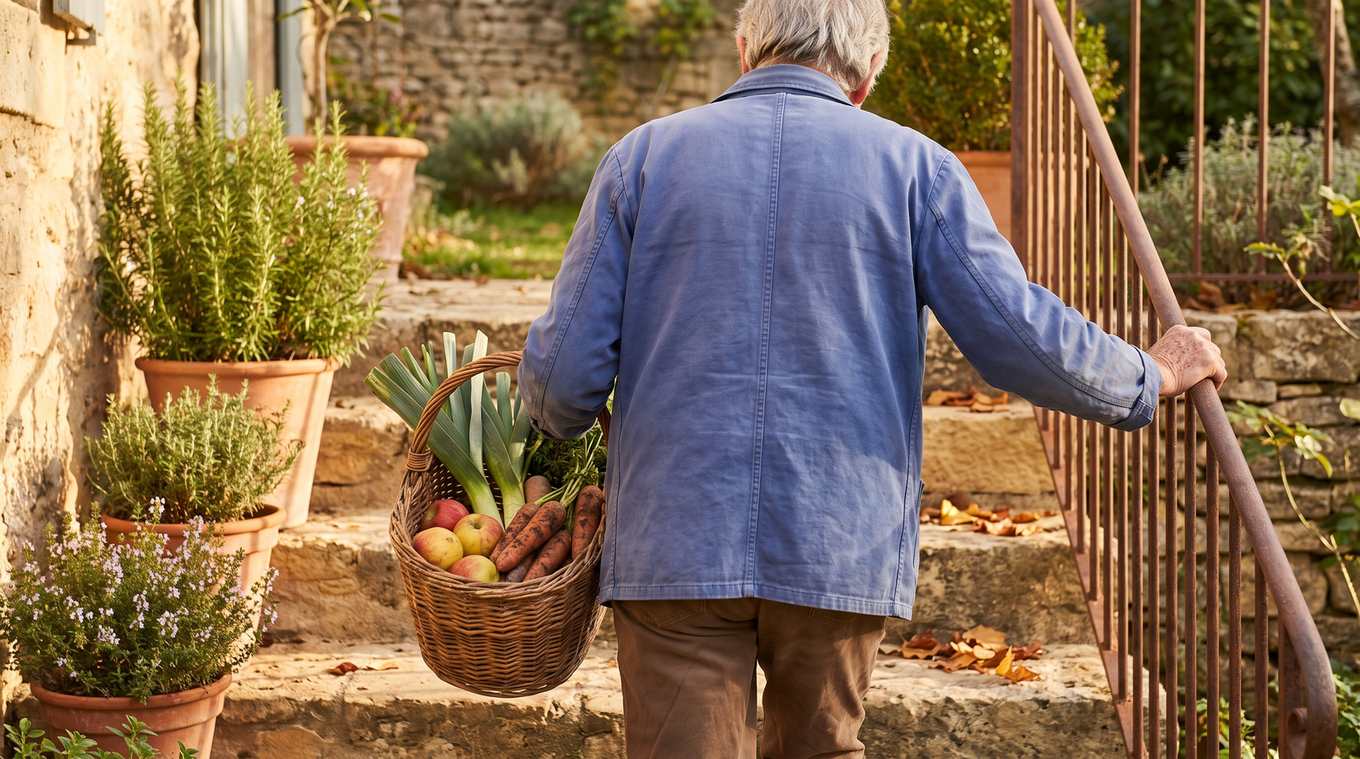
Climbing the stairs more slowly than you used to doesn't call for doubling your protein: when it comes to protein for seniors, ANSES settles on about 1 g per kilo per day after 65. An ordinary plant-based day is enough to reach it, and movement remains the best-documented lead for keeping your muscles. At Biovie, we built this page on the opinions of ANSES, EFSA, the Dutch Health Council and the WHO.
The fear of wasting away
Shopping bags feel a little heavier. The last step of the staircase asks for an effort you never noticed before, and your hand looks for the banister without thinking. Then the children worry: "And your protein, is that okay?"
This feeling of losing a bit of strength is common after 60, and it is anything but inevitable. Muscle loss in older people can be measured. And above all, it can be worked on.
I am an ISTOM engineer, vegan since 1992, and I founded Biovie in 2007. Around the age of 20, I met someone who had eaten plant-based since birth. That is when my view of food changed, a real shock for me, since I had always been led to believe that you needed animal products to be healthy.
Since then, I have been wary of ready-made answers about protein for seniors. Eat more or move more? The real question is rather the order in which you go about it.
Sarcopenia in plain language
What it is, what it isn't
"Sarco" means flesh, "penia" means lack. Sarcopenia is muscle that slowly shrinks with age, gently, like a ball of wool unwinding a little each year.
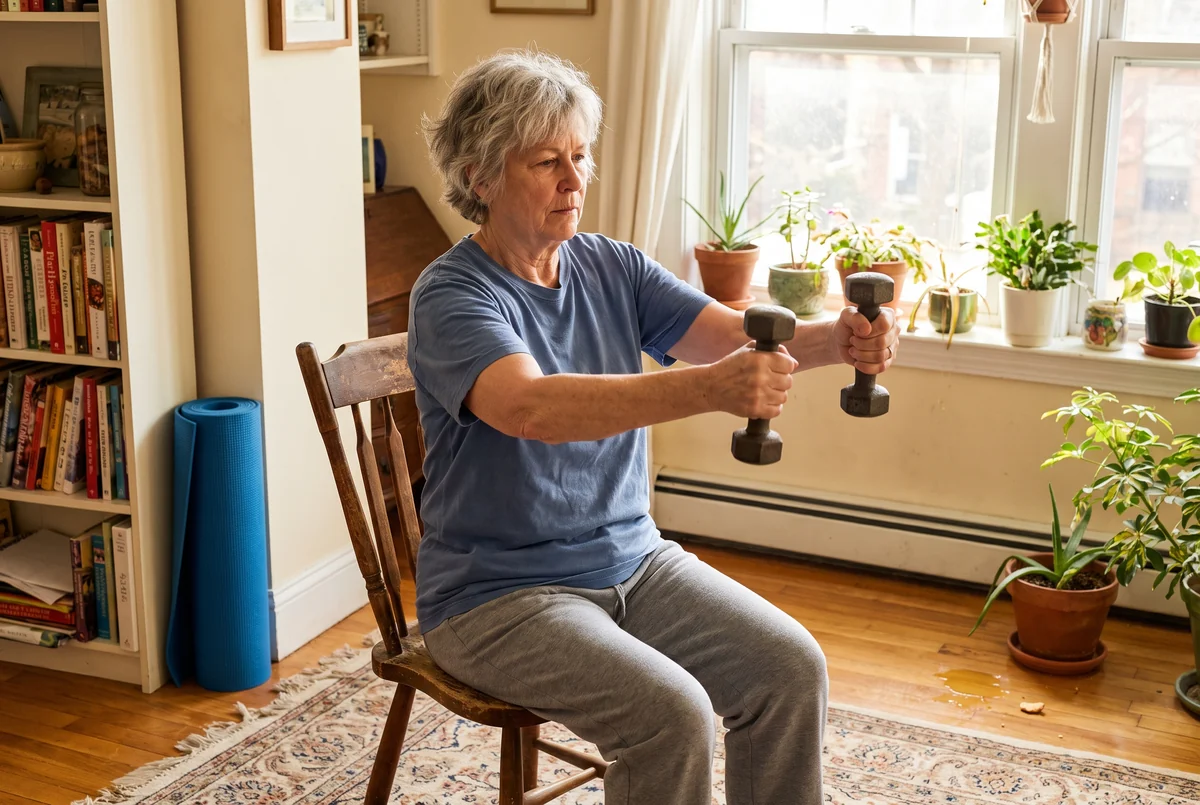
Not a disease you catch, nor a destiny written in advance. On the link between sarcopenia and diet (what some call a sarcopenia diet), I devoted an article to muscle loss after 50 and the place of seaweed; here, we are talking about the amount of protein.
How it is measured: strength, quantity, performance
The European consensus EWGSOP2 (Cruz-Jentoft et al., 2019) puts strength first. Muscle quantity comes next, to confirm. The markers:
- a handgrip below 27 kg in men, below 16 kg in women;
- more than 15 seconds to stand up from a chair 5 times;
- then muscle quantity;
- finally a walking speed of 0.8 m/s or less, which signals a severe form.
That 0.8 m/s is about 4 meters in 5 seconds (2.9 km/h): the pace of someone strolling past shop windows. These tests are done at the doctor's. Strength is measured first, and strength can be worked on.
How much protein after 60? The official guidelines
After 65, ANSES settles on about 1 g of protein per kilo of body weight per day. EFSA keeps 0.83 g for all adults. For 65 kg, that comes to about 65 g a day: 200 g of cooked lentils, 100 g of firm tofu, 100 g of cooked chickpeas, 120 g of wholegrain bread and 30 g of pumpkin seeds.
ANSES: about 1 g per kilo after 65
Its 2019 opinion covers women from menopause and men over 65: for 65 kg, it gives 65 g a day.
EFSA: 0.83 g for all adults
For EFSA, the average requirement is 0.66 g per kilo; the 0.83 g reference covers nearly everyone, older people included. Think of shoes. The average requirement is the average shoe size in a room, and the reference is the one that fits almost everybody. For 65 kg, it gives 54 g a day.
In 2021, the Dutch Health Council adopted these values for people over 60, because most studies in older people show no effect of a higher intake on muscle. It does not rule out a benefit in frail or undernourished people.
Why two serious agencies do not say the same thing
They read the same work without answering the same question. One covers the basic need, measured by nitrogen balance (a bank statement that compares what comes in with what goes out), and the other adds a margin for a muscle that is aging. The scientific debate is real. On the plate, the gap is about 11 g for 65 kg, or 120 g of cooked lentils (USDA).
These numbers on the plate
At 1.3 g per kilo, you need 91 g for 70 kg: 500 g of cooked lentils, 150 g of firm tofu, 30 g of pumpkin seeds and 90 g of wholegrain bread. A big salad bowl, already. Beyond about 1.62 g per kilo, a synthesis of trials no longer finds any average gain in lean mass, even in adults who train (Morton et al., 2018).
Protein contributes to the maintenance of muscle mass, as part of a varied and balanced diet and a healthy lifestyle. Going beyond the guideline has not shown a benefit. I told elsewhere the story of the 0.83 g per kilo norm. Remember this: when it comes to protein for seniors, the gap between 0.83 and 1 g per kilo fits in a small plate of lentils.
The study of 3,302 twins, told like an investigation
In 2023, a British study with a worrying title linked a high protein intake to sarcopenia in older twins (Ni Lochlainn et al., 2023). Let's read it like an investigation.
Why twins?
Identical twins share the same genes, fraternal twins half, and all grew up at the same table: comparing them rules out part of heredity. The study follows 3,302 twins from the TwinsUK registry, aged 60 and over (72.1 years on average), including 2,923 women, or 89%. Enough to fill a small country town. It includes 858 pairs of identical twins, 709 pairs of fraternal twins and 168 unpaired twins.
What it found
The reference group ate 1.0 to 1.3 g of protein per kilo per day. Above 1.3 g, the odds ratio is 2.04 for sarcopenia (95% confidence interval from 1.21 to 3.44; p = 0.008) and 1.76 for low muscle mass (from 1.39 to 2.24; p < 0.0001), after adjustment. Among those with a low protein intake, it drops to 0.52 for low muscle mass (from 0.40 to 0.67), with no significant association with sarcopenia (0.7; p = 0.229). Three keys to reading it:
- an odds ratio of 2.04 means about twice the "chances" of being classified in the group;
- p = 0.008 means that, if nothing were going on, chance alone would give this result less than once in a hundred;
- the confidence interval is the plausible range.
Associated is not caused
Here is the decisive point. This study is cross-sectional: it takes a photo at a given moment. A photo shows who is where, without telling how each person got there. To know what causes what, you would need a film: follow the same people for years, and see what happens before what.
Imagine a 75-year-old lady who is losing muscle. She is advised to eat more protein, and she does. On the day of the photo, she lands in both the "lots of protein" box and the "little muscle" box, without the protein being the cause. This is reverse causation.
Other limits: 89% women, few cases of sarcopenia, and a result that goes, the authors note, against the recommendation of ESPEN (the European society for clinical nutrition) in older people. Should we then eat less protein? No. The study does not say to eat less; it says that eating more is not a guarantee.
And the big 2026 review?
A literature review is a summing-up: like a librarian, the authors shelve what others have found. The one by Knopf and Lamming (2026), based on 355 references, reports that restricting protein, or certain amino acids (methionine, isoleucine, valine: pieces of the protein building set), improves metabolic health and lifespan in a variety of organisms.
Still, these are mostly yeast, flies and rodents. Human trials are short, and the authors consider the needs of older people an open question. The hormone FGF21, which rises when protein drops, remains a lead.
None of this justifies cutting back your protein after 60. An association remains a clue. For a verdict, other evidence is needed.
The lead we talk about least: moving
The cell's fuel gauge
In every cell, a molecule called AMPK acts as a fuel gauge. When reserves drop during effort, it lights up and gives the instruction to repair and clean house rather than build new. Studies suggest that exercise acts on several mechanisms of cellular aging, with AMPK as a central regulator of metabolism, that is, of the body's transformation work sites (Carapeto and Aguayo-Mazzucato, 2021). Mechanism described, no quantified benefit.
The bricks and the building site
Protein delivers the bricks, effort decides that you build. A meta-analysis (a calculation that pools trials) gathered 49 trials and 1,863 adults doing resistance training (Morton et al., 2018). Adding protein gave them on average 0.30 kg more lean mass (interval from 0.09 to 0.52), the weight of a part-used packet of lentils.
And the effect shrinks with age, even though the authors note that the doses given to older participants were low. Most of the gain comes from the training itself. Without a building site, the bricks stay on the pallet.
No gym needed
The WHO recommends 150 to 300 minutes of moderate activity per week, or about 20 to 45 minutes a day, muscle strengthening on at least 2 days a week and, for older people, balance and strength activities on at least 3 days. Walking, taking the stairs, carrying your shopping, digging the vegetable garden or standing up from your chair without your hands: it all counts. It's just common sense: observe nature.
Before resuming an activity, see your doctor, then go at your own pace. For strength training proper, with its sets and loads, I detailed the needs of a vegan athlete in another article.
In practice: a plant-based day at 1 g per kilo
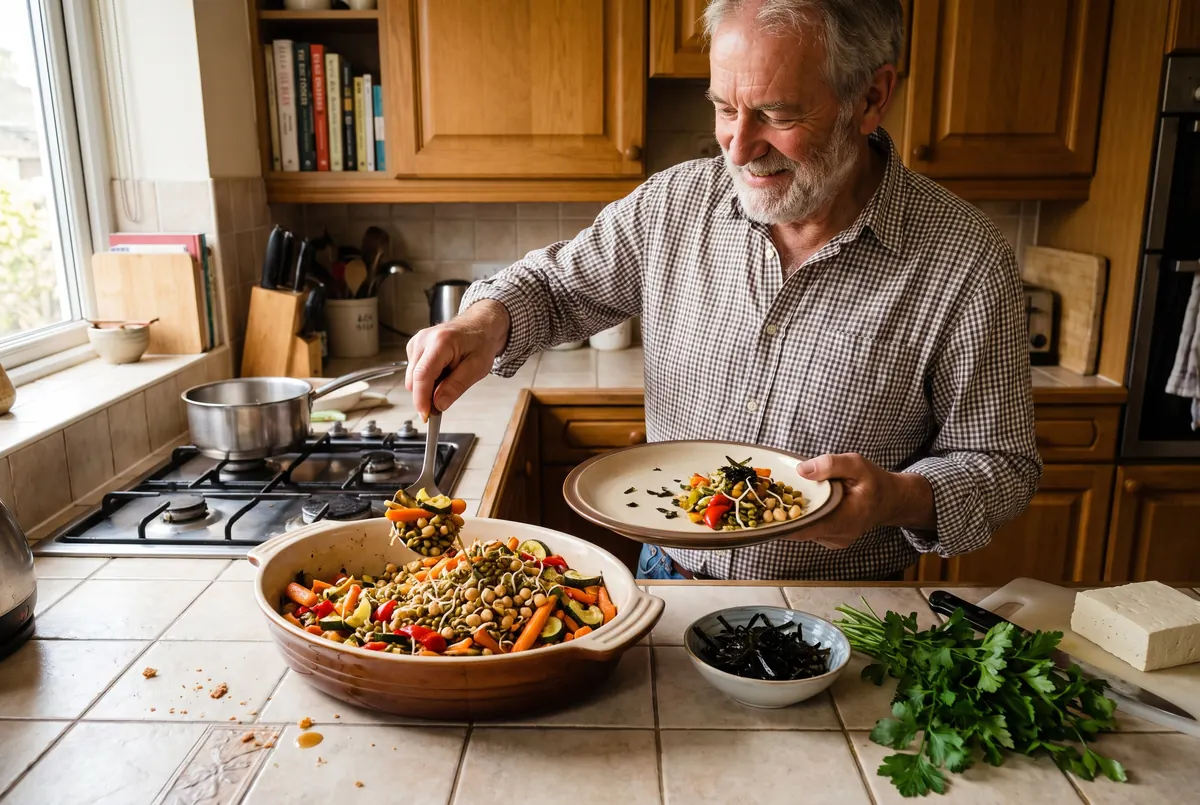
Almost all lists of high protein foods for seniors talk about animal products. Here is a plant-based day for 65 kg, calculated with USDA values, legumes soaked then cooked.
| Meal | Foods | Protein |
|---|---|---|
| Breakfast | 70 g of wholegrain bread (2 slices) + 15 g of pumpkin seeds | 8.7 + 4.5 = 13.2 g |
| Lunch | 200 g of lentils (soaked, then cooked) + 50 g of wholegrain bread + seaweed flakes added off the heat | 18.0 + 6.2 = 24.2 g |
| Snack | 15 g of pumpkin seeds | 4.5 g |
| Dinner | 100 g of firm tofu + 100 g of chickpeas (soaked, then cooked) | 17.3 + 8.9 = 26.2 g |
| Total | Vegetables, fruit and grains not counted | about 68 g |
This day reaches the ANSES guideline for 65 kg, as part of a varied and balanced diet and a healthy lifestyle. Watch out for "ordinary" tofu: 8.08 g of protein per 100 g, against 17.3 g for firm tofu. Read the label carefully.
Adjusting to your weight
At 60 kg, the same day without the snack is enough (63.6 g). At 70 kg, add 50 g of cooked lentils: you reach 72.6 g.
What about seaweed?
It has a reasonable place, as flakes or rehydrated, always added off the heat, but it weighs little in grams at the scale of a meal. For the real grams, see what plant proteins really allow for muscle, or nori and its protein.
Cook once, eat several times
The simplest way: cook a big pot of soaked legumes and keep portions. On tired evenings, ready-made lentils really change the game. To keep them, at Biovie we recommend vacuum sealing with the BocUp kit: a bell and a small hand pump, with no electricity and no plastic bag.
It works with your glass jars, if they have "shoulders" and a 65 or 84 mm lid. According to the manufacturer, fresh foods keep up to 5 times longer: a vegetable soup lasts 8 to 10 days instead of 2. Dry foods are protected from moisture and moths. At our place, activated almonds end up in vacuum jars after their time in the dehydrator, for a stock of several months.
Careful: vacuum does not replace the fridge or the freezer. It does not sterilize either. I talk about it at more length, with the right steps, in the article on vacuum sealing at home. In short, 1 g per kilo fits in a normal day, with no special diet.
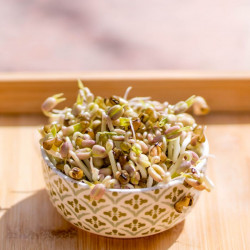
There is another way to put legumes on the menu without spending an hour at the stove: sprouting them. A jar, water, two rinses a day, and in three days the mung bean or azuki is ready, tender, to add to a salad or a warm soup. Sprouting starts the transformation of the seed's reserves and lowers its phytate content, those compounds that slow the absorption of certain minerals. Nothing spectacular: a simple habit, and legumes that are easy to chew, as part of a varied and balanced diet and a healthy lifestyle.