Organic Spirulina Powder: What the Label Guarantees, and How Much Protein and Iron It Provides
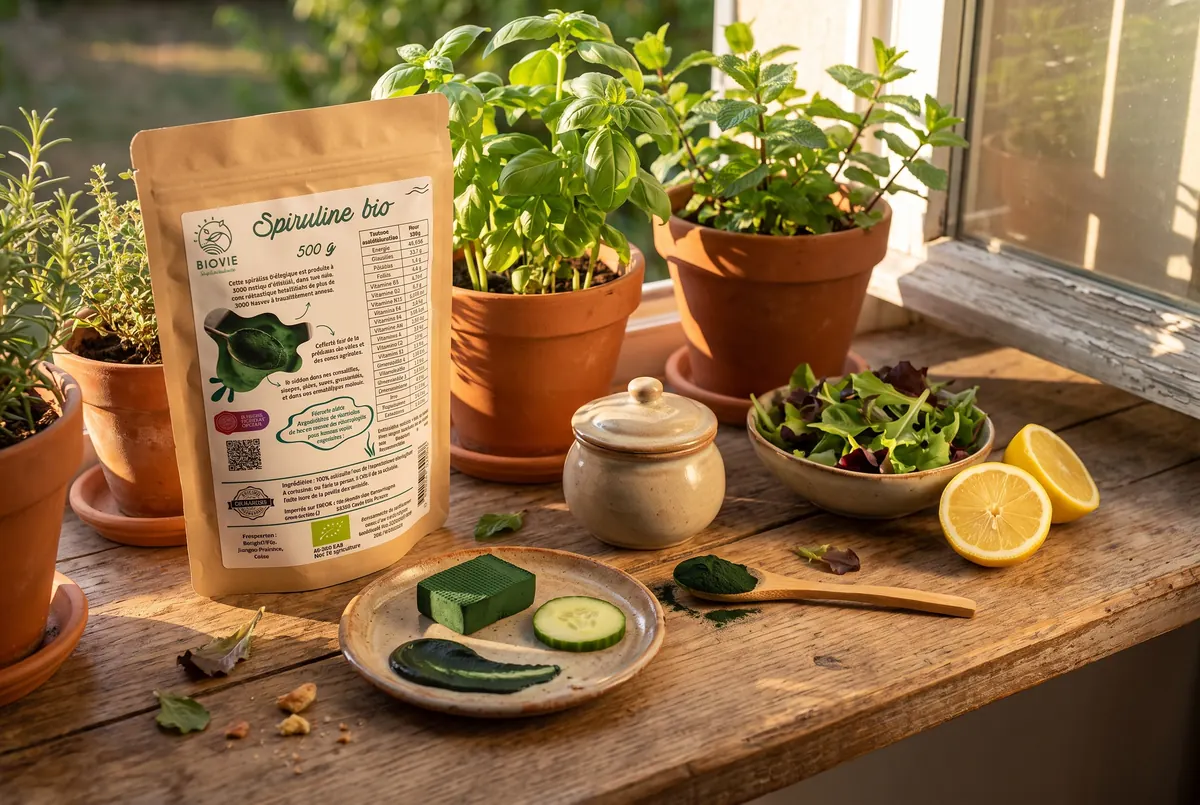
On a spirulina pack, two claims catch the eye: "organic" and "rich in iron". Organic spirulina powder is grown under European Regulation 2018/848, with plant-based inputs only, under the control of a certification body; dried, it provides 57.5 g of protein and 28.5 mg of iron per 100 g, i.e. 2.9 g and 1.4 mg in a 5 g serving. This Biovie page draws on the USDA database, the European regulations and the ANSES opinion: every figure points back to its source.
"Rich in iron", fine. But how much, exactly, in the spoonful you stir into your glass in the morning? Ask the product pages that fill the top of the search results: silence, or close to it. And on what the word "organic" really requires, not much more.
I have been the founder of Biovie since 2007 and am an ISTOM engineer, and I spent about ten years supporting farmers converting to organic in Burgundy. Organic specifications, I have read and explained more than a few. I know what they contain. And above all what they don't.
What is organic spirulina powder?
Let's start with the living thing itself. Spirulina is a cyanobacterium, Arthrospira platensis: a micro-organism grown in ponds, then eaten dried, as a powder, or fresh. Organic spirulina is grown according to Regulation (EU) 2018/848 on organic production, and checked by a certification body that verifies what goes into the pond.
What the organic label requires
At European level, organic spirulina falls under the rules of organic aquaculture, whether it grows in an open pond or a closed system, and only plant-based inputs are allowed for the production of algae (ministerial answer to written question no. 11850, French National Assembly, 2026). You might take that for a lawyer's detail. For spirulina, this rule weighs a lot: the culture has no soil and no roots, and everything that feeds it passes through the pond water. The organic label, in short, is control of the culture's pantry.
That is the logic of any organic specification, the same as on a farm in conversion: you look first at what goes in. The rest follows.
A framework still under discussion
The framework, by the way, is still moving. In October 2025, France proposed allowing nitrogen inputs of animal origin for spirulina, already permitted in organic farming. The European Commission did not take it up at this stage, and the other Member States did not support it, according to the Ministry of Agriculture's answer published in the Official Journal on 21 July 2026.
I understand the reasoning, and I won't pretend otherwise: these inputs are already accepted in organic fields, and wanting to align the ponds with the fields is not absurd. As a vegan, I am still not sorry to see the door stay closed, I won't hide that from you. Still, for now the rule remains plant-based, and that is what the logo guarantees.
What the label does not replace
Oh really, organic spirulina isn't necessarily analysed spirulina? Well, no. The label governs a way of producing; what is actually in the pack is what the analyses tell you. ANSES points out possible contamination of spirulina by cyanotoxins (microcystins), bacteria and metallic elements such as lead, mercury and arsenic (ANSES, 2017). Hence the agency's sensible advice: favour the best-controlled and traceable supply chains, with an identified manufacturer.
A French organic spirulina follows the same regulation as the others, no more and no less: the origin and the microcystin analyses remain two pieces of information to go and look for on top of the logo.
Protein and iron: the figures per 100 g and per serving
According to the USDA FoodData Central database, 100 g of dried spirulina contain 57.5 g of protein and 28.5 mg of iron (USDA, 2019). On paper, that is spectacular: more than half the weight of the powder is protein. Except that nobody eats 100 g of spirulina in one go (and I don't recommend it, we'll see why further down). The usual serving fits in a teaspoon, about 5 g.
So here are the values brought down to real servings, with iron expressed as a percentage of its nutrient reference value, 14 mg (Regulation (EU) No 1169/2011):
Form and quantity
Water
Protein
Iron
Iron as % of NRV (14 mg)
Dried spirulina, 100 g
4.68 g
57.5 g
28.5 mg
204%
Dried spirulina, 5 g serving
0.23 g
2.9 g
1.4 mg
10%
Dried spirulina, 3 g serving
0.14 g
1.7 g
0.86 mg
6%
Fresh spirulina, 100 g
90.7 g
5.92 g
2.79 mg
20%
These are USDA reference values for dried spirulina and for raw spirulina (2019). Labels vary by producer and by batch: the label of the product you actually bought is always the one that counts.
High in protein: what the rule says
Here we get to the hard part, but don't worry, it's middle-school arithmetic. Regulation (EC) No 1924/2006 reserves the "source of protein" claim for a food whose protein provides at least 12% of its energy, and "high protein" for at least 20%. Each gram of protein counts for 4 kcal: 57.5 g × 4 = 230 kcal, out of the 290 kcal in 100 g of dried spirulina. That is 79% of the energy.
Out of ten calories in dried spirulina, nearly eight come from its protein. As a plant protein, spirulina therefore meets, and then some, the conditions of the "high protein" claim. It doesn't take anyone's place for all that: as part of a varied and balanced diet and a healthy lifestyle, it comes alongside the other plant proteins on your plate, legumes or seeds.
High in iron: per 100 g, not per spoonful
For a mineral, the "source of" claim requires 15% of the nutrient reference value per 100 g, i.e. 2.1 mg of iron, and "high in" twice that, i.e. 4.2 mg. With 28.5 mg per 100 g, dried spirulina exceeds that threshold almost seven times over.
So this is indeed a spirulina that is high in iron in the sense of the regulation. Here's the catch: the regulation judges the food by the market kilo, not by the breakfast spoon. At 5 g a day, the spirulina iron content you actually get is 1.4 mg, a tenth of the daily reference. That is not nothing. It is not everything either. It is a supplementary contribution on the plate.
And is the iron well absorbed?
A 2025 study carried out at King's College London compared six cyanobacteria and micro-algae, first in simulated digestion, then on human Caco-2 intestinal cells grown in the laboratory (Wang et al., 2025). Spirulina showed the highest bioavailable iron content of the batch: 0.167 µg per mg of protein. I won't sell it to you as more than it is: a culture dish is not an intestine, and this result is neither a trial in humans nor a claim validated by EFSA.
The lead remains interesting all the same, because it matches a conviction I have defended for a long time: we are not what we eat, but what we absorb.
Dried or fresh spirulina: same food, different density
Between dried and fresh spirulina, the figures per 100 g are divided by about ten, and the whole difference comes down to a single ingredient: water. Fresh spirulina contains 90.7% water, the dried only 4.68% (USDA, 2019). It's the story of the grape and the raisin: you remove the water, the same fruit is left, smaller and more concentrated.
Brought back to dry matter, the profile of the two forms remains comparable. The use, though, is nothing alike. The fresh one is eaten raw, for its texture and mild taste; organic spirulina powder is measured out in grams into a drink or a dish, always off the heat.
At Biovie, our fresh organic spirulina block and our frozen fresh organic spirulina are grown in France, according to their product pages: it is through the fresh form that we answer the demand for French organic spirulina. For the powder, the origin is read on the label, as it should be.
Knowing what a food does not provide is already a way of using it well.ANSES points out that spirulina is not a reliable source of vitamin B12 for vegans, because it mostly contains an inactive analogue. An analysis of spirulina sold in tablet form, published in 1999, already identified pseudovitamin B12, inactive in humans, as the main form (Watanabe et al., 1999).
It is an analytical study, with no trial in humans. No reason to make a drama of it, or to throw the pack away. Vegan since 1992, I have known it for a long time: a vegan person needs another reliable source of B12, to be discussed with a healthcare professional, and spirulina keeps all its interest for its protein and its iron.
How much to consume, for whom, and how to store it?
Setting contamination aside, ANSES considers that spirulina does not seem to pose a risk at low doses, up to a few grams a day in adults. The most telling benchmark comes from beta-carotene: 5 g of spirulina a day provide 7 to 8.5 mg of it, above the limit of 7 mg a day estimated by ANSES for supplementation. A single teaspoon therefore already reaches that ceiling. Here, more is not better.
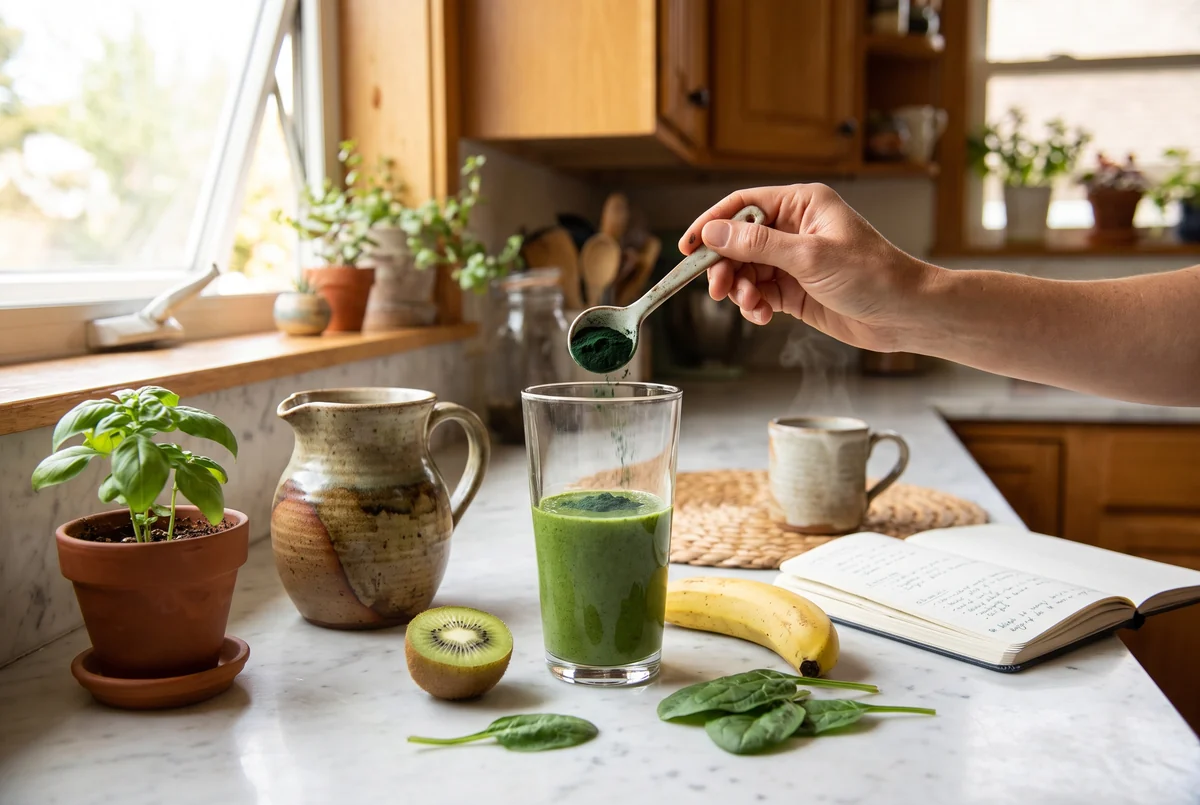
To start, no equipment and no big ritual needed: 3 g, a little more than half a teaspoon, in a dish you are already preparing, a vinaigrette, a smoothie. A few seconds, and it's done. You will find more ideas in these six ways to consume spirulina.
ANSES advises against spirulina for people with phenylketonuria and for those with an allergic predisposition. If you are on medication or have any doubt, ask your doctor's advice. As part of a varied and balanced diet and a healthy lifestyle, a few grams a day are enough.
How to store spirulina?
One day, in an organic shop, I saw a bulk spirulina counter where the part exposed to light had turned blue-green. An image that stays with you. Since then, at our place, the rule doesn't budge: the powder is kept away from light, and away from moisture.
Against moisture and moths, we vacuum-seal our jars with the BocUp kit: a bell, a small hand pump, and that's all. No electricity, no plastic bag, and the glass jars you already have will do, if they have "shoulders" and a 65 or 84 mm lid. According to the manufacturer, dry foods stay protected from moisture and moths, and fresh products keep up to 5 times longer, a vegetable soup 8 to 10 days instead of 2. A silly little detail, but it matters: glass lets light through, so the jar goes in the cupboard.
Vacuum does not replace the refrigerator or the freezer, and it does not sterilise. The fresh one stays in the refrigerator, the frozen one in the freezer. The full detail is in our article on the benefits of vacuum sealing.
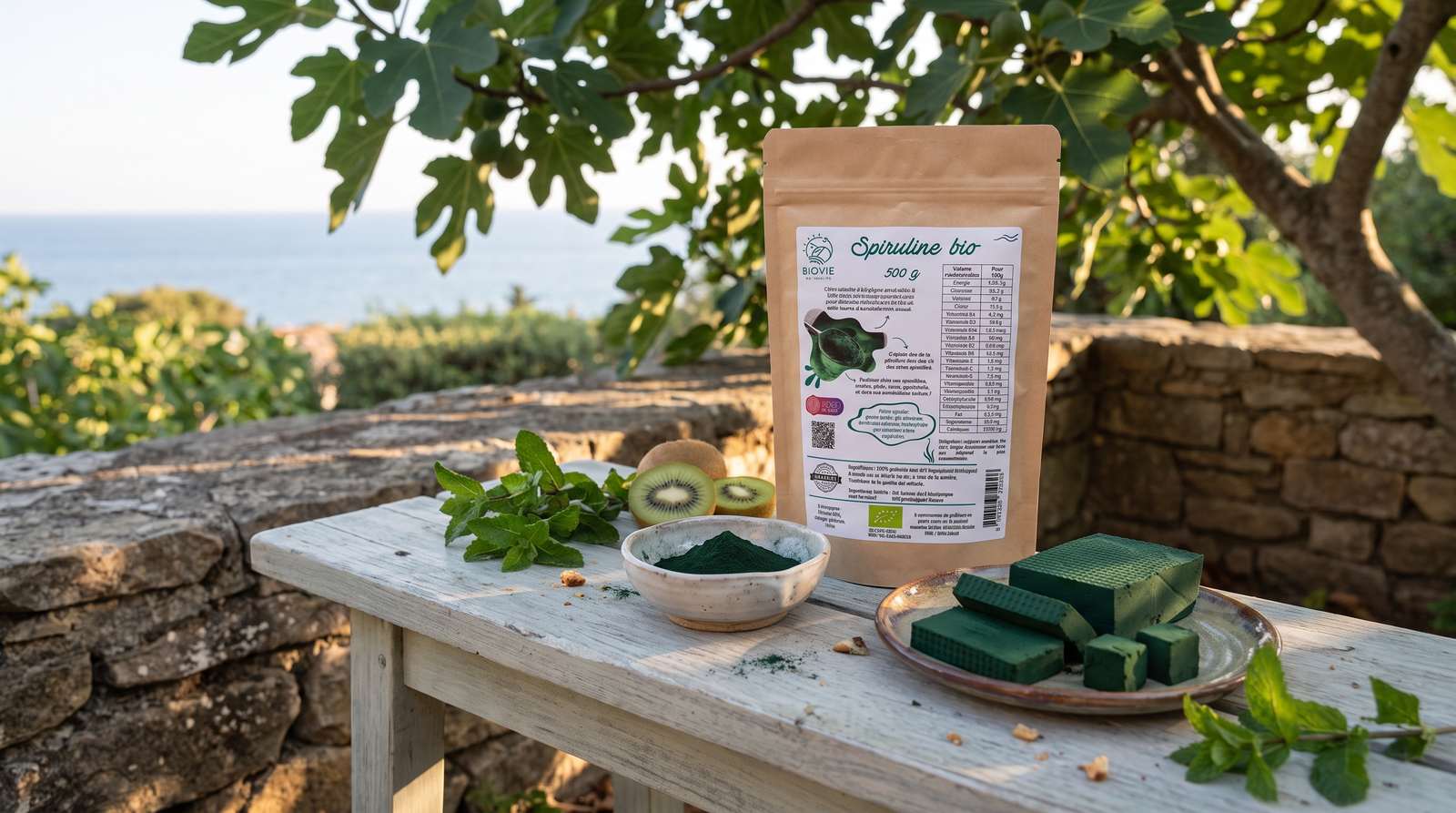
Biovie organic spirulina comes in 4 formats: fresh, grown in a greenhouse by Etika; frozen fresh, produced in northern France by Etika Spirulina; powder, from organic aquaculture; and phycocyanin, the concentrated extract of the blue pigment, almost tasteless but intensely colorful. To start a regular routine, powder is the most economical and the easiest to dose; for freshness, choose fresh or frozen spirulina of French origin, closer to the harvest. Phycocyanin suits anyone looking for a concentrated extract with a discreet taste, to add to a preparation without changing its flavor., 4
products
No laboratory needed: just turn the pack over. Four pieces of information are enough to tell a well-documented spirulina apart, and none requires you to be a chemist.
The organic label and the name of the certification body.
Contaminant analyses available, microcystins and metals first, as ANSES recommends.
The nutritional values per 100 g, to be brought down to your serving: for 5 g, simply divide each figure by twenty.
An identified manufacturer and clear traceability.
To go further, our spirulina buying guide details the criteria, and our page on the price of spirulina per kilo helps you compare budgets. A well-chosen organic spirulina powder finds its place as one food among others, added without taking anything away, as part of a varied and balanced diet and a healthy lifestyle.
I hope that one day every pack will show its analyses as legibly as its organic logo, and that this will be the rule rather than the exception. On that day, ignorance will truly be a choice. Until then, if a label leaves you puzzled, write to me!
Frequently asked questions
Is spirulina really high in iron?
Yes, in the sense of the European regulation: dried spirulina contains 28.5 mg of iron per 100 g according to USDA, far above the 4.2 mg threshold set for the “high in iron” claim. But a 5 g serving provides only 1.4 mg of iron, i.e. 10% of the nutrient reference value of 14 mg.
How much protein is in a spoonful of spirulina?
About 2.9 g for one teaspoon of spirulina powder, i.e. 5 g, based on USDA values for dried spirulina (57.5 g of protein per 100 g). Protein supplies 79% of its energy, well above the 20% required by the European regulation for the “high in protein” claim.
Can you take spirulina every day?
Yes, in small amounts. Setting contamination aside, ANSES considers that spirulina does not seem to pose a risk up to a few grams a day in adults. Watch the beta-carotene: 5 g a day provide 7 to 8.5 mg of it, above the limit of 7 mg a day estimated by ANSES for supplementation.
Who should avoid spirulina, and when is it not recommended?
ANSES advises against spirulina for people with phenylketonuria and for those with an allergic predisposition. If you are on medication or have any doubt, ask your doctor's advice before consuming it. Our complete guide to spirulina also goes back over these precautions.
Where can you buy organic spirulina?
From a controlled and traceable supply chain, with an identified manufacturer, as ANSES recommends, and ideally with contaminant analyses available. At Biovie, you will find our organic spirulina powder in a 500 g pouch, as well as fresh spirulina, as a block or frozen.
Where is organic spirulina grown?
In ponds, within the European Union as well as outside it, always under the organic aquaculture rules of Regulation (EU) 2018/848, which allow only plant-based inputs for algae. The fresh spirulina offered by Biovie is grown in France according to its product page; for the powder, the origin is shown on the label.
What time of day should you take spirulina?
None of the sources consulted establishes an optimal time to consume spirulina. The simplest is to pair it with a meal you are already preparing: the powder mixes into a drink or a dish off the heat, and the fresh form is eaten raw, in a salad or a smoothie.
The information presented in this article is provided for information purposes only and does not constitute medical advice. Consult a healthcare professional before making any change to your diet or supplementation.