Nori sheets: raw or roasted, how to choose, store and use them beyond sushi
Raw nori sheets are a red alga (yes, red, not black!) simply dried at low temperature, whereas roasted nori sheets (yaki-nori) go through heat afterwards, which makes them more brittle. To choose well, read the species and the ingredient list; to keep a sheet crisp, keep it away from humidity. At Biovie we sell a raw nori dried below 45 °C, and this page draws on FAO reports and Anses opinions.
You open a pack of 50 sheets for a maki night, roll a few, and the next sheet of nori waits for weeks at the back of the cupboard, limp as a piece of cardboard left out in the rain. This softening has a simple cause, humidity, and it can be avoided.
I am an ISTOM engineer and co-author of "Algues au quotidien", and I am keeping you informed here the way I do for the big seaweed articles on this blog: by looking for studies able to back up what I put forward. On nori, three questions come up again and again: which one to buy, how to keep it crisp, and what to do with it besides sushi. And if you are still asking what nori sheets are, you will have the answer in a few lines.
How are nori sheets made?
To picture the making of a sheet, think of handmade paper. The fresh seaweed is rinsed, chopped, then suspended in water; this mixture is spread in a thin layer on mats, drained, then put through a dryer (McHugh, FAO, 2003). What comes out is a standard sheet of 20 x 20 cm weighing between 3.5 and 4.0 g. A square barely bigger than an open hand, so light that a draught is enough to slide it off the table.
The one we sell at Biovie weighs 2.8 g, which makes 140 g for a pack of 50 sheets, a little under that standard.
The volumes, for their part, make your head spin. In figures published in 2003, the FAO counted around 400,000 tonnes of fresh seaweed harvested in Japan every year, close to 10 billion sheets; South Korea (270,000 tonnes) and China (210,000 tonnes) came next. That said, these figures, more than twenty years old, only work as an order of magnitude. They still tell one simple thing: in Asia, nori is an everyday food, as ordinary as bread is here (and I know something about that, being the son of a baker who is a Meilleur Ouvrier de France).
And then there is that taste. Its umami flavour, that round, deep taste that makes you want to come back for more, comes from large amounts of three amino acids, alanine, glutamic acid and glycine (McHugh, FAO, 2003). That is what turns a simple dry sheet into a condiment in its own right.
Raw or roasted nori sheets: what is the difference?
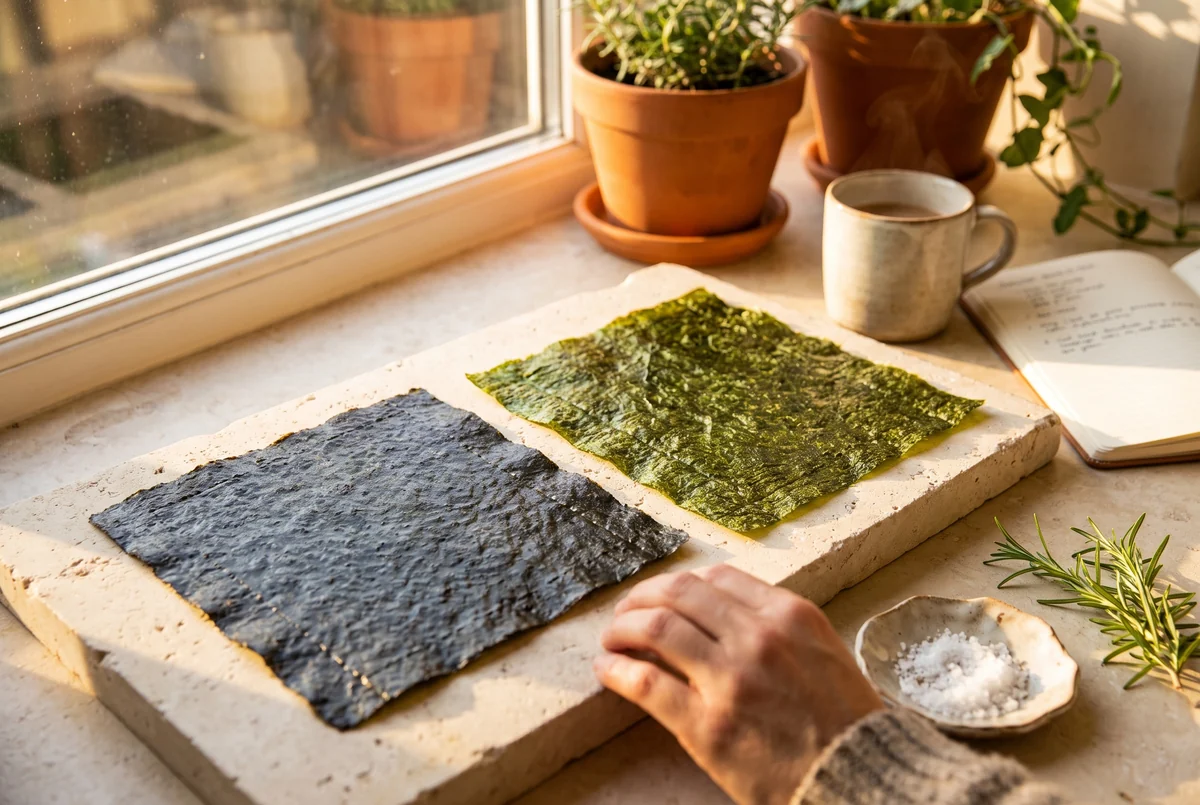
Raw nori is only dried, at low temperature (below 45 °C for ours). Roasted nori, or yaki-nori, then goes through heat: more brittle, it is sold in sealed packaging and sometimes receives a seasoning based on soy sauce and sugar (McHugh, FAO, 2003).
Criterion
Raw nori
Roasted nori (yaki-nori)
Seasoned nori
Drying
Dried at low temperature (below 45 °C for Biovie nori)
Dried, then put through heat
Roasted, then brushed with seasoning
Texture
More supple
More brittle and crisp
Crisp
Packaging
Pack of sheets (50 sheets, 140 g at Biovie)
Often in sealed packaging
Sealed packaging
Ingredients
The seaweed alone
The seaweed alone, for a plain nori
The seaweed and a seasoning (soy sauce, sugar: see the label)
Recommended uses
Crumbled, rolled, blended or added off the heat
Makis and rolls to prepare quickly
As a condiment, after reading the label
Why roast a seaweed that is already dry? To get a sheet that is ready to roll and crunchier under the tooth. Roasting is a comfort step, and I quite understand why people enjoy it on a maki night.
It does change the material, though, and a team of researchers measured it on Pyropia yezoensis (Masuda et al., 2015). In this laboratory composition analysis, iron goes from 19.0 mg per 100 g of dry weight in fresh nori to 22.6 mg in dried nori, then to 26.2 mg in roasted nori. Nothing was added. Water and a little matter leave, the iron stays and concentrates, exactly like a sauce reducing on the stove.
A second piece of data deserves to be known: ferritin, the protein that stores iron in the seaweed, is broken down by roasting. The study stops there, and I stop there too, because it says nothing about what your body takes from one sheet or the other. I often repeat it, we are not what we eat, but what we absorb. Raw or roasted, nori is eaten as part of a varied and balanced diet and a healthy lifestyle.
Seasoned nori and flakes
Seasoned nori contains ingredients other than the seaweed, and only the label tells you which ones: it is the label you need to read before buying.
Flakes need no separate manufacturing, since a dry sheet crumbled between your fingers is enough.
How do you choose nori sheets?
A pack of nori can be read quickly, as long as you know where to look. Five pieces of information are enough to compare two packs with full knowledge of the facts.
The species, Porphyra or Pyropia depending on the label.
The origin: the big producers described by the FAO are all Asian.
The mention raw or roasted.
The ingredient list, which for a plain nori comes down to the seaweed.
The number of sheets and the net weight, to compare the real price from one pack to another.
I owe you the same transparency for ours. Our nori is raw, dried below 45 °C and made from Porphyra yezoensis; it is produced and packed in China, in the partner workshop of our supplier. It is not certified organic, because organic nori sheets remain almost impossible to find. I prefer to write it in black and white rather than let you guess.
A good roasted nori? It has its strengths. Roasted nori sheets for sushi, ready to roll, do the job very well. My choice goes to the raw one, less processed, because it suits every use without cooking.
Out of its pack, a sheet of nori behaves like a dry biscuit left out of its tin. It drinks the humidity of the air and ends up going soft. The whole challenge of storage therefore comes down to one word: dry.
A storage trial published in 1987 followed dried nori (Porphyra yezoensis) for six months, kept at 5 °C or at 30 °C, under vacuum or with air (Kim et al., 1987). Deterioration was lower in the cold, and vacuum packaging preserved quality better than packaging with air. In other words, your dried nori sheets age more slowly in a cool, well-closed cupboard than on a shelf above the oven. Iodine, which is soluble in water, can also be lost when the seaweed is stored in humidity (Teas et al., 2004).
The basic gesture costs nothing: close the bag as soon as the sheet is out, put it in a dry, cool cupboard, and keep the desiccant sachet if there is one. It is just common sense. Light also damages dry seaweed, just like heat and oxygen, which I call the three enemies of a dry food when talking about olive oil.
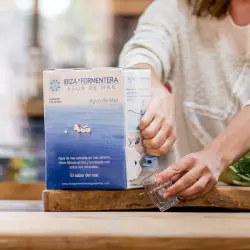
To go further, vacuum sealing in a jar is the method we recommend at Biovie for dry foods. The BocUp kit combines a dome and a small manual pump, with no electricity and no plastic bag, and it works with the glass jars you already have, if they have "shoulders" and a lid of 65 or 84 mm. Cut your sheets in half or in four so they fit in the jar, then put it away in the cupboard. According to the manufacturer, dry foods stay protected there from humidity and pantry moths.
Keep in mind that vacuum does not replace the fridge or the freezer, and that it does not sterilise. It slows deterioration down, nothing more. If the principle intrigues you, I explain how to vacuum seal your food at home and, for seaweed sold fresh, how to store fresh seaweed without waste.
Softened or expired sheet: what should you do?
The date printed on the pack is a best before date (10 March 2028 on our current batch). It tells you until when the manufacturer stands behind the quality, and an expired nori sheet with an unusual smell or traces of humidity is no longer eaten. A sheet that has simply gone soft can be reused crumbled or blended into a sauce.
To give it back its crunch, forget the frying pan and deep-frying. At Biovie we avoid cooking seaweed, and I would rather suggest a pass in the dehydrator at low temperature.
Ten simple uses for nori beyond sushi
Nori does not need rice to exist. Here are ideas rather than recipes, with no cooking of the seaweed at all, since the sheet can be crumbled, rolled, blended or laid on food off the heat. To begin with, half a sheet crumbled over a dish you are already making is enough, with no equipment at all.
You will find recipes for fried nori almost everywhere. I would rather do without. You choose a raw nori for its lightly processed material, and plunging it into hot oil undoes exactly what the gentle drying preserved.
To crumble
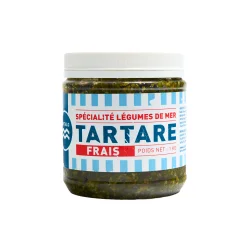
Crumbled between your fingers over a salad or a poke bowl, it gives the dish a taste of the seaside. An avocado with seaweed tartare is one of my fifteen-minute meals, and crumbled nori plays the same role on half an avocado when the tartare is missing. Blended with sesame seeds and a pinch of salt, it becomes a homemade condiment to keep dry, in a closed jar.
To roll
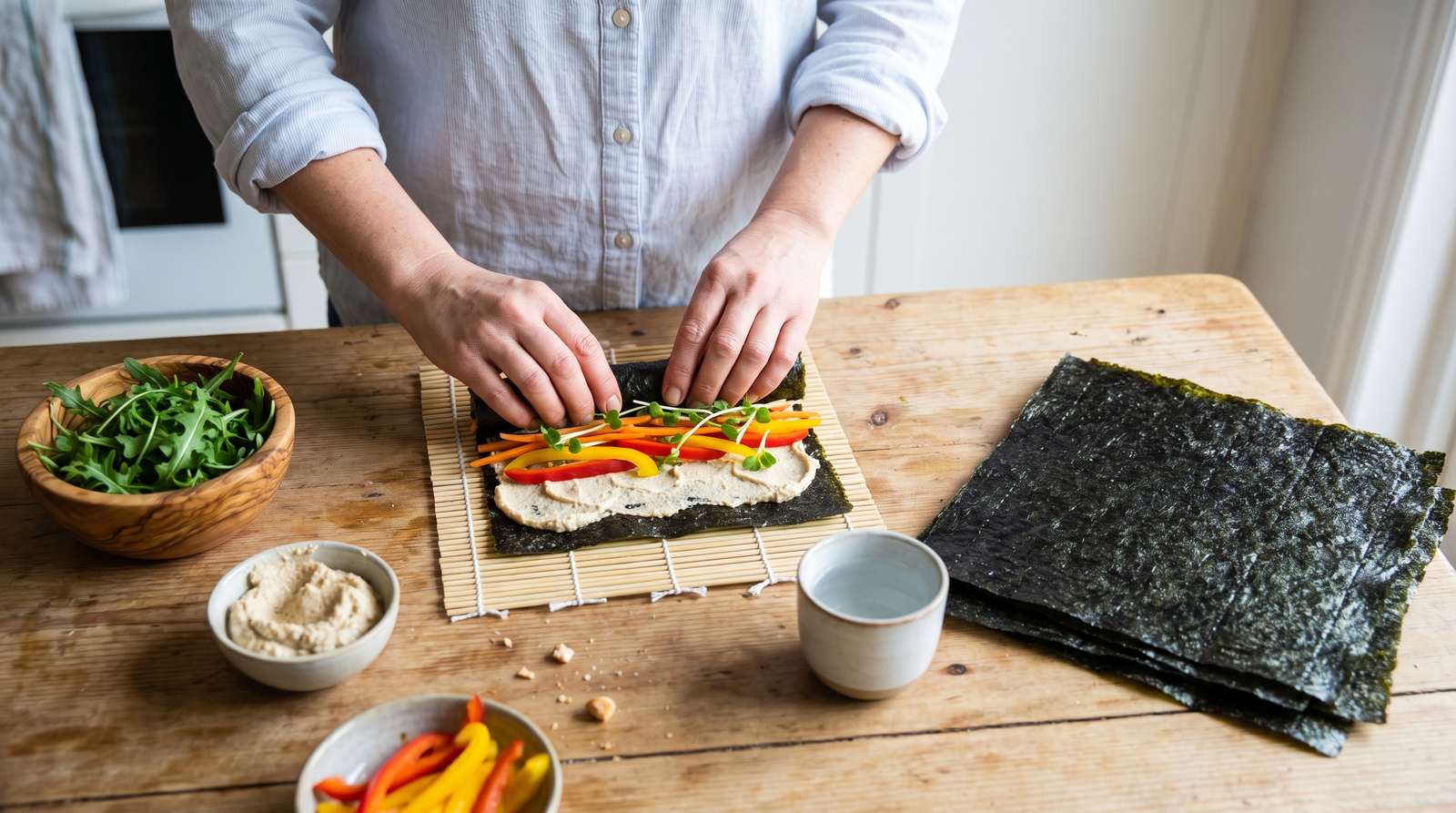
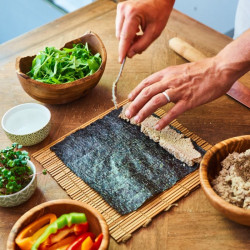
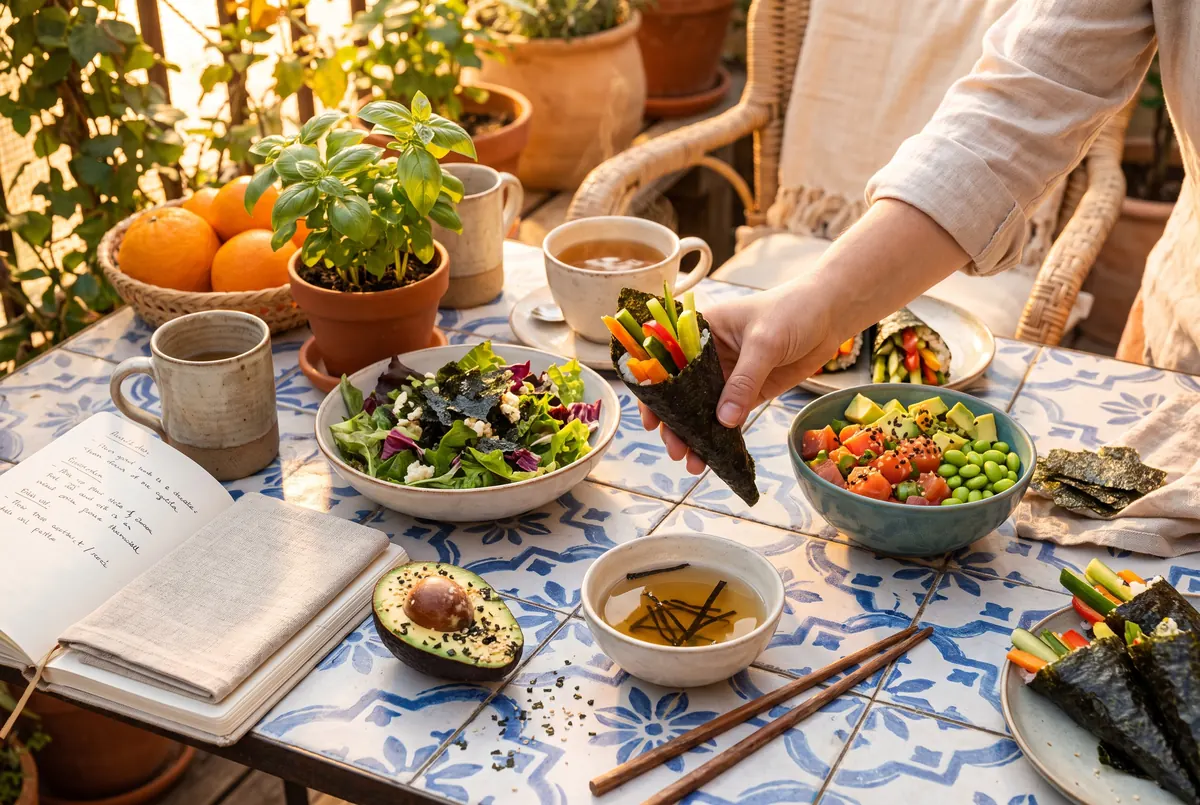
Shaped into a cone, the sheet becomes a raw-vegetable temaki, and it holds an onigiri like a headband. Cut large, it also replaces the flatbread of a raw-vegetable wrap, and for a sushi without rice, you just roll it around sticks of cucumber and avocado. As for which way up the sheet goes, the shiny side goes outside and the matt side, rougher, goes on the filling side. Moisten only the edge to seal the roll, never the whole sheet.
At a barbecue in the south of France, some guests ate our raw vegan makis with their chop, and I have no memory, by the way, of a raw dish being badly received at the table.
To blend
In a pesto or a tapenade, a blended sheet brings its iodine note without drawing attention to itself. It also slips into a homemade seaweed tartare.
In a broth
Steep a sheet of kombu royal in hot water, below boiling point, then pour the broth into the bowls. The nori, cut into strips, is added at the end, in the bowl and off the heat. A little grated ginger goes well with this bowl, as with temaki: here is how to keep fresh ginger close at hand.
Biovie has been selling organic seaweed online since 2007: fresh or dried sea algae, hand-harvested in Roscoff with Bretalg, and freshwater microalgae (spirulina, chlorella, klamath) grown under controlled conditions. We are one of the few companies in France offering fresh seaweed in generous quantities, alongside dried formats that are easier to store and to dose day to day. To get started, go for dried seaweed, easy to add to everyday dishes in small amounts; for regular cooking and an unmatched taste, fresh seaweed in 1 kg packs works out cheaper per kilo. Discover the full range here, from kombu flakes to fresh spirulina in block form., 26
products
Out of 12 edible seaweeds from the shops analysed by an American team, nori (Porphyra tenera) was the lowest in iodine, with about 16 µg per gram (Teas et al., 2004). At that level, a 2.8 g sheet would provide about 45 µg of iodine, an indicative calculation since the content varies greatly with the species and the place of harvest (Anses, 2018). A simple order of magnitude.
The official benchmarks help put this figure in context. EFSA sets an adequate intake of 150 µg per day for adults and 200 µg during pregnancy and breastfeeding (EFSA, 2014), and Anses recalls the tolerable upper limit of 600 µg per day for adults. One sheet therefore represents a modest share of the adult daily benchmark, and the Anses opinion mainly targets the kelps, far richer in iodine than nori. Nori is eaten as a condiment, as part of a varied and balanced diet and a healthy lifestyle.
Anses does, however, advise against seaweed-based foods in several situations:
a thyroid disorder;
heart disease;
kidney failure;
pregnancy and breastfeeding, without prior medical advice.
For children, it considers the data insufficient. If you are wondering whether nori has a place during your pregnancy, the right answer goes through your doctor or your midwife.
For the rest, start small: half a sheet crumbled over your next salad, and see whether that taste of the seaside speaks to you. I would love for nori to find, one day, the place it holds in a Japanese kitchen, that of an ordinary, everyday gesture.
Frequently asked questions
Which way up should a nori sheet go?
The shiny side goes outside the roll, the matt, rough side on the rice or filling side. This is the usage instruction given on nori packaging. To close the roll, moisten only the edge of the sheet with your fingertips: wet all over, it would turn soft and hard to roll.
How are nori sheets made?
The fresh seaweed is rinsed, chopped and suspended in water, then spread in a thin layer on mats, drained and dried, a bit like handmade paper. According to the FAO, a standard sheet measures 20 x 20 cm and weighs 3.5 to 4.0 g. Roasted nori then goes through heat.
What does nori seaweed contain?
Biovie nori contains more than 27 g of protein and 318 mg of calcium per 100 g according to its product page, and an analysis published in 2004 measures about 16 µg of iodine per gram of nori. These are composition data, to be placed as part of a varied and balanced diet and a healthy lifestyle.
Can you eat nori sheets when pregnant?
Not without medical advice: Anses advises against seaweed-based foods for pregnant or breastfeeding women without the agreement of their doctor. During pregnancy, EFSA sets the adequate iodine intake at 200 µg per day, and the iodine content of seaweed varies greatly from one species and one batch to another.
How long does an opened pack of nori keep?
It keeps as long as the sheets stay dry. Close the bag straight away, store it in a dry, cool cupboard, ideally under vacuum: a six-month storage trial observed less deterioration at 5 °C than at 30 °C, and under vacuum than with air. The best before date on the pack remains your quality benchmark.
How do you make a nori sheet crisp again?
With a pass in the dehydrator at low temperature, with no frying pan or deep-frying. At Biovie we avoid cooking seaweed, and a raw nori is bought precisely for its lightly processed material. If the sheet stays soft all the same, crumble it over a dish or blend it into a sauce: it is not lost for all that.
Do nori sheets need soaking?
No, a nori sheet is used as it is, unlike wakame or kombu, which are rehydrated before use. To seal a roll, moisten only the edge of the sheet. Crumbled over a salad or a bowl that is still moist, it softens by itself, with no prior soaking.
The information presented in this article is provided for information purposes only and does not constitute medical advice. Please consult a healthcare professional before making any change to your diet or supplementation.