Meat or airplane: which one really pollutes the most?
Here is an article that I have delayed writing, despite the fact that I am regularly questioned on the subject for years, and I am often taken to task when I mention business trips! At Biovie, we often talk aboutliving food, of superfoods, of sprouted seeds. But today, I wanted to address a topic that is debated and, frankly, deserves a closer look: the environmental impact of what we put on our plates compared to our air travel.
I have to confess something to you. For a long time, I myself thought that airplanes were THE main culprit of climate change. The images of those white trails in the sky, the debates on "flight shaming"... Everything leads us to believe that this is where the battle for the climate is being fought. And then, by digging into the numbers, I discovered a reality that truly surprised me. So, fasten your seatbelts...
The finding that changes everything
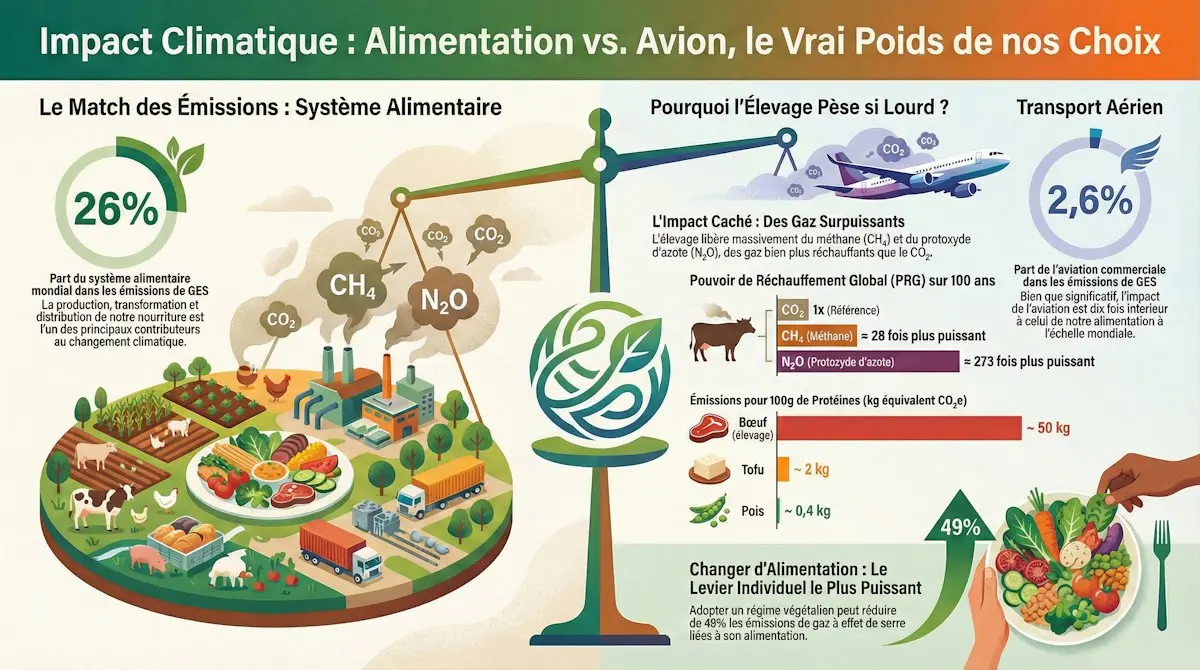
Reducing meat consumption to three times a week is equivalent to avoiding six short-haul flights per year. This equivalence, validated by a scientific study published in ScienceDirect in March 2024 [1], reveals a fact that few people know: global livestock farming emits 14.5% of greenhouse gases according to the FAO [2], which is nearly six times more than aviation, which accounts for about 2.5% of direct CO₂ emissions. [3].
How did we get here? And above all, why is no one really talking about it ?
In reality, it's a matter of visibility. When a plane takes off, everyone sees it. The contrails mark the sky. It's spectacular, it's tangible. But when you eat a steak, who thinks about the methane emitted by the cow, the deforestation to produce the soy that fed it, the transport, the processing? It's invisible. And yet, the impact is there, very real, and frankly considerable.
The numbers speak for themselves
Specifically, here is what the most recent data tells us:
One kilogram of beef generates between 28 and 35 kg of CO₂ equivalent. according to the ADEME Agribalyse database updated in November 2024 [4]. To give you an idea, it's the equivalent of 14 vegetarian meals. A single meal with beef pollutes as much as 14 plant-based meals. It's enormous.
The landmark study published in Science by Poore and Nemecek in 2018 [5] analyzed nearly 40,000 farms worldwide and confirms these magnitudes: beef generates 60 kg of CO₂ equivalent per kilogram on a global average, with significant variability depending on farming methods.
Food accounts for 22% of our individual carbon footprint in France. according to INSEE [6]. It is the second largest expense after housing, and ahead of transportation! And within this food category, animal products are the most significant. The 2022 report from WWF France [7] is unequivocal: switching to a vegetarian diet could reduce one's food footprint by 51%, and up to 65% for a vegan diet.
And what about French livestock, you might ask? It's true that we often hear that our cows grazing in the fields are "different." In reality, ADEME data shows that French beef emits about 35 kg of CO₂ equivalent per kilogram. [4], which is even slightly more than the global average. Grasslands do store carbon, but not enough to offset the methane emissions from ruminants.
Regarding aviation, the study by Lee et al. published in Environnement Atmosphérique in 2021 [3] calculated the overall climate effects of aviation (CO₂ + contrails + nitrogen oxides). The result: about 5.9% of anthropogenic radiative forcing. Even with this high estimate, livestock has two to three times more impact on the climate.
Why this subject is close to my heart
With Aurélie, we are supporting the transition towards theliving food For 18 years now at Biovie, we have seen thousands of people who wanted to change their diet, initially for their health and often later for environmental reasons.
What strikes me is this misplaced guilt that I encounter regularly and that is often thrown in my face. People who beat themselves up because they took a flight once a year to see their family, while they eat meat twice a day without questioning it. I'm not saying that one should take flights without thinking, of course not. But there is an imbalance in our collective perception.
The Climate Action Network calculated it in 2024. [8] : Reducing our meat consumption by 50% would allow France to achieve its climate goals.. Not to eliminate it completely, just to reduce it by half. It's accessible to everyone, it's daily, and the impact is considerable.
Concrete and accessible solutions
So, where to start? Honestly, it's simpler than you think.
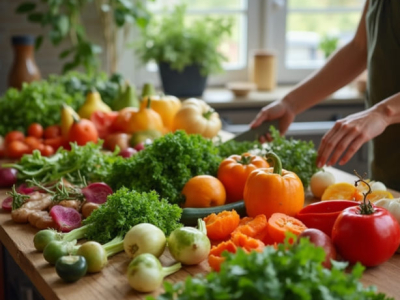
The idea is not to become vegan overnight. The transition can be gradual, and it's often more sustainable to proceed this way. Having three meals with meat per week instead of fourteen is already a major change for the planet.
The question of proteins often comes up. "And my proteins, where do I find them?" It's a legitimate concern, but one that is based on misconceptions. Plant-based proteins are not only sufficient but often of better nutritional quality when you know how to combine them. The organic spirulina, for example, contains between 60 and 70% complete proteins [9], which is three times more than meat. The sprouted legumes, the algae, hemp seeds... there is no shortage of alternatives.
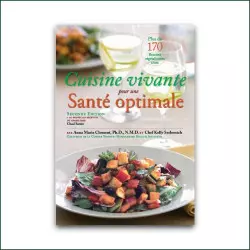
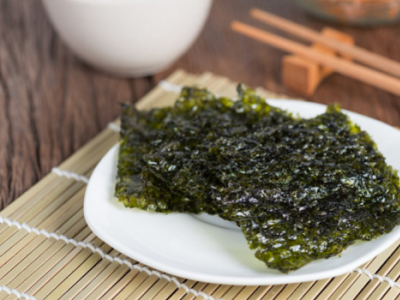
And then, there is an aspect that is often forgotten: Algae are true carbon sinks.. By consuming them, not only do you benefit from their remarkable nutritional qualities, but you also support an industry that positively contributes to the environment. This is what is called a virtuous circle. In fact, we co-wrote our book with Aurélie. Seaweed in everyday life, awarded the best cookbook in the world at the Gourmand CookBook Awards 2025, precisely to democratize these nutritional treasures.
The secret to a successful transition is not to put pressure on yourself. Here is what I have observed after all these years of supporting people in their dietary changes:
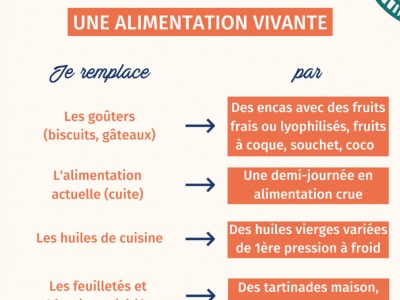
Start with one meal per day. Just one plant-based meal a day already reduces your food impact by 33%. No one is asking you to change everything at once.
Discover new flavors. Plant-based food, when well-prepared, is extraordinarily rich and indulgent. It is not a punishment; it is a discovery. With Aurélie, we have published My Raw Weeks Precisely to show that eating plant-based can be a true daily pleasure.
Invest in quality. A good plant-based meal with quality superfoods will always be more satisfying than a bland and tasteless meal. This is also why we select our products with such care at Biovie.
Equip yourself to succeed. Grow your own seeds with a Easygreen sprouter, it is to locally produce fresh plant-based proteins for a few cents. A simple habit that changes everything.
And above all, don't feel guilty if you sometimes give in. What matters is the overall trend, not absolute perfection.
What you can remember
Here, I wanted to share these thoughts with you because I sincerely believe that we collectively have the power to change things. And this power is found on our plates, three times a day.
Stopping the plane once doesn't change much. Changing its course every day changes everything.
It's not a matter of perfection or radicalism. It's about daily, accessible choices that, when combined, make a considerable difference. Over 60,000 customers trust us at Biovie to support them in this transition, and we see every day that it's possible, and even exciting.
As this quote that we love to share with Aurélie so aptly says: "Adding more raw and plant-based foods to your diet is something you can learn! At Biovie, it's been our specialty for 20 years."
Frequently Asked Questions
Does eating less meat really help the climate ?
Yes, and the numbers are unequivocal. The study by Sheridan et al. published in ScienceDirect in 2024 [1] demonstrates that reducing meat consumption to three times a week is equivalent to avoiding six short-haul flights per year. WWF France [7] confirms that a vegetarian diet reduces the food carbon footprint by 51%.
How much CO₂ does one kilogram of beef emit ?
According to the updated ADEME Agribalyse database in November 2024 [4], one kilogram of beef generates between 28 and 35 kg of CO₂ equivalent. The study by Poore & Nemecek published in Science [5] indicates a global average of 60 kg CO₂-eq/kg. This is the carbon equivalent of 14 vegetarian meals.
Does livestock farming really pollute more than airplanes ?
FAO data [2] are clear: global livestock farming accounts for 14.5% of greenhouse gas emissions, compared to 2.5% for direct CO₂ from aviation. Even when considering all the effects of aviation (contrails, nitrogen oxides), it amounts to about 5.9% according to the 2021 study by Lee et al. [3]. Livestock farming therefore weighs two to six times more.
Where to start to reduce my impact ?
Start simply with one plant-based meal per day. Discover the plant-based protein alternatives of quality like the spirulina or the algae. A gradual transition is often more sustainable than a radical change.
Are plant proteins sufficient ?
Absolutely. The spirulina contains 60 to 70% complete proteins [9]. Legumes, the algae, the sprouted seeds offer all the necessary amino acids. It's a matter of knowledge and combinations, not deficiency.
Bibliographic references
[1] Sheridan, H., McMahon, B.J., Carolan, K., et al. (2024). Comparing the carbon footprint of dietary choices: meat reduction versus aviation changes. ScienceDirect - Global Environmental Change, 84, 102795. DOI: 10.1016/j.gloenvcha.2024.102795
[2] Gerber, P.J., Steinfeld, H., Henderson, B., et al. (2013). Tackling Climate Change Through Livestock: A Global Assessment of Emissions and Mitigation Opportunities. Food and Agriculture Organization of the United Nations (FAO), Rome. Disponible sur : https://www.fao.org/3/i3437e/i3437e.pdf
[3] Lee, D.S., Fahey, D.W., Skowron, A., et al. (2021). The contribution of global aviation to anthropogenic climate forcing for 2000 to 2018. Atmospheric Environment, 244, 117834. DOI: 10.1016/j.atmosenv.2020.117834
[4] ADEME (2024). Base de données Agribalyse v3.1.1 - Impacts environnementaux des produits agricoles et alimentaires. Agence de la transition écologique, mise à jour novembre 2024. Disponible sur : https://agribalyse.ademe.fr/
[5] Poore, J. & Nemecek, T. (2018). Reducing food's environmental impacts through producers and consumers. Science, 360(6392), 987-992. DOI: 10.1126/science.aaq0216
[6] INSEE (2023). Empreinte carbone de la France en 2022 : bilan et répartition par poste de consommation. Institut national de la statistique et des études économiques. Disponible sur : https://www.insee.fr/fr/statistiques/
[8] Réseau Action Climat (2024). Comment l'alimentation peut contribuer à la neutralité carbone en France : scénarios et leviers d'action. Réseau Action Climat France, Paris. Disponible sur : https://reseauactionclimat.org/
[9] Soni, R.A., Sudhakar, K. & Rana, R.S. (2017). Spirulina – From growth to nutritional product: A review. Trends in Food Science & Technology, 69, 157-171. DOI: 10.1016/j.tifs.2017.09.010