





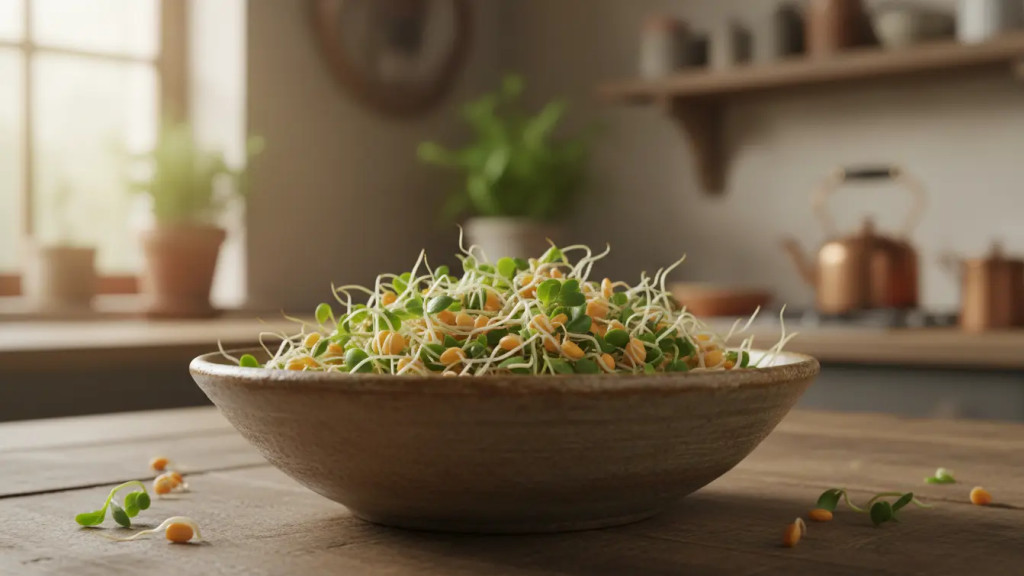
The sprouted seeds multiply vitamins by up to 600% and transform your diet in just 5 days. Personally, I have been consuming them daily for decades, and frankly, it's one of the simplest and most effective health habits I know. It was even at the heart of the creation of Biovie in 2007, as our first activity was the distribution of the Easygreen sprouter.
Are you lacking energy? Are you looking to boost your diet with truly nutritious foods without breaking the bank or spending hours in the kitchen? The sprouted seeds they are probably the answer you were waiting for. As an agronomist passionate about living food since 2007, I can assure you that germinate seeds At home is within everyone's reach. Here's everything you need to know to get started.
What is a sprouted seed ?
A sprouted seed is simply a seed that has begun its transformation process into a plant. This biological awakening, triggered by water and heat, releases exceptional nutritional energy that the seed had stored to give birth to a new plant.
The miracle of germination in 3 steps
In nature, for a seed to grow into a plant, it patiently waits for optimal conditions to awaken and initiate all the necessary biological and enzymatic processes.
- Soaking : the seed absorbs water and comes out of its dormancy
- Germination : the germ pierces the envelope and begins to develop
- Growth : the first leaves appear, this is the optimal stage for consumption
This process takes only 2 to 7 days depending on the varieties. Specifically, you can have sprouted seedsFresh on your table in less than a week.
Why germination transforms the seed
The first condition for this awakening to occur is the presence of water. As soon as the seed is soaked, enzyme inhibitors are released. One of the main inhibitors is thephytic acid, scientifically considered an antinutrient due to its ability to form insoluble complexes with micronutrients such as iron, magnesium, zinc, and copper.
Once soaking occurs, the seed releases its phytic acid and several forms of pre-digestion take place:
- Complex proteins are broken down into bioavailable amino acids
- Complex sugars become simple sugars that are easily assimilable.
- Micronutrients transition from an insoluble complex form to an assimilable form.
- The enzymatic activity is multiplied by 6 to 20.
It is a true explosion of vitality that occurs in this small seed.
Why they are called "biogenic" foods
The word comes up often in raw food circles, and it deserves to be explained rather than just repeated. A biogenic food is a living food, capable of generating life - the sprouted seed is the textbook example, since it is literally in the process of becoming a plant when you eat it.
In concrete terms, what happens during germination is nothing mystical: the seed mobilises its reserves, its enzymes activate, proteins and starch are partly pre-digested, and the antinutrients that were blocking mineral absorption decrease. It is this biological work that explains the better bioavailability of nutrients, not some magical property of "life force".
Alongside it, there is talk of bioactive foods (raw but not sprouted, like fresh fruit and vegetables), biostatic foods (preserved or refrigerated, whose vitality decreases) and biocidic foods (processed and refined). This hierarchy, inherited from the pioneers of raw food, remains a useful lens for building a plate - as long as you take it for what it is: a practical benchmark, not a scientific standard.
The 8 Proven Benefits of Sprouted Seeds
Multiplication of vitamins (up to 600%)
Dr. Bailey's research from the University of Minnesota has demonstrated that the Wheat germination increases its vitamin C content by 600%. Dr. Burkholder from Yale University observed a 1,300% increase in vitamin B2 in sprouted oats. These figures are not marketing approximations; they are validated scientific data.
To give you a concrete example: 75g of sprouted lentils provide 12.7 mg of vitamin C, compared to only 1.15 mg for the same amount of cooked lentils. The difference is simply spectacular.
Better nutrient digestibility
The sprouted seedsRelease digestive enzymes that significantly facilitate the work of our digestive system. Enzymatic activity can be increased by 6 to 20 times according to studies published in the Journal of Agricultural and Food Chemistry. These enzymes begin to pre-digest nutrients even before you consume them.
For my part, I have noticed that people who are new to raw food digest much better the sprouted seeds than classic cooked legumes.
Reduction of antinutrients (phytic acid)
Phytic acid present in dry seeds can reduce mineral absorption by 20 to 60%. Germination reduces this content by 56 to 76% according to studies conducted on fenugreek. Clearly, this is a considerable advantage for those looking to optimize their mineral intake.
Complete plant protein intake
Did you know that the sprouted alfalfa seeds contain 18.9% protein? By comparison, eggs contain only 13.1% and milk 3.3%. And these proteins are in the form of free amino acids, making them directly assimilable by the body.
Share this article
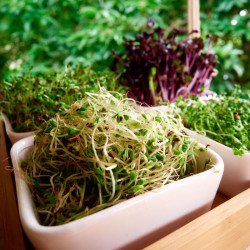
Organic Alfalfa Seeds
€2.80 Temporary out of stock
Detoxifying and alkalizing action
The sprouted seeds are among the most alkalizing foods that exist. They help maintain the body's acid-base balance, which is essential for overall good health. As modern diets are often too acidifying, sprouted seeds provide a welcome rebalancing.
Strengthening the immune system
Thanks to their richness in vitamins, minerals, and enzymes, the sprouted seeds contribute to the normal functioning of the immune system. The sprouted broccoli seeds are particularly interesting because they contain up to 100 times more glucoraphanin than mature broccoli. This compound is the precursor to sulforaphane, a powerful antioxidant studied for its numerous properties.
Digestive health support
Dr. Martine Cotinat, a gastroenterologist, regularly recommends the sprouted seedsTo his patients to support their digestive health. The presence of live enzymes and prebiotic fibers promotes a balanced gut microbiota.
Enzymatic capital: why germination does the work for you
This is the mechanism that ties together all the previous benefits, and it is worth stating clearly.
Our body produces two broad families of enzymes: digestive enzymes, which break down the macronutrients on your plate, and metabolic enzymes, which run and repair your cells. Both families draw on the same resources. The more effort digestion demands, the less is left for the rest - and this production capacity naturally declines with age.
Germination changes the equation, because it moves the work upstream. As soon as the seed wakes up, its own enzymes kick in and pre-digest its reserves: proteins become amino acids, fats become fatty acids, complex sugars become simple sugars. You are no longer eating a dormant reserve, you are eating a food that has already been partly broken down.
The numbers give a sense of the transformation. Sprouted mung bean and fenugreek reach about 30% crude protein; sprouted alfalfa has a higher magnesium content than almonds; and the vitamin C in sprouted wheat is multiplied sixfold after five days of germination. It is not the seed that changes, it is what it makes available.
In practice, this is what justifies the rule given earlier: one to two tablespoons a day, every day, as part of a varied and balanced diet and a healthy lifestyle. Regularity beats quantity.
Source of powerful antioxidants
Germination significantly increases the antioxidant content of seeds. These compounds help protect cells against oxidative stress, a phenomenon involved in cellular aging.
Which seeds to sprout ?
The ideal seeds to start with
If you are a beginner, I recommend starting with these three varieties, easy to to germinate and with a sweet taste:
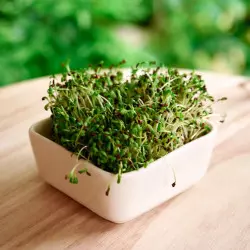
- Alfalfa (lucerne) : subtle and slightly sweet taste, sprouts in 5-7 days, ideal for salads and sandwiches. Discover our organic alfalfa seeds
- Green lentils : sweet flavor and crunchy texture, sprouts in 2-3 days, excellent source of protein
- Fenugreek : slightly spicy taste, sprouts in 3-4 days, recognized digestive properties. See our fenugreek seeds
These seeds forgive beginner mistakes and yield satisfactory results even without prior experience.
Seeds for athletes and active people
For those looking for a significant protein intake:
- Sunflower : very rich in proteins and healthy fats, nutty taste. Sunflower seeds for sprouting
- Chickpeas : firm texture, excellent in salads
- Mung beans (green soy) : the famous soybean sprouts, rich in protein
Which seed for which use?
Once you're past the first jar, the question becomes: which one should you keep going with? Here is how we guide our customers, depending on what they are looking for.
- Broccoli, for its sulforaphane concentration. If you had to remember only one, it would probably be this one. Slightly sharp taste, close to radish: it pairs very well with raw vegetables. One teaspoon a day is already enough.
- Fenugreek and alfalfa, for digestive comfort. Sprouted fenugreek, slightly spicy and sweet, is traditionally associated with digestion; alfalfa, very mild, remains the most widely consumed sprout in the world and the easiest one to start with.
- Sunflower and quinoa, for energy. Sprouted sunflower has a fresh nutty taste and provides protein, essential fatty acids and vitamin E. Sprouted quinoa, for its part, provides complete protein and iron - a good choice for active people.
Regularity matters more than quantity: one to two tablespoons a day, every day, beat one large portion now and then.
Depending on who's eating them: guiding the choice
The choice doesn't depend only on the goal, it also depends on the person - and above all on their palate. A few benchmarks drawn from what we hear at the counter.
- For children, start with mild seeds: barley, quinoa, lentil. Sprouted barley has a slightly sweet taste that goes down very well, where radish or mustard are too sharp for them.
- For older people, texture matters as much as content: sunflower and barley give tender sprouts, easy to chew, best worked into a warm soup rather than a crunchy salad.
- For busy periods - exam revision, deadlines, long weeks - lentils and fenugreek have the advantage of sprouting quickly, three to four days, and slotting in anywhere with no preparation.
- For very active people, parsley, spelt and sunflower provide minerals and essential fatty acids, as part of a varied and balanced diet and a healthy lifestyle.
- For digestive comfort, mung bean, coriander and caraway are the mildest, and the easiest to work into daily life.
There is no bad seed, only seeds poorly chosen for the person eating them. Start with the one whose taste you enjoy: that's the only one you'll sprout a second time.
The three families of seeds for sprouting
Not all of them are grown the same way, and that is cause number one of failed sprouting attempts.
- Non-mucilaginous seeds - radish, broccoli, clover, alfalfa, red cabbage, sunflower, lentil, mung bean, chickpea, leek, fenugreek… They sprout in a jar without difficulty: regular rinsing is enough. Allow 3 to 10 days depending on the species.
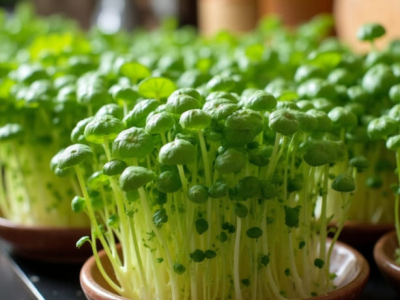
- Mucilage seeds - cress, arugula, chia, flax, basil, some mustards. They form a gel on contact with water. In a jar, this mucilage blocks air circulation and encourages mould: spread them on a flat surface, use a sprouter with a growing tray, or mix them with regular seeds at a ratio of about 15%.
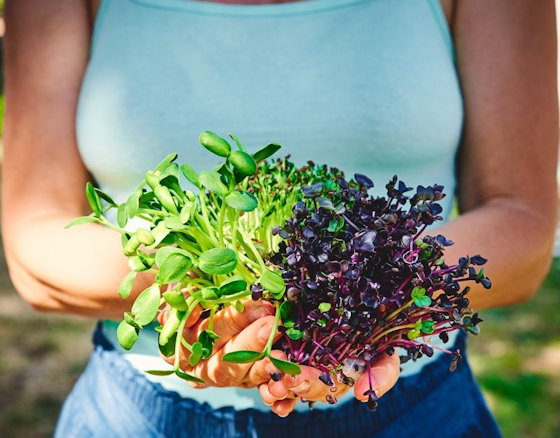
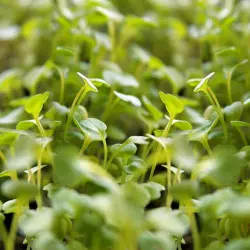
- Young shoots - sunflower, green pea, unhulled buckwheat. These are sprouted seeds left to grow longer, until the stem and first leaves appear. Crunchier and milder, they are grown on a thin bed of soil or in a dedicated sprouter.
Mucilage seeds (special technique)
Some seeds produce a mucilage (gel) when in contact with water and cannot germinate in a regular jar. They require a germination dish :
- Lin : rich in omega-3
- Chia : superfood par excellence
- Watercress : spicy flavor, very rich in vitamins
- Rocket : pronounced taste, excellent for enhancing dishes
The full range Sprouted seeds
Biovie offers 24 varieties of organic sprouting seeds, produced since 1896 by our Italian supplier Geo Bavicchi, and every batch is tested before it goes on sale (germination rate above 95% required). Radish, fenugreek, sunflower and alfalfa sprout the fastest and most easily for beginners, in 3 to 5 days on a windowsill. To discover several varieties without making a mistake, the packs (The 3 Radishes, The Essentials, The Pep's Seeds...) are a good starting point, before choosing your varieties individually. The range also covers microgreen seeds to grow on a substrate, and sprouters to get started without unnecessary equipment., 46 products
Discover the full range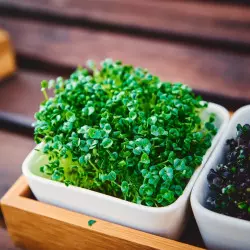
Seeds to NEVER germinate
Caution, some seeds are toxic once sprouted and should never be consumed:
- Tomato : contains toxic solanine
- Eggplant : same solanine problem
- Bell pepper : idem, toxic nightshade
- Rhubarb : contains oxalic acid in a dangerous quantity
Here, this list is important to keep in mind. If in doubt about a seed, do not germinate it.
Grow your own or buy ready-made?
Both approaches have their merits, but not for the same reasons. Growing your own costs a few cents a portion, guarantees absolute freshness and leaves you in control of the variety - in exchange for two minutes of attention a day. Buying ready-to-eat sprouts saves that time, but costs noticeably more and requires an impeccable cold chain: shop-bought sprouts travel, and their freshness is a matter of days.
Our advice: start with a jar and an easy variety - alfalfa or lentil. If the habit sticks, an automatic sprouter removes the chore of rinsing and lets you run several varieties in parallel.
Common mistakes to avoid
After years of practice and sharing with our clients, here are the mistakes I see most often:
- Too many seeds : the seeds swell a lot, never fill more than a third of the jar
- Insufficient rinsing : at least twice a day, otherwise there is a risk of mold
- Poor drainage : stagnant water is the number one enemy, make sure to tilt your jar properly
- Temperature too high : ideally between 18 and 22°C, avoid heat sources
- Poor quality seeds : always use organic seeds certified for germination
Hygiene and food safety
Essential precautions
Honestly, with some organic seeds With quality and rigorous hygiene, the risks are minimal; indeed, the vast majority, if not all, of the issues are related to transportation problems. Since 2011, the French Association of Sprouted Seed Producers (AFPGG) has implemented strict controls. Furthermore, ANSES notes an "absence of previous French epidemics linked to industrially produced sprouted seeds."
Here are the golden rules:
- Use some organic seeds certified, specifically intended for germination
- Always wash your hands before handling your seeds.
- Regularly clean your equipment. germination
- Rinse your seeds twice a day
- Consume your sprouted seeds within 5 to 7 days. Rinse them each day if you store them in the refrigerator once sprouted.
Optimal storage in the refrigerator
The sprouted seeds store in the refrigerator in a slightly open container to allow air circulation (definitely not a closed container!). They stay fresh for 5 to 7 days. Beyond that, they lose freshness and nutritional quality.
How to incorporate sprouted seeds into daily life
The beauty of the sprouted seeds, it is their versatility. Here are some ideas that we practice with Aurélie on a daily basis:
- At breakfast : add them to your smoothies or on your toasts
- In salad : they bring crunchiness and freshness
- In the sandwiches : replace the lettuce with sprouted seeds
- About soups : add them at the last moment to preserve the enzymes
- As a side dish : a handful next to your main dishes
The recommended amount is 2 to 4 tablespoons per day (30 to 50g), which provides significant nutritional value for a negligible cost.
To go further into raw food, also check out our articles on activated almonds and the benefits of spirulina.
.webp)
In summary
The sprouted seeds probably represent the best value for money in live food. For a few cents, you get a fresh, living superfood packed with enzymes, vitamins, and bioavailable minerals.
The protocol is disarmingly simple:
- Day 1 evening : soaking (2 minutes)
- Days 2 to 4 : rinse morning and evening (1 minute per day)
- Day 5 : harvest and tasting
For millennia, the sprouted seeds accompany humanity. The Hunzas, a people renowned for their exceptional longevity, consumed them daily. Captain Cook used them to protect his crews from scurvy during his long voyages. The Essenes made their famous Essene bread with sprouted seeds.
To try it is to love it! Start with alfalfa or lentils, and you'll be surprised by the ease and results. And if you want to delve deeper into the topic, feel free to check out our other articles on raw food.
FAQ - Your questions about sprouted seeds
How long does it take for seeds to germinate ?
The time of germination varies from 2 to 7 days depending on the varieties. Lentils sprout in 2-3 days, while alfalfa takes 5-7 days. Most of the seeds Common ones are ready in less than a week.
What are the best seeds to start with ?
For your first experiences, I recommend theAlfalfa, the green lentils and the Fenugreek. These seeds are easy to to germinate, have a sweet taste and forgive small handling errors.
Are sprouted seeds dangerous ?
With some organic seeds certified and with rigorous hygiene (rinsing twice a day, clean equipment), the risks are minimal. The AFPGG controls since 2011 ensure the safety of seeds intended for germination.
Is it possible to sprout seeds without a sprouter ?
Absolutely. A simple glass jar with a piece of gauze held by an elastic band is enough to start. Exception: mucilage seeds (flax, chia, cress) require a germination dish Specific.
How many sprouted seeds to eat per day ?
The recommended amount is 2 to 4 tablespoons (30 to 50g) per day. This amount provides an excellent nutritional supplement without excess.
What are the benefits of sprouted seeds for digestion ?
The sprouted seeds contain live digestive enzymes (activity multiplied by 6 to 20) and a reduced phytic acid content (-56% to -76%). They are therefore much more digestible than dry seeds or cooked legumes.
Which seeds should never be sprouted ?
The seeds of nightshades (tomato, eggplant, pepper) and rhubarb are toxic once sprouted and should never be consumed. If in doubt about a seed, refrain from using it. to germinate.
A varied and balanced diet and a healthy lifestyle are important.
How to germinate your seeds in 5 days
The germination is child's play. Here is a step-by-step process to succeed in your first sprouted seeds.
The necessary equipment (with or without a sprouter)
To start, you don't need to invest in expensive equipment. A simple glass jar with a piece of gauze or tulle held in place by a rubber band is more than enough.
If you wish to equip yourself for regular production, a sprouter multi-story will allow you to to germinate several varieties simultaneously and more conveniently. In fact, we manufacture the Easygreen Sol sprouter, the only autonomous sprouter low tech in the world that operates without electricity for a week thanks to an ingenious system using gravity and the siphon effect.
Step 1: soaking
This soaking is fundamental because it triggers the process of germination and eliminates some of the antinutrients.
Step 2: Daily rinsing
Rinsing literally takes 30 seconds. That's all you have to do: 1 minute per day in total.
Step 3: exposure to light
After 2-3 days, when the sprouts begin to appear, expose your seeds to indirect light. This allows for the development of chlorophyll and further increases the vitamin content.
Avoid direct sunlight that could dry out your seeds.
Step 4: Harvesting and final rinsing
When your sprouted seeds have reached the desired size (usually 1 to 5 cm depending on the varieties):
And here are your sprouted seeds are ready to be enjoyed !