How to Eat Fresh Bee Pollen: Dosage, Thawing and Precautions
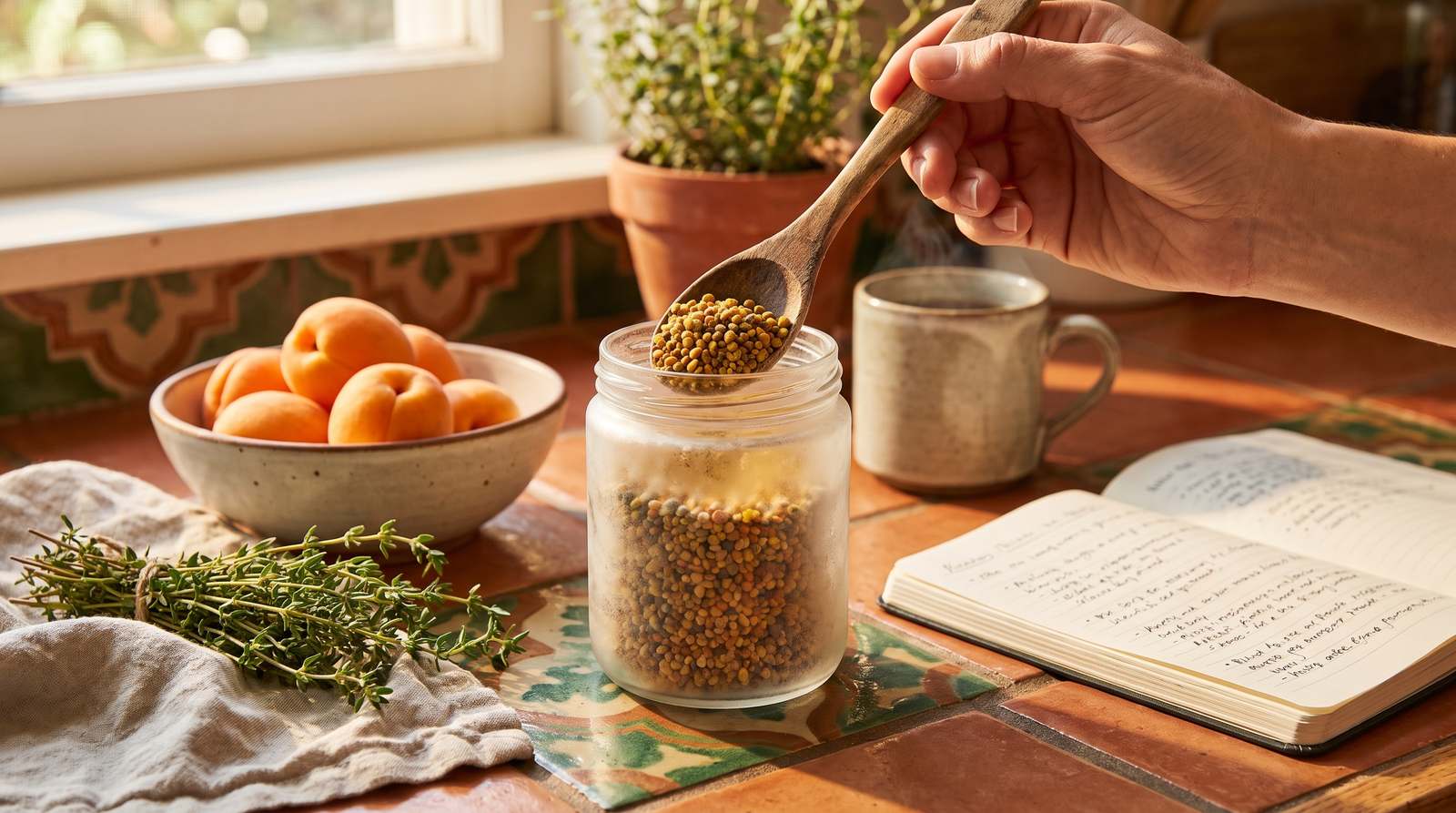
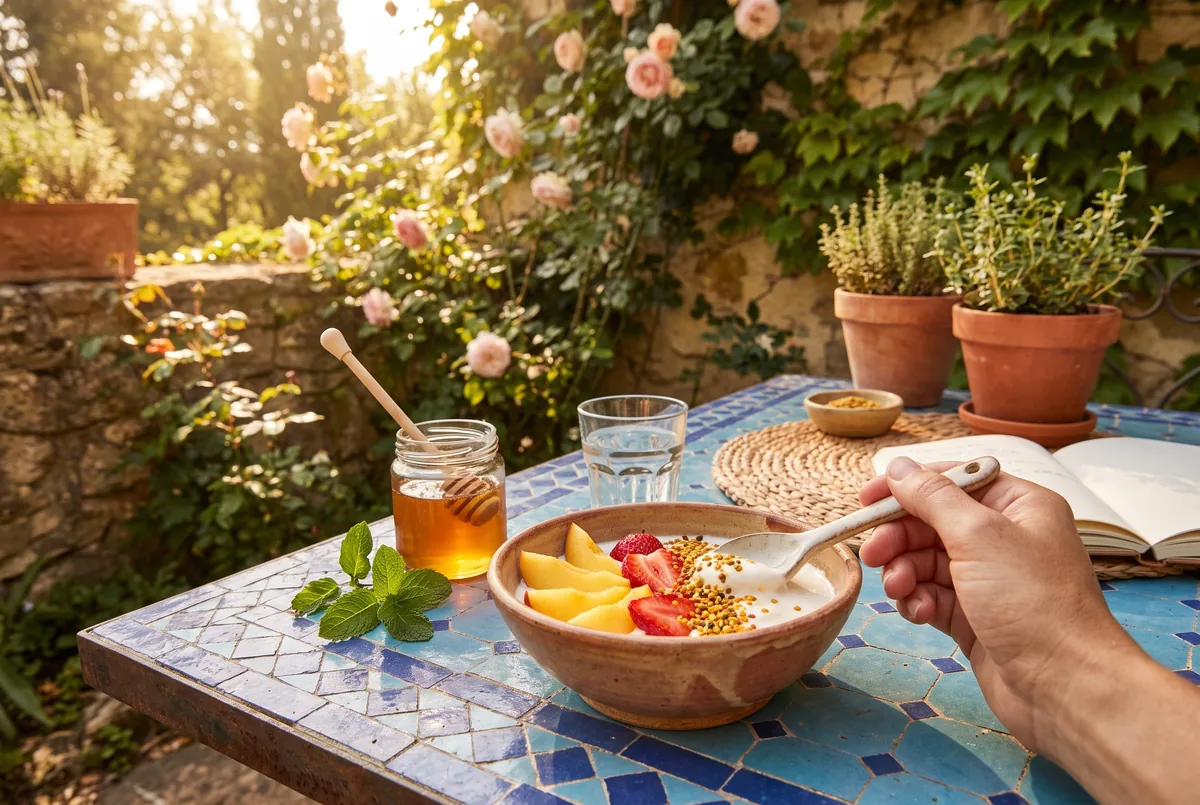
How to eat fresh bee pollen? Take the dose with a dry spoon from the still-frozen jar, put the jar back in the cold right away, then eat the grains as they are or in a yogurt, never in a hot drink, starting with just a few grains. At Biovie, we built this page on four scientific publications, one published clinical case and the opinion of Anses.
The jar comes out of the freezer, the lid resists a little, and the small pellets are already sticking to your fingertips. First question: do you need to thaw it? Second: how much should you take?
Before answering, I did what I always do: look at what water does in this moist food. Everything else follows from it, and I will walk you through it point by point, with sources.
How to eat fresh bee pollen, in short
To eat fresh bee pollen, take the dose with a dry spoon from the frozen jar, and put the jar back in the freezer right away. Then eat the grains as they are or after a few minutes, with a yogurt or some fruit (never in a hot drink), starting with just a few grains.
One single idea drives everything: fresh pollen is a moist food, which the cold keeps just as it was harvested. Taking it out wakes it up. Putting it back in the cold puts it back to sleep.
To understand how to eat fresh bee pollen, you simply need to know what it is: pollen as it is harvested, with no trip through the dryer, so moist and perishable. The dry kind, for its part, has been dehydrated. According to a standard proposed by Campos and colleagues in 2008, reported by a laboratory study (de Melo and Almeida-Muradian, 2011), fresh pollen contains 20 to 30% water, the dry kind 6% at most, dried at 42 °C at most (Brazil, which is stricter, sets 4% at most). In the fresh kind, about a quarter of the weight is water: that is why the pellets stick to your fingers.
Now, moist pollen ferments and spoils quickly (Anjum et al., 2024), hence a freezing that must start at harvest, not whenever there is time (El Ghouizi et al., 2023). The cold takes over from the dryer, without removing the water. That is the whole difference.
One fair question remains: does the freezer do better than the dryer? A laboratory study followed a single batch of polyfloral pollen for 15 months, frozen at -20 °C or -80 °C, or dried (Stebuliauskaitė et al., 2025). After 3 months, the frozen pollen had kept all its vitamin C, while the dried one had lost about 20%, that is a fifth. The cold does not freeze everything in place, though: phenolic compounds still dropped by 12 to 14% at 6 months. The authors conclude that freezing preserves vitamin C and phenolic compounds better than drying: a storage finding, measured on a single batch.
Frozen bee pollen: how to use it, and how to thaw it? The answer is simpler than the question. You do not thaw it: you take the dose and put the jar back in the cold right away.
Think of a bottle of water taken out of the fridge on a summer day: within moments, it is covered in droplets. A jar of pollen left on the breakfast table does exactly the same, the water vapor in the room condenses on the cold pellets, and that water restarts fermentation (de Melo and Almeida-Muradian, 2011). Every round trip between the freezer and the table adds a little water to the jar. You cannot see it, but it builds up, morning after morning.
Temperature swings are something I learned the hard way. One day, the cooling unit of one of our coconut containers broke down in the middle of the ocean: the coconuts arrived inedible. Your jar of pollen is the same story in miniature.
If you like a softer texture, let your portion (and only that) melt for a few minutes in the bowl. One condition only: a dry spoon.
And then there is the temptation of the hot drink, herbal tea or coffee. I understand it, but what is the point of keeping pollen cold with so much care only to drop it into a scalding cup? Above 40 to 50 °C, heat alters its phenolic compounds and its taste (Anjum et al., 2024). In a lukewarm drink, add it at the very end.
Fresh bee pollen dosage: how much, and when?
On fresh bee pollen dosage, websites contradict each other cheerfully: a teaspoon here, a heaped tablespoon there. This mess has a simple explanation, though.
A 2024 literature review gives 20 to 40 g a day for adults (Anjum et al., 2024), with no clinical dose trial behind that figure. There is no official dose for pollen, neither at EFSA nor at Anses. Nor will I convert spoons into grams to look serious, for lack of a verified measurement. Forty grams, in any case, is far more than the few grains I suggest you start with.
My approach, at your own pace:
just a few grains, for the first days;
then a teaspoon;
if all goes well, up to a tablespoon, as part of a varied and balanced diet and a healthy lifestyle.
Morning remains the most common moment. Fresh pollen at breakfast is mostly a matter of habit: none of the sources gathered here points to a better time of day.
As for composition, pollen contains 10 to 40% protein relative to its dry weight, depending on the flower and the region (El Ghouizi et al., 2023). From simple to fourfold: the gap is considerable.
Chew or blend?
Each pollen grain is protected by a hard wall, which limits the action of digestive enzymes (Anjum et al., 2024), and pollen is only partially digested (El Ghouizi et al., 2023). I like to picture the enzymes as carpenters in blue overalls: faced with a whole grain, they find a closed door. Chewing well, or blending the pollen into a smoothie, amounts to opening that door a crack for them.
We are not what we eat but what we absorb, and pollen illustrates it rather well. Fermentation, the kind that makes bee bread, also breaks down these walls (Anjum et al., 2024): an interesting lead, which I offer you without any promise.
What to eat it with: simple uses, no cooking
Can you eat raw bee pollen, and how? Fresh pollen is eaten raw, anywhere there is no fire and no heat. The only rule: nothing cooked, nothing hot.
Fresh pollen remains one food among others, to slip into a varied and balanced diet and a healthy lifestyle, one spoonful at a time. Not a complicated ritual, not a course of treatment. The gesture takes just a moment.
Cistus, chestnut, hawthorn: three pollens, three characters
From one flower to the next, pollen changes in color, taste and composition (El Ghouizi et al., 2023). A cistus pollen does not look like a chestnut pollen, and that is the whole point of having several.
Their tastes? I will let you judge for yourself. A few grains of each, side by side on a small spoon, remain the best way to find yours. And yours will not necessarily be mine, all the better.
Three fresh frozen pollens make up the Biovie selection: chestnut, hawthorn and cistus, plus a freeze-dried version of cistus for those who prefer a format that does not need freezing. Fresh frozen pollen keeps a texture closer to the harvest than the classic dried pollen sold in shops. A course usually lasts 3 to 6 weeks, between seasons, taking 1 to 2 tablespoons in the morning with breakfast. To start, chestnut pollen is the most versatile in taste; for a format that does not need a freezer, go for dehydrated cistus., 4
products
For the fresh kind, it all fits in one line: freezer, tightly closed jar, dry spoon, and the date written on the jar. How long can you keep frozen pollen? Go by that date first.
A 2025 laboratory study on a batch of polyfloral pollen gives some benchmarks: vitamin C stable after 3 months in the freezer, phenolic compounds down by 12 to 14% at 6 months (Stebuliauskaitė et al., 2025). The cold slows time down, without stopping it.
Pollen that smells of fermentation, or on which mold appears, goes in the bin without regret. The usual cause is, once again, humidity, which makes pollen ferment and deteriorate (de Melo and Almeida-Muradian, 2011).
The dehydrated cistus pollen, for its part, goes in the cupboard, away from humidity and light. That is where I like the BocUp kit, a real little low-tech object: a bell and a small hand pump create a vacuum in your glass jars, with no electricity and no plastic bag. It works with the jars with "shoulders" you already have, with a 65 or 84 mm lid: nothing else to buy.
According to the manufacturer, dry foods stay protected from humidity and moths, and fresh products keep up to 5 times longer: a vegetable soup lasts 8 to 10 days instead of 2. At our place, activated almonds end up in vacuum jars, a stock for several months. Still, the vacuum replaces neither the fridge nor the freezer, and it does not sterilize: fresh pollen stays in the freezer.
Pollen is still pollen, of course, and it would be dishonest to act as if nothing were the matter. On 25 July 2018, Anses reminded people who are allergic to pollen, and those prone to allergies or asthma, that they should avoid supplements based on pollen or hive products (Anses, 2018). It also asks people to report any side effect and to avoid prolonged, repeated intake without the advice of a health professional. If you wonder what happens if you eat bee pollen every day, that is the closest answer there is. Its opinion covers supplements; at Biovie, we apply the same caution to fresh pollen.
A clinical case published in 2015 (Choi et al., 2015) describes a 40-year-old man who had a severe allergic reaction about an hour after a tablespoon of pollen; his tests showed an allergy to several pollens present in the product. A single patient, then, and no indication of frequency: no reason to panic. It does explain, though, why I suggest you start with a few grains.
For a child, during pregnancy or with ongoing medication, ask a health professional first. For everyone else, knowing how to eat fresh bee pollen comes down to taming it gently: a few grains one morning, then a spoonful, as part of a varied and balanced diet and a healthy lifestyle. And if you have a lovely pairing to share, write to me!
Frequently asked questions
How long can you keep frozen pollen?
Until the date shown on the jar, as long as you keep it in the freezer, tightly closed. A 2025 laboratory study on a batch of polyfloral pollen measured stable vitamin C after 3 months of freezing and phenolic compounds down by 12 to 14% after 6 months.
Do you need to thaw fresh pollen before eating it?
No, simply take the dose with a dry spoon and put the jar back in the freezer right away. Thawing the whole jar lets humidity in through condensation, and humidity makes pollen ferment. If you prefer a soft texture, let only your portion melt for a few minutes in the bowl.
What are the side effects of pollen?
They are allergic reactions, sometimes severe, particularly in people who are already allergic to pollen. Anses recommends that these people, and those prone to allergies or asthma, avoid pollen-based supplements. A clinical case published in 2015 describes a severe reaction after a tablespoon.
What should you do with expired pollen?
Throw it away if it smells of fermentation or if you see mold, without trying to salvage it. Otherwise, go by the date on the jar and its appearance. Humidity is the usual cause of this deterioration: moist pollen ferments and spoils quickly, hence the value of a dry spoon and the freezer.
How much fresh pollen per day?
There is no official dose, neither at EFSA nor at Anses. A 2024 scientific review gives 20 to 40 g a day for adults, with no clinical dose trial behind that figure. The most prudent approach is to start with a few grains, then increase gradually up to a tablespoon.
Can you put fresh pollen in a hot drink?
No, it is better to avoid it: above 40 to 50 °C, heat alters the phenolic compounds and the taste of pollen, according to a 2024 scientific review. In a lukewarm drink, add it at the very end, when it can be sipped without blowing on it. The simplest option remains a yogurt or a bowl of fruit.
The information presented in this article is provided for informational purposes only and does not constitute medical advice. Consult a health professional before making any change to your diet or supplementation.