How to Eat Chia Seeds: Gel, Daily Amount, Raw or Not and Sprouting
How to eat chia seeds? The simplest way is to soak them: on contact with a liquid, each seed wraps itself in a transparent gel, and you eat them like that, in a yogurt or a compote, or else ground just before use, but never dry followed by a glass of water. This page from Biovie, an organic importer since 2007, draws on a study of the seed's microstructure and on the European texts that govern its sale.
On 2 August, a question reached us, the kind that goes straight to the point: “are your chia seeds raw, and can you sprout them?” None of the guides at the top of the search results really answers it.
Sprouted seeds, I know a bit about: I was already growing them as a teenager, at my parents' place. So I will answer that question, and the two you inevitably ask when you open the packet: how to prepare chia, and how much to use.
How to eat chia seeds every day
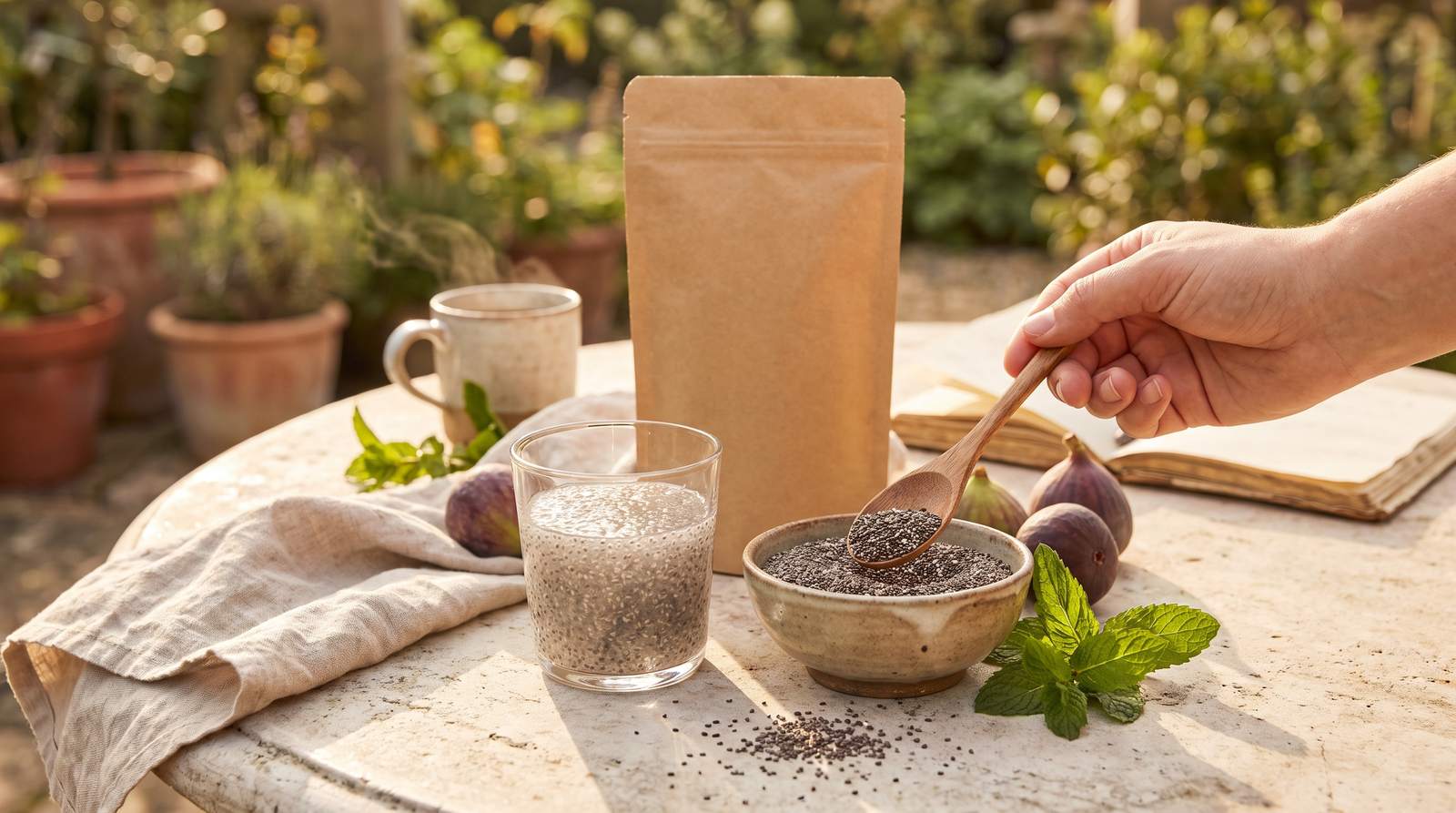
Chia is a seed that needs a drink before it reaches your mouth. Soaked in a liquid (water, homemade tiger nut milk, store-bought plant milk or yogurt), the seeds form a gel; you can also grind them just before use, or sprinkle them on a dish that is already moist, like a salad or a compote. Only one thing to rule out, and I will say it right away. Never dry with a glass of water.
In practice, I see four ways to prepare chia seeds to eat:
the gel, the base;
seeds ground just before use, in a coffee grinder;
sprinkling, on a dish that is already moist;
the drink, with seeds that have already swollen, never dry seeds thrown into the glass at the last minute.
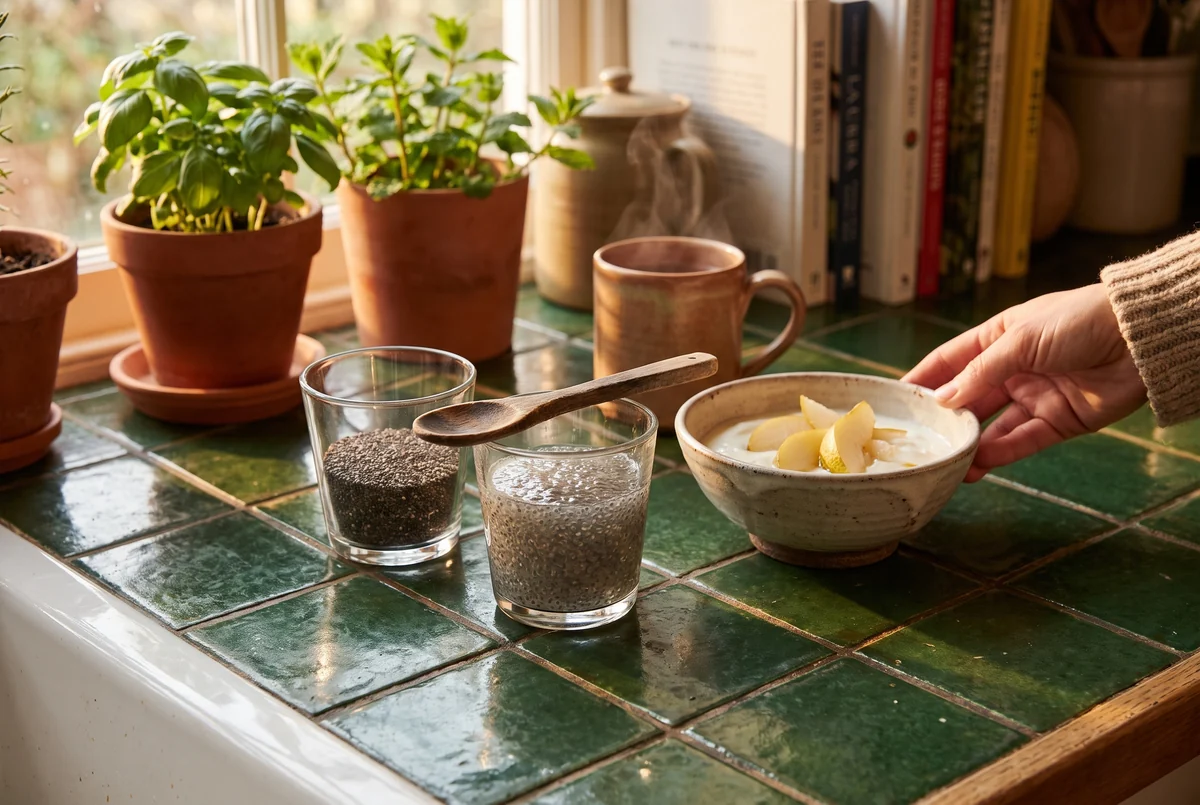
If you are wondering how to eat chia seeds in yogurt, no need to overcomplicate things: pour in a gel prepared in advance, and it mixes in by itself. The same goes for how to eat chia seeds with water: the water goes in the bowl first, never after the seeds.
As for how to eat chia seeds ground, the rule fits in one line: grind just before use, then mix into a moist preparation. Chia and flax are often paired, and they grind very well together, and to vary the sprinkling, hemp seeds have their place too.
Then there is the question of timing, which comes up often: how to eat chia seeds in the morning or in the evening? I am going to disappoint you, or reassure you. No data shows that one time of day is better than another: it is a matter of habit, at breakfast in a bowl or in the evening in a compote, whichever suits you.
How to make chia seeds swell: the gel explained
Put a chia seed in a spoonful of water and wait a little: it wraps itself in a translucent halo, like a tiny frog egg, a dark dot at the centre of a bubble of jelly.
This gel does not come out of nowhere, it has a precise address. A team looked at the seed under a microscope, in the laboratory, and the mucilage appears to be stored in the cells of the three outer layers of the seed coat, the seed's envelope, then comes out as filaments on hydration and ends up forming a transparent casing around it (Muñoz et al., 2012). Picture little sachets of dehydrated jelly tucked under the skin, waiting only for water to unfold.
The same study goes further: hydration is stronger when the pH rises and when the liquid is low in salt, with a maximum around 80 °C, water that is clearly steaming without boiling. In the kitchen, it translates very simply: a very salty liquid swells less well; cold, it is slower, but it is more than enough. Anyway, nobody needs a thermometer to get a good gel.
Why do you need to soak chia seeds?
The most solid reason lies in a published clinical case (Simmelink et al., 2017): a chia gel had blocked the esophagus of a man who probably had eosinophilic esophagitis. The authors titled their article “Watch it grow”, and that says it all: a seed swallowed dry does exactly what it is made to do, swell, except that it does so in the wrong place. One case, not a statistic: it measures no risk, but it shows that the gel should form in the bowl, before swallowing.
The authors advise letting the seeds swell completely in enough liquid before eating them, and taking extra care in case of swallowing difficulties.
Proportions and soaking times
Here is how to soak chia seeds, the reference point we use at Biovie. I prefer to be clear: it comes from practice, not from a study. Adjust it to the texture you like.
Use
Proportion
Soaking time
Plain gel (water or homemade tiger nut milk)
1 volume of seeds for about 10 volumes of liquid
At least 15 to 30 minutes
Made the day before
Same proportion, in a closed jar
Overnight, kept cool
Drink
Gel prepared as per the reference above, thinned in the glass
15 to 30 minutes before drinking
Sprinkling
No added liquid: the moist dish provides it
None, never on a dry dish
How much chia seeds to eat per day?
Type the question into a search engine: “15 g per day maximum” comes up almost everywhere, copied from site to site, without ever a hint of origin. So where does this figure come from?
From a European text. Implementing Decision 2013/50/EU authorised the sale of pre-packed chia seeds with the compulsory label mention “no more than 15 g per day”. Implementing Regulation (EU) 2020/24 replaced these conditions: the mention is no longer required, only the name “chia seeds (Salvia hispanica)” is still compulsory.
You may know the story of the roast. In one family, they always cut off both ends of the roast before cooking it. Why? Nobody knew, “we have always done it this way”, until someone asked the grandmother: her roast did not fit in her pot. Chia is at that stage. The mention has disappeared from the texts, the habit has stayed on the screens.
Better, then, to start from the composition. According to the USDA FoodData Central database, 100 g of dried chia seeds contain 486 kcal, 16.5 g of protein, 30.7 g of fat, 34.4 g of fiber and 17.8 g of alpha-linolenic acid (ALA), the plant omega-3. Fiber therefore makes up more than a third of the seed's weight.
Per serving, 15 g of seeds provide about 5.2 g of fiber and 2.7 g of ALA, and about 11 g is enough for 2 g of ALA. Put another way, a smaller serving than the old reference point already covers the reference amount for the claim that follows.
Because the authorised health claim concerns ALA itself: “alpha-linolenic acid (ALA) contributes to the maintenance of normal blood cholesterol levels; the beneficial effect is obtained with a daily intake of 2 g of ALA” (Regulation (EU) No 432/2012), as part of a varied and balanced diet and a healthy lifestyle. On chia's fiber, however, no claim is authorised, and I would rather tell you so than let you believe otherwise.
My advice: start with a small amount and increase at your own pace, drinking enough.
Are chia seeds raw?
Biovie's are, yes, and the proof is in the seed itself. Our organic chia seeds are sold in our range of sprouting seeds, and a seed that sprouts has a living germ: it has not been roasted. A toasted seed no longer sprouts. No cheating there.
At our long-standing supplier of sprouting seeds, selection works in a very simple way: before accepting a silo, they lay 100 seeds on a tray and count them three days later, by hand. Above 95, the batch is taken. We have been there. That is the whole spirit of a sprouting seed: you do not ask it to be pretty, you ask it to be alive.
Cooking remains possible, the regulation even provides for it: Implementing Regulation (EU) 2020/24 authorises chia up to 5% in bread, and up to 10% in bakery products and breakfast cereals. The EFSA (2020), however, considers the data insufficient to conclude on acrylamide formation when chia is heated above 120 °C, with a significant formation potential in dry biscuits containing 10 to 20% of chia flour. No worry, on the other hand, for hydroxymethylfurfural and furfural. In short, chia withstands the oven, but not just any way.
In practice, to enjoy it raw, the cold gel remains the simplest; when cooking, avoid very dry, very browned biscuits.
Yes, but not in a jar, because the mucilage that makes such a good gel glues the seeds into a compact mass: air no longer circulates, and the whole project goes under (literally).
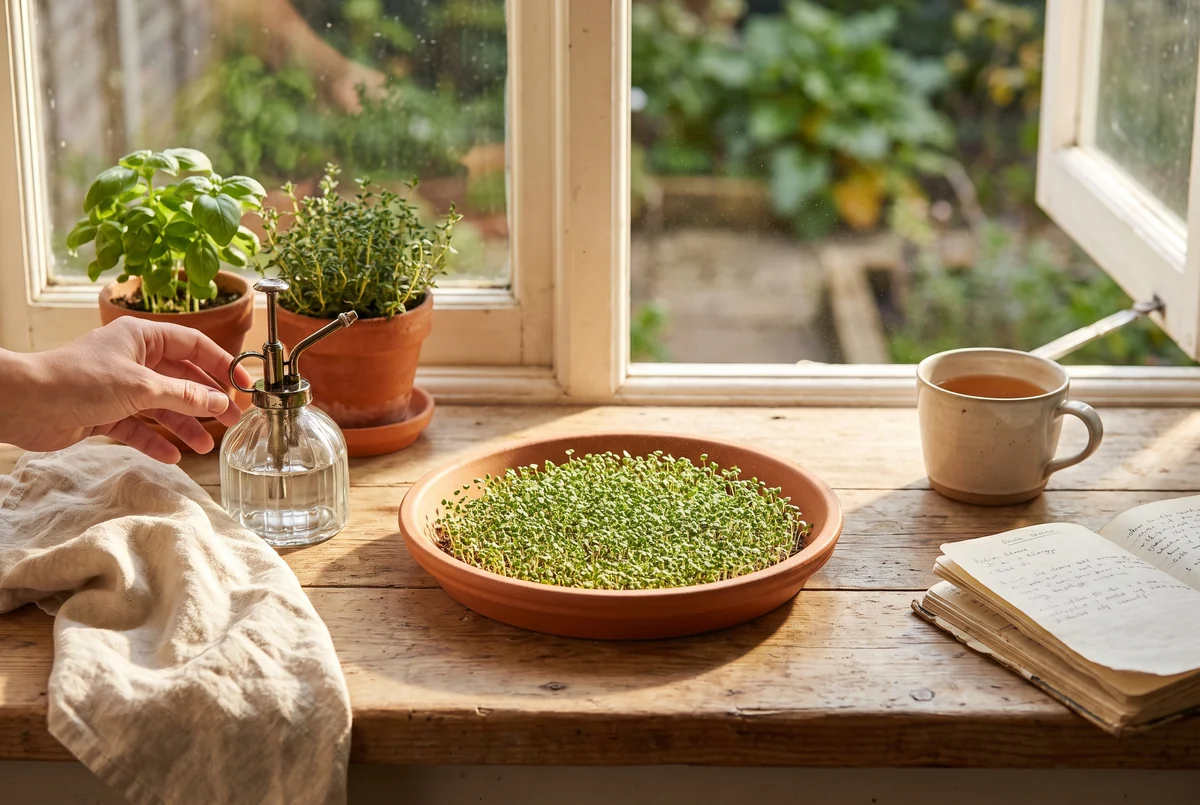
Look instead at how things happen outdoors. In a field, a chia seed does not sprout at the bottom of a pot of water: it falls on moist soil, in the open air. It is just common sense, observing nature and imitating it in your kitchen. To sprout chia seeds, spread them in a thin layer on a flat surface, a terracotta saucer or a simple plate, and moisten them with a mister rather than by watering them.
On the research side, a laboratory study compared flour from chia seeds sprouted under controlled conditions with flour from unsprouted seeds: the first contained more phenolic compounds, GABA, essential amino acids and total fiber, with a higher antioxidant activity (Gómez-Favela et al., 2017). It is a composition analysis, with no trial in humans: it describes what the sprouted seed contains. Nothing more.
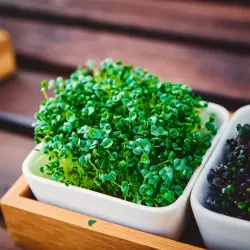
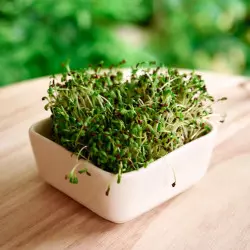
Biovie offers 24 varieties of organic sprouting seeds, produced since 1896 by our Italian supplier Geo Bavicchi, and every batch is tested before it goes on sale (germination rate above 95% required). Radish, fenugreek, sunflower and alfalfa sprout the fastest and most easily for beginners, in 3 to 5 days on a windowsill. To discover several varieties without making a mistake, the packs (The 3 Radishes, The Essentials, The Pep's Seeds...) are a good starting point, before choosing your varieties individually. The range also covers microgreen seeds to grow on a substrate, and sprouters to get started without unnecessary equipment., 46
products
No endless list of warnings. Only one precaution is really worth remembering.If you have swallowing difficulties or a narrowing of the esophagus, always eat well-swollen seeds and see a professional if you have trouble swallowing, as the authors of a clinical case of blockage by chia recommend (Simmelink et al., 2017).
For pregnancy, the subject deserves more than a paragraph: I refer you to our article on superfoods during pregnancy.
Honestly, nothing alarming for the rest. Chia seeds are eaten like any other food, starting with small amounts, as part of a varied and balanced diet and a healthy lifestyle.
How to store chia seeds
As long as it is whole, the seed protects its own reserves: all you need is to keep it away from light, heat and moisture. Once ground, it is another story, its fats are exposed to air and it keeps less well. Grinding just before use remains the rule. The prepared gel goes in the refrigerator and is eaten quickly.
At Biovie, for dry seeds we recommend vacuum sealing in a glass jar. The BocUp kit combines a bell and a small manual pump, with no electricity and no plastic bag, and works with the glass jars you already have, provided they have “shoulders” and a 65 or 84 mm lid. According to the manufacturer, dry foods stay protected from moisture and moths, and fresh products keep up to 5 times longer. Only one catch: glass lets light through, so store the jar in a cupboard.
The vacuum replaces neither the fridge nor the freezer, and it does not sterilise. To go further, read our article on the benefits of vacuum sealing at home.
And then, if you try sprouted chia on a saucer, write to me: I am curious to see your most beautiful plates of shoots.
Frequently asked questions
Why do you need to soak chia seeds?
So that the gel forms in the bowl and not in the esophagus. On contact with a liquid, the seed coat releases a mucilage that wraps it in a transparent casing. A published clinical case describes an esophagus blocked by a chia gel, hence the advice to let the seeds swell completely before eating them.
How much chia seeds to eat per day?
No maximum dose is on the label any more: the mention “no more than 15 g per day”, imposed by the EU in 2013, was dropped in 2020. About 11 g of seeds provide 2 g of ALA, the reference amount for the authorised claim. Start small, as part of a varied and balanced diet and a healthy lifestyle.
Can you eat chia seeds without soaking them?
Yes, provided you sprinkle them on a dish that is already moist, like a salad or a compote, or grind them just before use to mix into a preparation. What to avoid is swallowing dry seeds followed by a glass of water: a case of esophageal blockage by the gel has been published.
Can you eat chia seeds every day?
Absolutely, in moderate amounts, as part of a varied and balanced diet and a healthy lifestyle. The simplest way is to make it a habit, soaked or ground seeds, in a yogurt or a compote, increasing the amounts gradually, at your own pace.
What is the difference between basil seeds and chia seeds?
They are two different plants: chia comes from Salvia hispanica, a sage, and basil seeds from Ocimum basilicum. Both share a trait you can see in the kitchen: on contact with a liquid, they wrap themselves in a gel. So they are used in a fairly similar way, soaked before being eaten.
Do you need to chew chia seeds?
No, soaking or grinding is enough. Seeds well swollen in a liquid, or ground just before being mixed into a moist preparation, are eaten without any particular effort. No figures allow us to go further on this point, and the only real rule remains never to swallow dry seeds followed by water.
Is it better to eat chia seeds in the morning or in the evening?
Neither: no study shows that one time of day is better than another. It is a matter of habit, at breakfast in a yogurt or in the evening in a compote. What matters is to eat them soaked or ground, and to keep to moderate amounts, at your own pace.
The information presented in this article is provided for information purposes only and does not constitute medical advice. Consult a healthcare professional before making any change to your diet or supplementation.